How To Build Brand Voice With Social Media Automation
Oct 8, 2026
Black Friday: save up to 50% on all plans

Written by
Hassaan KhanUpdated
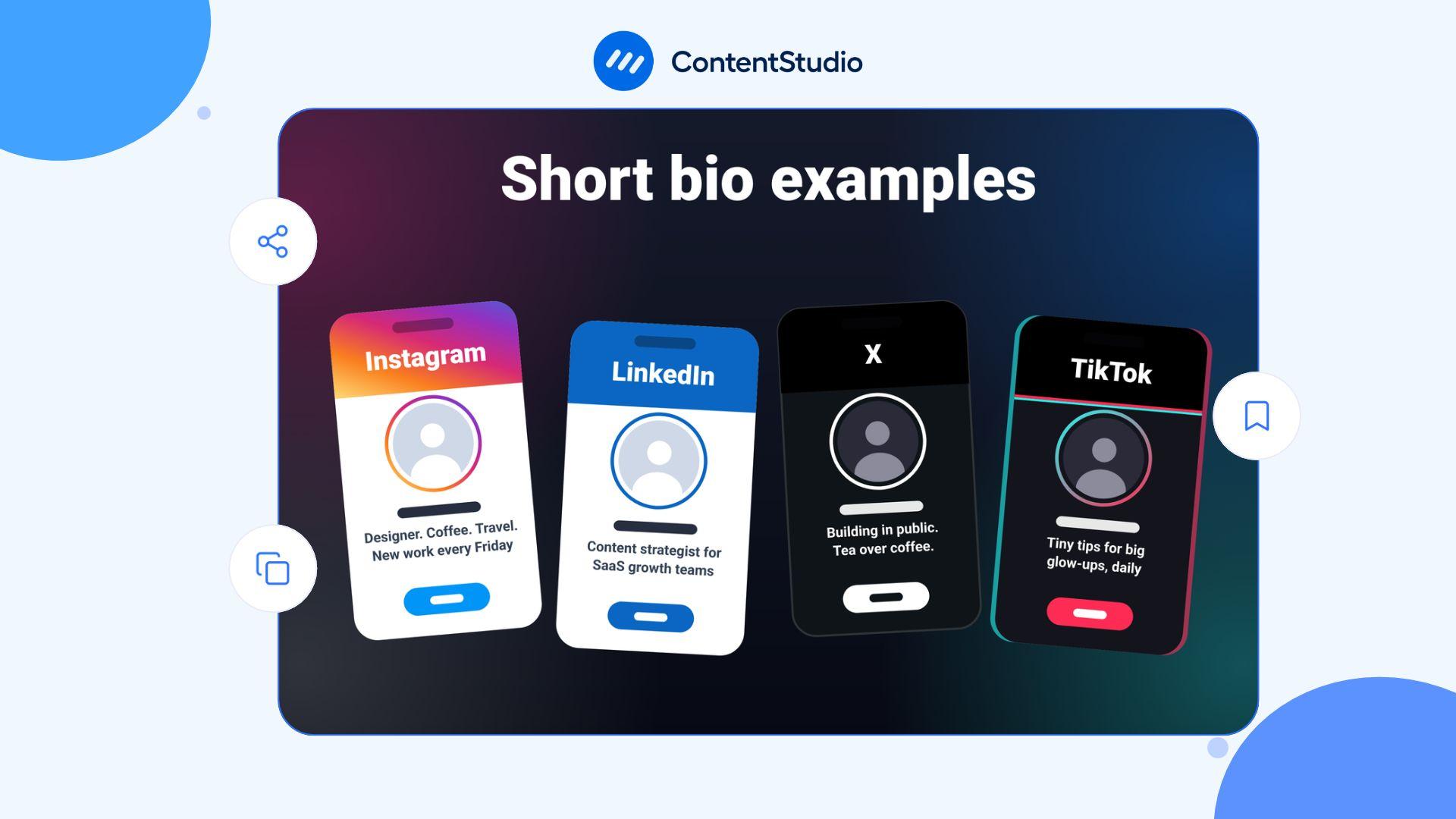
A short bio is one of the smallest things on a profile and one of the first things someone reads. It answers three questions in a few seconds: who is this, what do they do, and is this worth my attention? When the answer is clear, the reader stays. When it is vague or cluttered, they move on.
The same bio rarely works unchanged across a social profile, a website, a speaker page, and a professional directory. Each context has different length limits, different audience expectations, and a different purpose. This guide covers what to include, how to write for each platform, what real accounts do well, and what the most common mistakes look like.
A bio is one of the most visible expressions of your brand identity. The tone, the specific words, and what you choose to highlight should match how the brand presents itself across every other channel and touchpoint.
A short bio is a concise written introduction that tells someone who you are, what you do, and why the profile is relevant to them. The term covers a wide range of formats: a one-line social media description, a two-sentence website introduction, a paragraph on a speaker page, or an author byline at the end of an article.
What makes a bio short is not a specific word count. It is the discipline of including only what the reader needs to understand the profile and decide whether to look further. A short bio does not try to summarize an entire career. It answers the most relevant question for the specific context where it appears.
The same person will typically have several versions of a short bio in use at once: a compact one for Instagram, a slightly fuller one for LinkedIn, a speaker-focused one for event pages, and an author credit for published articles. Each version serves a different purpose and a different audience.
For marketing teams managing profiles across multiple brands, regions, or business units, an enterprise social media management workflow makes it practical to keep bios, profile details, and publishing consistent at scale without reviewing each account manually.
These two terms are often used interchangeably, but they describe different things. A short bio is defined primarily by length and purpose: concise, often platform-specific, and focused on immediate relevance. A professional bio is defined by content: a career summary that may run several paragraphs and is typically used in formal contexts such as a company website, a conference programme, or a press kit.
| Bio type | Primary question | Typical length | Where it appears |
| Social media bio | Who are you on this platform? | 15 to 160 characters | Instagram, TikTok, X, LinkedIn summary |
| Short professional bio | What do you do and why does it matter? | 2 to 4 sentences | Website About page, directory listings |
| Speaker bio | Why should this audience trust this speaker? | 50 to 100 words | Event programmes, conference websites |
| Author bio | Who wrote this and why are they qualified? | 20 to 60 words | Article bylines, book jackets |
| Business bio | What does this organisation do and who does it serve? | 1 to 3 sentences | Social profiles, Google Business, directories |
| Full professional bio | What is the complete career picture? | 150 to 400 words | Company website, press kit, media enquiries |
The structure of a short bio is consistent across most contexts, even when the length and tone vary significantly. The difference between a bio that works and one that does not usually comes down to whether it answers the right questions in the right order, not whether it uses a clever turn of phrase.
The core content of a bio stays largely consistent across platforms, but the length, format, and tone should shift to match the context. The guide below covers what works on each major platform, what to prioritize given the character limit, and what to avoid.
Instagram gives 150 characters in the bio field. At that length, every word needs to earn its place. The audience typically decides within seconds whether to follow, so the bio needs to communicate the main thing immediately. Line breaks help with scanning because Instagram renders them as separate lines rather than flowing text.
The link field below the bio is where the call to action belongs. The bio itself should explain why that link is worth tapping, not repeat information already in the display name or category label.
The Instagram bio ideas guide covers formats that work for creators, businesses, and personal brands, including how to structure each type differently. The Instagram bio generator can help draft a first version quickly.
X gives 160 characters in the bio field. The platform rewards a specific voice and penalizes generic self-description. The most effective X bios name what the account actually talks about and give the reader one genuine reason to follow, not a list of job titles. Personality plays better on X than on most platforms because the content format actively invites it.
The Twitter bio ideas guide covers what distinguishes a bio that earns follows from one that gets scrolled past.
TikTok’s 80-character bio field is the tightest on any major platform. At that length, the bio is usually a single declarative line. It should tell someone who the account is for and what they post. There is no room for personality that the content itself cannot demonstrate: the content is the personality on TikTok, and the bio should point toward it.
The TikTok bio ideas guide covers how to work within the character limit without sacrificing clarity.
LinkedIn’s About section allows far more space than other social platforms, but most readers see only the first two or three lines before tapping “see more.” Those first lines function as a short bio in themselves and need to earn the click to expand. Write the first two sentences as if they are the only ones the reader will see.
For the LinkedIn headline field, which appears above the About section and is visible across the platform, the LinkedIn headline examples guide covers what works for different industries and seniority levels.
Facebook business pages have both a short description field (255 characters) and a longer About section. The short description appears in search results and on the page header. For pages where discovery through Facebook search matters, the short description functions more like a directory listing than a creative bio: clarity and category relevance matter more than personality.
The Facebook bio ideas guide covers how to adapt the short description for pages across different business types.
The examples below are taken from real, publicly available accounts. Each one is broken down to show what makes it work and what it trades off, so you can apply the same reasoning to your own bio rather than simply copying a format.
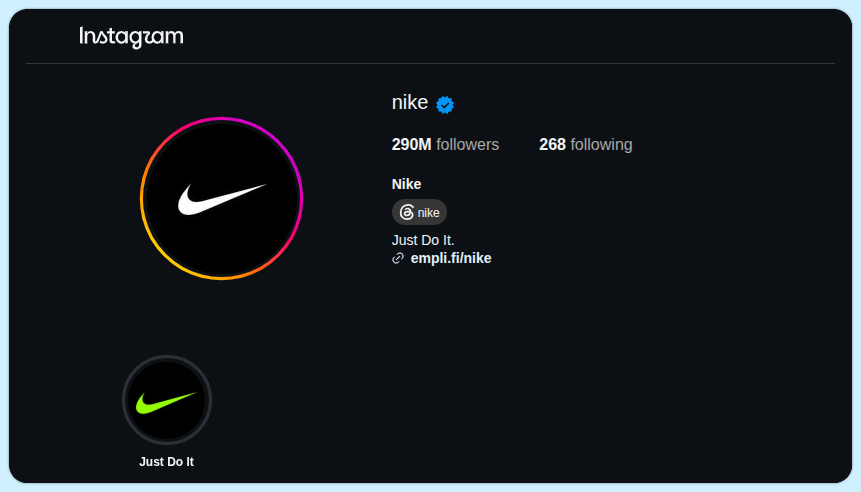
Nike (@nike)
“Just Do It.”
Nine characters used out of 150. Nike does not explain what it makes, what it sells, or who it is for. At Nike’s scale and category familiarity, identity is the product, not information. This bio works because it makes a philosophical claim that the entire brand reinforces through its content and campaigns. It would not work for an account without that level of recognition, but it demonstrates that a bio can be a positioning statement rather than a description.
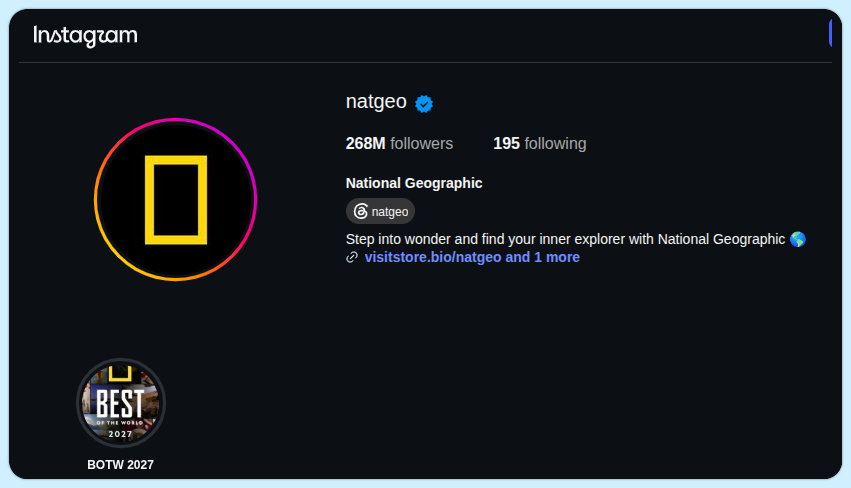
National Geographic (@natgeo)
“Step into wonder and find your inner explorer with National Geographic.”
This bio does three things cleanly: it states the mission, it names the audience (people who care about the planet), and it anchors credibility in the founding date. It is not a list of content categories. It is a reason to follow, expressed as a belief the brand has held for over a century.
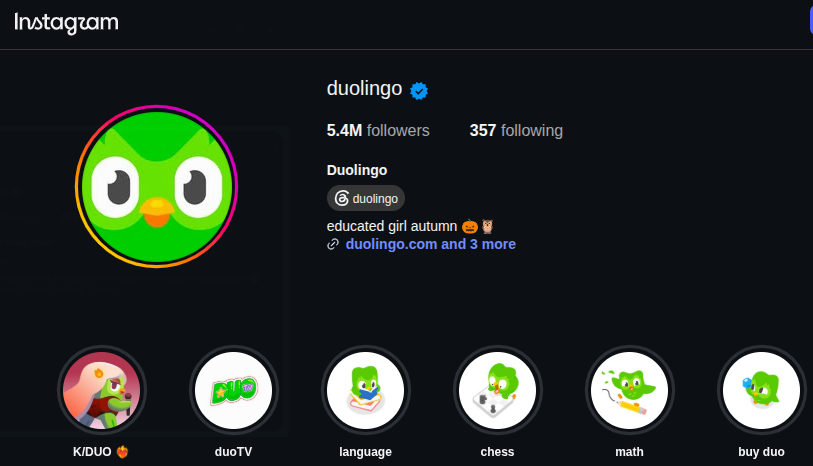
Duolingo (@duolingo)
“educated girl autumn 🎃🦉.”
Duolingo’s bio matches the brand’s well-known irreverence on social media. It reinforces the product’s core value proposition (free language learning) in the first sentence, then makes a dry joke that fits the platform and the brand’s voice. This works because the humor is on-brand, not random, and the bio still communicates what the product does.
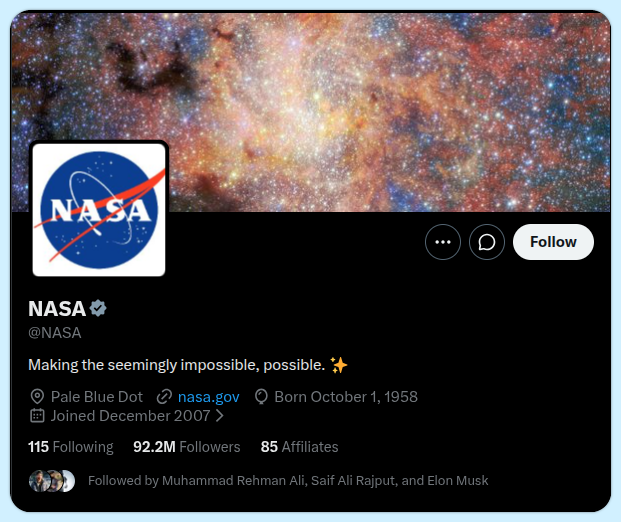
NASA (@NASA)
“Making the seemingly impossible, possible.. ✨”
NASA has 92 million followers and needs no description of what it does. The bio is a piece of wordplay: space as the subject matter and space as the room for everyone. It doubles as a welcoming statement. It has stayed consistent across years, which itself signals confidence. The single ✨ emoji adds warmth without clutter.
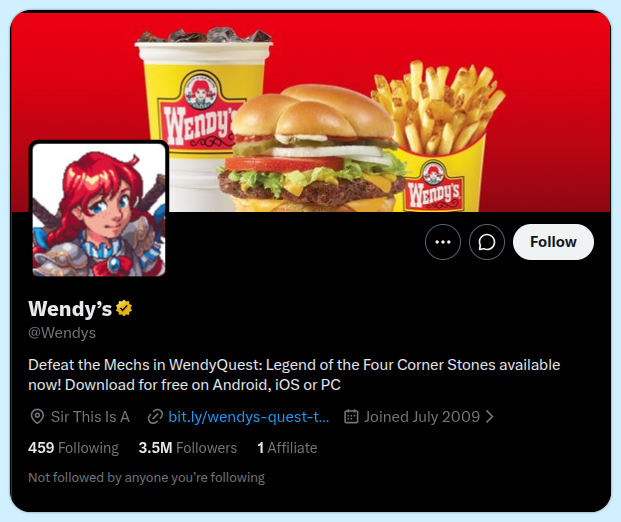
Wendy’s (@Wendys)
“Defeat the Mechs in WendyQuest: Legend of the Four Corner Stones available now! Download for free on Android, iOS, or PC.”
No hashtags, no location, no generic brand language. It has become one of the most cited brand bio examples on the platform for a reason.
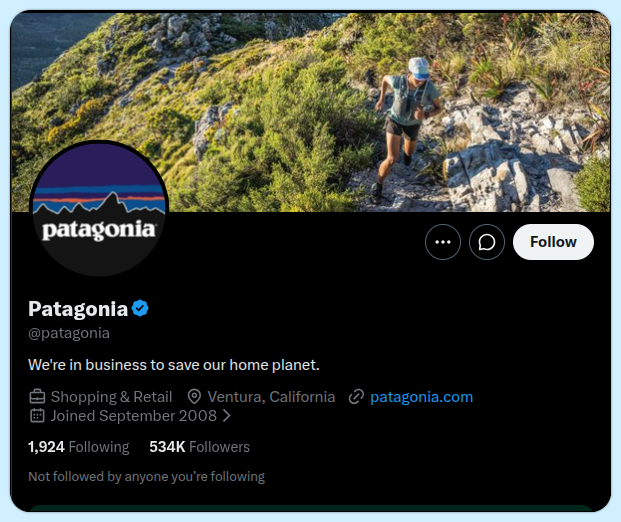
Patagonia (@patagonia)
“We’re in business to save our home planet.”
Patagonia’s bio is a mission statement with no product mention. What distinguishes it from vague purpose marketing is specificity: “save our home planet” is a falsifiable claim that the company has consistently backed with business decisions, including donating company ownership to a trust for the planet in 2022. The bio carries credibility because the actions match it.
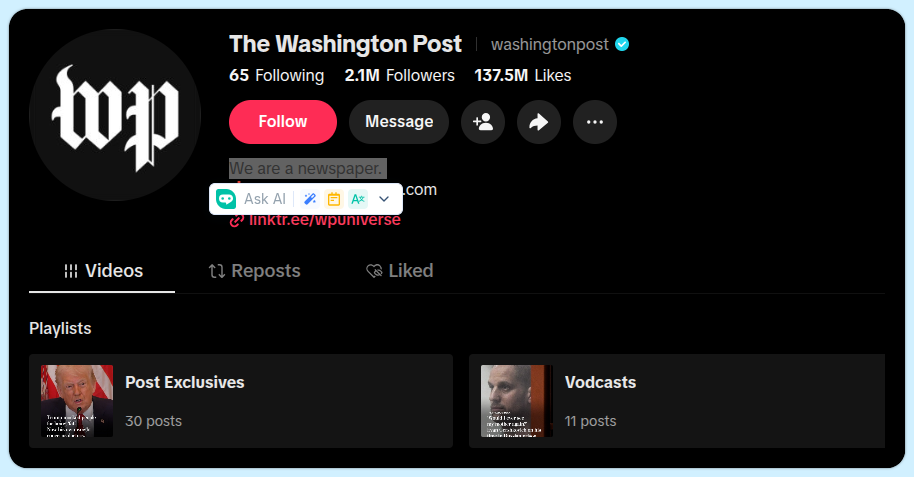
Washington Post (@washingtonpost)
“We are a newspaper.“
The Washington Post’s TikTok bio is frequently cited as an example of deadpan humor working in a small space. It plays on the brand’s identity as a 150-year-old broadsheet operating on a platform dominated by Gen Z entertainment content, and the contrast is the joke. The bio works because the content earns it: the account uses humor and fast-paced video to cover news in ways that have translated well on TikTok.
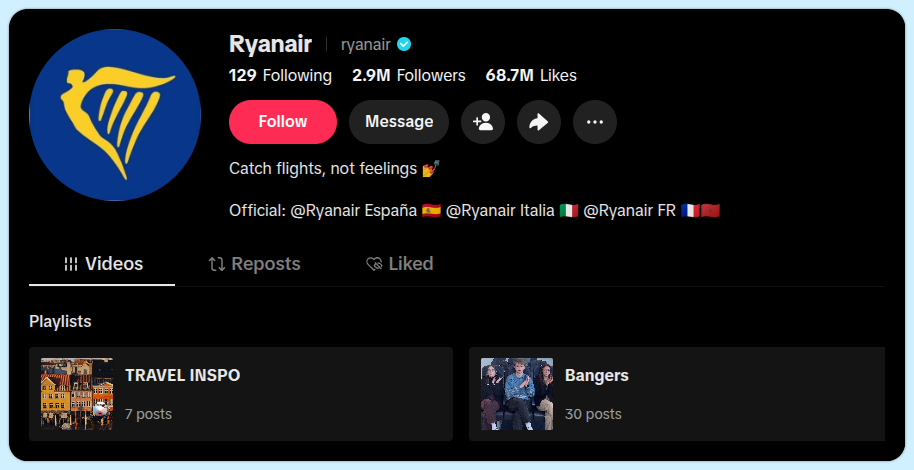
Ryanair (@ryanair)
“Catch flights, not feelings 💅”
No brand name, no corporate language, no qualifier. Ryanair’s content strategy leans heavily on self-aware humor about budget travel, and the bio matches that tone. It is specific about what the brand is (cheap flights), not aspirational about what it wants to be.
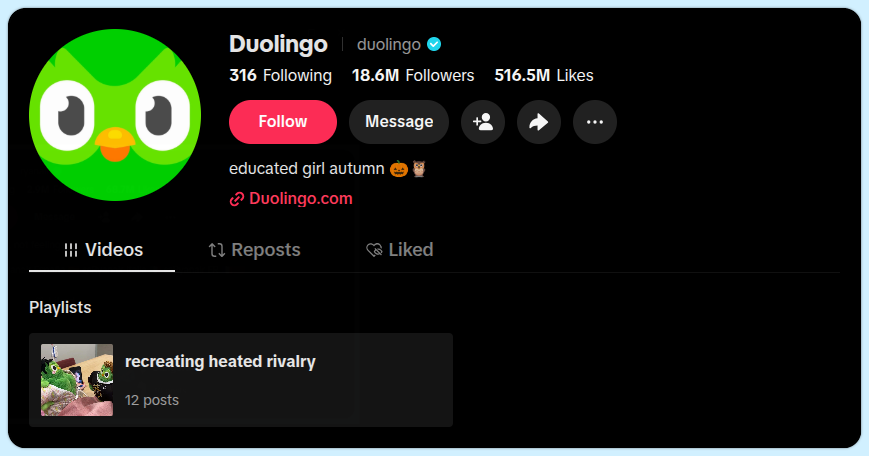
Duolingo (@duolingo on TikTok)
“educated girl autumn 🎃🦉”
The TikTok version drops the follow-me joke from the Instagram bio and leads with the core value proposition, keeping it within TikTok’s shorter limit. The owl emoji is the brand mascot, used as a visual anchor rather than decoration.
LinkedIn bios can run to 2,600 characters, but the opening two or three lines do the bio’s real work. The examples below show those opening lines, since that is what most readers see before deciding whether to expand.
Opening for a B2B consultant
“I help mid-market e-commerce brands reduce customer acquisition cost through owned-channel content. For the past six years I have worked with retailers in fashion, homewares, and beauty on SEO, email, and content strategy.”
This opening leads with the specific outcome, names the audience (mid-market e-commerce), and immediately gives a credential (six years, specific verticals). A buyer reading this within two lines knows whether this person is relevant to them.
Opening for a founder
“I built a fully remote team of 60 people across 11 countries before I knew what async-first meant. Now I advise distributed companies on the operational design decisions that matter before headcount hits 100.”
This opening uses a specific detail (60 people, 11 countries) to establish credibility, then pivots to the current work. The phrase “before I knew what async-first meant” is disarming and positions the person as a practitioner rather than a theorist.
REI (@REI)
“Outdoor gear and apparel for hiking, camping, climbing, cycling and more. Shop in stores, online and by phone.”
REI’s Facebook short description is functional rather than aspirational. It names the product categories, the audience (outdoor activity participants), and the purchase channels. For a retail brand where intent-based discovery matters, clarity about what is sold and where outperforms brand language.
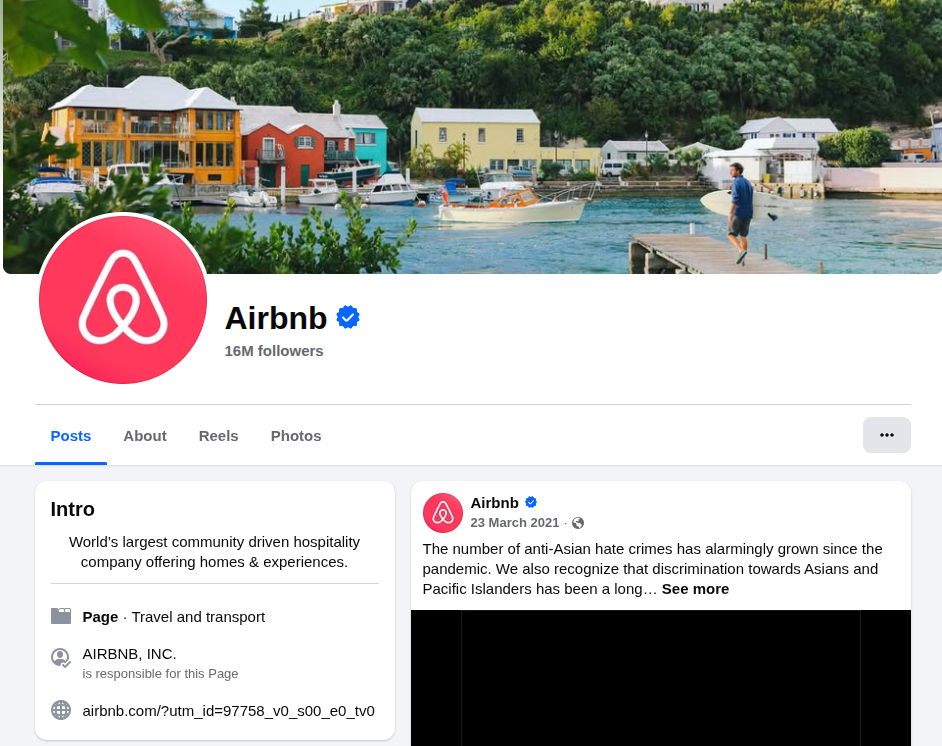
Airbnb (@Airbnb)
“Belong anywhere.”
Two words. Airbnb’s Facebook description follows the same approach as Nike’s Instagram bio: brand equity and a positioning statement that the content and product consistently reinforce. The phrase “belong anywhere” is both a tagline and a bio because, at Airbnb’s scale, the two have merged.
Platform aside, bios also serve different purposes depending on context. The examples below cover the most common non-platform situations where a short bio is needed.
A bio used in a work context typically appears on a team page, an internal directory, an email signature, or a conference badge. The audience already knows the organization, so the bio can focus on specific expertise and current focus. Third person is standard for most professional contexts.
Mia Chen is a Senior Product Designer at Korova, working on the checkout and onboarding experience. She specializes in accessibility and design systems for high-traffic e-commerce flows.
Daniel Park leads enterprise sales at Volta, focusing on financial services and infrastructure clients across North America.
Notice that both examples name the specific area of work rather than repeating the job title. “Works on checkout and onboarding” is more useful to a potential collaborator than “Senior Product Designer.” “Financial services and infrastructure clients” is more specific than “enterprise sales.”
A website bio appears in a context where the reader has already chosen to visit the site. They want to understand who is behind the work and whether this is the right person or business to trust. The bio can be warmer and slightly longer than a social profile, and it benefits from one specific detail that makes it feel genuine rather than template-driven.
I am a freelance brand strategist working with startups that are defining a new category or repositioning in an existing one. My background is in product marketing at two Series B companies, and I now work independently with founding teams on positioning, messaging, and launch preparation.
Aligning the About page bio with a coherent personal branding approach means the tone, specific claims, and emphasis should match how the brand presents itself in its content and other touchpoints.
A speaker bio answers a specific question from an event audience: why should I spend time listening to this person on this topic? It should lead with the most relevant credential for the specific event. Generic career summaries that do not connect to the talk topic are common and rarely useful.
Yusuf Okafor is the founder of Tempo, a workforce management platform serving 400 distributed companies across Europe. He has built and scaled remote teams since 2016 and advises early-stage founders on hiring, operational design, and culture in distributed organizations. At this summit he will walk through the frameworks Tempo used to reduce onboarding time by 40 percent without in-person orientation.
The last sentence is what distinguishes this bio from a standard professional one. It tells the audience exactly what they will learn, which is the only question they actually care about when reading a programme listing.
An author bio appears at the end of an article, in a newsletter, or on a publication profile page. The reader has already engaged with the work and may want to know more. The bio should confirm the author’s perspective and give a path to find more of their work.
Lena Brandt covers financial technology and payments infrastructure for FinancialStack. She previously reported on regulatory affairs for a European payments trade publication and holds a master’s degree in financial journalism.
A business bio should answer what the business does, who it serves, and what makes it the right choice. The more specifically it describes the customer, the more useful it is to anyone who actually fits that description.
Fieldwork is a user research operations platform for product teams running more than 20 studies a year. We handle participant recruitment, scheduling, consent management, and data storage so research teams can focus on the interview, not the logistics.
For social profiles specifically, the social media bio examples guide covers how the same business can adapt its core description for Instagram, LinkedIn, and X without losing consistency.
Tone is the aspect of a bio that most people get wrong in one of two directions: too formal for a platform where warmth helps, or too casual for a context that expects professionalism. The right tone is determined by the platform, the audience, and what the brand or person consistently communicates elsewhere.
| Tone | When it works | Real-world anchor | Example phrase |
| Minimal statement | Large brands with strong recognition | Nike: “Winning Isn’t For Everyone.” | “We build infrastructure for the next generation of payments.” |
| Wordplay or dry wit | Brands with active, personality-led content | NASA: “There’s space for everybody. ✨” | “Financial planning, without the jargon.” |
| Direct and functional | Retail, B2B, local business | REI: names product categories and channels | “Handmade ceramics for everyday use. Ships in 3 days.” |
| Competitive or bold | Brands confident in their category position | Wendy’s: “better than McDonald’s” | “The only email tool built for high-volume senders.” |
| Mission-first | Purpose-driven brands with demonstrated track record | Patagonia: “save our home planet” | “Legal services for founders who cannot afford to get it wrong.” |
The tone of a bio should be consistent with the brand voice defined for the brand or creator. If the content published on the account is warm and direct, a stiff corporate bio creates a mismatch that readers will feel.
Most underperforming bios fall into a small number of patterns. The examples below show each mistake alongside a comparison that illustrates the fix.
“Passionate, innovative, results-driven professional” tells the reader nothing verifiable. It describes almost every profile on the platform.
Before: Passionate marketer helping brands grow through innovative strategies and results-driven campaigns.
After: Performance marketing lead at a Series B SaaS company. I run paid acquisition across LinkedIn and Google for a product that sells to HR teams.
A bio that is relevant to everyone is relevant to no one. The more precisely it describes the work and the audience, the more useful it is to someone who actually fits.
Before: Helping businesses of all sizes achieve their goals through social media.
After: Social media strategy for independent restaurants and food retailers. 60% of my clients are in their first year of trading.
A bio that still names a previous role, a discontinued product, or a website that no longer resolves creates confusion even if the rest of the profile looks current. Review the bio whenever the work changes, not on a fixed calendar date, but when anything named in the bio is no longer accurate.
“Link in bio” is only useful when the link leads somewhere the reader actually wants to go. If the link goes to a generic homepage that does not connect to the bio’s content promise, the call to action wastes characters and credibility.
Third person is natural for event programmes and author bylines. On a personal Instagram or X profile, writing “John is a designer who…” reads as affected unless the account is a public persona or media brand. Use first person for personal social profiles.
The right time to review a bio is when any of the following changes: the current role or title, the primary area of work or expertise, the type of client or audience the work serves, the main platform or product being promoted, or the brand positioning and tone.
For teams managing profiles across multiple accounts, building a bio review into any rebranding, product launch, or team change is more reliable than relying on individuals to update their own profiles. A shared record of approved bio copy for different contexts and character lengths prevents the situation where the Instagram bio still describes the product from the previous launch.
Keeping social profiles consistent and current is part of broader social media profile optimisation, which covers how the bio, profile image, link, and content work together to give a coherent first impression to new visitors.
For teams that publish regularly, the bio is worth treating as part of the social media content strategy rather than a one-time setup task. It is the first thing a new follower reads before they encounter any of the content.
A short bio is a practical piece of work, not a creative exercise. The goal is to tell the right person quickly whether this profile is worth their attention. That means being specific about what you do, honest about who you help, and consistent with how the brand or persona shows up everywhere else.
Start now. Take the five-element structure from this guide (who you are, what you do, who you help, what makes you credible, next step), write a first draft for the platform where it matters most, and check it against the real examples above. Then adapt it for each other platform and context using the character limits and tone criteria in this guide.
If you manage TikTok, Instagram, LinkedIn, or other social profiles as part of a team workflow, ContentStudio keeps profile copy, publishing schedules, and approvals organized in one place. Start a seven-day free trial today. No credit card required. Set up your profiles, review your bios, and keep your publishing consistent from day one.
The right length depends on where the bio appears. TikTok limits bios to 80 characters, Instagram to 150, X to 160, and Facebook short descriptions to 255. A website About page or speaker programme can run 50 to 100 words. LinkedIn’s About section can go further, but the first two lines function as the working bio because that is what most readers see before deciding whether to expand. Write for the specific limit of the context, not for an ideal length in the abstract.
Use first person on personal social profiles and personal websites, where it feels natural and direct. Use third person for speaker programme bios, author bylines, press materials, and company team pages, where the convention is to describe the person as an external reference would. Do not mix the two within a single bio.
A LinkedIn headline is a single short label that appears directly under the display name and shows up throughout the platform in search results and hover cards. The About section is a fuller introduction that answers more context: who you help, what makes you relevant, and optionally a next step. The headline gets seen more often; the About section is for readers who click through to the full profile.
Choose one or two specific details that are directly relevant to the purpose of the profile rather than trying to summarize your entire background. A specific area of work, a credible achievement, or a distinctive angle makes a bio feel human and grounded. Avoid personal details that do not help the reader understand why the profile matters.
Update the bio whenever something changes that affects what a new visitor should know: a new role, a new primary area of work, a changed audience or offer, a new product or platform being promoted, or a shifted brand position. For teams managing multiple accounts, build a bio review into any process that changes what the account represents.
Emojis can help scan-ability on visual platforms like Instagram and TikTok, where they can replace words or separate lines cleanly. As of 2026, emoji clusters at the start of an X bio tend to read as bot-like on that platform, so one emoji used deliberately works better than several used decoratively. Avoid emojis in speaker bios, professional directory listings, author bylines, and any context where the standard register is formal.
Hassaan Khan is a Senior Contributing Writer and Editor at ContentStudio and a writer for SaaS and e-commerce brands, with bylines at SEMrush, ThriveGlobal, and BloggingCage. He covers social media marketing, technical SEO, and analytics, from Instagram impressions to hashtag analytics, and reviews articles for technical accuracy and SEO soundness.
View all posts by Hassaan KhanRecommended for you
How To Build Brand Voice With Social Media Automation
How Can You be Authentic on Social Media?
Social media compliance: Everything you need to know

Social media handles: What are they & how to choose the right ones


Plan, create and publish to 12 social channels
Up to 50% off on every plan
Offer ends in:
 Claim your deal
Managing social media doesn't get cheaper than this