GPT

What is GPT?
GPT stands for Generative Pre-trained Transformer, a type of artificial intelligence model designed to understand and generate human-like text.
First developed by OpenAI, GPT represents a significant breakthrough in natural language processing (NLP) technology.
These models are "generative" because they can create new content, "pre-trained" because they're exposed to vast amounts of text data before use, and built on a "transformer" neural network architecture that helps them understand context and relationships between words.
Since its introduction, GPT has evolved through multiple iterations (GPT-1, GPT-2, GPT-3, GPT-4), with each version demonstrating improved capabilities in generating coherent, contextually relevant text that closely mimics human writing.
This technology has transformed how we create content and interact with AI systems across numerous applications.
How GPT works?
GPT models operate on principles that make them remarkably effective at language tasks. Understanding these mechanics helps explain their capabilities and limitations.
Transformer architecture
At the core of GPT is the transformer architecture, a neural network design specifically created for processing sequential data like text.
Unlike earlier models that processed text one word at a time, transformers use a mechanism called "attention" that allows the model to consider the entire context of a piece of text simultaneously.
This approach enables GPT to better understand relationships between words regardless of their distance from each other in a sentence.
The ability to maintain context across longer text passages gives GPT models their impressive coherence when generating content or answering complex questions.
Pre-training and fine-tuning
GPT models undergo a two-stage development process:
- Pre-training phase: The model learns general language patterns by processing enormous datasets of text from the internet, books, and other sources. During this unsupervised learning phase, it develops a broad understanding of language without being trained for specific tasks.
- Fine-tuning phase: After pre-training, the model can be specialized for particular applications through additional training on more targeted datasets with human feedback.
This approach allows GPT to develop both general language capabilities and specialized skills for tasks like content creation, summarization, or answering questions about specific topics.
GPT versions and evolution
The capabilities of GPT technology have expanded dramatically with each new iteration.
GPT-1 to GPT-4
GPT-1 (2018): The original model contained 117 million parameters and demonstrated basic text generation capabilities.
GPT-2 (2019): With 1.5 billion parameters, this version showed significantly improved coherence and versatility, raising both excitement and concerns about potential misuse.
GPT-3 (2020): At 175 billion parameters, GPT-3 represented a massive leap forward, capable of generating remarkably human-like text and performing a wide range of language tasks with minimal instruction.
GPT-4 (2023): This iteration offered enhanced reasoning abilities, greater factual accuracy, and improved capacity to follow nuanced instructions, making it suitable for more complex applications.
GPT-4o (2024): Introduced in May 2024, GPT-4o ("Omni") is a multimodal model capable of analyzing and generating text, images, and sound. It is faster and more capable than GPT-4, supporting over 50 languages and offering native voice-to-voice interactions.
GPT-4.5 (2025): Released on February 27, 2025, GPT-4.5, internally known as "Orion," is OpenAI's latest large language model. It emphasizes deeper emotional understanding and intuitive communication, making interactions feel more human-like. Early tests show GPT-4.5 excels in creating compelling, conversational outputs, enhancing user experience. However, it is described as a "giant, expensive model," with costs significantly higher than its predecessors.
GPT-5: As of now, GPT-5 has not been released. However, it is anticipated to be more powerful than GPT-4.5 and is expected to integrate more of OpenAI’s technologies, including the new o3 reasoning model. GPT-5 aims to create a more capable AI system that could be closer to artificial general intelligence (AGI).
Each version has built upon previous capabilities while addressing limitations, leading to increasingly sophisticated AI tools for content creation.
ChatGPT and consumer applications
While the underlying GPT models are powerful, they became widely accessible to the public primarily through consumer-facing applications like ChatGPT. Launched in November 2022, ChatGPT provides a conversational interface to GPT technology, allowing users without technical expertise to interact with the AI through natural dialogue.
This accessibility has catalyzed widespread adoption of AI writing assistants across industries, demonstrating practical applications from drafting emails to generating social media content.
Applications of GPT in marketing and content creation
GPT technology has transformed numerous aspects of digital marketing and content production, offering capabilities that enhance efficiency and creativity.
Content generation
GPT excels at producing various types of content, including:
- Blog posts and articles: Generating drafts or sections of long-form content
- Social media captions: Creating engaging text for platform-specific posts
- Product descriptions: Developing unique descriptions at scale
- Email newsletters: Drafting personalized communication
These capabilities help marketers overcome content creation challenges while maintaining a consistent publishing schedule across channels.
Marketing copy enhancement
Beyond generating content from scratch, GPT serves as a powerful tool for refining existing marketing material:
- Tone adjustment: Modifying content to match brand voice or audience preferences
- Readability improvement: Enhancing clarity and flow
- Length optimization: Expanding or condensing content for different platforms
- Headline creation: Generating multiple compelling headline variations
These applications help marketers test different approaches and optimize their content strategy for better performance.
Social media management
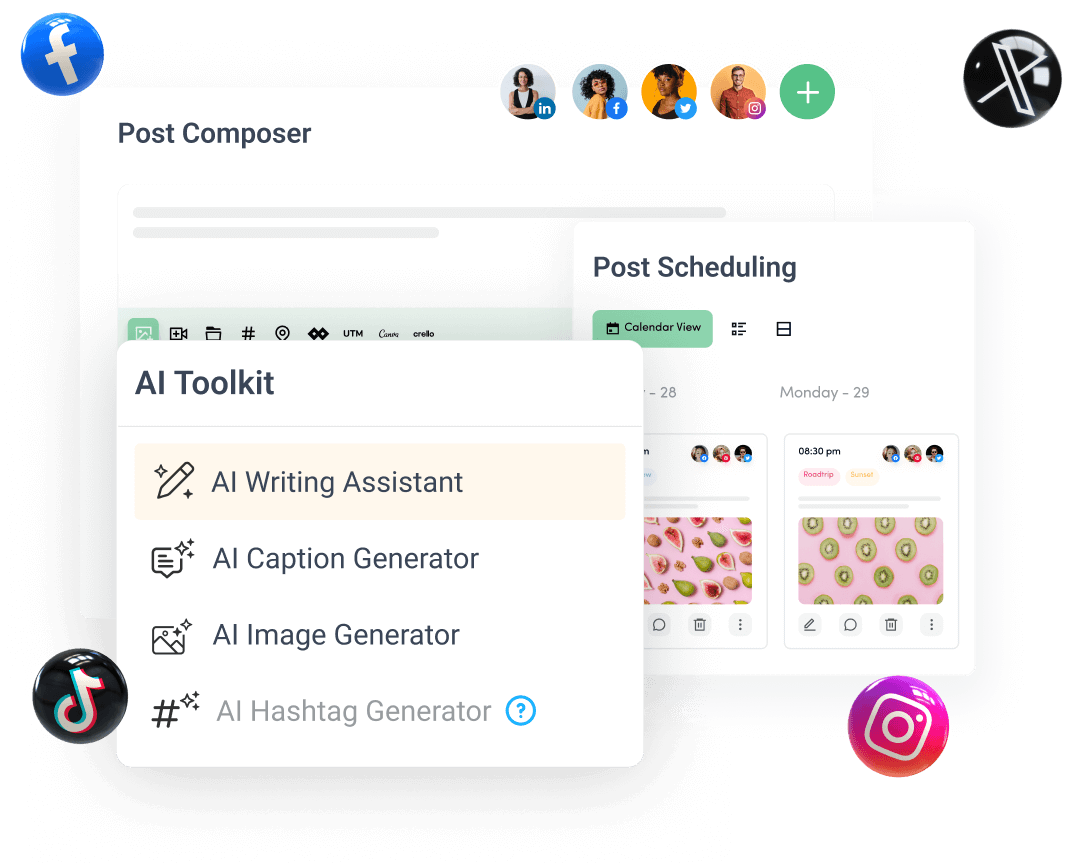
GPT has become particularly valuable for social media management, where platforms like ContentStudio leverage AI to help brands maintain an active, engaging presence:
- Post scheduling assistance: Suggesting optimal content types and timings
- Caption generation: Creating platform-appropriate text for social media posts
- Comment response drafting: Providing templates for engaging with audience comments
- Hashtag suggestions: Recommending relevant hashtags to improve content discoverability
These tools help marketers maintain consistent engagement across multiple social platforms simultaneously.
ContentStudio's AI writing tools
ContentStudio incorporates AI technology into its platform to provide marketers with AI-powered content creation capabilities designed specifically for social media and digital marketing needs.
AI assistant features
The platform's AI content assistant offers specialized functions for social media marketers:
- Social caption generation: Creating platform-specific captions that align with brand voice
- Content repurposing: Transforming existing content into new formats for different channels
- Post idea generation: Suggesting topics and approaches based on audience interests
- Content enhancement: Refining drafts for greater impact and engagement
These features integrate directly with ContentStudio's scheduling and publishing tools, creating a seamless workflow from content generation to distribution.
Industry-specific applications
ContentStudio's implementation of GPT technology offers specialized capabilities for various industries:
- E-commerce: Generating product descriptions and promotional content for social media e-commerce
- Hospitality: Creating destination highlights and service descriptions for hospitality businesses
- Finance: Developing compliant, accessible content for financial institutions
- Education: Producing informative content for educational organizations
This industry-specific approach helps marketers generate relevant content while maintaining compliance with sector-specific requirements.
Limitations and best practices
While GPT represents a powerful tool for content creators, understanding its limitations and implementing best practices remains essential for effective use.
Current limitations
GPT models have several important constraints:
- Knowledge cutoffs: Models have information only up to their training date
- Factual accuracy: They may occasionally generate plausible-sounding but incorrect information
- Nuance understanding: Complex cultural contexts or specialized jargon can be challenging
- Creativity boundaries: While impressive, AI-generated content may lack truly innovative ideas
These limitations highlight why human oversight remains crucial when using GPT for content marketing.
Effective implementation guidelines
To maximize the benefits of GPT while mitigating limitations, consider these best practices:
- Use as a starting point: Treat AI output as a draft requiring human refinement
- Provide clear instructions: Specific prompts yield better results
- Maintain brand voice: Review AI content to ensure consistency with your established tone
- Fact-check information: Verify all factual claims before publishing
- Optimize for engagement: Enhance AI content with audience-specific insights
Following these guidelines helps ensure that GPT serves as an enhancement to human creativity rather than a replacement for it.
Future of GPT technology
The rapid evolution of GPT models suggests significant developments ahead for content creation and marketing technology.
Emerging capabilities
Future GPT iterations will likely feature:
- Enhanced multimodal abilities: Better integration of text with images, audio, and video
- Improved reasoning: More sophisticated analysis and logical thinking
- Greater personalization: More precise adaptation to individual brand voices and audience preferences
- Expanded multilingual support: Better handling of non-English languages and cultural contexts
These advances will further integrate AI writing assistance into content marketing workflows, potentially transforming how brands approach content creation and distribution.
Integration with marketing ecosystems
As GPT technology matures, expect deeper integration with comprehensive marketing platforms like ContentStudio, creating more seamless workflows that connect content creation, curation, and distribution functions.
The evolution of GPT will likely enhance social media automation capabilities, allowing for more sophisticated, context-aware content generation that addresses specific audience needs while maintaining authenticity.
Ethical considerations
The power of GPT technology brings important ethical questions that content creators and marketers must consider.
Transparency and disclosure
When using AI-generated content in marketing, transparency best practices include:
- Appropriate disclosure: Being honest with audiences about AI involvement in content creation
- Maintaining authenticity: Ensuring AI-generated content aligns with genuine brand values and messaging
- Setting clear boundaries: Determining which content types are appropriate for AI assistance and which require fully human creation
These practices help maintain brand authenticity in an increasingly AI-influenced content landscape.
Avoiding misuse
Responsible use of GPT technology involves:
- Preventing misinformation: Verifying factual claims in AI-generated content
- Avoiding demographic biases: Reviewing content for unintended stereotypes or exclusionary language
- Protecting privacy: Not using private data as input for content generation
- Respecting intellectual property: Ensuring AI-generated content doesn't inappropriately mimic existing protected works
These considerations help marketers leverage GPT technology while maintaining ethical social media management practices.
Getting started with GPT for content creation
For marketers interested in incorporating GPT into their workflow, several approaches offer entry points tailored to different needs and expertise levels.
Tools and platforms
Several options exist for accessing GPT technology:
- Integrated marketing platforms: Services like ContentStudio's AI assistant provide purpose-built GPT implementations for social media and content marketing
- Standalone AI writing tools: Specialized applications focused exclusively on content generation
- API access: Direct technical integration with GPT models for custom applications
- Web interfaces: Public-facing implementations like ChatGPT for general-purpose use
The choice depends on your specific needs, technical capabilities, and how deeply you want to integrate AI into your content marketing strategy.
Implementation strategies
Consider these approaches when adding GPT to your content workflow:
- Start with specific use cases: Begin with clearly defined applications like social media captions or email subjects
- Implement human review processes: Establish clear workflows for reviewing and refining AI-generated content
- Test and measure results: Compare performance metrics between AI-assisted and traditional content
- Gradually expand applications: As you build confidence, extend GPT use to additional content types
This measured approach helps organizations adapt to AI-assisted content creation while maintaining quality and brand consistency.
Conclusion
GPT represents a transformative technology for content creation and marketing, offering unprecedented capabilities to generate human-like text at scale. From drafting social media posts to developing long-form content, these models are changing how marketers approach their craft.
While GPT provides powerful assistance, the most effective implementations combine AI efficiency with human creativity and oversight.
Platforms like ContentStudio that integrate GPT capabilities into comprehensive social media management tools offer marketers the best of both worlds—AI-powered efficiency with the controls needed for brand-consistent, authentic communication.
As GPT technology continues to evolve, staying informed about capabilities, limitations, and best practices will help marketers leverage these tools effectively while maintaining the authentic connections that drive meaningful engagement with audiences.
Create, plan, schedule, and publish posts on all social media networks