Meta Business Suite guide: Setup, scheduling, inbox, and insights
Oct 14, 2026
Black Friday: save up to 50% on all plans

Written by
Khadija AnwarUpdated
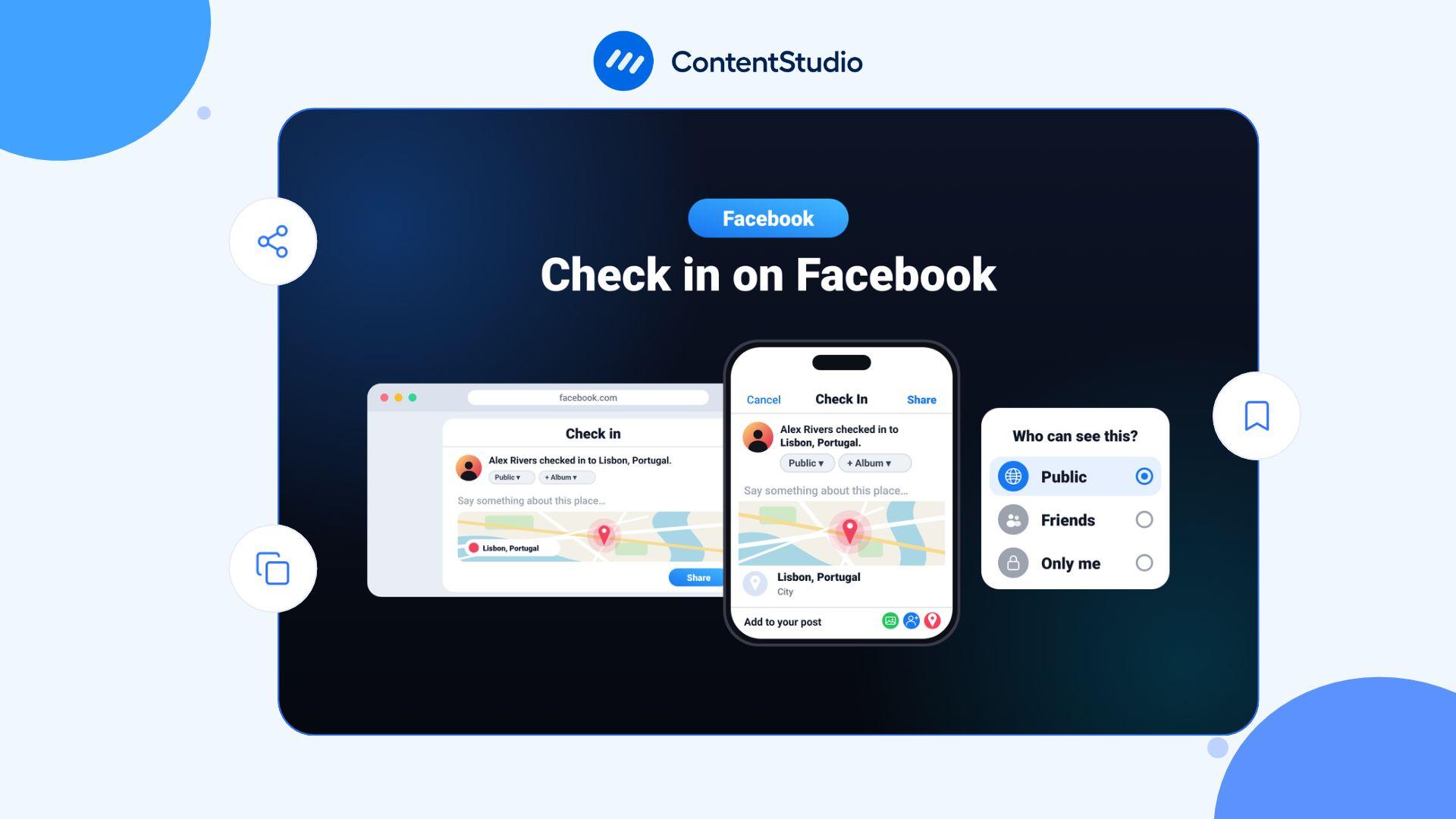
A Facebook check-in adds a location to a post. You can use it to share a visit to a restaurant, event, landmark, or business, but you should choose the audience carefully because the post can reveal where you are. Facebook’s check-in flow lets you select a nearby location or search for one, add optional content, choose an audience, and share the post. If you are using Facebook for business, a clear Facebook marketing strategy should define how location-based posts support local discovery and sit alongside other content on the Page.
Keeping the broader content calendar consistent while running location-based campaigns is easier with a planning tool. A Facebook scheduler helps maintain a steady publishing rhythm so location posts fit naturally into the wider content plan rather than appearing in isolation.
People do not search for “how to check in on Facebook” for a single reason. The goal is usually to share a visit, document a moment, or let a specific group know where they are.
| Underlying goal | What the reader wants | Better approach |
| Share a visit | Let friends know they are at a restaurant, event, or destination | Create a check-in with a carefully chosen audience |
| Recommend a place | Highlight a business or venue they enjoyed | Add a photo, review-style caption, and location |
| Document travel | Record a trip or destination for later | Check in at a city, landmark, or venue |
| Support a local business | Show that they visited a business | Check in and add context, without implying a formal endorsement |
| Coordinate an event | Help attendees locate a venue | Check in at the event location with a limited audience |
| Keep people informed | Let a small group know where they are | Use a custom or friends-only audience, not a public post |
| Promote a business | Encourage customers to share a visit | Ask customers to check in and tag the Page |
| Protect privacy | Avoid broadcasting a location publicly | Use a limited audience or avoid a real-time check-in |
A Facebook check-in adds a location to a post. It can be a nearby place, a business, an event venue, or any location Facebook recognizes. When you check in, the location appears on the post and may be associated with the business or place’s Facebook Page.
Facebook says that when you check in, you can add a photo or video, live video, feeling or activity, tag friends, choose an audience, and write an optional status update.
| What a check-in can include | What it adds to the post |
| Location | The specific place you are checking in to |
| Photo or video | Visual context for the visit |
| Feeling or activity | Context about what you are doing at that location |
| Tagged friends | People who are with you at the location |
| Audience selection | Who can see the post: public, friends, or a custom group |
| Caption or status update | A message, comment, or description about the visit |
Several common assumptions about check-ins are inaccurate. Understanding what a check-in does not do helps you use it appropriately and avoid unintended exposure.
| Limitation | What it means |
| It does not provide continuous location sharing | A check-in is a single post, not a live location tracker; use a dedicated location-sharing app for real-time tracking |
| It does not replace emergency services | Do not rely on a Facebook check-in for safety or emergency situations; contact emergency services directly |
| It does not guarantee privacy | The audience selector determines who can see the post, but check-ins linked to public Pages may have broader visibility |
| It does not automatically endorse a business | A check-in shows that you visited, not that you recommend or endorse the business |
| It does not work identically on every device | Interface labels and available options can vary by app version, device type, and account settings |
The mobile flow starts from the What’s on your mind field at the top of the Feed, not from the profile. The audience selector appears before you share, so choose visibility before tapping Share.
Step 1: Open the Facebook app on your phone.
Step 2: Scroll to the top of your Feed and tap the What’s on your mind field.
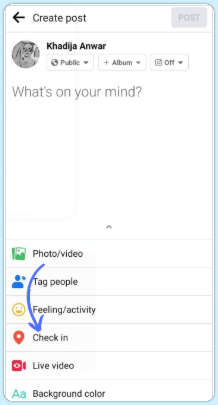
Step 3: Tap Check in from the options in the post composer.
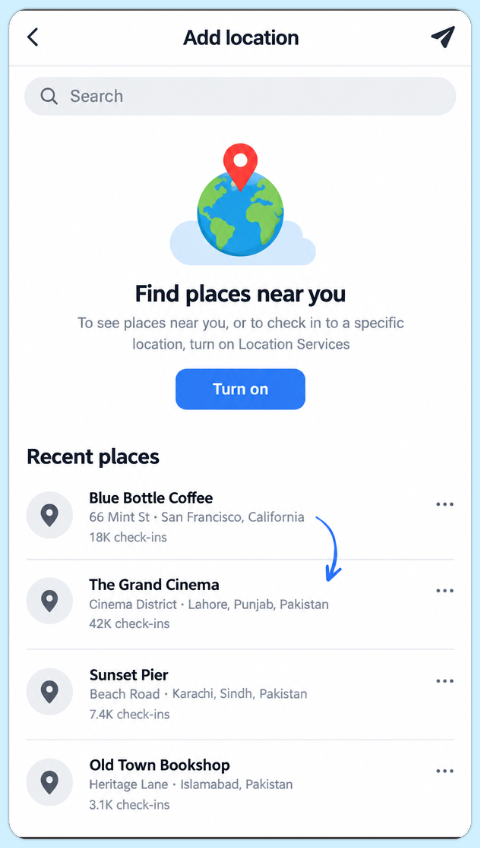
Step 4: Search for a nearby location or select one from the suggested list.
Step 5: Add optional content such as a photo, video, feeling, activity, or tagged friends.
Step 6: Tap the audience selector and choose who can see the post.
Step 7: Tap Next.
Step 8: Tap Share to post the check-in.
Note: If nearby locations do not appear, check whether Facebook has permission to access your device location. The troubleshooting section below covers this in more detail.
The desktop flow follows the same structure as mobile but uses click instead of tap. The check-in option sits inside the post composer on the Feed.
Step 1: Open Facebook in a browser on your computer.
Step 2: Click the What’s on your mind field at the top of the Feed.
Step 3: Click Check in from the options in the post composer.
Step 4: Select a location from the suggested list or search for a specific location.
Step 5: Add optional content such as a photo, video, feeling, activity, or tagged friends.
Step 6: Select the audience for the post using the audience dropdown.
Step 7: Click Post to publish the check-in.
If you forgot to add a location when posting, you can edit the post and add a check-in after the fact. The steps are the same on mobile and desktop.
Step 1: Go to your Facebook profile and scroll to the post you want to update.
Step 2: Click or tap the three-dot menu (Options) in the top-right corner of the post.
Step 3: Click or tap Edit post.
Step 4: Click or tap Check in inside the edit composer.
Step 5: Click or tap Where are you? and search for a location or select one from the list.
Step 6: Click or tap Save to update the post.
After posting a check-in, you can change the location, remove it without deleting the post, or delete the entire post. Each option affects the post differently.
| Action | What to do | What changes |
| Edit the location | Open the post, choose Edit post, then select Check in and choose a new location | The location on the post changes to the new one |
| Remove the location only | Open the post, choose Edit post, then delete the location without removing other content | The post remains visible but the location is removed |
| Delete the whole post | Open the post, choose Delete post, then confirm | The entire post, including the check-in, is permanently removed |
| Change the audience | Open the post, choose Edit post, then change the audience selector | Who can see the post changes |
The audience selector in the post composer controls who sees the check-in. Because a check-in reveals a location, it is worth reviewing the audience before tapping Share, especially for a personal location. If you want to limit visibility more broadly, the guide to making Facebook private covers the full range of privacy controls available for posts and the profile.
| Audience option | Who can see it | Best use |
| Public | Anyone on Facebook | Promoting a business, event, or public venue where broad reach is the goal |
| Friends | All of your Facebook friends | Personal updates about a visit or destination |
| Friends except… | All friends except selected people | Personal updates with specific exceptions |
| Specific friends | Only the people you select | Coordinating with a small group at a location |
| Only me | Only you | Saving a location privately without sharing it |
| Custom | A configured group of people | A controlled update for a defined audience |
If you want to reduce visible engagement signals on a check-in post, hiding likes on Facebook can limit what others see about how the post was received.
Check-in accuracy depends on whether Facebook can access your device’s location. If nearby suggestions are not appearing or the check-in is not finding the right place, the most likely cause is a permissions setting.
Facebook says that location services help it provide location features including posting content tagged with a location and finding places nearby. It also says that when location services are off, Facebook may still estimate a location using check-ins, events, and information about the internet connection.
| Setting | What it controls | Why it matters |
| Facebook app location permission | Whether Facebook can access the device’s GPS | Controls whether nearby locations appear in the check-in search |
| Device location services | Whether the device shares location with apps at all | Affects check-in accuracy and nearby suggestions |
| Facebook location settings | How Facebook uses and stores location information | Affects location-based features and ad targeting |
| Audience selector | Who can see the check-in post | Controls visibility of the location |
| Tagged friends | Whether other people are associated with the post | Can expand the post’s reach to the tagged friends’ audiences |
| Page location | Whether a business Page has an address set | Affects whether the Page appears in check-in search results |
If you want to reduce what others can see about your online activity more broadly, turning off active status on Facebook hides the indicator that shows when you are actively using the platform.
Most check-in problems come from one of three sources: the app needs updating, location permissions are restricted, or the location is not listed in Facebook’s database. The table below maps the most common problems to their causes and fixes.
| Problem | Likely reason | What to do |
| The Check in option does not appear | The Facebook app may be outdated | Update Facebook through the App Store or Google Play |
| Nearby locations do not appear | Location permission for Facebook is off or limited | Open device settings, find Facebook, and set location access to While Using or Always |
| The specific location cannot be found | The place may not have a Facebook Page or may not be in the database | Search for a nearby landmark, street name, or the city; create a Facebook Page for the business if it is yours |
| The check-in fails to post | Poor internet connection or a temporary app error | Check the connection, close and reopen the app, and try again |
| The post reached more people than expected | The audience was set to Public or Friends when a narrower option was intended | Edit the post and change the audience, or delete the post if necessary |
| The business Page does not appear in check-in results | The Page may not have a verified address or may not be eligible for check-ins | Check the Page’s location details in Page settings or contact the Page admin |
For businesses with a physical location, check-ins from customers serve as social proof that is visible to the customer’s network. A single customer check-in can reach their friends without any ad spend.
| Goal | Better approach | Example |
| Encourage customer check-ins | Ask at the point of visit; include a prompt on receipts or signage | “Check in at our location and share your visit with friends.” |
| Promote an event | Create a Facebook Event and encourage attendees to check in on the day | “Share your check-in from tonight’s opening night.” |
| Highlight a new location | Post a check-in from the new address on launch day with photos | “We are now open at our new downtown studio.” |
| Build local discovery | Keep the Page’s address, hours, and phone number accurate | Accurate Page details help the business appear in nearby check-in searches |
| Support user-generated content | Ask permission before resharing customer check-ins or photos | “Tag us in your visit photos and we may feature them.” |
| Track local interest | Use Facebook Page Insights to monitor location-related engagement | Monitor which posts mentioning the location generate the most reach |
If the business does not yet have a Facebook Page, the guide to creating a Facebook business page explains how to set up the Page with a verified location so it appears in check-in search results. A Page without an address will not show up when customers try to check in, which limits the organic reach a check-in would otherwise provide.
Location and events work well together for businesses running a launch, class, pop-up, or community gathering. The guide to creating an event on Facebook covers how to set up the event so attendees can check in from the event page on the day.
Facebook offers several ways to associate a location with content or activity. The table below distinguishes the four main options so you can choose the right one for each situation.
| Feature | What it shares | Who can see it | Best use |
| Check-in | A location attached to a post at a specific moment | The audience chosen for the post | Sharing a visit, event, or destination publicly or with friends |
| Location tag | A location added to a photo or post as a label | The audience chosen for the post | Adding geographic context to any post without a full check-in |
| Event RSVP | Attendance at a Facebook Event | Determined by the event’s privacy settings | Letting people know you plan to or have attended an event |
| Live location | A real-time, continuously updating location | People in a specific Messenger conversation | Coordinating a meetup or sharing a route in a private conversation |
A check-in can be a natural way to share a visit or promote a location, but the audience selector is the most important setting in the flow. A public check-in reaches far beyond Facebook friends, while a custom or friends-only audience keeps the location update within a trusted group.
Do not use a check-in as a safety tool or a live location tracker. For businesses, check-ins work best when they reflect a genuine visit and when the Page’s location information is accurate and up to date.
ContentStudio helps teams organize Facebook content, review and approve posts, and schedule publishing across channels. Start a seven-day free trial. No credit card required.
Yes. You can type a broader location, such as a city name or neighborhood, instead of selecting a specific venue. You can also choose a limited audience so the check-in is visible only to friends or a custom group, which limits who can see the location even if the venue is specific.
Not necessarily. You can manually type a location name in the search field without granting Facebook access to your device’s GPS. Location permissions improve nearby suggestions but are not required to complete a check-in. If location services are off, the nearby suggestions list will be empty and you will need to search manually.
No. A check-in is posted from the account doing the posting. You can tag friends in a check-in to associate them with the location, but tagging someone adds them to your post rather than creating a check-in on their behalf. Tagged friends may also receive a notification and can remove the tag from their timeline.
Facebook does not offer a toggle to disable the check-in feature for your account entirely. You can avoid using it, and you can set the audience for each post individually. If you want to prevent friends from tagging you in their check-ins, you can review tagging settings in your Privacy settings to require your approval before a tag appears on your profile.
A check-in is a single post that records a location at one point in time. Once posted, it does not update. A live location share through Messenger is a continuous, real-time feed of your current position that updates as you move and expires after a set time. Use a check-in for social sharing and a live location share in Messenger for active coordination with someone in a conversation.
Khadija Anwar is a Senior Technical Writer at ContentStudio with over 500 published write-ups across the ContentStudio blog and beyond. She specializes in step-by-step platform guides and Help Center content across Facebook, Instagram, LinkedIn, YouTube, TikTok, and X, and reviews how-to articles to verify every step and platform detail is accurate and current.
View all posts by Khadija AnwarRecommended for you
Meta Business Suite guide: Setup, scheduling, inbox, and insights

How to automate Facebook posts?

12 best Facebook analytics tools in 2026

Facebook marketing tools: The 2026 guide to building your stack


Plan, create and publish to 12 social channels
Up to 50% off on every plan
Offer ends in:
 Claim your deal
Managing social media doesn't get cheaper than this