
Facebook marketing tools: The 2026 guide to building your stack
Aug 4, 2026
Black Friday: save up to 50% on all plans

Written by
Khadija AnwarUpdated
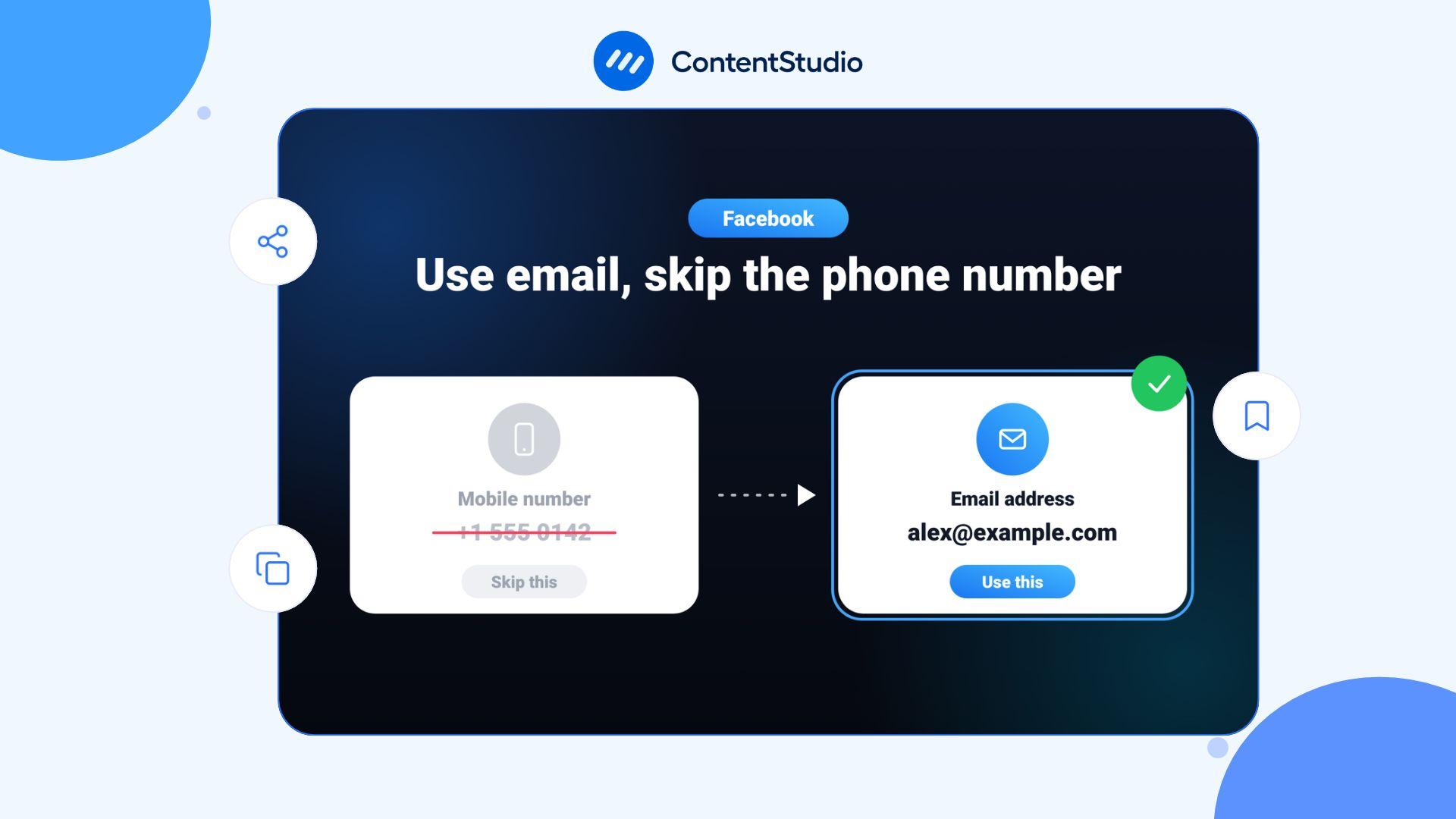
You can create a Facebook account without entering a phone number by signing up with an email address instead. Facebook lets you use either an email address or a mobile number, but you must confirm the contact method you choose.
Using an email address can reduce the personal information you share at signup, but it does not make the account anonymous. Facebook requires the name you go by in everyday life and says profile names must meet its name standards. If you are using Facebook for business, a clear Facebook marketing strategy should define how the personal profile, Page, and recovery email work together as a coherent identity.
Keeping the public content calendar consistent while updating account or Page details is easier with a planning tool. A Facebook scheduler helps maintain a steady publishing rhythm so the team is not scrambling to post manually while handling account or security changes.
People do not search for this topic for a single reason. The goal is usually to avoid sharing personal contact details, protect privacy, or separate a business presence from a personal phone number.
| Underlying goal | What the reader wants | Better approach |
| Protect privacy | Avoid sharing a phone number with Facebook | Sign up with an email address you control |
| Avoid spam | Reduce unwanted calls or texts linked to Facebook | Use an email address and review Facebook’s contact privacy settings |
| Create a separate account | Keep personal and business activity distinct | Use a dedicated email address and follow Facebook’s real-name rules |
| Protect recovery access | Maintain a way to reset a forgotten password long term | Use an email address you can access reliably |
| Reduce SIM-related risks | Avoid relying on a phone number that can be lost or transferred | Use email for recovery and an authenticator app for two-factor authentication |
| Manage a business presence | Separate a personal profile from a Facebook Page | Use a personal profile for account access and a Facebook Page for the business |
| Create a legitimate account | Avoid impersonation and policy issues | Use your real name and follow Facebook’s name standards |
Yes. Facebook lets you sign up using an email address instead of a mobile number. You must confirm the email address you use, but you do not need to provide a phone number to create the account.
What you cannot skip is verification. Facebook requires you to confirm the contact method you chose, whether that is an email address or a mobile number. For email, confirmation works through a link in the confirmation email, not a numeric code.
No. Using an email address at signup reduces the personal contact information you share with Facebook, but it does not make the account anonymous.
Facebook requires the name you go by in everyday life and says profile names must meet its name standards. An account created with an email address is still subject to those rules, to Facebook’s identity verification processes, and to the same content policies as any other account.
| What email can do | What email cannot do |
| Let you sign up without entering a phone number | Make the account or its activity anonymous |
| Provide a recovery method for the account | Replace the need to follow Facebook’s name and community rules |
| Receive security alerts and login notifications | Guarantee Facebook will never ask for additional verification later |
| Support account recovery if a password is forgotten | Prevent account loss if access to the email is also lost |
| Be used as a two-factor authentication contact method | Remove the need to protect the email account itself with strong security |
Facebook says that to create an account, you enter your name, email address or mobile phone number, password, date of birth, and gender. After completing the form, you need to confirm the email address or mobile number you used.
| Contact method | What Facebook asks for | How confirmation works |
| Email address | An email address you control | Click or tap the link in the confirmation email Facebook sends |
| Mobile number | A mobile phone number | Enter the numeric code sent by SMS to that number |
Important: The confirmation email contains a link, not a numeric code. Click or tap the link to confirm the email address. Entering a code is the SMS process for mobile number confirmation, not for email.
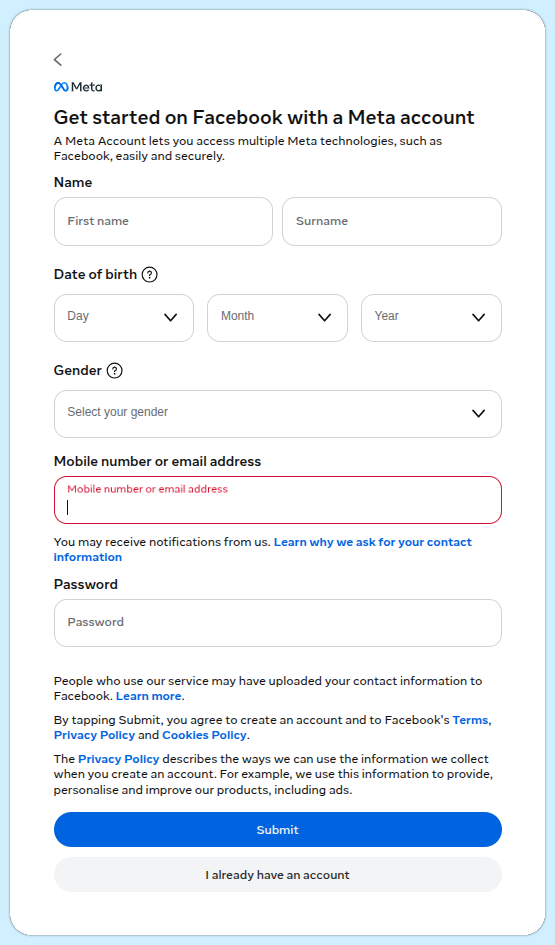
The desktop signup form asks for name, email or phone number, password, date of birth, and gender in one screen. Use the email field rather than the phone number field.
Step 1: Go to Facebook.com in a browser.
Step 2: Click Create new account.
Step 3: Enter your name as it appears in everyday life.
Step 4: Enter your email address in the email or phone number field.
Step 5: Create a password.
Step 6: Select your date of birth.
Step 7: Select your gender.
Step 8: Click Sign up.
Step 9: Open the inbox for the email address you entered.
Step 10: Find the confirmation email from Facebook.
Step 11: Click the confirmation link in the email.
Step 12: Return to Facebook and complete the profile setup.
The mobile app flow separates the sign-up steps across several screens. When the app asks for a phone number, look for the option to use email instead.
Step 1: Open the Facebook app on your phone.
Step 2: Tap Create new Facebook account.
Step 3: Tap Next.
Step 4: Enter the name you go by in everyday life.
Step 5: Select your date of birth.
Step 6: Select your gender.
Step 7: When the phone number screen appears, tap Sign up with email address instead of entering a mobile number.
Step 8: Enter your email address.
Step 9: Create a password.
Step 10: Tap Sign up.
Step 11: Open the inbox for the email address you entered.
Step 12: Find the confirmation email from Facebook and tap the confirmation link.
Facebook sends a confirmation email when you create a new account or add a new email address to an existing one. The email contains a link, not a code. Click or tap the link to complete confirmation.
Step 1: Open the inbox for the email address you used to sign up.
Step 2: Look for an email from Facebook. Check the spam, junk, or promotions folder if it does not appear in the main inbox.
Step 3: Open the email.
Step 4: Click or tap the confirmation link.
Step 5: Return to Facebook and finish setting up the profile.
If you need to update the email address linked to your account after setup, the guide to changing your Facebook email explains how to add a new address and set it as the primary contact.
Confirmation emails can be delayed, filtered, or misdirected. Work through these checks before requesting a new confirmation email.
| Problem | Likely reason | What to do |
| No email arrives | The email may be delayed by a few minutes | Wait five to ten minutes and check again |
| Email is in spam or promotions | The email provider may have filtered it | Check the spam, junk, promotions, or other folders |
| Email address appears to be misspelled | The address entered at signup may be incorrect | Log into Facebook and check or update the email address in account settings |
| Email provider is blocking Facebook | The email provider may filter messages from Facebook’s sending domain | Check the provider’s blocked-sender or spam settings |
| Email account is inaccessible | The email address used may not be one you can log into | Use an email address you control and can access independently |
Using only one email address creates a single recovery path. If access to that email is lost, recovering the Facebook account becomes significantly harder. Facebook says that if you forget your password, you need an updated phone number or email address to reset it.
| Recovery method | Why it matters | Best use |
| Primary email address | Lets you reset a forgotten password and receive security alerts | Use an email you control long term and protect with a strong password |
| Phone number (added later) | Provides a second recovery option independent of the email | Add if you are comfortable sharing it; useful when the email is inaccessible |
| Authenticator app for two-factor authentication | Adds a second verification step without relying on SMS or email alone | Use an authenticator app for stronger security if you do not want SMS |
| Recovery codes | Provides one-time backup codes for account access | Store them securely offline |
| Trusted contacts | Lets selected friends help you recover the account | Choose people who you trust and who are reachable |
Facebook says you can add or remove a mobile phone number in your settings at any time. Adding a phone number later can strengthen recovery options if you change your mind about sharing a number.
Step 1: Click your profile picture in the top-right corner of Facebook.
Step 2: Click Settings and privacy, then click Settings.
Step 3: Click Accounts Center.
Step 4: Click Personal details.
Step 5: Click Contact info.
Step 6: Click Add new contact, then Add mobile number.
Step 7: Enter the mobile number.
Step 8: Choose which accounts to add it to.
Step 9: Enter the confirmation code sent by SMS.
Step 10: Click Next, then Close.
The same Accounts Center path that lets you add a phone number also lets you remove one.
Step 1: Click your profile picture.
Step 2: Click Settings and privacy, then Settings.
Step 3: Click Accounts Center.
Step 4: Click Personal details.
Step 5: Click Contact info.
Step 6: Find the phone number you want to remove.
Step 7: Click Remove.
Step 8: Confirm the removal.
If you are reducing your Facebook presence more broadly alongside removing contact details, the guide to how to deactivate Facebook explains how to pause the account without permanently losing it. Deactivation removes the profile from public view but keeps the account recoverable, which is useful when the goal is a temporary absence rather than a permanent exit.
Deactivation and deletion are different outcomes with different implications for data and recovery. If the goal is to leave Facebook permanently rather than take a break, the guide to how to delete a Facebook account explains the difference and what happens to contact details and messages in each case.
An email-only account has fewer built-in recovery paths than an account with both contact methods. The security measures below compensate for that by strengthening the email account itself and adding non-SMS verification where possible.
Start by changing your Facebook password to something unique that is not reused across other sites. A password manager makes it easier to maintain distinct passwords for each service.
| Security method | What it does | Why it matters for an email-only account |
| Unique strong password | Protects the account from guessing and credential attacks | An email-only account relies on one contact path; a compromised password is a bigger risk |
| Password manager | Stores and generates unique passwords securely | Prevents reuse that could expose both the Facebook account and the recovery email |
| Two-factor authentication via authenticator app | Requires a second step at login without relying on SMS | Protects the account even if the password is exposed, without needing a phone number |
| Login alerts | Notifies you of unrecognized logins | Provides early warning of unauthorized access |
| Email account security | Protects the email address used for Facebook recovery | If the recovery email is compromised, the Facebook account is also at risk |
| Recovery codes | Provides one-time backup access codes | Useful if access to the authenticator app is lost |
Note: Facebook says that for security reasons, you cannot use the same mobile number for both two-factor authentication and password reset. If you add a phone number later, you may need to assign it to one purpose or the other.
Yes. Facebook says you should enter the name you go by in everyday life and that profile names must meet its name standards. This applies regardless of whether you signed up with an email address or a phone number.
The FAQ in the original article said you could create an account with a fake name as long as you used a real email. This is inaccurate. Facebook’s name policy applies to all accounts. Using a name that does not reflect everyday use can result in Facebook requiring verification or restricting the account.
| Avoid | Why it matters |
| Fake or invented names | Violates Facebook’s name standards and can result in verification requests or account restrictions |
| Impersonating another person | Violates Facebook’s policies and can result in account removal |
| Multiple personal accounts | Can create policy issues and complicate recovery if one account is restricted |
| Temporary or disposable email addresses | Makes recovery significantly harder if access to the account is needed later |
| Shared email addresses | Creates access and privacy issues if another person also uses the same address |
| Email addresses you do not control | Prevents email confirmation and blocks recovery |
For businesses, the most common reason to prefer email over a phone number at signup is to separate business access from a personal mobile number, particularly when multiple people share responsibility for a Facebook Page.
If you are setting up a business presence on Facebook and need to create the Page itself, the guide to creating a Facebook business page explains how to set up the Page from a personal profile and assign team roles.
The table below shows how the three common account setups differ in what they provide for recovery and security.
| Account setup | What you provide | Recovery options | Two-factor authentication options | Best use |
| Email only | Email address | Email-based reset; relies on a single contact path | Authenticator app or recovery codes | Avoiding a phone number at signup; suitable with an authenticator app |
| Phone number only | Mobile number | SMS-based reset; relies on the phone number remaining accessible | SMS code or authenticator app | Simpler setup when a phone number is preferred |
| Email and phone number | Both | Either method can be used; strongest recovery coverage | SMS, authenticator app, or recovery codes | Best account recovery and security coverage |
Creating a Facebook account with an email address is straightforward. The key difference from a phone number signup is that confirmation works through a link in an email, not a numeric code.
Use an email address you can access long term, protect it with a strong password and two-factor authentication, and consider adding a phone number later if you want a second recovery option.
ContentStudio helps teams organize Facebook content, review and approve posts, and schedule publishing across channels. Start a seven-day free trial. No credit card required.
No. When you sign up with an email address, Facebook sends a confirmation email containing a link. You click or tap that link to confirm the address. Entering a numeric code is the process for mobile number confirmation, not for email.
You can in some cases, but it is not recommended. A temporary email address cannot be used for account recovery after it expires. If you lose access to the Facebook account and the confirmation email address no longer works, recovering the account becomes significantly harder. Use an email address you control and can access independently of any service that might close or expire.
If your email address becomes inaccessible and you have no other recovery method on the account, recovering the Facebook account is difficult. Facebook says that if you forget your password, you need an updated phone number or email to reset it. If neither is available, there may still be an identity verification path through Facebook’s Help Center, but it is not guaranteed
Yes. Facebook supports two-factor authentication through an authenticator app, which does not require a phone number. It also supports recovery codes as a backup. These options give you strong account security without relying on SMS, which is particularly useful for an email-only account where phone-based recovery is not available.
Possibly. Facebook may prompt you to add a phone number for security purposes, particularly after certain actions like login from a new device, password reset, or account recovery. These are prompts, not requirements in every case, though Facebook may require additional verification if the account triggers a security review. You can dismiss optional phone number prompts, but doing so means phone-based recovery remains unavailable.
Khadija Anwar is a Senior Technical Writer at ContentStudio with over 500 published write-ups across the ContentStudio blog and beyond. She specializes in step-by-step platform guides and Help Center content across Facebook, Instagram, LinkedIn, YouTube, TikTok, and X, and reviews how-to articles to verify every step and platform detail is accurate and current.
View all posts by Khadija AnwarRecommended for you
Facebook marketing tools: The 2026 guide to building your stack

How to create a Facebook community (group setup, settings, and growth)

How to make Facebook Reels that get seen in 2026

How to view private Facebook profile?


Plan, create and publish to 12 social channels
Up to 50% off on every plan
Offer ends in:
 Claim your deal
Managing social media doesn't get cheaper than this