Facebook ads analytics: How to track and improve your performance
Aug 20, 202617 minutes

Written by
Esha ShabbirUpdated
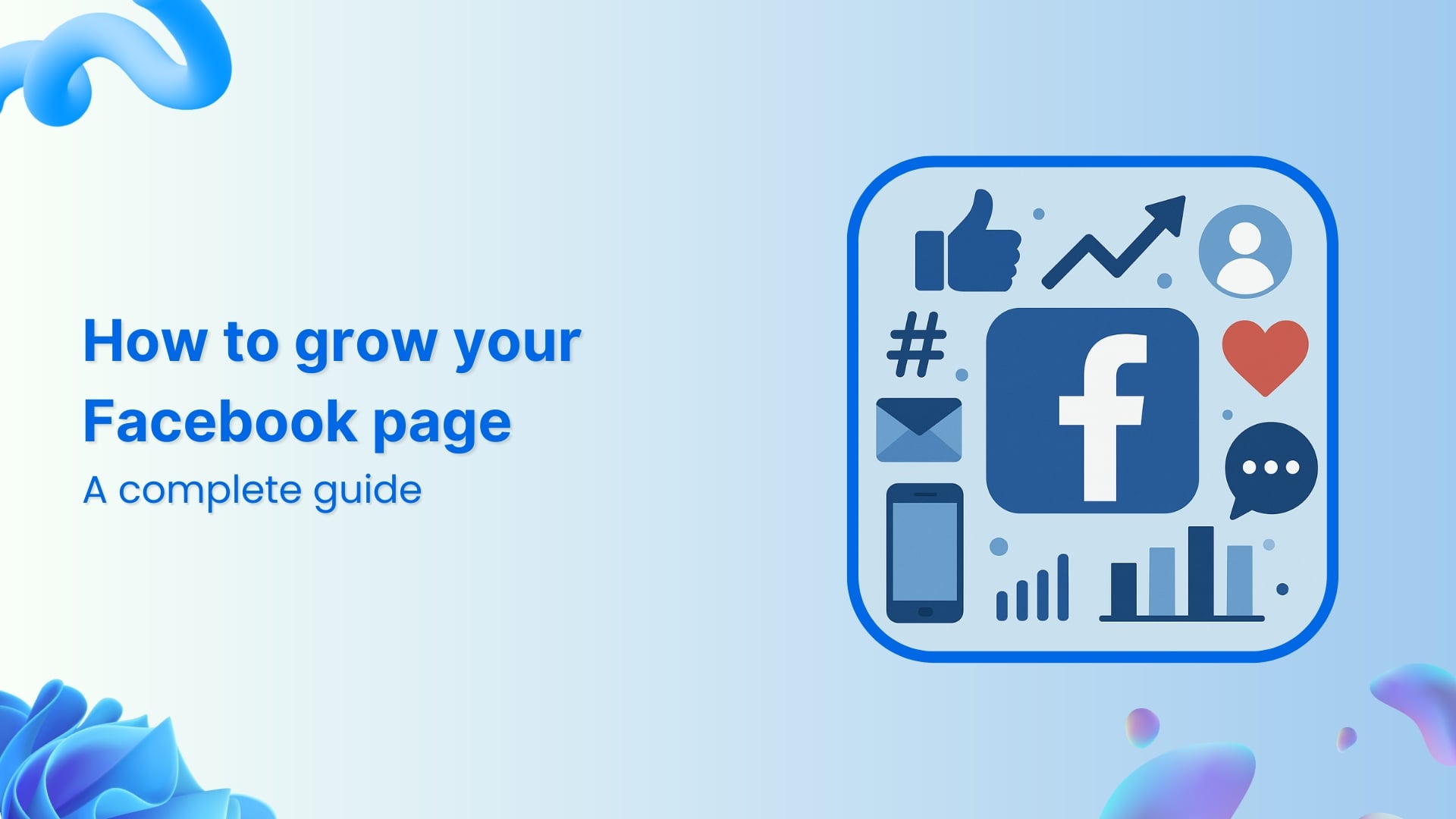
You can grow your Facebook page organically by posting content that earns shares, replying to every comment within the first hour, and using Reels to reach new audiences through Facebook’s discovery feed. Pages that do this consistently, with the right content mix, see compounding reach over time without paid promotion.
This guide covers how Facebook’s algorithm ranks content in 2026, which formats drive the most reach, and the habits that separate growing pages from stagnant ones.
A well-optimized Facebook page gives the algorithm enough signals to understand who should see your content. Completing your profile fields, consistent branding, and a content workflow before any growth tactics are the foundation.
Before any strategy works, the page itself needs to be in order. A missing category, a blank About section, or an inconsistent cover image signals inactivity to the algorithm. Incomplete pages also convert fewer visitors into followers.
Here’s what a growth-ready Facebook page requires:
Once the page is complete, the next priority is a content workflow. Posting whenever you get around to it is how pages plateau. A Facebook scheduler lets you plan and queue a full week of content in advance so publishing doesn’t depend on daily manual effort.
Your page setup is also where foundational Facebook marketing strategy decisions take shape, including how you’ll balance content types, posting frequency, and audience engagement as the page grows.
Facebook uses a four-step ranking process. It runs through inventory, signal collection, prediction, and relevance scoring for every post. In 2026, private shares via Messenger, first-hour comment velocity, and video completion rate carry the most algorithmic weight.
Meta hasn’t published its full ranking formula, but the structure is well-documented:
The signals that carry the most weight have shifted in 2026. Here’s how they rank:
When someone forwards your post to a friend via Messenger or WhatsApp, the algorithm reads that as a strong personal endorsement. Private shares now rank as the single most valuable interaction signal on Facebook. A post with 10 private shares performs very differently from one with 100 passive likes.
A post that gets 12 comments in the first hour will get broader distribution than one that reaches 12 comments over 48 hours. The algorithm interprets early comment activity as genuine interest and decides in that window whether to expand reach beyond your existing followers.
Facebook tracks how much of a video a viewer watches. A 40-second Reel watched all the way through carries more weight than a 4-minute video where most viewers drop off in the first 30 seconds. Shorter videos with high completion rates beat longer videos with high drop-off rates.
A save signals that the content had enough value to return to. A share signals that it was worth passing along. Both tell the algorithm to distribute the post further. A basic like, by contrast, signals passive approval and moves the needle far less.
Understanding how Facebook’s algorithm works in depth helps you read performance dips correctly. When a post underperforms, check the private share count and first-hour comment rate before drawing conclusions.
A growing share of Facebook feed content now comes from pages a user has never followed. The algorithm actively surfaces content to new audiences when it earns strong early engagement, which means any post can reach well beyond your current follower count if the signals are there.
Reels drive the most reach because Facebook distributes them to non-followers through the discovery feed. Photos produce the highest engagement rates among existing followers. A mix of Reels, photos, carousels, and text posts gives the algorithm multiple signal types and keeps multiple distribution channels active.
The format you choose determines which part of Facebook’s distribution system handles your content.
Facebook actively promotes Reels as its highest-priority format. Since mid-2025, all video content on Facebook is classified as Reels. Videos between 15 and 90 seconds, formatted vertically for mobile, get the strongest algorithmic push and are the primary format for reaching non-followers.
Facebook Reels for reach is especially effective for pages with fewer than 10,000 followers, because Reels appear in the discovery feed to users who have never seen your page. The hook in the first two seconds determines whether someone watches or scrolls. A strong visual or a direct opening statement is what keeps the video playing.
Static photos produce higher engagement rates among existing followers than most other formats. They load fast, require no commitment from the viewer, and generate more comments and reactions per impression than average. Use photos for branded content, community moments, product showcases, and quotes.
Each swipe on a carousel registers as an interaction. A five-card carousel generates five separate engagement signals from a single viewer. Use them for step-by-step content, comparisons, or multi-point tips.
Videos uploaded directly to Facebook consistently outperform YouTube or Vimeo links. Facebook reduces reach on posts that send users off-platform. Upload video files directly and add captions, since a large share of Facebook users watch without sound.
Text-only posts work well for questions. “Which of these would you actually use in your workflow?” or “What’s your biggest challenge with X?” generates comments from followers who wouldn’t engage with a static caption. Text posts rarely drive discovery, but they build the comment velocity the algorithm uses to assess audience engagement.
For pages with fewer than 50,000 followers, 3 to 5 feed posts per week, 2 to 3 Reels per week, and daily Stories is the recommended cadence. Consistency matters more than volume. A page that posts four times a week, every week, will outperform a page that posts twelve times in one week and then goes silent.
Posting more frequently than your engagement rate can support pushes the algorithm in the wrong direction. A stretch of low-engagement posts trains the algorithm to limit your reach. Post as often as you can maintain quality.
What matters more than the absolute number is regularity. Facebook’s algorithm treats posting gaps as signals of inactivity and reduces distribution accordingly. If you need to step away, schedule posts in advance to keep the cadence running.
Scheduling your Facebook posts in advance removes the daily decision-making that causes inconsistency. It also lets you consistently hit the best time to post for your specific audience without being manually present at each window.
The tactics that consistently grow Facebook pages include replying to comments within 60 minutes, participating actively in Facebook groups, running engagement-focused giveaways, collaborating with other creators, and asking specific questions in every caption. Each of these feeds the engagement signals the algorithm uses to decide reach.
The first hour after posting is when the algorithm decides whether to expand distribution. Replying to comments during this window triggers notification alerts, pulling commenters back to the post and extending the thread. Build your posting schedule around times you can actively monitor.
Facebook groups reach more people organically than business pages. Contributing genuinely useful content to niche groups, and referencing your page only when directly relevant, attracts followers already interested in your topic. It takes longer than other tactics but builds durable authority.
Generic questions get ignored. Specific ones get answered. “Which format would you use for your client onboarding?” or “Have you tried X and did it work?” gives people a clear, low-effort path to respond. The more specific the question, the higher the comment rate.
Giveaways are one of the fastest ways to spike engagement and follower counts. However, Facebook’s algorithm actively penalizes engagement bait. Asking people to “share to enter” can significantly reduce your post’s organic reach. Ask for a comment response instead: “Tell us in the comments which product you’d choose and why.” The engagement quality improves and the algorithm treats it as a genuine interaction.
Tagging pages or creators with complementary audiences in your posts, when the mention is genuine, often results in the tagged account sharing or commenting. That exposes your content to their audience. For this to work, the content has to be relevant to the page you’re tagging. Unrelated mentions read as spam.
Facebook hashtags for discovery work differently than on Instagram. Using 3 to 5 specific hashtags performs better than stacking broad popular ones. Specific hashtags help the algorithm categorize your content and surface it to users with established interest in that topic.
Share your Facebook page link in your email newsletter, Instagram bio, and YouTube description. People who follow you elsewhere convert to Facebook followers at a solid rate when your Facebook content offers something distinct.
Paid promotion accelerates growth on Facebook pages that already have strong organic performance. Running ads before your organic content is earning consistent engagement wastes budget and gives the algorithm inaccurate signal data about your audience.
The order of operations matters. Paid reach on top of low-engagement content drives visitors to a page they won’t follow. The click-to-follow conversion rate from ad traffic is much lower if the page’s recent posts have minimal engagement. Build organic first, then layer in paid.
Once your organic content is performing consistently, here are the paid approaches that drive page growth:
Running an engagement campaign in Facebook Ads Manager amplifies posts already performing well organically. The paid reach generates additional signal data, which sometimes causes organic reach to increase alongside it. Boost posts with above-average engagement rates. Leave underperforming posts unboosted.
Meta’s Advantage+ audience tool identifies users most likely to engage based on behavioral signals and lookalike patterns. Targeting too broadly increases cost per follower; targeting too narrowly limits reach. An interest-specific audience that’s not overly restricted by demographics typically gives the best cost-per-follower ratio.
Boost the posts that already outperform your page average organically. Using a social media management platform to track which posts consistently outperform your page average makes the selection decision straightforward. Boosting a low-performing post does not improve its quality signal in the algorithm’s view.
The most common reason Facebook pages plateau is a pattern of low-engagement posts that trains the algorithm to limit reach over time. Buying followers, missing the first-hour engagement window, and posting too many promotional updates are the three habits most likely to stall organic growth.
Purchased followers never engage. Facebook’s algorithm compares follower count to engagement rate, and a page with 15,000 followers averaging 20 likes per post reads as low-quality. The vanity metric creates a long-term reach penalty.
Posting and then going offline for six hours is a structural problem that compounds over time. The first hour determines whether the algorithm expands distribution beyond your current audience. Build your schedule around times you can actively monitor and reply.
“Share this post for a chance to win” sounds harmless. Facebook categorizes it as engagement bait and reduces reach on posts that use those mechanics. Ask for genuine comment responses instead. The engagement quality is higher, and the algorithm treats it as real interaction.
Pages where more than 30% of posts are promotional (sale announcements, service pitches, sign-up requests) lose followers faster than they gain them. Followers tolerate occasional promotion. They don’t engage with it consistently, and low engagement on promotional posts pulls down the page’s overall distribution.
A two-week posting gap is enough to reduce the reach of your next post meaningfully. Schedule content in advance if you need to step away. Never let the page go quiet and expect strong reach when you return.
Track organic reach, share rate, and engagement rate weekly. A growing page shows consistent improvement in reach per post even when follower count is flat, because the algorithm is distributing content to people who don’t yet follow the page.
Follower count is the metric everyone watches and one of the least useful for diagnosing growth. A page can lose 100 followers in a week and still be growing if reach, comment rate, and share rate are all increasing.
The metrics that actually tell you what’s happening:
| Metric | What it tells you |
|---|---|
| Organic reach per post | Whether the algorithm is distributing content to more people over time |
| Engagement rate | Total interactions divided by reach. Below 1% signals a mismatch between content and audience |
| Share rate | Shares divided by reach. The strongest predictor of further organic distribution |
| Private share count | Messenger forwards per post. The highest-weight signal in the 2026 algorithm |
| Follower growth rate | Net new followers as a percentage of total. A more useful signal than raw count. |
| Comment rate | Comments divided by reach. A high comment rate triggers further distribution |
Tracking Facebook page analytics through Facebook Insights gives you access to all of these. Check them weekly. Daily numbers are too noisy to act on. Weekly trends show the actual direction.
If reach is increasing but engagement rate is flat, the content is being distributed but not resonating. If engagement rate is high but reach isn’t growing, your existing audience is engaged, but the algorithm is not distributing to new people. Both are different problems with different fixes, and neither is visible by watching follower count alone.
Growing a Facebook page in 2026 is a function of consistent output, format choices the algorithm currently rewards, and genuine engagement in the first hour after every post. Private shares, comment velocity, and video completion are what move reach, and all of them come from content worth actually engaging with.
The pages that outperform are not necessarily posting the most. They’re posting well, responding fast, and reading their analytics honestly each week to understand what the algorithm is and isn’t distributing.
If there’s one place to start, build a consistent publishing schedule and commit to it for 90 days. Consistency is the single thing that separates pages that compound over time from pages that plateau and never understand why.
Post 3 to 5 times per week with a mix of Reels and photos, and reply to every comment within 60 minutes. Share rate is the most reliable signal that the algorithm is expanding your reach beyond current followers.
Start with Reels, since Facebook distributes them to non-followers through the discovery feed. Cross-promote your page in your email list, other social platforms, and relevant Facebook groups to get initial traction before organic reach can compound.
Post consistent original content, use native video and Reels, and respond to every comment. Business pages grow organically when they produce high-share and high-comment content consistently across multiple format types over time.
Check your first-hour comment rate and share rate in Facebook Insights. If both are low, the content is reaching people but not resonating; if reach itself is low, a history of underperforming posts is likely suppressing your page’s overall algorithmic distribution.
Plan 0 Days of Content in 0 Minutes
Create, schedule, publish and analyze your content across all your social media channels from one simple dashboard.
4.7 on Capterra • 16,500+ marketers trust ContentStudio
Esha Shabbir is a content marketer at ContentStudio, specializing in social media strategy, SEO-led content, and editorial workflows for marketing teams. She writes practical, research-backed content that helps marketers understand what to publish, how to organize their content, and how to build a more consistent social media presence.
View all posts by Esha ShabbirRecommended for you
Facebook ads analytics: How to track and improve your performance
70 ChatGPT prompts for Facebook to drive reach and engagement
Facebook cover photo size: The complete 2026 guide
Ultimate guide to schedule Facebook posts, Reels & Stories