How to automate Facebook posts?
Jul 20, 2026
Black Friday: save up to 50% on all plans

Written by
Khadija AnwarUpdated
If the Share button is missing on a Facebook post, the audience setting is almost always the reason.
Facebook only shows the Share button to people who can see the post. Set a post to Friends, and only your friends can share it. Set it to Public, and anyone on Facebook can see and share it. This applies to new posts and existing ones. For businesses publishing to a Facebook Page, the shareable setting matters for organic reach, and understanding the full set of sharing controls is part of a sound Facebook marketing strategy for content distribution.
Getting the audience setting right is only the starting point. Doing it consistently across every post over time is where most teams fall short. Planning which posts go Public and when they publish so the content calendar runs without manual intervention is where a Facebook scheduler makes the most practical difference, particularly for teams managing multiple Pages or accounts.
Every Facebook post has an audience selector that directly determines whether the Share button appears.
| Audience setting | Who can see the post | Who can share it | Share button visible to |
| Public | Everyone, including people not logged in to Facebook | Anyone on Facebook | All viewers |
| Friends | Only your Facebook friends | Only your friends | Your friends only |
| Friends except | All friends minus the people you name | Friends who can see it | Those friends only |
| Specific friends | Only the friends you name | Only those named friends | Those friends only |
| Only me | Only you | No one | No one — no Share button shown |
| Custom | People you specify by name or list | People in that audience | That audience only |
Facebook Pages: Page posts are Public by default. Anyone can share them unless the Page admin has disabled sharing for a specific post. This section about privacy settings applies primarily to personal profile posts.
Set the audience before you post. The Share button appears immediately for everyone once the post goes live as Public.
Step 1: Open the Facebook app and start a new post.
Step 2: Tap the audience selector below your name. It shows the last audience you used, such as Friends or Public.
Step 3: Select Public.
Step 4: Write your post and publish it.
Important: Facebook remembers the last audience you used. If you change one post to Public, your next post will also default to Public until you change it again.
The audience can be changed on any published post you own.
Step 1: Find the post on your profile.
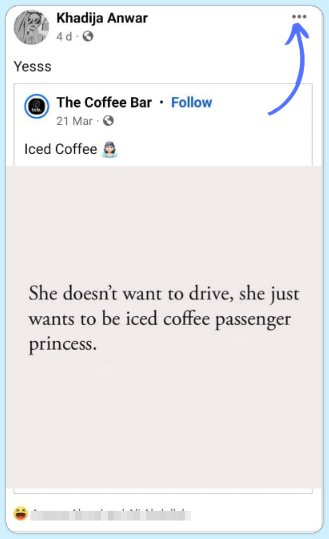
Step 2: Tap the three-dot menu (…) in the top-right corner of the post.
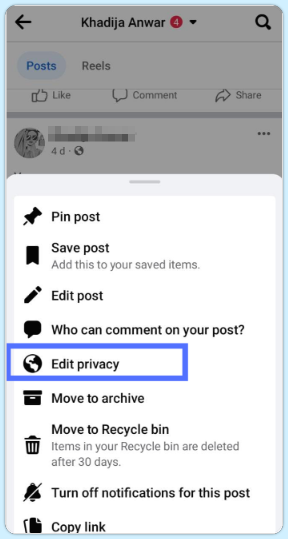
Step 3: Tap Edit privacy.
Step 4: Select Public.
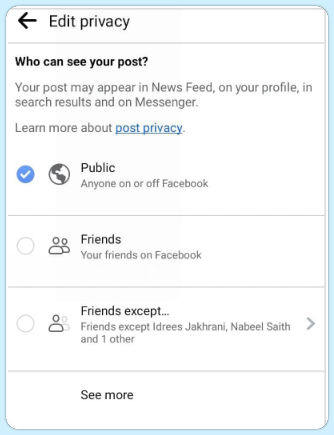
The change is immediate. The Share button becomes visible to all viewers right away.
Step 1: Find the post on your profile timeline.
Step 2: Click the three-dot menu (…) in the top-right corner of the post.
Step 3: Click Edit privacy.
Step 4: Select Public and save.
Instead of changing each post individually, you can set a default so every new post starts as Public.
Step 1: Open Facebook and go to Settings and privacy, then Settings.
Step 2: Tap or click Privacy.
Step 3: Find Your future posts and tap or click Edit.
Step 4: Select Public as the default audience.
Note: This changes the default only. You can still override it on any individual post when composing. Setting it to Public means all future posts will be shareable unless you manually change a specific post to a narrower audience.
Page admins can control whether individual Page posts can be shared by viewers. This is a separate setting from the audience selector and is not visible in the same place.
Step 1: Go to the Facebook Page post you want to manage.
Step 2: Click or tap the three-dot menu on the post.
Step 3: Look for Edit post or Post options, then find the sharing toggle.
Note: Not all Page post interfaces show this toggle in the same place. Some versions of the interface expose it during post composition under audience settings. If a viewer reports that a Page post has no Share button, check whether sharing was disabled when the post was created.
Sharing another person’s post works through the Share button on that post. The Share button only appears if the original poster set their audience to allow you to share it.
Step 1: Find the post you want to share and tap or click Share.
Step 2: Choose where to share it: your own timeline, a friend’s timeline, a Group, or a Page you manage.
Step 3: Add an optional comment and publish.
Note: When you share someone’s post, the share carries the original audience restriction. A Friends post you share stays within your friends’ view; it does not become Public through your share.
Sharing to a Group sends the post directly into that Group’s feed rather than to your personal timeline.
Step 1: Tap or click Share on the post.
Step 2: Select Share to a Group.
Step 3: Search for and select the Group.
Step 4: Add a comment if needed and post.
Note: You must be a member of the Group to share into it. The post will follow the Group’s own visibility rules, not your personal privacy settings.
After setting the audience to Public, the Share button should appear for all viewers. If it is still missing, one of these situations applies.
| Situation | Why the Share button is missing | What to do |
| Post is from a closed or private Group | Group posts can only be shared within the Group regardless of personal settings | Share within the Group, or repost the content to your timeline as a new post |
| Page admin disabled sharing on this post | Admins can turn off the Share button per post | No workaround unless the admin re-enables it |
| Viewing a Friends post from someone else | You can only share what the original poster allows | Ask the poster to change the audience to Public |
| Video has regional distribution restrictions | Facebook restricts some video content at the content level | No workaround; the restriction is applied by Facebook |
| App or browser is outdated | UI elements, including the Share button, can disappear in older versions | Update the app or clear the browser cache and reload |
Public posts are the foundation of organic reach on Facebook. Only Public posts can be shared beyond your friend network, appear in search results, or be surfaced to people who do not follow you. When someone shares a Public post, that share can reach their entire friend network or beyond depending on their own settings.
Friends’ posts can be shared too, but each share stays within the friend networks of people who can see it. The post does not become Public through sharing. For content intended to spread widely, Public is the only setting that enables it.
The missing Share button is almost always an audience setting issue. Setting a post to Public, either when composing or by editing afterward, makes it shareable by all viewers. For teams publishing consistently, setting Public as the default and using a scheduler means shareable posts go out at the right time without manual audience changes each time.
ContentStudio helps teams organize Facebook content, review and approve posts, and schedule publishing across channels. Start a seven-day free trial. No credit card required.
No. Changing the audience on an existing post is silent. No notification is sent to people who can now see the post. The change takes effect immediately, and future viewers see the updated audience, but no one is alerted that the post became Public.
No. When a friend shares your Friends post, their share stays within their own audience settings. The original post remains a Friends post. It does not become Public through the share. Someone who is not your friend but is in your friend’s network may see the shared version, but only if that friend shared it with their own friends or publicly.
Page admins can disable the Share button on individual Page posts. If you cannot share a Page post, the admin has likely turned off sharing for that specific post. There is no way to override this as a viewer. If the post belongs to a business or creator you work with, ask the Page admin to check the post sharing settings.
If the original poster deletes their post, any shares of that post also lose the content. The share that appeared on your timeline or in a Group will show a placeholder or disappear entirely because the source post no longer exists. Your share continues to exist as a post object, but it no longer has content to display.
By default, if a post is Public, anyone who can see it can comment on it. However, Facebook allows you to control commenting separately from visibility. You can set a post to Public for sharing but limit who can comment by adjusting the comment audience in the post options. This is useful for posts you want widely shared but where you do not want to manage open comments from people outside your network.
Khadija Anwar is a Senior Technical Writer at ContentStudio with over 500 published write-ups across the ContentStudio blog and beyond. She specializes in step-by-step platform guides and Help Center content across Facebook, Instagram, LinkedIn, YouTube, TikTok, and X, and reviews how-to articles to verify every step and platform detail is accurate and current.
View all posts by Khadija AnwarRecommended for you
How to automate Facebook posts?

How to create a Facebook Business Page?
How to create a Facebook community (group setup, settings, and growth)
Facebook analytics: What the metrics mean and how to use them


Plan, create and publish to 12 social channels
Up to 50% off on every plan
Offer ends in:
 Claim your deal
Managing social media doesn't get cheaper than this