How to promote affiliate links on social media in 2026
Oct 2, 202616 minutes

Written by
Esha ShabbirUpdated
AI in social media management is the practice of using generative and predictive tools to run social content operations more efficiently, covering content drafting, scheduling optimisation, performance analysis, and community management. The result is a workflow where your team focuses on strategy and judgment, and the tools handle execution.
Unlike basic scheduling automation, AI learns rather than executes, reading your account’s performance history, picking up on what works, and adjusting automatically. Most platforms with an AI layer, including AI Studio, handle this without manual reconfiguration.
This guide covers where AI fits in social media management, how to use it well, and what tends to go wrong.
AI in social media management is the application of machine learning, natural language processing, and generative models to automate or assist with tasks across the content lifecycle. This includes content creation, scheduling optimisation, performance analysis, community management, and trend monitoring.
Social media management has always involved a high volume of repetitive decisions. When to post. What to write. Which hashtags to use. How to respond to a comment. Which content to put budget behind. For years, teams made those decisions manually, supported by scheduling tools that did nothing more than publish posts at a time you specified.
What changed is not just that AI got added on top of those tools. The underlying technology shifted fundamentally. Large language models can now produce platform-specific captions, reply suggestions, and content variations at a quality that is editable rather than throwaway. Machine learning models trained on your account’s historical data can predict which posting times and content formats will perform best for your specific audience. Not the industry average. Yours. Image and video generation tools produce usable visual assets from a text description in under a minute.
These are qualitatively different from what social media scheduling tools could do five years ago. The shift matters because it changes what a small team can produce without proportionally increasing headcount.
A common source of confusion is treating AI in social media management as the same thing as automating social media workflows. They overlap, but they are not the same.
Automation handles rule-based tasks. Schedule a post at a fixed time. Re-queue evergreen content every thirty days. Send an auto-reply when a DM matches a specific keyword. The automation does exactly what you configured it to do, every time, without deviation.
AI adds a learning and generative layer on top of that. An AI scheduling tool does not just publish at a time you set. It analyses your account data and recommends when to post based on when your audience has actually engaged with your content historically. An AI content tool does not follow a template you built. It generates new variations based on context, platform norms, and the brief you gave it.
The practical distinction: automation without AI just does the wrong things more consistently. Posting at a fixed time regardless of when your audience is online is efficient execution of a flawed decision. Posting at an AI-recommended time based on real engagement data is efficient execution of a better one. The output from the same content is measurably different.
AI does not know your brand history, your audience’s sensitivities, or the context around a real-time event. It does not understand why a content format that worked in January stopped working in April. It produces output confidently and incorrectly when the prompt is vague or when the underlying claim it is drawing on is wrong.
The judgment layer stays with the people running the account. Every capability covered in this guide requires a human in the loop to be reliable at scale.
AI operates across four main areas in social media management: content creation, scheduling and publishing, analytics and reporting, and inbox and community management. Each has a different reliability profile, and content creation is typically the strongest starting point.
Understanding where AI fits becomes clearer when you separate it into distinct capabilities rather than treating it as one general technology. The reliability varies significantly across these four areas. Scheduling optimisation is the most mature. Content generation is high-potential but requires oversight. Analytics is strong for pattern detection, less so for interpretation. Inbox automation works well for high-volume, low-complexity interactions.
Here is how the four areas map to what AI handles and where human involvement stays essential:
| Use case | What AI handles | Where humans stay involved |
| Content creation | Captions, images, video, hashtags, post variations | Brand voice, factual review, creative direction |
| Scheduling and publishing | Optimal timing, queue management, bulk upload, cross-platform formatting | Campaign planning, real-time decisions, special events |
| Analytics and reporting | Performance summaries, trend detection, anomaly flags, sentiment tracking | Interpreting context, deciding what to change |
| Inbox and community | Auto-replies, comment filtering, sentiment tagging | Complex queries, escalations, relationship-building |
The sections below cover each area in detail, including what the practical workflow looks like, what breaks when implemented poorly, and which use cases deliver the most time savings earliest.
AI social media content creation uses generative models to produce draft captions, headlines, hashtags, image assets, and video content from a brief or prompt. The output is a working draft, not a finished product, and it needs editing for brand voice before it publishes.
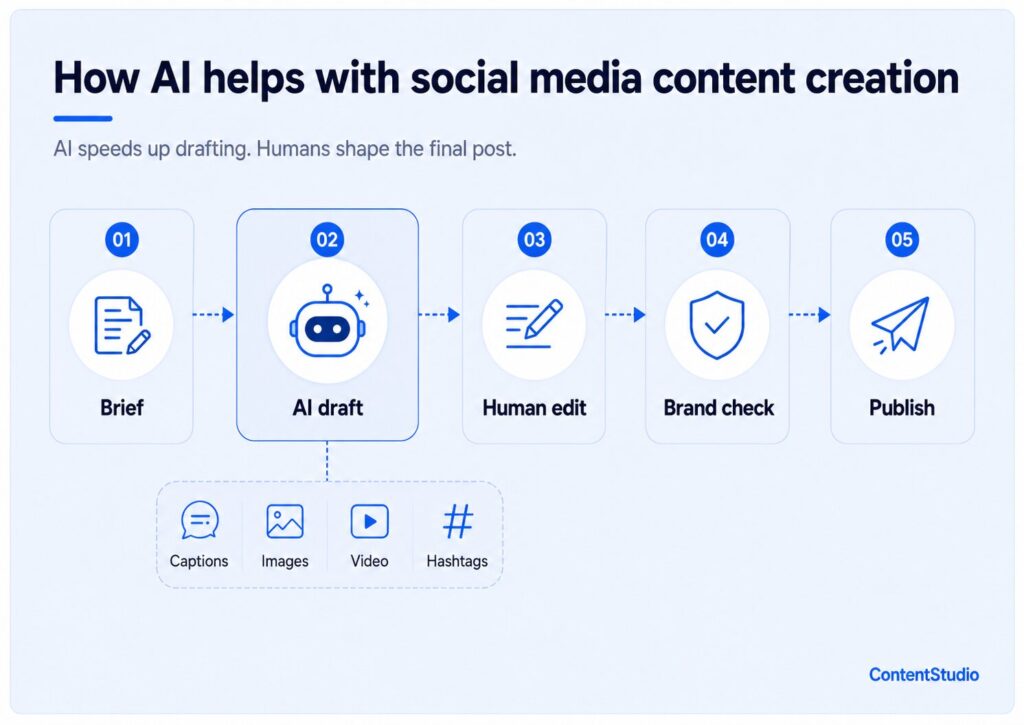
Content creation is where teams typically see the fastest time savings from AI and also where most of the early frustrations come from. The frustration almost always traces back to one mistake: treating AI output as finished content rather than a first draft that still needs a human editor.
Set that expectation clearly upfront, and the workflow becomes substantially more efficient.
An AI content generation tool takes a brief, a URL, a core message, or a product update and produces platform-specific caption variations in seconds. For a team publishing across five platforms daily, this eliminates the blank-page problem for every single post.
The working loop is straightforward. Brief in, draft out, human edits the best variation, publishes. The ratio of time spent creating versus refining shifts heavily toward editing. The writing time that disappears is the time spent before a first draft exists.
The consistent limitation is brand voice. Generative models default to a slightly generic, professional register unless they are working from strong examples of your brand’s actual writing. A one-line instruction in the prompt (“write in a casual tone”) produces something generically casual. Your brand voice is more specific than that.
Teams that get consistently useful output from AI content tools have done the work upfront: detailed voice documentation, example posts that represent the brand well, and prompt templates built around the formats they publish most. Teams that skip that step end up rewriting every draft from scratch, which removes the time-saving entirely.
AI prompts for social media structured around your content types and platform norms make the difference between output you edit and output you replace. That infrastructure is worth building before you scale AI content generation.
Social media image generation has moved from an experimental tool to a viable production option for brands that need a high volume of original visual content. You describe the image you need, select a style, and the model produces multiple options in under a minute.
Where it works well: atmospheric and illustrative content, concept visuals, product mockup backgrounds, and imagery where brand-specific precision is not critical. Where it consistently falls short: anything needing brand-consistent visual elements across a series, readable text rendered inside the image, realistic human subjects, or exact product representations.
The practical approach is to treat AI-generated images as production starting points rather than final assets. A designer refines or uses them as references. This compresses the asset production timeline without removing quality control from the process.
AI video tools have moved quickly. You can now generate short-form video from a script, convert a blog post into a narrated clip, add automatic captions and subtitles, and repurpose long-form content into platform-specific cuts without a production team. For teams building AI video marketing content into their content mix, the quality ceiling for certain formats is now viable for direct social publishing without further production work.
The constraint is visual consistency. AI video generation works well for formats where a tight brand visual identity matters less. Informational clips, trend responses, and text-on-screen content all fit that description. It struggles when every frame needs to fit within a precise brand system.
Writing one post and adapting it correctly for five platforms is a task that gets skipped or done poorly when done manually. Each platform has different character limits, different norms around formatting, different expectations from the audience, and different content structures that perform.
AI handles the adaptation reliably. You input the core message, specify the platforms, and the model adjusts format, length, tone, and structure for each destination. LinkedIn posts want professional framing and more developed thought. Instagram captions want personality and hashtags at the end. X wants concision. TikTok descriptions serve a different function from the video itself. Getting these right manually for every post is tedious. AI does it in seconds, and the output usually needs only a light edit rather than a full rewrite.
AI-powered scheduling uses your account’s historical performance data to recommend optimal posting times and manage content queues automatically. The result is a more consistent publishing cadence with significantly less daily manual effort.
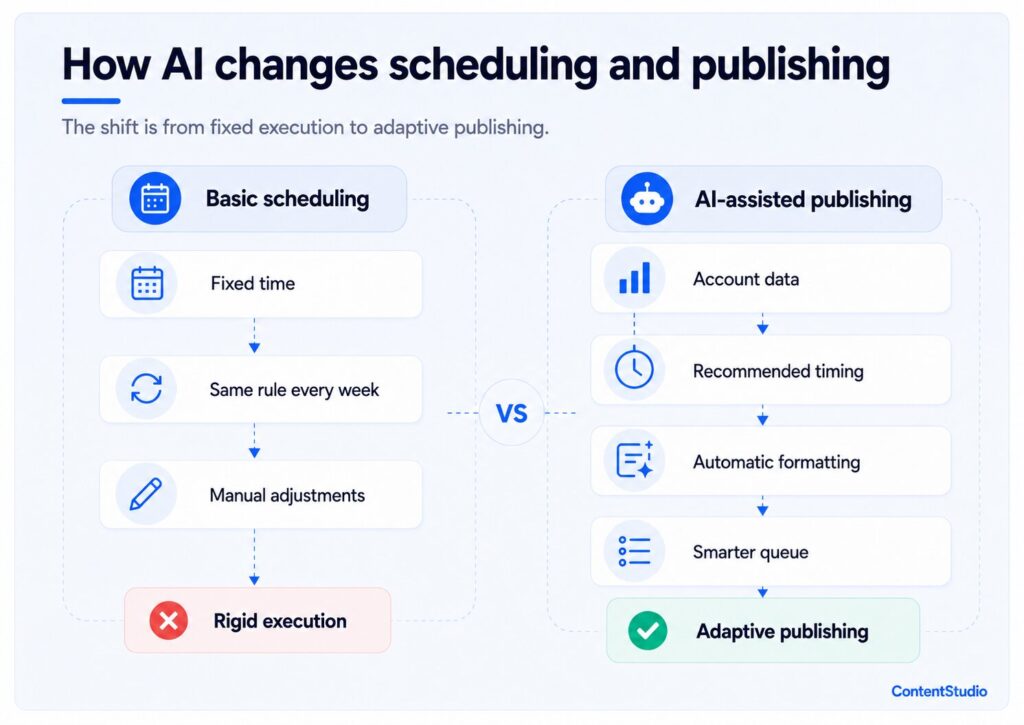
Scheduling is one of the highest-confidence uses of AI in social media management. The inputs are structured, the outputs are measurable against prior performance, and the feedback loop is short enough that the recommendations improve over time as the model learns your account’s patterns.
Generic “best time to post” guides aggregate data across millions of accounts. They are correct on average and wrong for almost any specific account, because your audience’s behaviour is not the average of everyone else’s audience.
AI-powered scheduling tools analyse your specific account’s historical performance data to find when your audience actually engages with your content. For some accounts, that is early weekday mornings. For others, it is late evenings or weekend afternoons. The difference between posting at the right time and the wrong time for your specific audience can produce a meaningful gap in reach and engagement per post. That gap compounds across every post you publish in a year.
This level of account-specific optimisation used to require running structured experiments manually and tracking results in a spreadsheet. AI does it automatically and updates the recommendations as your audience’s behaviour shifts.
For teams managing high content volumes, the mechanical work of scheduling individual posts is a significant time drain. AI scheduling tools support bulk imports, template-based recurring schedules, and automatic queue filling so the publishing calendar stays populated without someone spending an hour on it every morning.
The gain multiplies for teams managing multiple accounts. Automated social media publishing for scheduling specifically means each account’s queue runs on its own publishing logic without daily manual intervention to keep it filled. The time cost of adding a new account to the workflow drops substantially when the scheduling layer is automated and intelligent rather than purely manual.
Publishing correctly to five different platforms in a single workflow involves more complexity than it appears. Character limits, link handling, tagging conventions, image dimension requirements, and caption formatting vary by platform. A social media management platform with AI publishing support handles these automatically, so the content reaches each platform correctly formatted without manual adjustment per channel.
The friction reduction here is less dramatic than scheduling optimisation or content generation, but it compounds across every piece of content your team publishes. Eliminating small recurring sources of friction adds up over a month.
AI social media analytics processes performance data across platforms automatically and surfaces patterns, anomalies, and trends that would take hours to identify manually. It does not replace analysis but makes the information you need available faster and with less mechanical work.
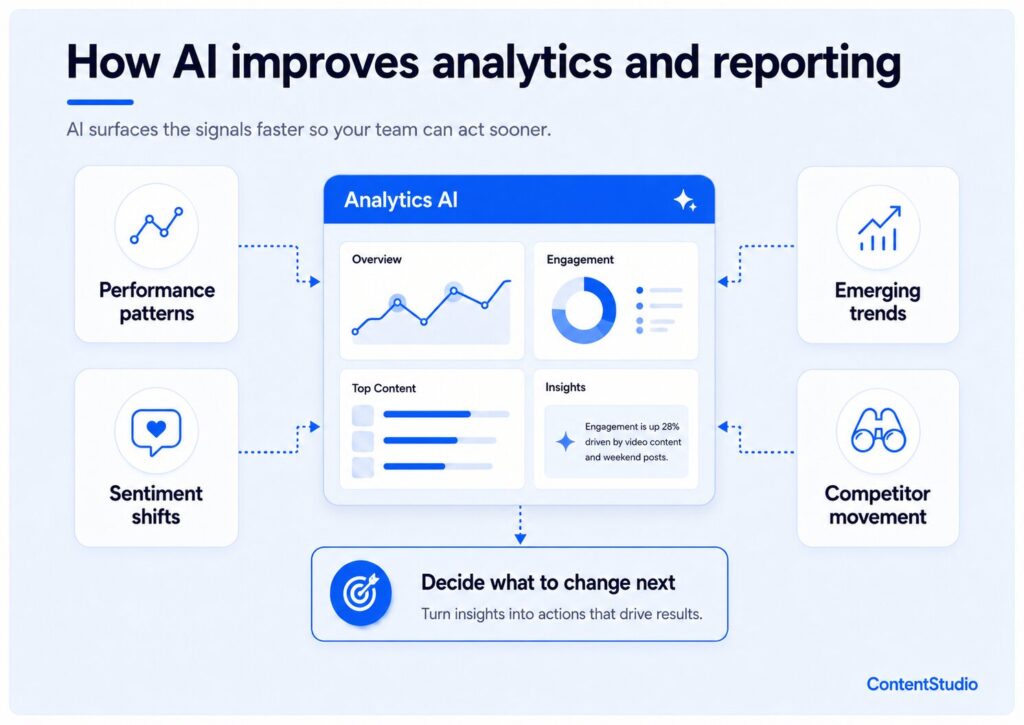
Reporting is one of the most time-consuming parts of social media management, particularly for teams covering multiple channels or producing monthly reports for stakeholders. AI has compressed the mechanical work of reporting substantially.
AI analytics tools aggregate data across your channels and produce performance summaries automatically. Engagement rates, reach trends, top-performing content formats, and audience growth patterns are surfaced in real time rather than in a report built once a month from manually exported spreadsheets.
For teams running AI-managed social campaigns, this means seeing what is working partway through a campaign and adjusting before the budget is spent. The feedback loop compresses from weeks to hours, which changes the decisions you can make mid-campaign. A team that can identify an underperforming ad set on day three and reallocate budget operates differently from a team that discovers the same thing in the post-campaign report.
AI monitors search trends, social conversations, and content performance patterns across your niche continuously. When a topic gains momentum before it peaks, the system surfaces it.
The practical value: a team that spots a relevant trend three days before it peaks gets the reach that comes with being early. A team that spots the same trend after it peaks has missed the window. The difference is not effort. A person manually monitoring trends across five platforms would need to do so constantly, and still could not process the volume. AI does it automatically.
Sentiment analysis applies natural language processing to classify mentions, comments, and messages as positive, negative, or neutral at scale. For brands with significant mention volume, tracking sentiment manually across platforms is not feasible.
The application is two-sided. At the brand level, it tells you whether your reputation is shifting. At the content level, it tells you which posts generated positive versus negative audience reactions. That matters more for content strategy than raw engagement metrics. A post with high engagement and predominantly negative sentiment is a different situation from a post with high engagement and positive sentiment. Engagement counts do not tell you which is which. Sentiment analysis does.
AI tools can monitor competitor accounts, track their publishing cadence, identify their highest-performing content types, and compare their audience growth trajectory to yours automatically. This kind of intelligence is not something you could gather manually at any useful frequency. You would need to visit each account daily and track changes in a spreadsheet, which is neither reliable nor sustainable.
The output feeds directly into content strategy. If a competitor’s educational content is significantly outperforming their promotional posts, and you see the same pattern in your own analytics, that is a strong signal about what your shared audience actually wants. Acting on that signal is faster when you did not spend two hours finding it.
It also prevents a common trap: assuming that what is working for you is working in isolation. Competitor data shows whether you are genuinely outperforming the field or whether a rising tide is lifting all boats in your niche. The distinction matters for how you allocate content effort.
AI can reliably manage high-volume, low-complexity inbox interactions: common question auto-replies, comment moderation, and sentiment tagging. It is not suited for complex complaints, escalations, or interactions where the audience relationship depends on a real person being present.
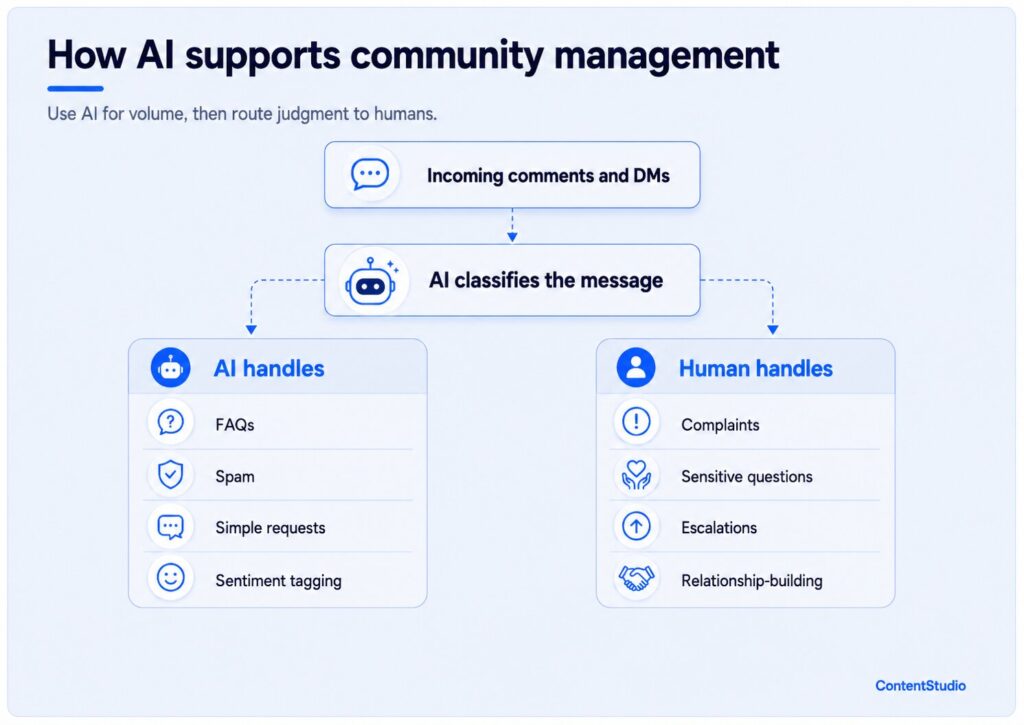
For brands receiving hundreds or thousands of messages and comments daily, the inbox represents some of the most time-consuming work in social media management that has the least strategic value. AI handles the portion that does not require judgment. That portion is larger than it appears.
AI-powered auto-reply systems classify incoming messages by intent and trigger a configured response for recognisable categories. Questions about pricing, shipping times, store hours, product availability, and account troubleshooting are handled without a human reviewing each one.
The risk is misclassification. A message that looks like a routine question but carries an emotional subtext, or an escalation framed politely, will receive an auto-reply the sender experiences as dismissive. The fix is an escalation path into a human queue and daily review of what the automation is handling, not setting up the system and checking in monthly. Automation without regular oversight creates problems that grow quietly until they are visible.
AI moderation applies rules to comments continuously, flagging or hiding content that matches spam patterns, profanity filters, competitor mentions, or brand-safety violations without requiring a human to review each one. For brands running high-traffic campaigns or managing large communities, this is operationally necessary rather than a convenience.
Use it as a filter and review what it removes. Models trained on general data will make errors specific to your brand’s context. A term that is neutral in most contexts might carry specific significance for your audience. Catching those mismatches early prevents the configuration from becoming a long-term problem.
Inbox automation is one touchpoint in a broader AI in customer experience strategy. How AI handles escalations, routes complex queries to human agents, and passes conversation context when it hands off determines whether the automation helps or frustrates the person on the other side. Getting the escalation path right is as important as getting the initial auto-reply right.
An AI-assisted social media workflow layers AI into specific handoff points across the content lifecycle without delegating the decisions that determine whether the content is actually good. The key is knowing what to automate and protecting the steps that require human judgment.
There is no single correct workflow for every team. What works for a solo social media manager is different from what works for a team of twelve at an agency. But there is a core structure that applies across contexts and that teams tend to adapt rather than rebuild from scratch.
Here is what a standard AI-assisted social media content workflow looks like in practice.
Social publishing automation handles Steps 6 and parts of Step 7. Automation is the mechanism that executes consistently. AI is the intelligence layer that makes the execution decisions better. Both are necessary; neither replaces the other.
Automation without AI intelligence executes the same decisions repeatedly. If your audience’s engagement patterns shift, the automation does not adapt. AI scheduling recognises the shift and updates the recommendations. The automation then executes the updated timing. The combination outperforms either component alone.
The social media content workflow does not exist in isolation. It connects to editorial calendars, campaign planning, SEO-informed content production, and brand messaging strategy. Understanding how AI fits into AI-driven content strategy determines which AI capabilities to prioritise and in what sequence.
Teams that implement AI at the social media layer without connecting it to their broader content strategy tend to produce more content without improving the strategy behind it. Output volume without strategic direction rarely improves results, regardless of how efficiently the output was produced.
Removing the approval step to recover time is the most common implementation mistake. AI produces confident, grammatically correct content that is factually wrong, tonally off, or contextually inappropriate for the moment. It does not know what happened in your brand’s PR last month. It does not know that a particular phrase landed badly with your audience six weeks ago. It does not know about the sensitivity around a topic currently in the news.
A human reviewer catches these things before they publish. The time cost of review is low relative to the cost of publishing something that damages the brand or requires a public correction.
The primary risks of AI in social media management are brand voice inconsistency, factual errors in generated content, declining engagement from over-automation, and regulatory exposure in sensitive industries. These risks are manageable with the right governance structure, but they are not theoretical. They show up when teams implement AI without oversight.
Every vendor in this space focuses on what their tools can do. The risks associated with using those tools without appropriate controls get less attention. The section below is specific rather than general, because vague risk warnings do not help anyone build a better process.
Generative AI produces output that is coherent and averaged. The more your team relies on AI for content without strong prompt infrastructure and brand voice documentation, the more your output converges toward a generic register. Your posts start sounding like every other brand using the same underlying model.
This is not theoretical. Teams that implement AI content generation without detailed voice guidelines and customised prompts notice the drift within a few weeks of publishing. Audiences notice it longer term, even if they cannot articulate exactly what changed. The engagement patterns shift before anyone identifies the cause.
The fix requires upfront investment: write detailed brand voice documentation, build it into your prompt templates, and compare AI-generated content against your strongest human-written posts on a regular schedule. When you notice convergence toward a generic style, adjust the prompts before it compounds further.
AI language models generate text confidently regardless of whether the underlying information is accurate. They produce statistics that do not exist, attribute statements to wrong sources, and describe product features incorrectly when the prompt creates space for inference rather than requiring grounded information.
Every piece of AI-generated content that includes a specific claim, a number, a quote, or an attribution requires a human to verify it before publishing. This is not a step you deprioritise when you are busy. Publishing a false statistic to tens of thousands of followers because an AI wrote it confidently is a brand problem that no disclaimer resolves after the fact.
There is a point at which the automation of a social media presence becomes visible to the audience. Accounts that feel fully automated train their audiences not to engage, because there is no real person to engage with on the other side.
Comments that receive generic auto-replies, posts that never respond to discussion, and content that never references real-time moments or events all signal to the audience that no one is actually running the account. The engagement decline is gradual, which makes it easy to attribute to algorithm changes or seasonal patterns until the trend is already established.
The equilibrium between automation and human presence is different for every brand and audience type. High-frequency informational content tolerates more automation than brand storytelling or community-driven content. Know which parts of your content mix need a genuine human voice and protect those parts from the automation logic.
In regulated industries including finance, healthcare, legal services, and consumer-facing businesses operating under advertising standards regulations, AI-generated content carries compliance obligations that most social media teams are not equipped to navigate alone.
Generated claims about product efficacy, investment returns, legal outcomes, or health benefits can expose a brand to regulatory action even when the claim was accurate at the time of generation. AI does not know which statements require disclaimers, which phrases trigger advertising standards review, or which regulatory frameworks apply in which markets.
The detailed considerations around AI compliance for social content warrant a dedicated review before rolling AI out across a regulated brand’s channels. This is not a step to defer.
For agencies managing five or more client accounts, AI meaningfully compresses the time cost of content production, scheduling, and reporting per account. The per-account margin improves without proportionally increasing headcount. The upfront investment is in workflow design and prompt infrastructure, not in tool licensing.
The economics of AI for agencies are more compelling than for single-brand teams because the time savings multiply across accounts. A one-hour saving per account per week is a small efficiency gain for a solo brand manager. For an agency with twenty accounts, it is effectively half a working day per week, every week, without additional cost.
Content production is the highest-volume, most repetitive part of agency work. An AI-powered drafting tool that consistently produces usable first drafts changes the role of the writer on the team. Writers become editors. The same number of people produce more output across more client accounts.
Monthly reporting is the second-largest opportunity. Building performance reports manually across twenty accounts takes a full day or more. AI analytics tools that aggregate data and generate narrative summaries compress that to a fraction of the time. The account manager’s time shifts from data extraction and slide formatting to analysis and client advisory.
Scheduling and queue management compound at agency scale. When each client account’s publishing calendar is managed by an AI layer that recommends timing and fills queues automatically, the marginal time cost of adding a new account drops significantly. The growth ceiling for the team moves.
The real advantage for agencies that single-brand teams cannot replicate is cross-account pattern recognition. A social media management platform with AI capabilities that identifies what is working across all your client accounts simultaneously gives you analytical insight that no individual client’s team could develop alone.
If a content format is significantly outperforming on three unrelated client accounts in the same week, that is a signal worth acting on quickly. Identifying that pattern manually across twenty accounts, in real time, is not feasible. AI surfaces it automatically, and the agency team acts on it proactively rather than reactively.
Running successful AI-optimised social campaigns across multiple client accounts also means your campaign optimisation learning transfers between accounts in ways it cannot when each account is managed in a separate manual workflow.
Pricing adjustments, team structure, and workflow design for AI for social media agencies all need to align before the efficiency gains compound across accounts.
The most immediate operational challenge is brand voice consistency. Each client has a distinct tone, and a single generic prompt configuration does not serve all of them. Agencies that build client-specific prompt libraries, with one configuration per account reviewed during onboarding, get consistently better output than those using the same setup across every client.
The internal question of who owns the AI layer also needs an answer early. Someone needs to maintain prompt quality, review flagged outputs, and update configurations as client briefs evolve. Treating it as everyone’s responsibility tends to mean it becomes no one’s.
Look for tools that integrate AI capabilities across the full content lifecycle rather than covering just one step. A standalone caption generator, a standalone scheduler, and a standalone analytics platform create more workflow friction in combination than a single platform covering all three. The value is in how the capabilities connect.
Before evaluating any specific tool, apply these five criteria. A tool that fails on any of them will create friction that offsets the time savings elsewhere.
Here is a practical evaluation framework for assessing AI social media management tools:
| Criterion | What to evaluate | A sign of a problem |
| Content generation quality | Does the output match your brand voice with reasonable prompt investment? | Generic drafts that require full rewrites to be usable |
| Scheduling intelligence | Does it use your account’s data or industry-wide averages? | Recommended posting times identical across different accounts |
| Analytics depth | Does it surface specific insight or just display charts? | Dashboards with no anomaly detection, narrative summaries, or performance commentary |
| Workflow integration | Does AI output connect directly to your approval and publishing process? | Content generated in one tool, manually copied into the scheduler |
| Team and access structure | Can you set permissions by role and by client account? | Admin-only access with no team-level structure or approval workflow |
The most common implementation mistake is adopting AI across every workflow step simultaneously. The result is too many changes at once, no clear baseline for what is improving, and difficulty diagnosing which change caused any problems that appear.
Start with content generation. It is the most visible use case and shows measurable time savings quickly. It also forces the team to build the prompt infrastructure (voice documentation, format templates, platform-specific guidelines) that every other AI use case depends on.
Once content generation is stable and the output quality is consistently at an editable standard, move to scheduling optimisation through leading AI scheduling tools. Analytics follows once you have a real baseline worth measuring against.
The teams getting the most from AI in social media management are not the ones running the most automation. They are the ones who used AI to identify where their time was actually going and made deliberate choices about where human judgment still had to live.
AI does not replace the work of building an audience, understanding what they care about, or knowing when a moment calls for a real response. It removes the mechanical load around those things, which makes the parts that require a person more visible and more important than they were before.
If you are still deciding whether AI belongs in your social media workflow, it already does for your competitors. The question is where you start. Pick one use case, measure what changes, and build from there.
AI in social media management automates content creation, scheduling, performance analysis, and inbox management using machine learning and generative models. Teams use it to reduce execution work and focus on strategy.
AI generates captions and visuals, predicts optimal posting times, analyses content performance, monitors brand mentions, and handles common replies. Content creation typically delivers the fastest time savings.
AI handles specific tasks reliably, including scheduling, comment moderation, and FAQ replies, but cannot run an account without human oversight. Fully automated accounts tend to lose engagement over time.
The main risks are brand voice drift, factual errors in generated content, over-automation, and compliance exposure in regulated industries. All are manageable with human review at key workflow steps.
Start with content generation. Build prompt templates, generate a test batch, and edit until the output is consistently usable, then add scheduling optimisation.
Plan 0 Days of Content in 0 Minutes
Create, schedule, publish and analyze your content across all your social media channels from one simple dashboard.
4.7 on Capterra • 16,500+ marketers trust ContentStudio
Esha Shabbir is a content marketer at ContentStudio, specializing in social media strategy, SEO-led content, and editorial workflows for marketing teams. She writes practical, research-backed content that helps marketers understand what to publish, how to organize their content, and how to build a more consistent social media presence.
View all posts by Esha ShabbirRecommended for you
How to promote affiliate links on social media in 2026
Multi-location social media management workflow guide
Best SaaS affiliate programs for social media marketers in 2026

19 best social media management tools to plan, schedule, and grow in 2026