
How does X (formally Twitter) Algorithm Work in 2023? 15 Hacks to Beat It
Aug 4, 202213 minutes

Written by
Wasiq NaeemUpdated

Twitter advanced search is X’s built-in tool for finding specific public posts by keyword, exact phrase, account, date range, language, engagement level, and media type. You can open the form at x.com/search-advanced on desktop or a mobile browser, or type search operators such as from:, since:, and min_faves: straight into the search bar, including inside the X app.
Twitter rebranded to X in July 2023, so you’ll see posts instead of tweets and reposts instead of retweets throughout the app. The search tool itself carried over almost unchanged, which is why most people still look for it as Twitter advanced search.
That second route matters more than most people expect. X now shows search results only to logged-in users, and the iOS and Android apps don’t include the advanced search form at all. The operators still work everywhere, and they are what turn an endless feed into something you can actually research.
Twitter advanced search is a filtered version of X’s regular search. Instead of typing one keyword and scrolling through whatever X decides is relevant, you set rules that every result must match. You can:
Here’s how it compares to a plain search:
| Basic X search | Twitter advanced search | |
|---|---|---|
| Keyword matching | Loose match on the words you type | All words, exact phrase, any word, or excluded words |
| Accounts | Not filterable | From, to, or mentioning specific handles |
| Dates | Recent and “Top” posts only | Any range back to 2006 with since: and until: |
| Engagement | Not filterable | Minimum likes, replies, and reposts |
| Content type | Media tab only | Links, images, videos, quotes, replies, and reposts on or off |
For agencies, in-house social teams, and brands, that precision turns X into a searchable research database for:
Getting good at X advanced search is one of the cheapest ways to sharpen your Twitter marketing strategy: it costs nothing and gives you first-hand data about what your audience and competitors are saying right now.
Advanced search matters because X’s default search is built for browsing, not research. It mixes popular posts, ads, and loosely related results. Advanced search strips that back to the exact posts you need, which makes it useful well beyond casual lookups.
A basic search for “social media management tool” returns a mix of product pitches, unrelated threads, and promoted posts. Add an exact phrase, exclude words like “course” or “free,” and filter out reposts, and you’re left with the posts that actually relate to your campaign.
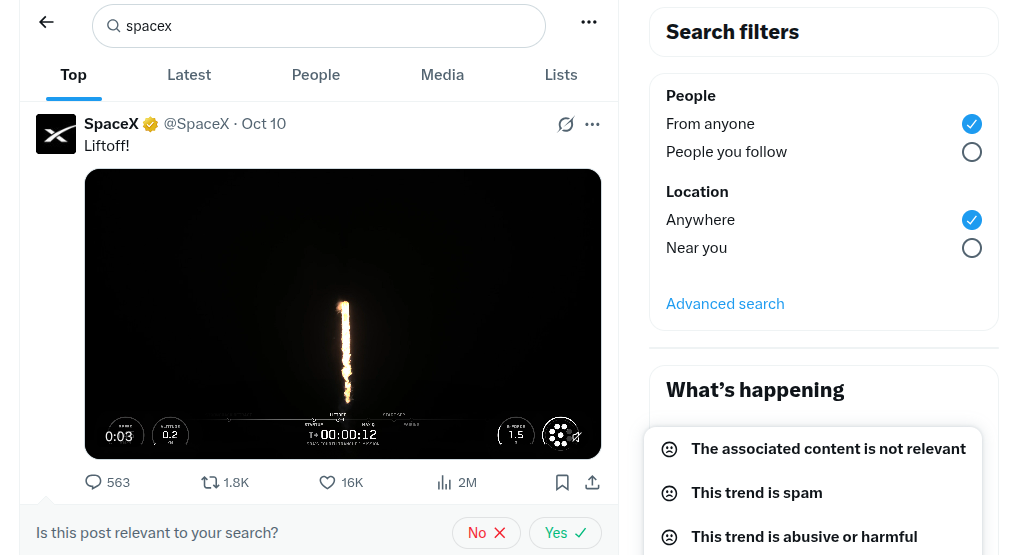
If certain topics keep flooding your results and your timeline while you work, you can mute words and phrases on X, so they stop getting in the way.
Advanced search lets you see what competitors post, which of their posts get traction, and what customers say about them in public. That’s first-hand input for competitor positioning that no third-party report can match for freshness. We cover repeatable queries for this in the use cases below.
Search lets you find people describing their problems, asking for recommendations, or complaining about a product, all in their own words. Those phrases are gold for content, ad copy, and support. They also show you where your customer care needs work.
Searching a topic and switching to the Latest tab shows you how a conversation is moving minute by minute. Combine that with researching popular X hashtags to find the tags people actually use, rather than the ones you assume they use.
When you find a conversation worth joining, timing matters. Lining up your posts in ContentStudio’s X scheduler lets you publish your take while the topic is still active, instead of rushing a reply from your phone.
Date filters make it easy to compare chatter before, during, and after a launch, event, or ad flight. Pair them with language filters to see how a campaign lands in different markets, then adjust messaging accordingly.
You can open the full advanced search form on desktop or in a mobile browser at x.com/search-advanced. You need to be logged in to an X account. In the X app, you won’t find the form, but you can type the same operators into the search bar.
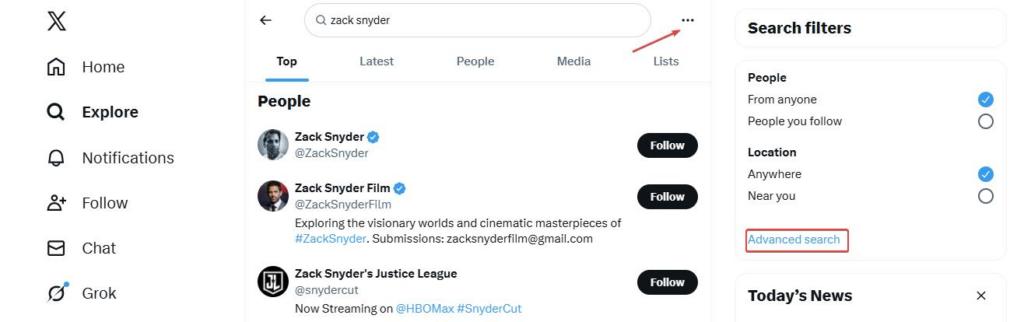
Or skip the steps and go straight to x.com/search-advanced. You’ll see a form with fields for words, accounts, filters, engagement, and dates. Every field you fill in narrows the results.
The official X apps for iOS and Android don’t show the advanced search form. To use it on your phone:
Prefer the app? Type operators directly into its search bar. A query like from:contentstudioio since:2026-01-01 filter:media works the same way in the app as it does on desktop.
If you mainly need date-based lookups, our walkthrough on finding old tweets by date covers that in more detail.
Every field in the advanced search form maps to an operator you can also type by hand. The real power comes from combining them. Here’s what each section does and when to use it.
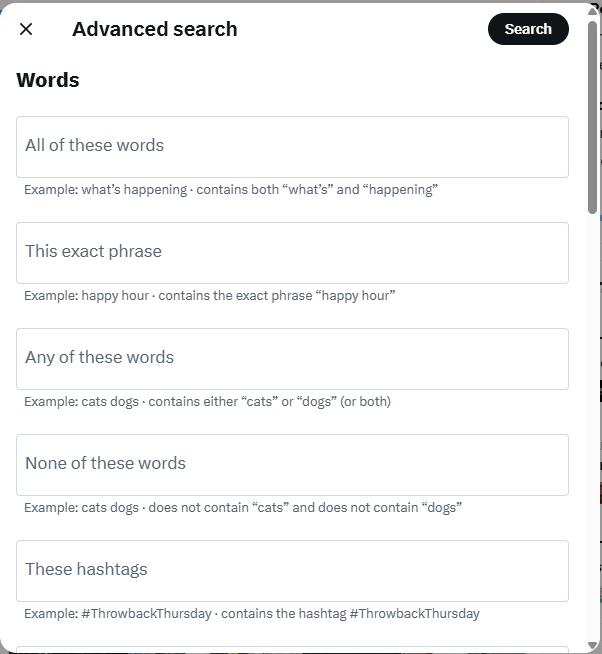
These fields control what must, can, or can’t appear in the post text.
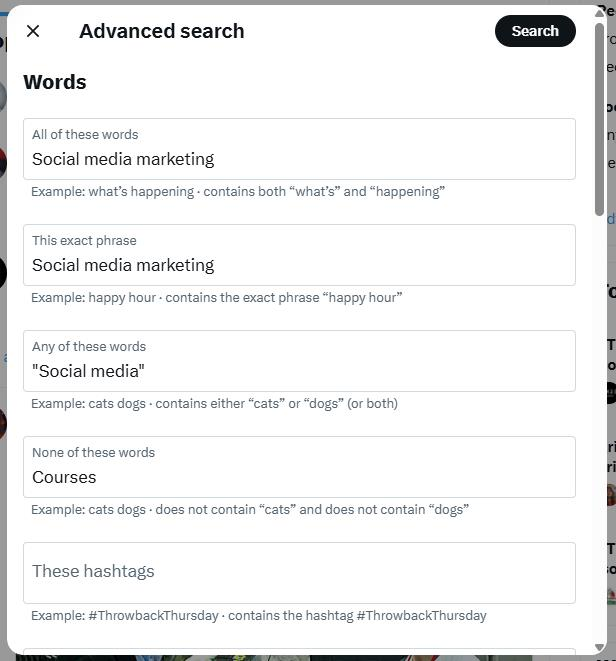
You can type the same logic straight into the search bar:
A space between words already means “and,” so you don’t need to type AND.
Pick a language in the form or add lang: with a two-letter code, such as lang:en or lang:es. This is the most reliable way to segment conversations by market now that location search no longer works (more on that below).
These fields focus your search on specific accounts and interactions:
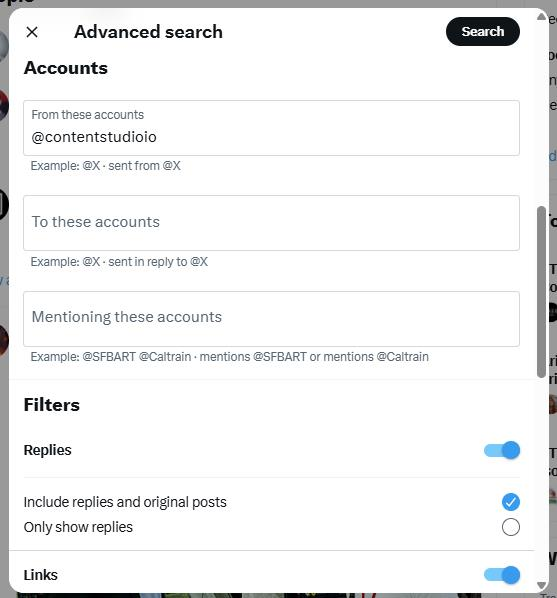
The operator versions are from:username, to:username, and @username. Two more are worth knowing:
Account filters are essential for competitor research, influencer vetting, and tracking replies to your own support handles. When you only know a name, not a handle, these methods for finding people on X help you track down the right account first.
The Dates section sets when posts were published. Pick a start date, an end date, or both. Typed as operators:
Use date filters to analyze reaction to a launch window, follow how a trend developed over a week or month, or compare mentions before and after a campaign.
→ For a step-by-step version with more examples, here’s how to search X posts by a specific date range.
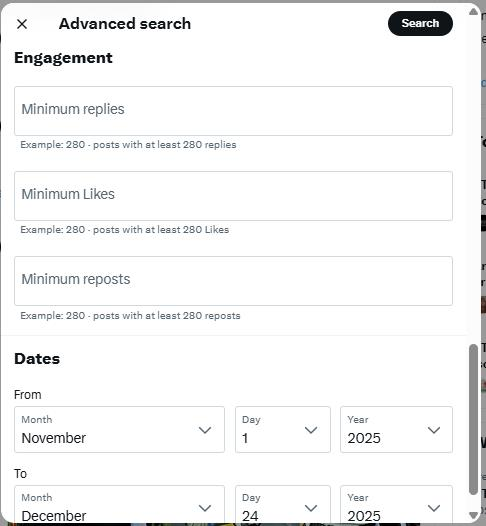
These filters help you find posts that actually got attention.
Engagement thresholds are the quickest way to find what resonates in a niche. Just remember that likes and reposts are only part of the story.
→ How X counts impressions and what drives engagement on X give you the full picture of reach and response.
Type these operators into the search bar to filter by content type:
This turns Twitter advanced search into a content research tool for finding high-engagement threads, popular articles, and visual formats in your niche.
Older guides, including earlier versions of this one, recommended queries like pizza near:Chicago within:10mi. As of 2026, the location operators near:, within:, and geocode: return no results in independent tests because X stopped supporting location search. Very few people geotagged posts in the first place, so the data was thin even when it worked.
To find local conversations now, search for the place as a keyword instead: city or neighborhood names, local hashtags, venue names, or airport codes. For example: (“Chicago” OR #Chicago) “pizza” ?
X used to treat 🙂 and 🙁 as positive and negative sentiment filters. Those emoticon operators no longer work, and X has no native sentiment filter in advanced search today. You can approximate it with keyword groups:
Keyword-based sentiment is rough. Sarcasm and mixed opinions slip through. If you need sentiment scored accurately across thousands of mentions, that’s what dedicated social listening tools are built for.
Here’s every operator covered above in one place, with its current status.
| Operator | Finds posts… | Example | Status in 2026 |
|---|---|---|---|
| word word | containing every word, any order | watching now | Works (default) |
| “phrase” | containing the exact phrase | “happy hour” | Works |
| OR | containing either term | love OR hate | Works (upper case only) |
| -word | excluding a word or operator | beer -root | Works |
| #hashtag | with that hashtag | #haiku | Works |
| ? | asking a question | “crm” ? | Works |
| from: / to: / @ | sent by, replying to, or mentioning an account | from:NASA | Works |
| list:ID | from members of an X list | list:1234567890 | Works on web |
| lang: | in a specific language | lang:es | Works |
| since: / until: | within a date range (UTC) | since:2026-01-01 | Works on web and app |
| min_faves: / min_retweets: / min_replies: | above an engagement threshold | min_faves:100 | Works in X search (not in the X API) |
| filter:replies / -filter:retweets | only replies / no reposts | from:NASA -filter:replies | Works |
| filter:quote | that are quote posts | @NASA filter:quote | Works |
| filter:links / url: | with links / linking to a domain | url:nasa.gov | Works |
| filter:media / images / videos / native_video | with media of that type | puppy filter:images | Works |
| filter:blue_verified | from accounts with a blue checkmark | ai filter:blue_verified | Works on web |
| near: / within: / geocode: | near a location | near:London within:10mi | No longer returns results |
| 🙂 / 🙁 | with positive / negative sentiment | brand 🙁 | No longer works |
| filter:periscope / filter:vine | with Periscope or Vine content | — | Retired with those products |
X doesn’t publish an official, current list of these operators, so any of them can change without notice. If a query suddenly returns nothing, test each operator on its own to find the one that broke.
Once you know the filters, the next step is turning them into repeatable searches. Save these queries in a doc and swap in your own brand, competitors, and keywords.
Twitter advanced search is a free starting point for ongoing competitive research.
Try these queries:
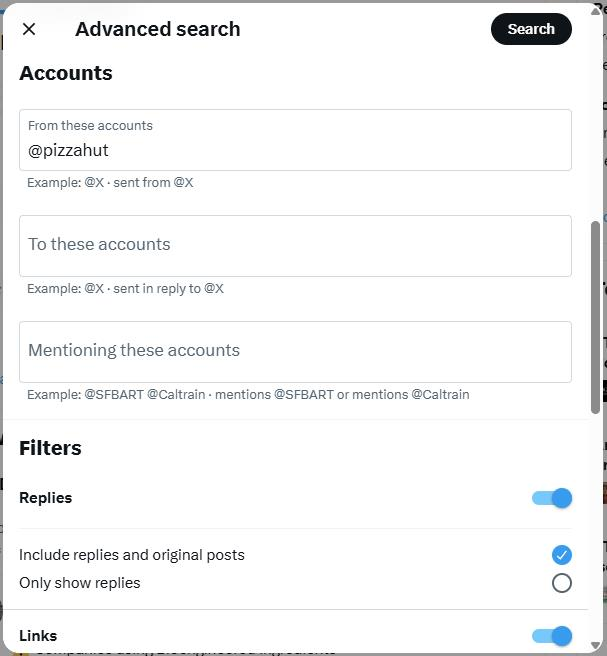
Why it helps:
Manual searches are great for spot checks. If you want follower growth, engagement, and posting patterns benchmarked side by side over time, ContentStudio’s competitor analytics tracks that without you rerunning queries every week.
Agency and in-house teams need to know what people actually talk about, not just what shows up in reports. Advanced search on X lets you listen at scale.
Try these queries:
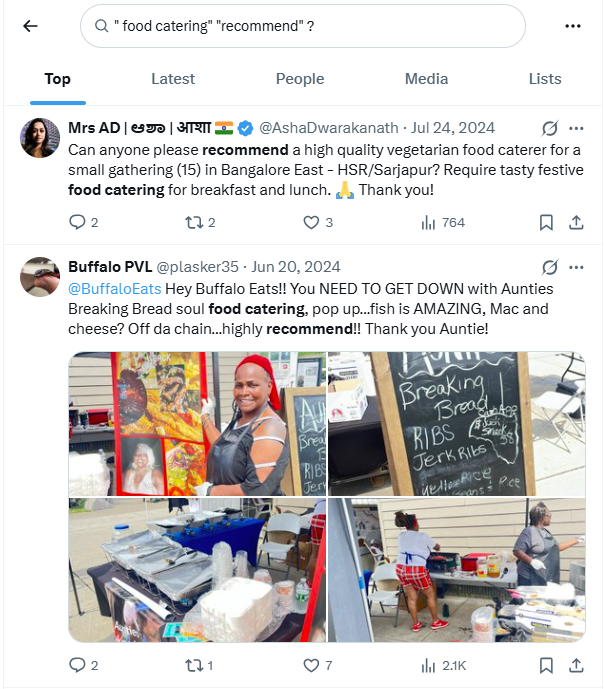
Use these searches to:
Feed what you find into your content calendar so your posts and offers match real questions and frustrations. The hashtags people attach to those complaints are worth tracking too.
Plenty of customers complain about a brand on X without ever tagging it. Advanced search helps you find them.
Try these queries:
Then turn those searches into a daily customer care routine on X: respond quickly, track recurring issues, and pass patterns to the product team.
Sales teams can treat Twitter advanced search as a live feed of buying intent.
Try these queries:
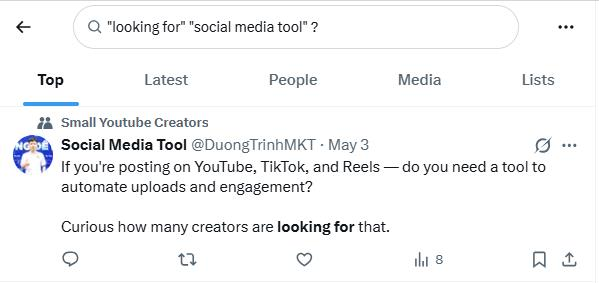
Used thoughtfully, this helps your team start helpful, relevant conversations with people who have already said they need something, without coming across as pushy. Lead with an answer, not a pitch.
Recruiters and hiring managers can use the same approach.
Try these queries:
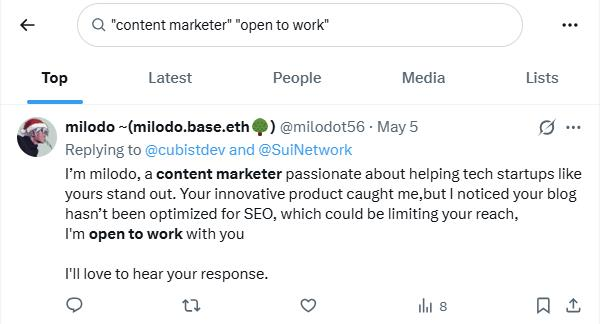
Pair this with posts that show your company culture, and build relationships by joining relevant conversations instead of sending cold DMs.
Engagement filters show you what already works in your niche, so you can stop guessing.
Try these queries:
Once you’ve collected a batch of ideas, the ContentStudio X scheduler lets you draft, schedule, and spread them across your calendar, so a good research session turns into weeks of posts.
Advanced search works on your own account too, and it’s often faster than digging through analytics.
Try these queries:
Search tells you which posts won. To understand why, line the results up against your X analytics data and the best times to post on X for your audience.
Advanced search is powerful, but it has real gaps. Knowing them up front saves you from drawing the wrong conclusions.
If you’re running the same 10 searches every morning for several clients, it’s time to automate. ContentStudio’s social listening collects brand, competitor, and keyword mentions into one feed, tags each mention with AI sentiment (positive, negative, or neutral), and sends alerts when mention volume or negative sentiment spikes. Use advanced search for quick, deep-dive research and a listening tool for always-on monitoring.
Twitter advanced search gives you direct access to what people are saying on X right now, filtered down to the posts that matter. Learn a handful of operators, save your best queries, and rerun them on a schedule: competitors on Monday, customer complaints daily, content ideas before every planning session.
The payoff is clearer insight into what your audience cares about and better timing when you join the conversation. Fold what you learn back into your overall X marketing plan, and pair search with one of these tweet schedulers so research turns into posts that go out on time. For more options built specifically for the platform, see our picks of X tools for marketers.
Yes. Twitter was renamed X in July 2023, and the advanced search form moved to x.com/search-advanced along with the rest of the site. The filters and operators work the same way, so guides and queries written for Twitter advanced search still apply, apart from the retired operators listed above.
No. Since July 2023, X has required users to log in before it shows search results, including advanced search. Logged-out visitors are sent to a sign-in prompt first.
Partly. The iOS and Android apps don’t include the advanced search form, but they understand every operator. Type a query like from:NASA since:2026-01-01 into the app’s search bar, or open x.com/search-advanced in a mobile browser for the full form.
No. Deleted posts are removed from X’s search index, so they can’t be found through advanced search or regular search. Advanced search only shows posts that are currently live and public. If you’re clearing out your own history, here’s how to delete old tweets in bulk.
Advanced search can reach back to the first public posts in 2006, as long as the account is public and the posts haven’t been deleted. Use since: and until: with a from: handle to browse a specific account’s history, and switch to the Latest tab to see results in date order.
The most common causes are being logged out, typing or in lowercase instead of OR, forgetting that until: excludes its end date, using a retired operator like near:, or searching for posts from a protected account. If X search fails across the board, these fixes for X not working cover app and connection issues.
The Top tab ranks results using X’s own relevance signals, such as engagement, the account posting, and how well the post matches your query. The Latest tab shows matching posts newest first. For research, Latest is usually the better choice because it isn’t filtered by popularity. Our breakdown of how the X algorithm ranks posts explains the ranking side in more depth.
Yes. Run your search and open the Media tab, or add an operator to your query: filter:media for any media, filter:images for images, filter:videos for any video, and filter:native_video for videos uploaded directly to X.
Plan 0 Days of Content in 0 Minutes
Create, schedule, publish and analyze your content across all your social media channels from one simple dashboard.
4.7 on Capterra • 16,500+ marketers trust ContentStudio
Wasiq Naeem is a Senior Content Strategist at ContentStudio and a research-driven content and digital marketing veteran. He writes on social media strategy, analytics, audience growth, and competitor analysis, covering topics like best posting times and competitor mapping. As a senior editor, he also reviews and fact-checks articles for depth and accuracy.
View all posts by Wasiq NaeemRecommended for you
How does X (formally Twitter) Algorithm Work in 2023? 15 Hacks to Beat It

10 Twitter Best Practices for Businesses

Twitter Analytics from ContentStudio to Help Measure Engagement
100+ high-performing X (Twitter) hashtags