How to promote affiliate links on social media in 2026
Oct 2, 202616 minutes

Written by
Arooj IshtiaqUpdated
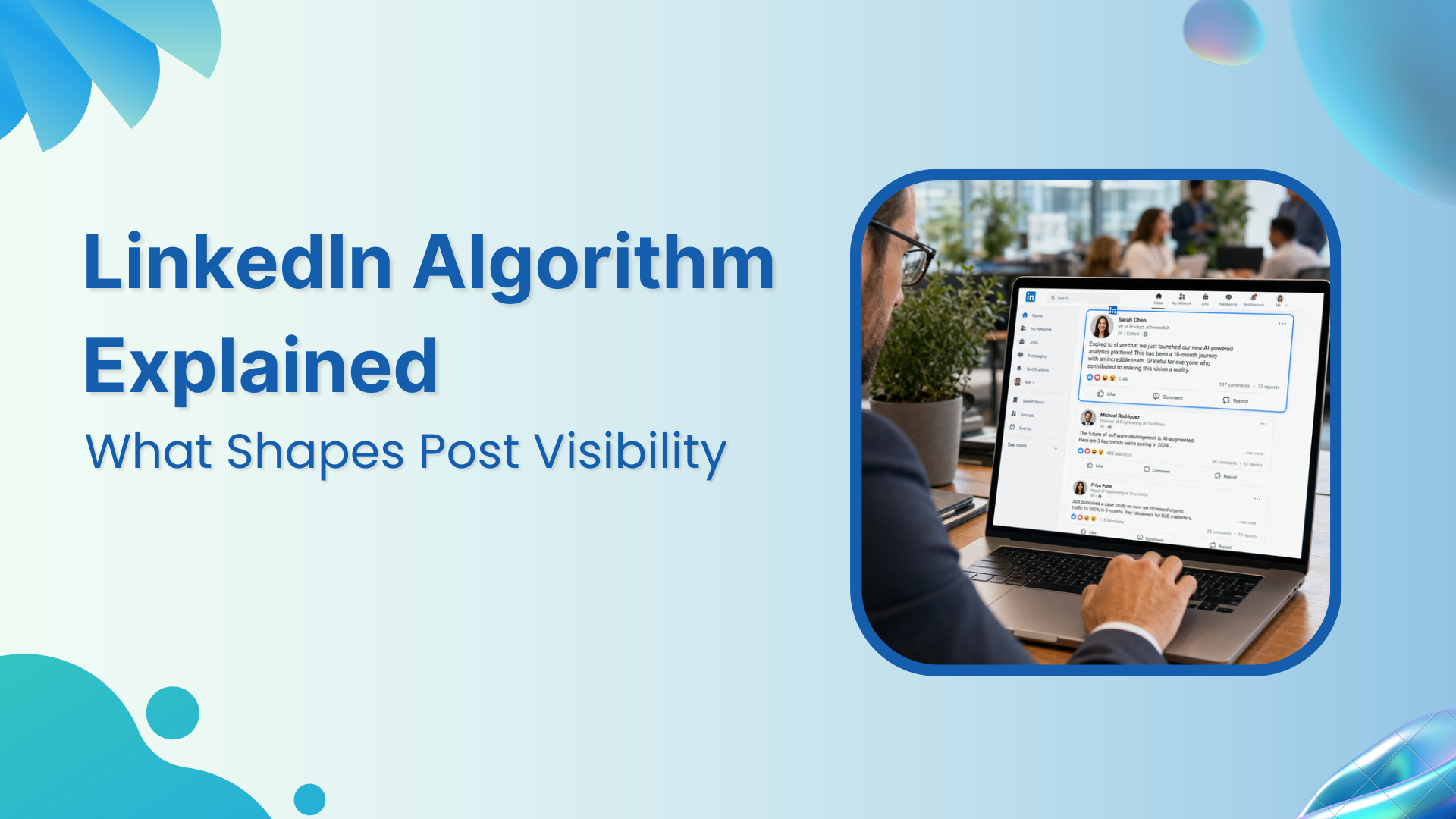
The LinkedIn algorithm is not a secret score that rewards a handful of tricks. It is a set of relevance systems that helps LinkedIn decide which posts, people, conversations, and updates may be useful to each member. That is why the same post can be prominent in one person’s Feed and barely appear for another.
A strong LinkedIn marketing plan starts with that reality. It gives a defined professional audience something clear and useful to consider, rather than trying to force reactions. A reliable publishing process also helps teams learn what works over time, and a LinkedIn scheduler can support that consistency without replacing the judgment and conversation that make LinkedIn valuable.
This article focuses on the algorithm itself: the public signals LinkedIn describes, the role of relevance and recency, the difference between Feed and Search, the factors that can weaken distribution, and a practical way to test what helps your posts reach the right people.
Key takeaways
Use these principles as a working model of what LinkedIn has actually confirmed, not a checklist of tricks.
LinkedIn’s Feed is built to help members discover professionally relevant content. Its systems recommend updates from connections, people and companies a member follows, groups, sponsored placements, and other content that might fit that member’s interests and professional context. LinkedIn itself says it uses information and engagement data to recommend content, connections, and features that may be useful to each member.
That purpose matters because it changes the objective for creators. The goal isn’t to satisfy some universal ranking checklist. It’s to make it easy for the platform and the reader to understand who the content is for, what it’s about, and why it’s worth their attention.
LinkedIn doesn’t show every member the same Feed. Someone’s profile, workplace, skills, follows, connections, recent interactions, viewing patterns, and topic interests can all shape what shows up. Two professionals who follow the same person can still see completely different posts from that person, simply because their broader context differs.
For B2B teams, this means popularity is an incomplete measure of success. A useful post should be designed to earn recognition from a particular group, whether that’s marketing leaders, agency owners, founders, sales managers, or social media teams. The right audience matters more than the largest possible one.
LinkedIn publicly groups its Feed relevance signals into identity, content, and activity. These categories offer a useful working model, but they’re not a scorecard. LinkedIn doesn’t disclose a fixed formula or the relative weight of any individual signal.
| Signal group | What LinkedIn says it may include | What it means in practice |
|---|---|---|
| Identity signals | Profile details, location, workplace, skills, and professional background | Your profile helps provide context about the expertise, audience, and professional setting behind a post. |
| Content signals | The topic, knowledge or advice value, recency, language, source relationship, tags, and whether the conversation is constructive or professional | A post should have a clear subject, a credible point, and a professional reason for the intended audience to care. |
| Activity signals | Reactions, comments, shares, viewing behavior, follows, connections, recent interactions, and frequent interactions | Relationships and repeated topic engagement can help LinkedIn understand what a member may want to see. |
Identity signals help LinkedIn understand the professional context around both the publisher and the potential reader. A profile that accurately explains a person’s role, work, industry, and experience gives people a clearer reason to trust what they’re reading, and it also gives the platform context for where that content might be relevant.
That doesn’t mean a profile should be stuffed with keywords or broad claims. LinkedIn cautions that adding more keywords doesn’t automatically improve Search visibility, and that overly optimized profiles can even get caught up in spam systems. The practical standard is simple: use accurate language that reflects real work and real expertise.
Content signals relate to what the post is about and how it’s presented. LinkedIn names topic, knowledge or advice value, recency, language, source relationship, tags, and the tone of the discussion as relevant considerations. A post doesn’t need to be a tutorial to be useful, but it should offer some clear professional value: an informed point of view, a useful framework, a concrete lesson, or a well-supported interpretation.
Activity signals provide evidence about what members actually care about. LinkedIn lists interactions such as reactions, comments, shares, viewing behavior, follows, connections, frequent interactions, and recent interactions. These actions help build context, but LinkedIn doesn’t state that any one action carries a permanent or universal weighting over another.
The useful lesson here isn’t “collect more engagement.” It’s “create the kind of interaction that shows the content was relevant to the people you actually want to reach.” A substantive comment from a qualified peer can tell you more than dozens of generic reactions ever could.
Relevance and recency work together, but they’re not the same thing. Recency can help a post fit into a member’s current Feed session. Relevance helps determine whether that post is actually likely to be useful to that particular member. A recent post with no clear audience fit may get ignored entirely, while an older but genuinely useful post can stay relevant when the topic, relationship, or reader interest lines up.
A creator doesn’t need to talk about one narrow subject forever. Still, a recognizable set of themes makes it easier for people to understand what the creator is actually known for, and it creates a more coherent pattern of audience interest. If a B2B marketer repeatedly publishes useful observations about content operations, reporting, and approval workflows, readers have a much clearer reason to follow than if every post jumps to an unrelated subject.
A focused LinkedIn content strategy makes that consistency easier to maintain, since it defines the recurring themes, audience question, and format for each piece in advance.
On LinkedIn, topical authority isn’t an official ranking label or a promise of reach. It’s the practical outcome of being consistently useful on a subject a professional audience actually cares about. Readers start to associate a person or company with a particular area of knowledge because the content is clear, credible, and repeatedly helpful.
That association builds through a combination of posts, comments, profile context, examples, and professional relationships, and it’s stronger when the creator can show firsthand experience or explain where their knowledge actually comes from.
Engagement can help LinkedIn understand whether content was relevant, but the type and quality of engagement matters more than a raw count. LinkedIn publicly lists reactions, comments, shares, and viewing behavior among the activity signals it considers, but it doesn’t publish a universal hierarchy stating that comments are worth some fixed multiple of likes, or that saves always outrank reposts.
A useful comment can do more than bump up a visible number. It can surface a reader’s real question, pull a qualified peer into the discussion, or show that a topic genuinely resonates with people working in that field. A thoughtful reply can add exactly the missing context that makes the whole thread more valuable for anyone who reads it later.
None of that justifies engagement bait, though. Asking people to comment a random word, arranging comment pods, or posting vague questions purely to manufacture activity creates weak value for readers. Good discussion comes from a specific point that people actually have a reason to respond to.
A saved post can suggest someone found the material useful enough to want to revisit it. A repost can carry an idea into a new network. Viewing behavior can suggest a reader spent real time with the content. These are all meaningful things to notice, but the platform doesn’t publish fixed thresholds or weights for any of them, so it’s worth treating them as signals to study in your own results rather than targets to chase.
The phrase “LinkedIn golden hour” is a community term, not an official LinkedIn concept. It usually refers to the idea that early engagement determines whether a post gets wider distribution. LinkedIn does identify recency and interaction patterns as relevant signals, but it has never published a fixed 60-minute, 90-minute, or two-hour deadline that decides a post’s outcome.
There’s still a sensible operational reason to publish when your team is actually available, though. If relevant people start a discussion, a timely, useful response can genuinely make the conversation better. That’s just good community management, and it shouldn’t be mistaken for a guaranteed distribution tactic.
Yes. An older post can still surface when it stays relevant to a member, gets revisited through a new interaction, or fits into a current professional conversation. LinkedIn includes recency among its content signals, but it also weighs relationship, activity, and topic context. That’s why a genuinely useful post can keep getting attention well after its publish date, even though recent content has an obvious edge in any given Feed session.
Links, tags, and hashtags can all add context to a post, but none of them should be treated as an algorithm shortcut. The better question to ask is whether each element actually makes the post more useful or easier to understand for the reader.
There’s no official LinkedIn statement saying every external link reduces distribution. A link is appropriate when it gives readers access to research, a registration page, a product walkthrough, or a deeper resource. The post itself should still contain useful information on LinkedIn, so readers don’t feel like they were handed only a teaser.
Putting every link in the first comment isn’t a proven workaround either. It can make a useful resource harder to find and can interrupt the reading experience. Test links based on the outcome that actually matters: relevant clicks, useful on-site behavior, and qualified next steps.
Hashtags can help describe a topic, but they can’t make an unclear or irrelevant post perform well. Use them when they genuinely help categorize the conversation for a professional audience. A long list of broad tags can actually make a post look less focused, especially when the tags don’t match the real subject.
Tags make sense when the person, company, source, or collaborator has a real connection to the post. They shouldn’t be used to pull unrelated people into a conversation or manufacture artificial visibility. An unnecessary tag can annoy the recipient and make the whole post feel promotional rather than useful.
No LinkedIn post format is a universal winner. A format should be chosen because it communicates the idea well: a clear written observation may work best as text, while a step-by-step process may be easier to understand as a document. Video can be useful when a person’s explanation or a visual demonstration adds something that text would not.
| Format | When it fits the message | What the algorithm question really is |
|---|---|---|
| Text post | A concise viewpoint, lesson, story, or observation | Does the opening make the topic and reader value clear? |
| Document or carousel | A sequence, framework, comparison, or checklist | Does the visual structure make the idea easier to understand? |
| Video | A demonstration, expert explanation, or visual example | Does the viewer understand the relevance quickly? |
| Image post | A visual that proves, illustrates, or adds context to the claim | Does the image add information instead of decoration? |
| Article or newsletter | An evergreen topic needs more explanation and structure | Does it provide original depth rather than duplicate existing content? |
| Poll | A lightweight prompt can start a focused professional discussion | Does the follow-up add useful interpretation? |
The format itself does not create value. The fit between the format, the audience, and the idea does. A complex process may be easier to retain in a document, while a sharp opinion may lose impact if it is stretched into ten slides.
Personal profiles and company Pages can both appear in the Feed, but they create different relationship contexts. A personal profile can carry an individual’s perspective, experience, and professional connections. A company Page provides a stable brand destination, official updates, and a central record of what the business does. Neither should be treated as an automatic algorithm advantage.
The practical question is which voice best fits the message. An executive explaining a lesson from customer conversations may publish from a personal profile. A product release, company statement, or event update may be more appropriate from the Page. The strongest programs often coordinate both without duplicating the same post.
Feed distribution and Search visibility are related but different. The Feed recommends content a member may find professionally relevant. Search responds to a deliberate query. A profile may be visible in Search because it accurately matches a query and the searcher’s context even if the person has not seen your recent posts in their Feed.
| System | Primary purpose | What the creator can influence |
|---|---|---|
| Feed | Recommend relevant professional content | Topic clarity, professional usefulness, relationship context, content quality, and sustainable activity |
| People Search | Return profiles that match a member’s query and context | Accurate profile language, real experience, relevant skills, and current work information |
| Page Search | Return company Pages relevant to the query and member context | Clear Page information, useful updates, relevant discussion, and accurate category details |
LinkedIn says that People Search results are unique to each member. Query relevance, the searcher’s profile, connections, past searches, activity, and behavior from similar searches can all influence the result. A few manual searches from one account do not accurately represent overall Search visibility.
Profile context therefore supports both Feed relevance and Search visibility, but the two systems still call for different tactics. Search optimization on LinkedIn deserves its own dedicated treatment beyond what this article covers.
Low visibility is not always a penalty. A post may simply be too broad, unclear, poorly matched to its audience, or competing with more relevant updates. However, LinkedIn also says it filters out or tapers the distribution of low-quality and unsafe content, and members can hide, unfollow, mute, or report material they do not want to see.
| Risk | Why it weakens the reader experience | A better choice |
|---|---|---|
| A vague or exaggerated hook | Readers cannot tell what the post is actually about or feel misled by the promise | State a specific problem, observation, or outcome in the opening |
| Repeated self-promotion | The audience receives little new value from following | Balance product content with practical insight, proof, and useful perspective |
| Generic engagement bait | It asks for reactions without creating a professional reason to respond | Ask a focused question connected to a real decision or experience |
| Copied or thin content | It adds little original insight or context | Add firsthand experience, a distinct example, an interpretation, or evidence |
| Keyword stuffing | It reduces clarity and can trigger spam concerns | Use accurate professional language naturally |
| Irrelevant tagging | It pulls people into content that does not concern them | Tag only genuinely relevant people, companies, or sources |
| Hostile discussion | It makes the conversation less constructive and professional | Disagree with context, evidence, and respect |
| Over-automation | It creates generic activity without real professional value | Automate workflow tasks, not judgment or conversations |
The algorithm changes over time, and every audience is different. A useful test does not attempt to reverse-engineer a hidden score. It tests whether a clearer topic, stronger example, better format, or more appropriate call to action helps the content reach and engage the right people.
The table below breaks a few common variables into what to change, what to hold constant, and what to review.
| Test area | What to change | What to keep stable | What to review |
|---|---|---|---|
| Opening | Problem-led opening versus perspective-led opening | Topic, audience, and posting window | Relevant comments, viewing behavior, profile visits |
Format | Text post versus document for the same core idea | Audience, topic, and main takeaway | Quality of engagement, saves, reposts, and follow-up questions |
| Topic angle | Tactical advice versus a first-hand lesson | Format and CTA | Which angle attracts people in the intended role or industry |
| CTA | Discussion prompt versus a resource next step | Topic and format | Relevant replies, clicks, and downstream actions |
| Timing | Two or three repeatable publication windows | Topic type and format where possible | Engagement quality and audience fit, not impressions alone |
| Weeks | Focus |
|---|---|
| Weeks 1–2 | Establish a baseline with a small number of consistent themes and formats. |
| Weeks 3–4 | Test the opening angle while keeping the subject and audience similar. |
| Weeks 5–6 | Test the format fit by turning a proven idea into a different format. |
| Weeks 7–8 | Test calls to action that match different levels of reader intent. |
| Weeks 9–12 | Increase effort behind the topics and approaches that attract the most relevant people and conversations. |
Keep a brief record of the topic, target reader, hook, format, call to action, time of publication, relevant comments, profile views, and meaningful next steps. The note beside the numbers often matters most. A single discussion with a decision-maker at a target account may be more valuable than a high-reach post that attracts no relevant attention.
You cannot inspect LinkedIn’s internal ranking model, but you can examine the outcomes of your content choices. The aim is to connect basic visibility with audience relevance and then with the actions that matter to the business or professional goal.
| Signal | Question it answers | What it does not prove alone |
|---|---|---|
| Impressions | How often was the post displayed? | That the right people saw it or found it useful |
| Reach | How many unique people saw the post? | That the audience matched your intended market |
| Comments | Did the content start a meaningful discussion? | That the conversation will create a commercial outcome |
| Saves and reposts | Did readers find it useful enough to keep or share? | That the reader has active buying intent |
| Profile views | Did the post create curiosity about the author or company? | That the visitor is a qualified lead |
| Clicks | Did readers want the next resource? | That the landing page or offer converted |
| Qualified conversations | Did relevant people begin a useful professional exchange? | That every conversation will become revenue |
None of these signals proves a business outcome by itself, which is why they work best alongside a dedicated LinkedIn analytics process that tracks reach, engagement quality, and pipeline evidence together over time rather than in isolation.
The table below separates commonly repeated claims from what LinkedIn has actually confirmed.
| Common claim | What we know | What to do instead |
|---|---|---|
| “The first hour decides all reach.” | LinkedIn lists recency and activity signals but does not publish a fixed deadline. | Publish when you can participate in useful discussion, then judge outcomes over time. |
| “Comments have a fixed value above likes.” | LinkedIn does not disclose a universal engagement-weight formula. | Aim for relevant, voluntary professional discussion rather than metric farming. |
| “External links always suppress reach.” | LinkedIn does not state that all outbound links receive a blanket penalty. | Use links when they improve the reader’s next step and measure relevant clicks. |
| “One format always wins.” | LinkedIn does not publish a universal format hierarchy. | Choose a format that makes the specific idea easier to understand. |
| “You need to post every day.” | Posting volume alone does not establish relevance or trust. | Use a consistent rhythm that leaves room for quality and response. |
| “More hashtags improve every post.” | Hashtags can add topic context but cannot fix unclear or low-value content. | Use only tags that accurately describe the discussion. |
| “A single search tells you your LinkedIn ranking.” | LinkedIn Search is personalized for each member. | Review profile visits, inbound interest, and relevant search behavior over time. |
Use this checklist before publishing and again when reviewing results.
The LinkedIn algorithm is not a fixed rulebook. It is a personalized relevance system that tries to connect professionals with useful content, people, and conversations. The creators who tend to build durable visibility are not necessarily those who chase the most tactics. They are the ones who understand their audience, publish something real and useful, maintain credible professional context, and learn from the response they receive.
Focus on the signals you can influence responsibly: relevance, clarity, originality, professional usefulness, relationship context, and consistent learning. Those are more dependable than any supposed shortcut, and they are more likely to serve both the reader and the long-term health of your LinkedIn presence.
LinkedIn uses relevance systems to recommend posts, connections, jobs, and features that may be useful to each member. For Feed recommendations, LinkedIn publicly describes identity signals, content signals, and activity signals. The company does not publish a fixed formula that guarantees a post will receive a particular level of reach.
LinkedIn describes identity, content, and activity as broad Feed signal groups. These can include professional background, the topic and freshness of a post, its knowledge or advice value, relationships, viewing behavior, interactions, follows, and recent activity. LinkedIn does not disclose a fixed ranking weight for each signal.
Both can matter. Recency helps content fit a current Feed session, while relevance helps LinkedIn assess whether the post is likely to be useful to a particular member. A recent post without audience fit may not travel far, while an older useful post can still gain attention through relevant activity or renewed discussion.
The “golden hour” is a creator convention, not an official LinkedIn rule. Publishing when your team can respond to useful discussion is sensible, but LinkedIn does not publish a fixed early-engagement period that determines whether a post will succeed.
Comments can provide more context than a reaction because they reveal whether a post started a meaningful discussion. However, LinkedIn does not publish a universal formula that assigns fixed values to comments, reactions, saves, reposts, or viewing behavior. Relevant conversation quality is more useful than a raw engagement count.
LinkedIn does not state that all external links receive a blanket distribution penalty. An outbound link is useful when it takes a reader to research, a registration page, a product resource, or another logical next step. The LinkedIn post should still provide enough value on its own.
Yes. Recency is one content signal, but LinkedIn also considers relevance, relationships, content interest, and activity. An older post can receive new attention when it remains relevant to a member or is brought back into view through a relevant interaction.
No. The Feed recommends content based on likely professional relevance. Search responds to a query and is personalized using the query, the searcher’s context, profile and network signals, prior activity, and related search behavior. The same search can produce different results for different members.
Low visibility can result from weak audience fit, vague writing, repetitive promotion, copied or thin content, irrelevant tagging, keyword stuffing, or a poor reader experience. LinkedIn also says it filters or tapers low-quality and unsafe content, while members can hide, mute, unfollow, or report content they do not want to see.
B2B teams should examine reach and impressions alongside the relevance of commenters, profile visits from target accounts, useful website activity, qualified messages, and professional conversations. The aim is to understand whether the content reaches the right people, not simply whether it produces a larger visible number.
Plan 0 Days of Content in 0 Minutes
Create, schedule, publish and analyze your content across all your social media channels from one simple dashboard.
4.7 on Capterra • 16,500+ marketers trust ContentStudio
Arooj Ishtiaq is a Content Marketing Strategist with 5+ years of experience writing about social media, SaaS, and AI. At ContentStudio, she creates practical guides, tutorials, and how-to content that help marketers navigate social media trends, sharpen their strategies, and get more from their content.
View all posts by Arooj IshtiaqRecommended for you
How to promote affiliate links on social media in 2026
Multi-location social media management workflow guide
Best SaaS affiliate programs for social media marketers in 2026
19 best social media management tools to plan, schedule, and grow in 2026