How to promote affiliate links on social media in 2026
Oct 2, 202616 minutes

Written by
Esha ShabbirUpdated
Social media trends in 2026 are the platform and content shifts brands need to act on right now. The nine biggest: agentic AI, micro-communities, vertical video, educational content, authentic storytelling, social search, show-don’t-tell content, social TV, and social commerce. Together, these trends are moving social media away from broadcast distribution and toward participation, specificity, and proof.
This guide covers each major shift, the evidence behind it, and what it means for how your team plans and publishes content.
Before breaking each trend down, here’s where the landscape stands. These are the shifts consistently showing up in platform data, creator behavior, and how audiences are engaging with content this year.
| Trend | What’s driving it | Who it affects most |
| Agentic AI in content workflows | LLM maturity and automation integration | All content teams |
| Micro-community growth | Audience fatigue with broadcast-first feeds | Brands, agencies, creator accounts |
| Vertical video as the baseline format | Mobile-first consumption across every platform | Every brand producing video |
| Social search replacing traditional search | TikTok and Instagram used as search engines | All brands relying on discovery |
| Educational content outperforming promotional | Algorithm prioritization of saves and watch time | B2B, SaaS, lifestyle brands |
| Authentic storytelling and micro-dramas | Audiences detecting and skipping polished AI content | Every brand producing social content |
| Show-don’t-tell content and “receipts” | Skepticism toward generic AI-generated advice | Creators, agencies, B2B brands |
| Social TV and big-screen content | YouTube and TikTok increasingly viewed on TVs | Brands investing in video production |
| Social commerce maturation | TikTok Shop and Instagram Shopping gaining real traction | Retail, DTC, and consumer brands |
The majority of content teams are still using AI at the wrong stage.
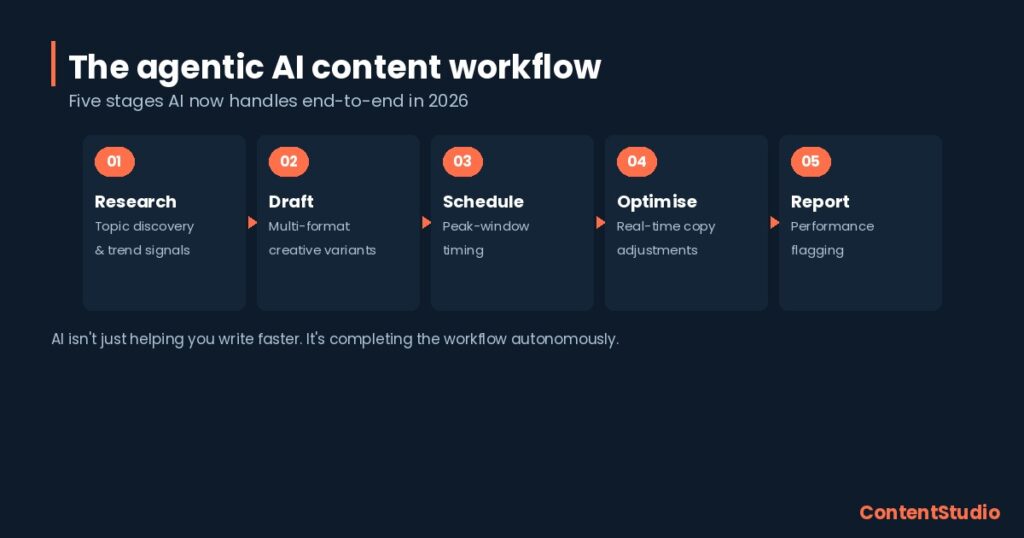
A year ago, AI tools helped write captions faster. In 2026, the capability has shifted significantly. AI agents can now research trending topics in a niche, generate creative variants across formats, schedule posts based on predicted performance windows, and optimize copy using real engagement data. They respond to comments using brand voice guidelines and complete these tasks in sequence, without a human making each individual decision in the chain.
Teams that have fully integrated this aren’t just saving time. They’re operating at a fundamentally different output level without adding headcount. Building that system typically starts with a social media management platform that gives every channel visibility from one place.
The teams moving fastest on this aren’t the largest ones. Smaller content operations are adopting agentic AI workflows faster because the efficiency gain is proportionally bigger. A two-person team that automates three hours of daily production work has effectively doubled its content capacity without a hire.
The practical version of this in 2026 means identifying the most repetitive stages of your production workflow and asking whether an AI agent could complete them to a publishable standard. First-draft captions, platform-specific resizing, scheduling within peak windows, flagging low-performing content for refresh. All of this sits in that category now.
This is where the biggest capability gap sits right now. Using AI to generate a post is the easy part. Using AI to identify what’s gaining traction in your category, and then briefing content around that intelligence, is where the competitive advantage actually lives.
That means tracking which topics are seeing engagement spikes, which formats are getting saved and shared on which platforms, and what your competitors are publishing and how it’s performing. Tools that surface this in real time are accessible well outside the enterprise tier. If your team is still briefing content primarily on instinct and last month’s calendar, that’s a structural decision to be reactive rather than predictive.
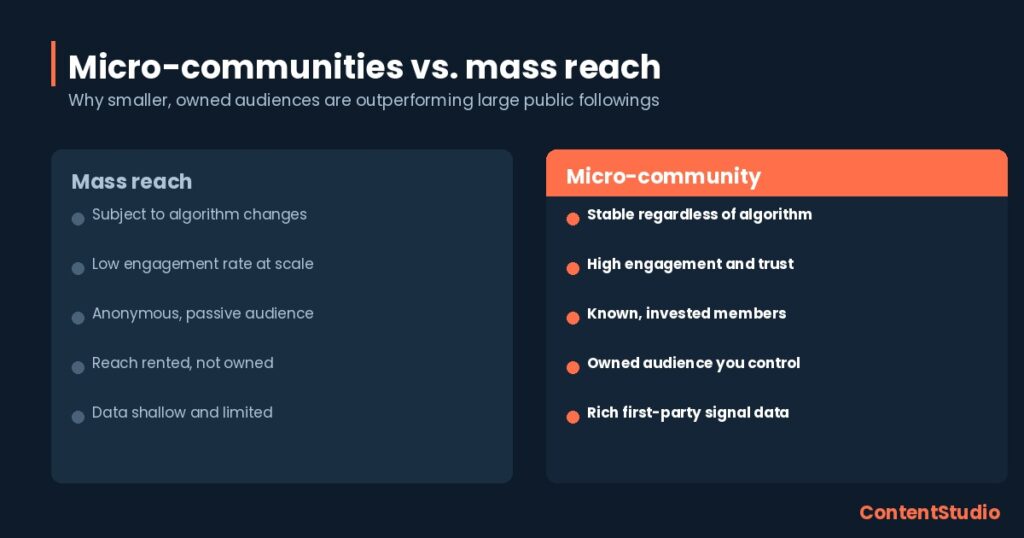
There’s a counterintuitive dynamic playing out across every major platform right now. Follower counts are becoming a weaker predictor of content performance. Smaller, more concentrated audiences are consistently outperforming large but diffuse ones on engagement rate, conversion, and content retention.
The reason is structural. Mainstream platform algorithms have gotten better at surfacing content to strangers, which has increased the total supply of content without increasing the time audiences have to consume it. The result is a signal-to-noise ratio that keeps declining. Micro-communities (Discord servers, private LinkedIn groups, Circle communities, brand-owned membership spaces) operate completely outside that dynamic.
The appeal of micro-communities isn’t just better engagement numbers. It’s stability. A private community with 3,000 engaged members isn’t subject to reach algorithms the same way a public account is. When platforms change how they distribute content, and they always do, brands with owned communities absorb the impact differently than brands that rely entirely on public feed distribution.
The data these communities generate is also qualitatively different. People inside a community opted in, self-identified as interested, and are more likely to give honest feedback, test new products, and become advocates. That’s a research and development asset sitting inside a marketing channel.
If you’re not building an owned community from scratch, finding an active social media community in your niche and becoming genuinely useful within it is often the faster path to this kind of signal.
Niche audiences, even small ones, tend to surface what’s working before broader audiences do. Content that performs strongly in a concentrated community travels outward if it’s genuinely useful. The reverse rarely happens.
The brands applying core niche marketing principles at the strategy level, not just targeting a niche as a segment but building their entire identity around serving one audience exceptionally well, are the ones building durable followings rather than growing and losing audiences in cycles.
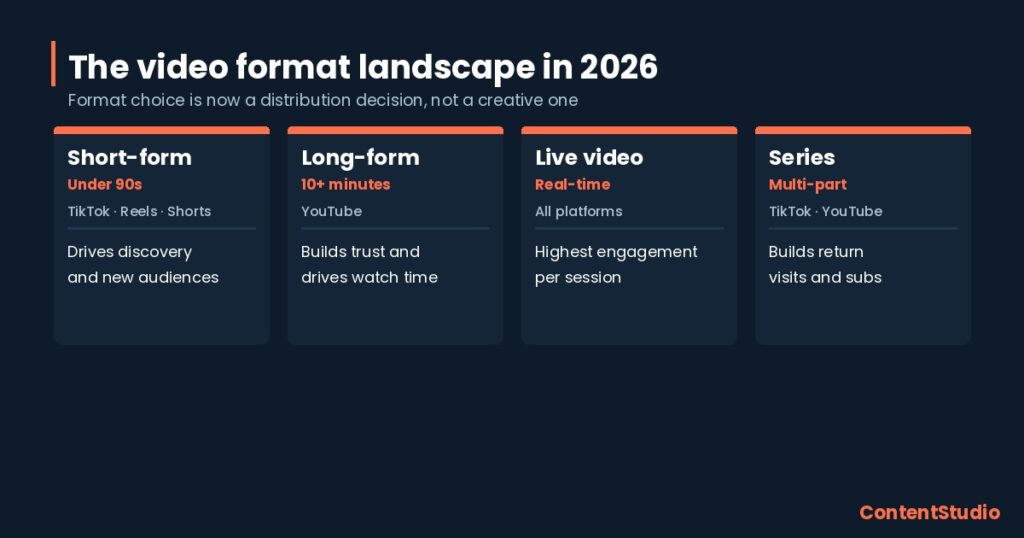
Video is no longer a format choice. It’s the default medium of social media.
Here’s where the video landscape stands in 2026.
The entire premise of short-form video distribution is that the algorithm shows content to a small audience first and expands reach based on watch time and completion rate. That makes the first two seconds the most consequential part of the production. If you don’t give the viewer a reason to stay, the algorithm reads the skip as a negative signal against the content.
Strong hooks on short-form platforms in 2026 follow one of three patterns. A counterintuitive claim, a specific and unexpected number, or a direct question that names the viewer’s exact situation. Knowing how to write strong social media hooks is one of the highest-leverage skills a social video producer can develop right now.
Posting the same video across every platform is not a strategy. A TikTok video with a TikTok watermark uploaded to Instagram Reels gets algorithmically suppressed. A LinkedIn video that performs well is typically longer, more information-dense, and filmed differently than a TikTok that performs well.
The correct approach is to identify which platform is primary for each piece of content and build it natively there first. Then repurpose with intent. Reshoot the hook, change the caption structure, adjust the length. Don’t just download and reupload. Platform-native content consistently outperforms repurposed content even when the underlying information is identical.
One of the clearest performance differentials in 2026 social media data is between content that teaches something and content that promotes something. Educational content is seeing higher save rates, higher video completion rates, more shares, and stronger algorithmic reach across TikTok, LinkedIn, and YouTube.
The algorithm behavior on each of these platforms now strongly rewards saves, shares, and repeat views. Not just initial likes. Educational content earns all three. Someone saves a how-to video to come back to it. They share a practical tip with a colleague. They watch a tutorial multiple times. Promotional content earns a like at best, and a skip more often.
The brands getting the most from educational content in 2026 treat it as a curriculum, not a collection of one-off posts. A series on TikTok with a consistent naming convention builds subscriber behavior. A LinkedIn post series covering a topic from multiple angles over several weeks builds the kind of topical authority that makes an account worth following rather than just occasionally discovering.
Branded social media challenges can extend this by turning educational content into something audiences actively join. The challenge structure works when it’s genuinely easy to replicate and tied to something audiences already care about. It doesn’t work when it’s built around a brand mechanic nobody outside the company understands.
Different platforms favor different educational formats. Choosing the right one matters because the same content in the wrong format on the wrong platform doesn’t perform regardless of quality.
| Platform | Educational format that works | Why |
| TikTok | Quick practical skills, 30-90 second how-tos, counterintuitive facts | Discovery algorithm rewards fast, specific, re-watchable content |
| YouTube | Long-form tutorials, deep-dive series, documentary-style explainers | Watch time signals favor completion; subscribers return for long content |
| Data-led posts, opinion-backed frameworks, professional skills | Professional audience actively looking for development content | |
| Visual step-by-step carousels, Reels tutorials | Strong save behavior on practical visual content |
Audiences in 2026 have developed a genuine ability to detect manufactured content. This isn’t a soft cultural preference. It’s showing up in hard engagement data. Content that feels overly polished, scripted, or visibly AI-generated is being skipped at higher rates than it was two years ago.
The shift was visible in creator content first. Creators who showed process, admitted mistakes, and filmed in real environments started outperforming accounts with brand-safe production quality. That pattern has now transferred to brand content.
One of the most visible formats to emerge from this shift is what audiences are calling the “Netflix Documentary” skit. A creator sits in a chair with a clip-on mic and dramatically narrates a personal story, business failure, or pop culture mystery as if starring in a premium streaming docuseries. The format uses the visual language of prestige documentary filmmaking (close-up, static shot, measured delivery) applied to entirely accessible content. It works because it signals commitment and seriousness while staying deeply relatable.
This is more specific than “be real.” It means listening to how your audience actually describes their problems and using that language in content rather than the language your internal team uses.
Someone who manages social media for a living doesn’t search for “leveraging platform synergies to enhance digital reach.” They search for “how to post on LinkedIn without sounding corporate.” The gap between those two phrasings is the gap between content that resonates and content that gets scrolled past.
Using your audience’s vocabulary, their skepticism, their shorthand, and their humor signals that you actually know the space. That signal is what separates relatable content that resonates from content that reads as branded output. Social media meme formats operate on the same principle. A single well-timed post communicates cultural fluency faster than a paragraph of branded copy ever could.
User-generated content is the most credible signal a brand can share because audiences trust other customers more than they trust the brand itself. A customer video showing how a product actually works in a real setting consistently outperforms the same product in a brand-produced studio shoot, on both engagement and conversion.
The brands winning on authenticity right now aren’t just encouraging UGC. They’re building systems to collect it, curate it, and redistribute it on a regular cadence. That means request flows for customer photos and videos, incentive structures that don’t dictate the content, and licensing agreements that let the brand repost without friction.
Gen Z audiences have raised the bar for what authenticity looks like in practice. Their platform behaviors, content preferences, and what Gen Z marketing requires are distinct enough to warrant a dedicated approach rather than a modified version of a broader strategy.
One of the clearest behavioral shifts in 2026 is that audiences, particularly under-35 users, are increasingly using TikTok and Instagram as their first search destination rather than Google. Not for every query, but for specific ones: local restaurant recommendations, product reviews, how-to tutorials, and category introductions.
TikTok has reported that a significant portion of Gen Z prefer TikTok Search for discovery-based queries. The interface feels native. Video answers are more engaging than text links, and results come from people rather than websites. Instagram’s search function is seeing similar adoption for visual categories like food, travel, and fashion.
The implication for content teams is that social search optimization is now a distinct discipline alongside traditional SEO. TikTok transcribes audio and indexes it, which means what you say in a video affects whether it surfaces in search. Instagram indexes caption text and hashtags. Both platforms reward content that directly answers questions rather than content that circles around them.
The mechanics overlap with what makes content hook-forward and high-retention, because content that answers a specific question clearly tends to generate strong completion rates. It also changes which social media statistics to track. Reach from search is a different signal than reach from the For You feed, and the two need to be tracked separately.
“Sustainable fashion” is a category. “Is Everlane actually sustainable?” is a search query. Content built around the first gets discovered by the algorithm when it’s trending. Content built around the second gets discovered when someone is actively looking for that answer.
For brands, social search optimization means building a portion of your content calendar around the specific questions your audience is typing into TikTok or Instagram search. You can find these by typing your category into the platform’s search bar and watching what autocompletes. Those autocomplete suggestions are real search queries from real users.
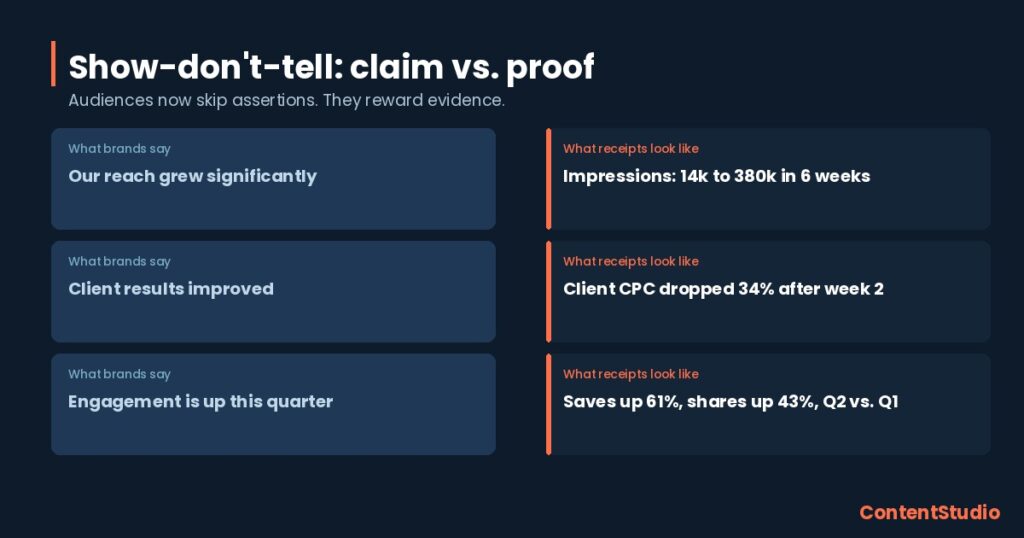
With AI generating vast quantities of generic marketing advice, audiences have developed a real skepticism toward content that makes claims without evidence. The response from the creators and brands performing best right now is what audiences are calling “receipts” content.
The format is exactly what it sounds like. Instead of saying “my email list grew significantly last year,” you show the Mailchimp dashboard. Instead of claiming a client got strong results, you show the analytics screenshot with real numbers. Instead of sharing a negotiation tip, you show the actual email exchange where the tactic worked.
This is being cited by AI Overviews and LLMs as a defining trend in content creation right now because it runs directly counter to what AI-generated content can do. AI can claim anything. It can’t show evidence of anything that hasn’t happened.
The practical shift for content teams is to build a habit of screenshotting results as they happen, not trying to reconstruct them after the fact for content purposes. A real-time screenshot of an analytics dashboard performing well is more credible content than a written case study published three months later.
This applies across platforms but is most visible on LinkedIn and TikTok. On LinkedIn, posts that include screenshots of real email replies, real team conversations, or real performance data consistently outperform text-only posts making the same claims. On TikTok, creators building followings in finance, business, and marketing are getting their highest engagement on content that shows actual numbers from their real operations.
The other dimension of this trend is that audiences reward specificity even when they can’t verify it. Saying “engagement rates dropped 23% when we stopped using hooks” is more credible than “engagement rates dropped significantly.” The specificity signals that someone actually measured it.
This connects to why specificity makes content feel credible. Specific details signal lived experience. Vague claims signal that someone either didn’t do the thing or didn’t pay attention when they did.
A less obvious but increasingly relevant trend in 2026 is that a significant and growing portion of YouTube and TikTok content is now being consumed on television screens rather than phones. YouTube has reported over one billion hours of content watched on TVs daily globally. TikTok’s TV app has seen significant adoption in markets where it’s available.
This matters because TV viewing behavior is fundamentally different from phone viewing. On a phone, content is consumed in portrait mode during brief moments. On a TV, it’s often viewed in a seated, intentional setting, frequently with other people. Sound is on. The screen is large. Attention spans are longer.
The practical implication for brands producing video content is that text overlays (timestamps, subtitles, data callouts, captions) need to be legible on a 65-inch screen at normal viewing distance. Many content teams optimize text size for a phone held at arm’s length, which produces text that’s technically readable but not comfortable on a large screen.
The “Netflix Documentary” format naturally transfers well to TV because it’s shot at a quality that scales up. Talking-head content filmed in poor lighting with muddy audio, which might be acceptable on a phone feed, looks noticeably worse on a large display. This is pushing some creators and brands toward a higher baseline of production quality, not for the sake of polish, but because their audience is increasingly watching in an environment that exposes technical shortcuts.
Content designed with TV in mind also tends to have characteristics that help it spread. The viral marketing patterns behind content shared to group chats and living room screens overlap significantly. Strong narrative arc, clear audio, and a payoff that rewards full viewing are the common factors.
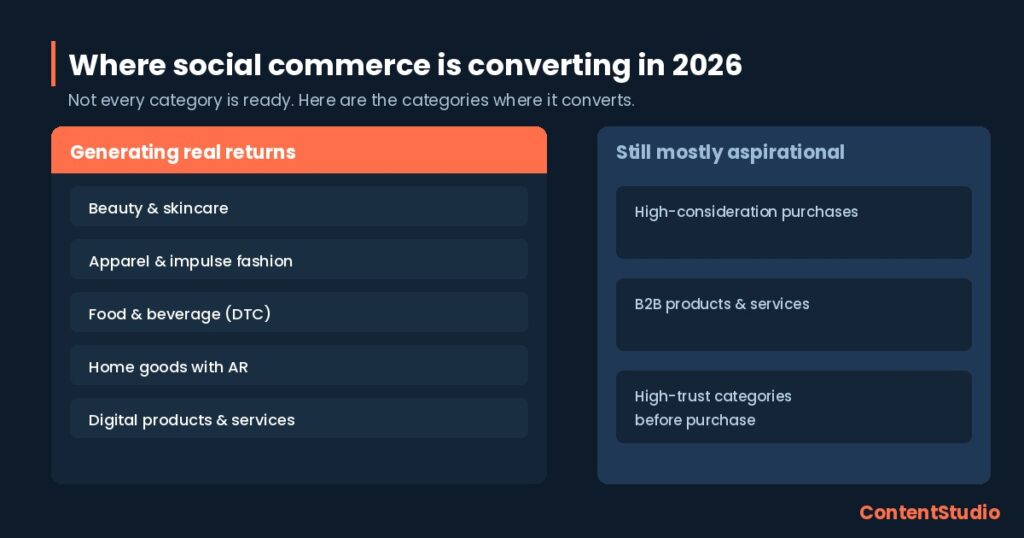
Social commerce has finally crossed from “the next big thing” into standard infrastructure for specific categories. In 2026, it’s a channel driving real revenue for brands that have set it up correctly.
The categories where social commerce is generating real returns:
The categories where social commerce is still mostly aspirational are high-consideration purchases, B2B products, and anything requiring significant trust-building before a transaction.
TikTok Shop has crossed from early adopter territory into mainstream commerce infrastructure for consumer brands. The integration between content discovery and purchase is tighter than on any other platform. A product can go from unknown to out of stock within 24 hours when the right creator content lands. That speed is both the opportunity and the risk. Brands without catalog infrastructure in place can’t respond when it happens.
Instagram Shopping has matured more slowly but reaches a broader demographic. For brands selling to audiences over 30, Instagram’s commerce tools often outperform TikTok Shop on conversion, even when TikTok drives more top-of-funnel discovery. What makes each platform work as a social media e-commerce channel comes down to audience age, category fit, and where in the funnel that platform serves best.
Augmented reality try-on features have crossed from novelty to standard expectation in the categories where they’re applicable. Brands using AR for glasses, makeup, and furniture placement are consistently seeing lower return rates and higher first-purchase conversion. The reason is that the single biggest barrier to online purchase is uncertainty about how a product looks or fits in context. AR addresses that directly.
If your product category is eligible for AR features on Instagram or TikTok, not using them is a decision to accept higher abandonment rates than necessary.
For teams managing multiple clients or channels, 2026 creates a sequencing problem. There are more platforms, more formats, more tools, and more requests than any team can deliver at quality simultaneously. The answer is triage, not expansion.
Tier 1: Do these first
Tier 2: Add when capacity allows
Tier 3: Test when Tier 1 and 2 are stable
The agencies retaining clients in 2026 treat social channels as a coordinated system rather than isolated deliverables. A coordinated omni-channel marketing presence, where each platform serves a distinct role in the customer journey, consistently outperforms brands posting the same content everywhere. And for brands running social and email as separate briefs, connecting social media and email marketing so that one builds the audience and the other converts it produces measurably better results than treating both as standalone programs.
The era of social media as a broadcast medium is ending. Platforms are rewarding participation over reach, evidence over assertion, and specificity over volume. The brands pulling ahead in 2026 aren’t the ones with the biggest budgets or the most channels. They’re the ones that picked a defined audience, developed a real point of view, and built a production system capable of sustaining quality consistently.
Start with one structural change. Pick the trend creating the biggest gap between how your team currently operates and where platform behavior is headed. Build the capability. Then move to the next one.
The major shifts in 2026 are agentic AI in content workflows, micro-community growth over mass-reach strategies, vertical video as the default format, and platforms functioning as search engines. Together they’re moving social media away from broadcast distribution and toward participation, specificity, and proof.
Short-form vertical video dominates discovery on TikTok, Instagram Reels, and YouTube Shorts. Long-form is recovering on YouTube, where watch time drives reach. A growing share of this content is now consumed on TV screens, which is raising production standards for some formats.
Viral content in 2026 is specific, evidence-based, and natively formatted for the platform it’s published on. The “Netflix Documentary” skit and “receipts” content (showing real screenshots and data) are among the fastest-growing formats because they can’t be replicated by generic AI tools.
Social search optimization is structuring content to surface in TikTok and Instagram search results, not just algorithmic feeds. It means keyword-rich captions, spoken words platforms can index, and content that answers specific questions. It’s now treated as a distinct discipline alongside traditional SEO.
Monitor the top creators in your category rather than broad platform trending pages. Track engagement rate changes on competitor content over time. Social listening tools surface trends one to two days before saturation, which is the window where brand content can still be timely.
Paid social is shifting toward first-party targeting as third-party data erodes. The strongest-performing ads now look like organic content, specifically creator-style video, customer testimonials, and UGC. AI-optimized creative testing has also made it significantly faster to identify what works than manual A/B testing.
Owned community is becoming more valuable than public follower count, AI is taking on more of the production workflow, and social search is eating into Google’s share of discovery queries. These trends aren’t reversing. They’re the baseline everything else builds on.
Cross-posting identical content, high-frequency low-quality posting, and visibly AI-generated content are all losing effectiveness. BeReal has shut down, Clubhouse has deprioritized its core product, and broad celebrity influencer campaigns are being replaced by longer-term micro-creator partnerships.
Social search, show-don’t-tell content, the “Netflix Documentary” format, and social TV are the most notable emerging trends. All four are cited by AI Overviews as defining shifts this year, and all four are a direct response to AI-generated content flooding standard feeds.
Update your vertical video production cadence, audit which platforms are generating measurable results, and integrate AI into at least one repetitive production stage. If your content makes claims without evidence, shifting to a show-don’t-tell approach has the most immediate impact on trust.
Plan 0 Days of Content in 0 Minutes
Create, schedule, publish and analyze your content across all your social media channels from one simple dashboard.
4.7 on Capterra • 16,500+ marketers trust ContentStudio
Esha Shabbir is a content marketer at ContentStudio, specializing in social media strategy, SEO-led content, and editorial workflows for marketing teams. She writes practical, research-backed content that helps marketers understand what to publish, how to organize their content, and how to build a more consistent social media presence.
View all posts by Esha ShabbirRecommended for you
How to promote affiliate links on social media in 2026
Multi-location social media management workflow guide
Best SaaS affiliate programs for social media marketers in 2026
19 best social media management tools to plan, schedule, and grow in 2026