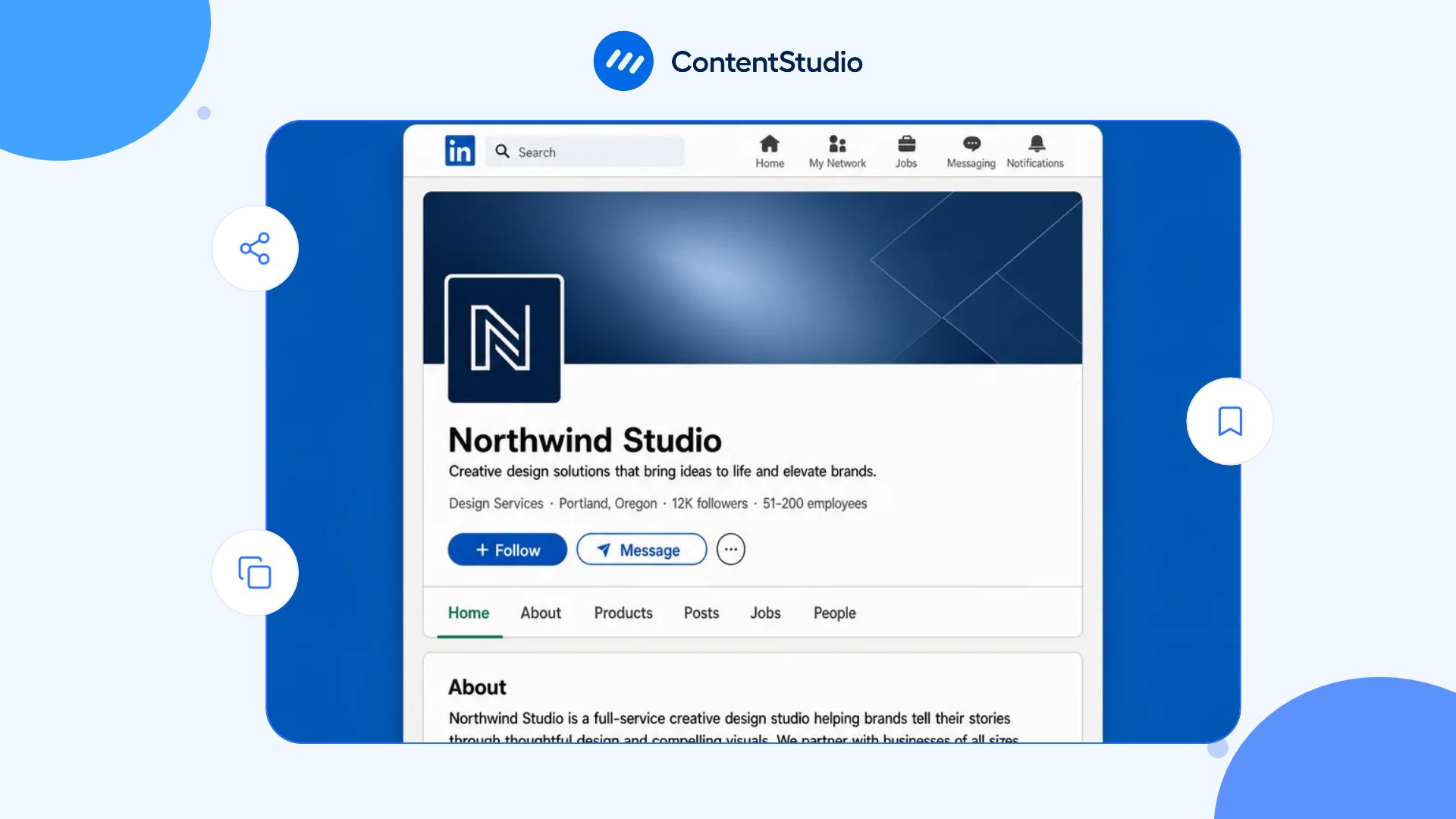
LinkedIn Company page guide: How to create, optimize, and grow it
Sep 24, 202621 minutes

Written by
Arooj IshtiaqUpdated
Running out of LinkedIn post ideas usually is not an ideas problem. It is a source-material problem. Most professionals and companies already have useful raw material in customer questions, sales calls, projects, product feedback, hiring conversations, events, research, team expertise, operational decisions, and industry changes.
A focused LinkedIn content marketing strategy gives each post a job to do, whether that is building awareness, educating customers, attracting candidates, supporting demand, strengthening partnerships, or contributing to a professional community.
A dependable LinkedIn content planning and scheduling tool helps turn those raw ideas into a practical calendar with owners, approvals, formats, and review points.
This article gives you 75 LinkedIn post ideas, explains when each one is useful, and shows how to build a repeatable idea system instead of relying on last-minute inspiration.
Use these principles to turn raw material into post ideas worth publishing.
A LinkedIn post can introduce expertise, explain a problem, answer a question, start a professional discussion, support a customer, highlight a product use case, attract a candidate, or give an employee a useful way to share what they know.
But content loses value when it is published only to fill a calendar. A stream of generic quotes, broad motivational claims, company anniversaries, product promotion, and copied “thought leadership” can make a Page or profile harder to understand.
The better question is not “What should I post today?” It is:
What useful thing can I help a specific professional audience understand, decide, avoid, or do?
A strong content strategy on LinkedIn turns that question into recurring themes, source material, formats, owners, and a review process.
Before selecting an idea, define three things:
For example:
| Weak idea | Better post idea |
|---|---|
| “Post about leadership” | “Three questions a first-time manager can ask before giving difficult feedback” |
| “Share product news” | “What changed in our reporting workflow and which teams will save time as a result” |
| “Talk about company culture” | “How our support team documents recurring customer questions before they become training gaps” |
| “Write about AI” | “What operations leaders should clarify before using AI to summarize customer calls” |
| “Share a customer story” | “The onboarding handoff that helped a customer reduce repeated implementation questions” |
The better ideas give the writer a defined reader, a specific subject, and a reason to provide evidence.
Thought leadership is not a self-assigned label. It comes from helping people think more clearly about a relevant professional issue through experience, evidence, analysis, or a useful point of view.
Identify a belief that creates poor decisions in your field, then explain what is missing.
Example:
“More content” is not always the solution to low inbound demand. If buyers cannot understand what category you belong to, publishing more broad ideas can increase activity without improving relevance
A contrarian point should challenge a common assumption for a clear reason. Avoid disagreement for attention alone.
Example:
The best customer case study is not the one with the largest percentage increase. It is the one that explains the decision, constraint, and process another team can actually learn from.
A revised view can demonstrate learning and professional honesty.
Example:
I used to think a detailed content calendar solved most publishing problems. Now I think the missing piece is often source material: teams do not have a reliable way to collect customer questions and expert insight.
Break down a confusing professional term and explain why the distinction matters. Examples:
Describe a recurring pattern without sharing confidential information.
Example:
A pattern I keep seeing in customer onboarding: teams document the setup steps but not the business decisions customers need to make after setup is complete.
Professional readers often need help evaluating options, not being told there is one perfect answer.
Example:
A weekly newsletter can build a valuable subscriber relationship, but it creates an editorial obligation. A monthly briefing may be more useful if the team cannot sustain original analysis every week.
Explain what a change means for a defined audience rather than summarizing headlines.
Example:
The important question about a new AI feature is not whether it is impressive. It is which review step, data boundary, or customer expectation changes when a team uses it.
A prediction should be framed as an informed perspective, not a certainty.
Example:
I expect more B2B content teams to measure whether prospects can explain the problem after reading, not only whether they clicked.
Share a simple model that helps a reader make a decision.
Example:
Before publishing a customer story, review the context, change, evidence, limitation, and lesson. If one of those is missing, the story may feel promotional rather than useful.
Share the pattern behind a recurring issue.
Example:
The strongest sales conversations often begin before the meeting. The buyer has already encountered language, examples, or resources that helped them name the problem.
A failure story is useful when it explains what happened, what was learned, and what changed afterward.
Example:
We launched a webinar with a strong topic but weak registration because the event description named the format instead of the audience problem. Here is what we changed.
Avoid generic career advice. Anchor it in a real professional decision.
Example:
Early in my career, I would have benefited from learning that “being helpful” is not enough. You also need to make your expertise easy for the right people to understand.
Customer conversations are often one of the richest sources of relevant content ideas. They show the language people use, the decisions they struggle with, and the objections or misunderstandings that need better explanation.
Do not expose customer information without permission. Remove confidential details and focus on the transferable lesson.
Turn one question heard repeatedly in sales, onboarding, support, or account reviews into a clear post.
Example:
Address the reasoning behind an objection without criticizing the buyer.
Example:
“We already have a tool for that” may mean the buyer has software, but no one owns the workflow it is supposed to improve.
Explain a pattern without naming the customer.
Example:
A customer reduced reporting delays when they stopped asking every department for the same data in different formats. The operational lesson was simple: define one shared source of truth before building another dashboard.
Help buyers evaluate a category more intelligently.
Example:
Before choosing a social media analytics platform, ask whether the team needs reporting, publishing, approvals, client collaboration, competitive analysis, or all of the above.
Honest boundaries can build trust.
Example:
A content calendar will not solve a weak strategy. It can help a strong strategy become more consistent, visible, and easier to manage.
Show how a particular role, team, or industry uses an approach.
Example:
How a customer-success team can turn onboarding questions into a reusable education library.
Describe characteristics of an effective process, result, or decision.
Example:
A useful executive report does not contain every metric. It contains the few signals that change what leaders decide next.
Use a poll only when the results will lead to useful follow-up.
Example:
Which part of your monthly content workflow causes the most delay? Ideas / Drafting / Approvals / Reporting
After the poll, publish an interpretation of the responses and a practical resource.
Explain the deeper issue customers are trying to resolve.
Example:
Buyers rarely ask for “better analytics.” They ask for confidence that a budget, channel, or campaign decision is based on evidence.
Describe how two teams can work together more effectively.
Example:
When sales promises a use case that onboarding has not documented, the customer experiences the gap as a product problem, even if the product works.
A Company Page should not be a noticeboard of press releases and internal celebrations. It should show what the organization knows, who it helps, how it works, and why following it will remain useful.
LinkedIn’s Page guidance recommends a mix of videos, questions, newsletters, articles, events, polls, thought leadership, images, product updates, company milestones, leader spotlights, event promotion, eBooks, third-party content, and original research.
Do not simply announce a feature. Explain the workflow or decision it improves.
Example:
We added approval reminders because content teams told us that the hardest part of publishing was not scheduling, it was knowing which stakeholder still needed to review a draft.
A milestone is more useful when it recognizes the people, customers, or work behind it.
Example:
This month marks five years since our first customer launch. The biggest lesson from those five years: software adoption improves when teams document the decisions surrounding the tool, not only the tool itself.
Feature a leader because they can explain a useful professional idea, not merely because of their job title.
Example:
Our VP of Customer Success explains the three signals her team watches before a renewal conversation becomes urgent.
Show what an employee knows and why their perspective matters.
Example:
Meet Hana, one of our product researchers. She spends much of her time listening to how agency teams coordinate approvals across clients, contributors, and internal reviewers.
Show how the organization approaches a relevant aspect of its work.
Example:
Here is how our research team reviews source quality before publishing a benchmark report.
Values are more credible when connected to behavior.
Example:
We say clarity matters. In practice, that means every customer-facing release note includes who the change is for, what it solves, and what users need to do next.
Do this only with permission and enough context to explain why it matters.
Example:
Our partners at [Company] contributed a practical perspective to our webinar on content governance: the best approval process is the one that makes ownership visible before deadlines become emergencies.
Focus on the work and professional environment rather than generic culture claims.
Example:
What new support-team members learn in their first month: not only how the product works, but how to identify the decision a customer is trying to make.
A job post should explain what the person will help solve.
Example:
We are hiring a lifecycle marketer to improve how customers discover and use education resources after onboarding. Here is what the role will own and how it works with product and customer success.
A Company Page can publish an official perspective when the topic affects customers, employees, or the industry.
Example:
Our view on AI-assisted content workflows: automation should reduce repetitive work, but accountability for accuracy and customer context must remain clear.
Personal profiles are often the right place for professional judgment, experience, lessons, and relationship-led conversation.
Use a real work pattern, not a vague inspirational statement.
Example:
The most valuable part of a content review is often the question that reveals the audience has not been defined yet.
Show the system behind the work.
Example:
Before I draft a client content plan, I collect five inputs: sales questions, support questions, industry change, product priorities, and expert experience.
Explain why the resource matters and who may find it useful.
Example:
This report is useful for operations leaders because it separates automation opportunities from the governance decisions that need human ownership.
Focus on the decision, transferable skills, or process.
Example:
Moving from agency work to in-house marketing taught me that stakeholder management is not a soft skill; it is part of how work actually gets done.
Example:
A common misconception about product marketing: it is not only launch messaging. It is the work of helping the company understand the market, customer, category, and buying decision.
Avoid turning the post into a diary entry. Find the transferable lesson.
Example:
A customer call reminded me that many reporting problems are really ownership problems. The dashboard may be accurate, but no one knows who is expected to act on it.
Explain the practical implication rather than posting a generic recommendation.
Example:
This research on buyer confidence changed how I think about content: readers often need help understanding the decision before they need more product detail.
Ask a question you are genuinely interested in answering.
Example:
For people leading distributed teams: what is one recurring meeting you changed or removed because it no longer improved decisions?
Explain the professional contribution.
Example:
One lesson I learned from my first manager: feedback becomes useful when it describes the specific behavior, its impact, and the next practice to try.
Explain what worked, what did not, and what you would change.
Example:
We had strong webinar attendance but weak follow-up because we treated the event as a finish line. Next time, we will prepare the resource, attendee segments, and follow-up paths before registration opens.
Product updates can be useful when they explain what changed for the customer. Avoid feature lists without context.
Example:
Teams told us they lost time chasing approvals across messages and spreadsheets. The new approval view makes ownership and status visible in one place.
Use an image, screen recording, document, or short video to explain a practical task.
Example:
Here is how a team can move from content brief to approval to scheduled post without losing the source material behind the decision.
Explain the difference between two approaches.
Example:
Manual reporting can show what happened. A connected reporting workflow helps teams decide what to change next.
Use permission and remove sensitive details.
Example:
A multi-brand team used a shared content calendar to clarify which team owned each campaign, reducing duplicated planning work across regions.
Answer the questions customers are likely to ask.
Example:
What changes for existing users? Who can access the feature? What problem does it solve? What does the workflow look like? What should teams do first?
This is especially useful when a product update may concern customers.
Example:
Our reporting update changes how teams organize campaign views. It does not change historical data, existing access permissions, or scheduled reports.
Example:
Myth: A scheduler is only for publishing. Reality: The strongest scheduling workflows connect planning, approvals, collaboration, publishing, and learning.
Help customers prepare for success.
Example:
Before switching reporting tools, define the three decisions your monthly report needs to support. That answer should shape the dashboard, not the other way around.
Customer education posts can reduce confusion, support adoption, and provide useful material that customer-facing teams can share.
Example:
New to social-media reporting? Start with these five questions before building your first dashboard.
Example:
How an agency can separate client reporting, internal planning, and approval workflows without creating three disconnected calendars.
Example:
The most common onboarding mistake is treating training as a single session instead of giving customers resources at the moment they need to make a decision.
Example:
If your scheduled posts are not producing useful insight, check whether the content is tagged by objective, audience, format, and campaign before reviewing performance.
A LinkedIn carousel post can make a multi-step answer easier to save and revisit.
Example:
“Five checks before publishing a client-approved post” can become a five-slide operational checklist.
Example:
Use this content-brief template to document the audience, objective, proof source, message, format, and next step before drafting.
Example:
Captioning short videos matters because viewers often encounter them without sound, but the larger principle is making information usable in the context where people actually consume it.
Events create content before, during, and after the session. Do not limit event promotion to one registration link.
Example:
Our next webinar is for B2B teams trying to explain content performance to executives. We will cover which metrics change decisions and which only decorate dashboards.
Example:
Meet our speaker, Alicia: she has led customer onboarding teams through three major product changes and will share the handoff questions that prevent confusion after launch.
Example:
Before attending our workshop, bring one example of a content approval delay. We will use it to map ownership and identify the actual bottleneck.
Use results in the event or in a follow-up post.
Example:
Which part of your content workflow needs the most improvement this quarter: ideas, production, approvals, publishing, or reporting?
Example:
One point from today’s discussion: teams do not need more data before making a decision; they need agreement about which metric is supposed to trigger action.
Use a document carousel to share three to seven practical lessons, not a photo dump.
Example:
If you missed the discussion, this section on turning customer questions into education resources may be the most relevant place to start.
Original research can create a substantial source of LinkedIn content when the data is explained responsibly.
Example:
We surveyed agency leaders about content approval delays. Here is the question we wanted to answer and why it matters for delivery quality.
A large report may contain several distinct ideas. Turn each relevant finding into a focused post.
Example:
The most common reporting bottleneck in our survey was not data access. It was deciding which team owned the interpretation.
Readers need to know what the data represents.
Example:
This survey includes 220 respondents from mid-market B2B companies. It does not represent every industry, but it provides useful context for how this group approaches approval workflows.
Use a simple chart only when it makes the finding easier to interpret. Include a source, date, sample, and explanation.
Example:
One result surprised us: teams that published less often did not always report lower confidence. The differentiator was whether they had a clear review process and defined content themes.
Example:
Does this match what you see in your organization, or does your biggest content delay happen somewhere else?
Employer content is more credible when it shows how people work, learn, collaborate, make decisions, and grow, not only perks and office celebrations.
Example:
Before we start a major product project, the team documents the customer problem, success criteria, dependencies, and decision owner. Here is why that improves collaboration.
Example:
Every new manager completes a feedback practice session using real but anonymized scenarios. The goal is to make difficult conversations more specific and useful.
Example:
Our product, support, and marketing teams meet monthly to review recurring customer questions. The result is not only better documentation; it is better product context in customer-facing content.
Example:
This customer-success role is not only about answering tickets. It owns the education path that helps customers move from setup to real adoption.
Example:
Candidates for this role will meet the hiring manager, complete a practical discussion, and receive a clear update after each stage. Here is what we are evaluating and why.
A common reason teams run out of ideas is that they treat every topic as a one-time post. A strong professional question can often support several formats and angles.
For example, take the topic: customer onboarding.
| Angle | Post idea |
|---|---|
| Myth | “Implementation completion is not the same as customer adoption” |
| Checklist | “Five questions to ask before an onboarding kickoff” |
| Story | “The handoff issue that caused repeated customer confusion” |
| Data | “What our onboarding survey revealed about time to value” |
| Opinion | “Why customer education should begin before implementation” |
| Employee expertise | “What a customer-success manager notices in the first 30 days” |
| Product use case | “How a shared workspace reduces onboarding handoff gaps” |
| Event | “A webinar discussion on measuring customer adoption” |
| Article | “A complete framework for customer onboarding content” |
| Carousel | “The customer onboarding review checklist” |
This approach gives the team depth without copying the same caption or repeating one message.
An idea bank is a running collection of raw material, not a finished content calendar. It prevents useful observations from disappearing after a sales call, event, customer meeting, product launch, support discussion, or internal review.
Create a simple process for collecting:
Each entry only needs a few fields:
| Field | Example |
|---|---|
| Source | Customer onboarding call |
| Audience | Customer-success leaders |
| Question or observation | Teams measure training completion but not adoption |
| Possible angle | Myth, checklist, framework, or case-based lesson |
| Evidence needed | Anonymized example and internal subject-matter review |
| Format | Text post, document, article, or webinar |
| Owner | Customer-success lead |
| Status | Captured, researched, drafted, approved, published, reused |
A LinkedIn post generator can help turn a well-defined idea into several draft structures, but it cannot replace the source material, expertise, factual review, or audience judgment behind the post.
A balanced Page or profile should not only publish self-promotional content. LinkedIn’s Page guidance recommends a wider mix that includes original content, third-party content, questions, thought leadership, videos, events, newsletters, articles, polls, product updates, company milestones, leader features, research, and eBooks.
A practical mix may include:
Do not apply a rigid ratio if it does not fit your audience. The objective is variety with coherence.
A good idea can still underperform if the writing is vague, the format is poorly matched, or the Page or profile does not support the message.
The first lines should help the intended reader recognize the problem, question, or insight.
Weak opening:
Content is important for businesses.
Stronger opening:
A content calendar does not solve the problem of unclear priorities. It only makes unclear priorities easier to schedule.
The stronger version gives the reader a specific idea to consider.
LinkedIn is often read in a feed, including on mobile devices. Use short paragraphs, clear breaks, concise headings where appropriate, and lists when they improve comprehension.
Do not use excessive line breaks to create artificial suspense. Format for readability, not performance theater.
A post becomes more useful when it includes a real example, data point, decision, process, customer-safe story, source, or practical application.
Avoid empty advice such as “be authentic,” “provide value,” or “post consistently” without explaining what those actions look like in the reader’s context.
A call to action should match the post’s purpose. Useful next steps include:
“Comment YES,” “Agree?” or “Follow for more” may create activity, but they rarely improve a professional conversation unless the request is genuinely useful.
A post can become more valuable after publication when the author answers questions, acknowledges useful perspectives, clarifies context, and continues relevant discussion.
Assign ownership for replies on Company Pages. Employees should respond to conversations they are qualified to address, and complex customer, legal, product, support, or recruiting issues should be moved to the appropriate channel.
There is no universal posting frequency that guarantees reach or engagement. LinkedIn reports that companies that post at least weekly see a 2x lift in engagement, but the right rhythm depends on the quality of available source material, audience needs, team capacity, content formats, and ability to respond to discussion.
A sustainable cadence is better than an ambitious calendar that produces rushed, repetitive, or generic posts. For many professionals or businesses, a workable starting rhythm may include:
The exact pattern should support the business objective and leave time for research, drafting, review, approvals, design, replies, and measurement.
The highest-reach post is not always the most valuable post. Measure the activity that matches the post’s purpose.
Visibility measures can include:
These signals show whether content was displayed or discovered. They do not confirm relevance or commercial value.
Ask:
Depending on the objective, useful next steps may include:
A consistent LinkedIn performance measurement framework helps teams connect post activity with broader evidence instead of celebrating isolated numbers.
Even strong ideas can underperform when a post is vague, overly promotional, or disconnected from what the audience needs. Avoiding these common mistakes helps keep LinkedIn content useful, credible, and easier for the right people to engage with.
A quote can be useful if it introduces a specific lesson or context. Generic motivational content rarely explains why a person or organization has expertise in a professional topic.
Milestones, launches, awards, hiring updates, and internal celebrations have a place, but they should not dominate the content mix. Most followers need useful industry context, expertise, resources, and relevant discussion.
Employees should add their own perspective, examples, and role-specific context. Identical reposts can make a coordinated campaign look inauthentic and give readers little new value.
A trending topic is not automatically relevant. If the business cannot add informed context, it is better to stay focused on the subjects where it can provide real value.
People can recognize promotion. Product and service content is more useful when it explains the customer problem, use case, decision, or workflow before asking for a commercial next step.
When a post brings someone to a profile or Company Page, that destination should clearly explain the expertise, offer, proof, and next step. A post cannot compensate for an unclear profile or incomplete Page.
The best LinkedIn post ideas are already close to your work. They appear in customer questions, team decisions, implementation lessons, product updates, event discussions, research, hiring conversations, and professional observations.
Instead of searching endlessly for new content prompts, build a system for collecting those sources, choosing an audience and purpose, selecting the right format, and reviewing the response. That approach produces content that is more useful, more credible, and easier to sustain.
The goal is not to publish 75 different post types. It is to develop a repeatable set of ideas that helps the right people understand, trust, and act on your expertise.
Useful business post ideas include customer education, product use cases, company research, employee expertise, event promotion and recaps, culture stories grounded in real work, hiring context, industry analysis, customer-safe case studies, webinars, newsletter updates, and practical frameworks.
Personal profiles can share professional lessons, career transitions, role-specific observations, frameworks, opinions with evidence, project retrospectives, recommendations with context, useful questions, industry analysis, and stories that reveal transferable lessons.
A Company Page can post expertise, research, industry analysis, product education, customer-safe lessons, employee perspectives, events, newsletters, articles, job context, culture stories, milestones, third-party content, and relevant professional questions. The mix should reflect what the organization wants to be known for.
Create an idea bank from recurring customer questions, sales objections, support issues, product feedback, events, research, employee expertise, hiring conversations, internal processes, industry news, and professional discussions. One substantial topic can often support several different post angles and formats.
Plan 0 Days of Content in 0 Minutes
Create, schedule, publish and analyze your content across all your social media channels from one simple dashboard.
4.7 on Capterra • 16,500+ marketers trust ContentStudio
Arooj Ishtiaq is a Content Marketing Strategist with 5+ years of experience writing about social media, SaaS, and AI. At ContentStudio, she creates practical guides, tutorials, and how-to content that help marketers navigate social media trends, sharpen their strategies, and get more from their content.
View all posts by Arooj IshtiaqRecommended for you
LinkedIn Company page guide: How to create, optimize, and grow it
LinkedIn marketing in 2026: Strategy, content, and growth
LinkedIn articles: How to write, publish, and use long-form content

How to Use LinkedIn Hashtags Without Overdoing It