LinkedIn Company page guide: How to create, optimize, and grow it
Sep 24, 202621 minutes

Written by
Arooj IshtiaqUpdated
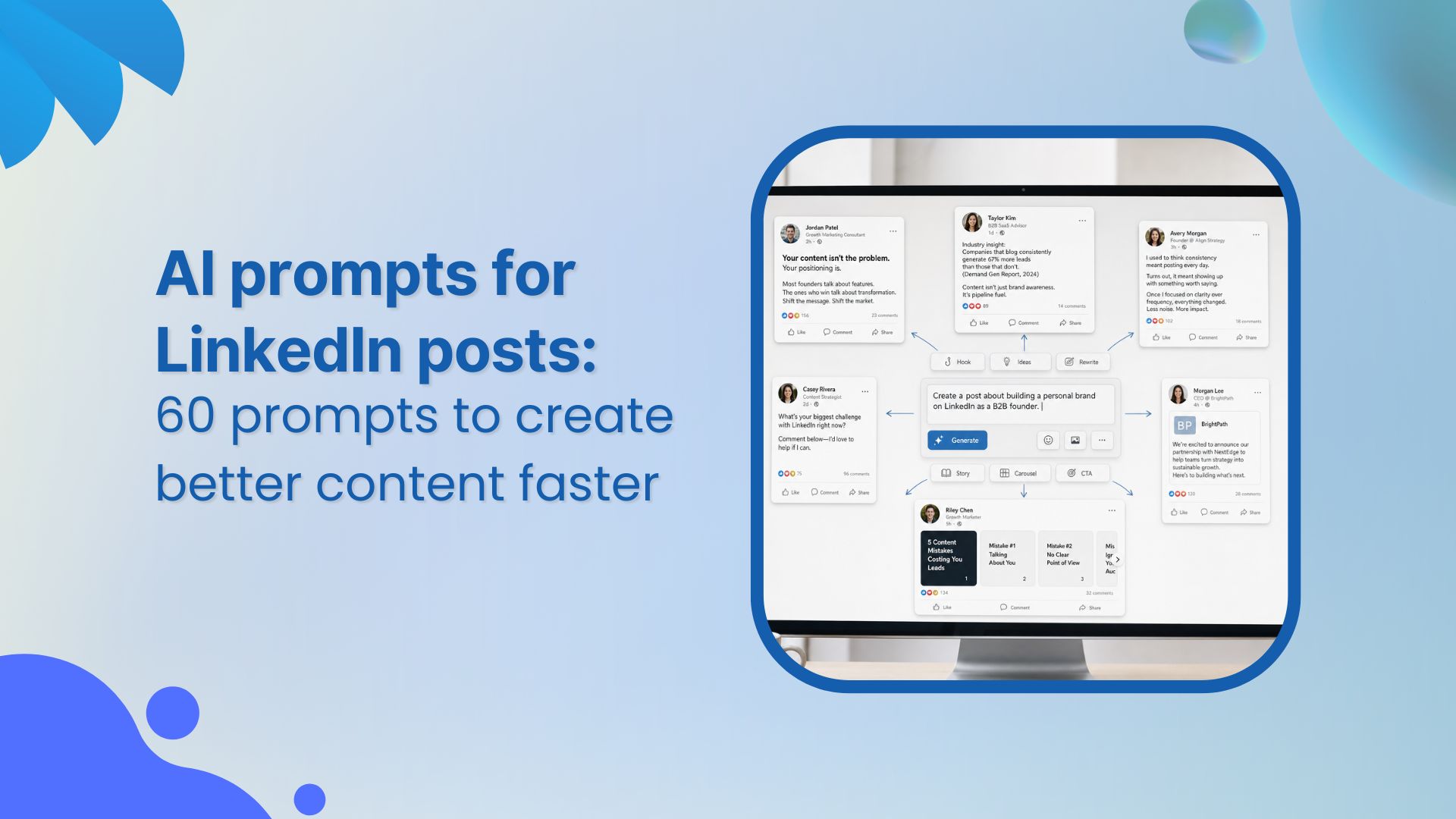
AI can help you research, organize, draft, edit, repurpose, and review LinkedIn content, but it cannot replace the experience, judgment, evidence, and professional point of view that make a post worth reading. The most useful AI prompts do not ask a model to “write a viral LinkedIn post.” They provide real context and assign a focused task: analyze a voice, generate angles, structure an argument, tighten a draft, identify missing proof, or adapt an idea for a specific audience.
A clear LinkedIn content marketing strategy gives AI-assisted work a defined purpose, whether that is customer education, brand awareness, demand generation, recruitment, professional credibility, or community participation. ContentStudio’s LinkedIn content scheduling and approval platform can then help teams organize drafts, gather feedback, schedule approved posts, and review performance—without treating AI output as automatically ready to publish.
This article includes 60 practical AI prompts for LinkedIn posts, explains how to give AI enough context, shows how to preserve your voice, and outlines a responsible workflow for turning AI assistance into useful professional content.
Use these principles before you write a single prompt.
AI prompts for LinkedIn posts are instructions that tell an AI tool what content task to perform. A prompt can help generate post ideas, analyze your writing voice, build an outline, draft a hook, simplify technical language, create a carousel structure, adapt a long article into several shorter posts, or review a draft for generic phrasing.
The quality of the result depends heavily on the quality of the input. A vague request such as:
Write a LinkedIn post about leadership.
usually produces vague, interchangeable content.
A stronger request includes a reader, a situation, a point of view, evidence, and a constraint:
I lead customer-success teams at B2B SaaS companies. Create three post outlines for customer-success leaders who measure implementation completion but struggle to measure adoption. Use this experience: [paste notes]. Each outline should include a specific hook, three practical points, one customer-safe example, and a closing action. Do not invent statistics, customer names, or results.
The second prompt gives the AI a defined role and reduces the chance of generic output.
The best AI workflow starts before you ask for a draft. First, decide what you know that is worth sharing.
Useful LinkedIn content often begins with material you already have:
AI can help you turn that material into clearer content. It should not manufacture the underlying insight.
If your team needs a repeatable way to turn customer questions, event notes, sales conversations, and internal expertise into content opportunities, use a LinkedIn post-idea framework to build a stronger source library before prompting AI.
Instead of asking AI to do every part of the job, assign one task at a time. For example:
This approach keeps you in control of the thinking while using AI to accelerate the production work.
A useful practice is to give AI several examples of your approved writing and ask it to identify patterns, rather than assuming it knows your voice. Use the following process:
A voice profile should include both what to do and what to avoid.
Example:
| Voice element | Instruction |
|---|---|
| Tone | Practical, direct, calm, and informed |
| Sentence style | Short to medium sentences; occasional longer explanation when needed |
| Vocabulary | Plain professional language; avoid jargon unless it is defined |
| Point of view | Specific and evidence-led; willing to acknowledge trade-offs |
| Structure | Clear opening, practical middle, relevant conclusion |
| Avoid | Hype, clichés, fake urgency, rhetorical questions, generic “thought leadership,” excessive emojis, and unsupported certainty |
A LinkedIn post may be AI-assisted, but it should still sound like a person who understands the work behind the idea.
Your writing voice should also align with the professional positioning people see when they visit your profile. Use this guide to improve your LinkedIn profile to make your headline, About section, experience, Featured content, and published perspective reinforce one another.
Use this structure to create stronger prompts.
| Prompt element | What to provide | Example |
|---|---|---|
| Role | The perspective the AI should work from | “Act as a B2B content editor” |
| Audience | Who the post is for | “Customer-success leaders at mid-market SaaS companies” |
| Objective | What the post should help achieve | “Help readers identify a weak onboarding metric” |
| Source material | Facts, examples, notes, or draft | “Use these anonymized customer-call notes” |
| Point of view | The main argument or lesson | “Completion is not the same as adoption” |
| Format | Post, carousel, article, poll, or message | “Write a LinkedIn text post” |
| Constraints | Length, tone, structure, exclusions | “No invented statistics; no clichés; under 220 words” |
| Next step | What the reader should do | “End with one action for the next onboarding review” |
| Review instruction | How to check output | “Flag any claim that needs verification” |
You are helping me create a LinkedIn post.
Audience: [describe the exact audience]
Objective: [what the post should help the reader understand, decide, or do]
Source material: [paste verified notes, examples, facts, or draft]
Core point of view: [your actual argument or lesson]
Voice: [paste your approved voice brief]
Format: [text post, carousel outline, article outline, poll, event post]
Constraints: [word count, no invented facts, no clichés, no generic call to action, no exaggerated claims]
Task: [specific task, such as generate five hooks, create an outline, tighten a draft, or write a first version]
First, list any facts, names, numbers, quotations, or claims that require me to verify. Then provide the requested output.
This prompt makes verification part of the workflow rather than an afterthought.
Each prompt below is a starting template, not a finished instruction. Swap in your own verified audience, source material, and constraints before you run it, and treat the output as a first draft to edit, not a final post.
These prompts turn raw material you already have, like customer questions, sales calls, or a job role, into a shortlist of specific post ideas rather than a blank page.
Use this when you have a list of recurring customer questions and need to turn them into content themes.
I work with [audience] in [industry]. Here are 10 recurring customer questions: [paste questions]. Group them into five LinkedIn content themes. For each theme, suggest three specific post ideas, the reader problem, a useful format, and one source of proof I should gather. Do not write the posts yet.
Use this to mine sales-call notes for the professional problems worth writing about.
Review these anonymized sales-call notes: [paste notes]. Identify five professional problems prospects repeatedly mention. For each problem, suggest one educational LinkedIn post idea that helps the reader understand the issue without promoting our product directly. Do not invent customer details or outcomes.
Use this to turn a handful of career experiences into several distinct post angles.
Turn these five professional experiences into a LinkedIn content bank: [paste experiences]. For each experience, identify the lesson, the emotional tension, three possible post angles, the target audience, and the best format. Keep the ideas specific and avoid generic career advice.
Use this to turn recurring support themes into proactive customer-education posts.
Here are anonymized support themes from the last quarter: [paste themes]. Identify which themes could become proactive customer-education posts. For each, suggest a post title, the reader question, a practical takeaway, and the evidence we need to verify before publishing.
Use this to turn one verified report into several focused post ideas.
Review this verified industry report summary: [paste summary and source]. Suggest eight LinkedIn post ideas for [audience]. Each idea should focus on one finding, explain why it matters, and avoid overstating the report’s conclusions.
Use this to audit your past posts and spot themes or questions you have not covered yet.
Review these 15 LinkedIn post titles and summaries: [paste]. Identify repeated themes, missing audience questions, and underused formats. Suggest 10 new post ideas that add useful depth rather than repeating existing topics.
Use this to plan a full run of posts before, during, and after an event.
We are hosting [event] for [audience] about [topic]. Create a LinkedIn content plan with five pre-event posts, three live-event posts, and five post-event follow-ups. Each post should have one purpose, one key message, one format recommendation, and one appropriate next step.
Use this to turn release notes into customer-facing angles instead of a feature list.
Here are the verified notes for a product update: [paste]. Generate five LinkedIn post angles that explain the customer problem, workflow, or decision behind the update. Avoid feature-list language and do not invent product capabilities.
Use this when you want post ideas grounded in the day-to-day decisions of your role.
I am a [job title] working with [audience]. List 20 recurring decisions, mistakes, questions, or trade-offs people in my role encounter. Then identify the 10 that could become useful LinkedIn posts based on professional experience.
Use this to build a month’s worth of varied ideas around a few core themes.
Create a 30-day LinkedIn idea bank for [audience] around these three themes: [theme 1], [theme 2], and [theme 3]. Include a mix of educational, opinion, research, story, checklist, event, and employee-expertise ideas. Do not repeat the same angle.
Use these prompts before you write to figure out what needs a source, what’s missing, and what questions are still open, so the draft doesn’t start on shaky ground.
Use this before publishing to flag every claim in a draft that still needs a source.
Review this LinkedIn post draft: [paste draft]. List every factual claim, statistic, trend statement, customer outcome, or causal assertion that needs a credible source or internal verification. Do not fact-check by inventing sources. Mark each claim as “verify,” “qualify,” or “remove.”
Use this to plan what you need to verify before writing about an unfamiliar topic.
I want to write about [topic] for [audience]. Create a research brief that lists the questions I need to answer, the types of primary sources I should look for, the internal experts I should consult, and the claims I should avoid making without evidence.
Use this to turn one verified source into angles that do not overstate what it actually shows.
Using only the verified facts in this source summary: [paste], create three LinkedIn post angles. For each angle, state the exact fact being used, the interpretation that is supported, the interpretation that would overreach, and a practical takeaway for [audience].
Use this to check whether a draft gives readers enough context to interpret it fairly.
Review this draft about [topic]: [paste]. Identify what context a reader would need to interpret the argument responsibly. Suggest questions I should answer, examples I should add, and claims that need caveats.
Use this to prepare questions that will surface real experience instead of generic answers.
I need to interview a subject-matter expert about [topic]. Create 12 questions that will uncover practical experience, trade-offs, examples, failure modes, and advice. Avoid questions that invite generic answers.
Use this to separate confirmed facts from opinions and hunches in raw meeting notes.
Review these meeting notes: [paste]. Separate them into: verified facts, opinions, hypotheses, customer anecdotes, and possible LinkedIn post ideas. Flag anything that should not be published without approval.
These prompts help you capture how you actually write and speak, then hold new drafts to that standard instead of letting them drift into generic AI phrasing.
Use this once, with a sample of your best writing, to build a reusable voice brief.
Analyze these 10 approved LinkedIn posts: [paste]. Extract my tone, sentence patterns, vocabulary, structural habits, point-of-view style, and recurring strengths. Create a voice brief I can reuse. Also identify phrases or habits that make the writing less clear.
Use this to catch generic or obviously AI-written phrasing in a draft.
Review this draft: [paste]. Identify phrases that sound generic, overly polished, cliché, overly motivational, or obviously AI-generated. Replace them with more specific, plain professional language while preserving the facts and point of view.
Use this to rewrite an AI draft so it matches your voice brief without changing the facts.
Here is my voice brief: [paste]. Here is a draft: [paste]. Rewrite the draft to match my voice without changing the meaning, adding claims, or inventing examples. Show a short list of major changes you made.
Use this to draft a few honest, specific ways to describe your expertise.
Based on this career background and audience: [paste], draft five positioning statements for my LinkedIn profile. Each should state who I help, what professional problem I address, and the experience or approach behind it. Avoid buzzwords such as “passionate,” “results-driven,” “guru,” and “thought leader.”
Use this to test the same verified post in a few different tones before choosing one.
Rewrite this verified post in three versions: practical and direct, analytical and calm, and warm and conversational. Keep all facts identical. Explain which audience each version may suit best.
Use this to make a technical explanation accessible without oversimplifying it.
Rewrite this explanation for [non-specialist audience]: [paste]. Keep the technical meaning accurate, define necessary terms, and use one practical example. Do not make the topic sound simpler than it is.
A weak opening loses the reader before the point lands. These prompts generate several opening options built from real context, not clickbait.
Use this to generate several openings that name a real problem instead of teasing one.
Create 12 LinkedIn hooks for [audience] about [topic]. Each hook should name a recognizable professional problem, avoid clickbait, and make a clear promise that the rest of the post can fulfill. Keep each hook under 18 words.
Use this for a tighter, two-line opening built around a specific tension.
Create 10 two-line LinkedIn openings for this idea: [paste idea]. The first line should create a specific professional tension. The second line should clarify why it matters. Avoid vague curiosity hooks and do not use rhetorical questions.
Use this to open a post with a verified finding instead of a generic claim.
Using this verified finding: [paste finding and source], write 10 LinkedIn post openings that explain what the finding means for [audience]. Do not exaggerate causation or invent implications.
Use this to challenge a common assumption without being contrarian for its own sake.
Write five possible openings that challenge this common assumption: [assumption]. Use this evidence or experience: [paste]. Each opening should be respectful, specific, and defensible, not provocative for attention alone.
Use this to open with a real moment from your own experience.
Use this professional experience: [paste]. Write five openings that begin with a concrete moment, decision, mistake, or observation. Do not invent dialogue, emotions, or details that are not in the source material.
Use this when an opening is not working and you need sharper alternatives.
Here is my current opening: [paste]. Explain why it may not be clear or relevant to [audience]. Then write five stronger alternatives that retain the same core point without using clickbait.
Use these prompts to organize an idea into a logical sequence before you write full sentences, so the argument holds together instead of wandering.
Use this to turn one core point into a structured outline before drafting.
Create a LinkedIn text-post outline for [audience] about [topic]. Use this core point: [paste]. Include a hook, context, three practical points, one example, and a closing action. Keep the eventual post under [word count] words.
Use this to organize scattered notes into a clear argument without adding new facts.
Organize these notes into a clear LinkedIn post structure: [paste]. Do not add new facts. Identify the strongest argument, remove repetition, and recommend the order of ideas.
Use this for a post that needs to walk through a problem and a better approach.
Create a LinkedIn post structure that explains:
1. the problem [problem],
2. why common approaches fail,
3. what a better approach looks like, and
4. one action the reader can take.
Use this verified context: [paste].
Use this to structure a post around a real project and what it taught you.
Turn this project experience into a LinkedIn post outline: [paste]. Include the initial assumption, what happened, the lesson, what changed afterward, and what another professional can apply. Do not make the lesson sound universal if it is based on one example.
Use this to structure a post that corrects a common misconception.
Create a LinkedIn post outline around this myth: [myth]. Use these verified facts or experiences: [paste]. Include the myth, why it persists, what the evidence or experience shows, and a practical next step.
Use this to lay out two approaches fairly instead of declaring a winner.
Build a LinkedIn post comparing [approach A] and [approach B] for [audience]. Include where each approach works, limitations, trade-offs, and one decision rule. Avoid declaring one option universally better.
Once the idea, structure, and voice brief are ready, these prompts produce a first full draft for a specific type of post, always with the source material and constraints built in.
Use this once you have source material and a voice brief ready, to produce a first full draft.
Write a LinkedIn post for [audience] explaining [topic]. Use only this verified source material: [paste]. Start with a specific problem, explain three practical points, include one example, and end with a useful action. Use my voice brief: [paste]. Do not invent facts, statistics, customer results, or quotes.
Use this to draft an opinion post that is grounded in real evidence or experience.
Write a LinkedIn post expressing this perspective: [paste]. The audience is [audience]. Support it with this experience or evidence: [paste]. Acknowledge one limitation or trade-off. Keep the tone practical, not preachy, and avoid calling it “thought leadership.”
Use this to draft a post that helps customers without turning into a pitch.
Write a LinkedIn post for current and prospective customers about [topic]. Explain the customer problem, a practical framework, and the first action they can take. Use these approved notes: [paste]. Do not mention our product unless it is directly relevant to the solution.
Use this to draft an announcement that leads with the user’s problem, not the feature.
Write a LinkedIn post announcing this verified product update: [paste]. Begin with the user problem it addresses, explain what changed in plain language, state who it is for, and clarify what users should do next. Do not use exaggerated claims such as “game-changing” or “revolutionary.”
Use this to turn a career experience into a post with one clear, transferable lesson.
Turn this career experience into a LinkedIn post: [paste]. Focus on one transferable lesson for [audience]. Keep the story specific, avoid exaggerated hardship or forced inspiration, and end with one practical reflection.
Use this to draft a post around a specific finding, including what it does not prove.
Write a LinkedIn post using this research finding: [paste with source, date, sample, and limitations]. Explain what the data measures, what it may suggest for [audience], what it does not prove, and one action the reader can consider.
Use this to recognize a team’s work without generic celebration language.
Write a LinkedIn post recognizing this team achievement: [paste]. Explain the work, the people involved, the customer or business context, and the lesson learned. Avoid generic celebration language and do not disclose confidential information.
Use this to draft an event promotion that leads with the question it will answer.
Write a LinkedIn post promoting [event] for [audience]. Start with the professional question the event will answer, identify the speaker or format, explain what attendees will gain, and end with a clear registration action. Avoid generic phrases such as “don’t miss out.”
These prompts turn an idea, post, or dataset into a slide-by-slide outline for a document carousel, built for sequence rather than dense paragraphs.
Use this to structure a multi-slide carousel before you touch a design tool.
Create a 7-slide LinkedIn document-carousel outline for [audience] about [topic]. Slide 1 should state a clear professional problem. Slides 2–6 should advance one idea each. Slide 7 should summarize the action. Use this verified source material: [paste]. Do not write dense paragraphs.
Use this to adapt an existing post into a carousel sequence.
Convert this approved LinkedIn post into a carousel outline: [paste]. Keep the main point, identify the most useful sequence, and suggest what visual or example belongs on each slide. Do not add unsupported claims.
Use this to turn a process into a slide-by-slide checklist.
Create a LinkedIn carousel outline titled “[title].” It should help [audience] evaluate [decision or process]. Include a cover slide, five checklist slides, one example slide, and a final action slide. Use this source material: [paste].
Use this to present findings slide by slide with proper sourcing on each one.
Create a LinkedIn document-carousel outline based on these verified findings: [paste]. For each data point, state the source, date, sample, and interpretation. Include one slide explaining what the data does not prove.
Use this to structure an approved customer story into a full carousel.
Turn this approved customer-safe case study into an 8-slide LinkedIn carousel. Include context, challenge, decision, process, outcome, limitation, lesson, and next step. Remove identifying details unless they are explicitly approved for publication.
A strong LinkedIn document carousel should simplify a sequence or framework, not turn a full article into tiny text slides. Use AI to structure the slide flow, then let a human review the factual claims, visual hierarchy, mobile readability, and source information.
Use these prompts for longer-form work: outlining an article, turning a transcript into one, planning a newsletter, or breaking an existing article back down into posts.
Use this to plan a longer article before writing the full draft.
Create a detailed LinkedIn article outline for [audience] about [topic]. Include a clear problem statement, context, section headings, examples needed, evidence needed, practical steps, limitations, and FAQs. Identify where internal and external sources would add value. Do not write the full article yet.
Use this to turn a transcript into a structured article outline.
Use this verified webinar transcript or notes: [paste]. Create an article outline that preserves the most useful insights, removes repetition, attributes speakers accurately, identifies claims requiring verification, and includes practical takeaways for [audience].
Use this to plan several newsletter editions around one recurring promise.
I want to publish a LinkedIn newsletter for [audience] about [topic]. Create a 12-edition editorial plan. For each edition, include the reader question, core insight, evidence source, likely format, and how it connects to the larger newsletter promise.
Use this to break one approved article into several distinct post ideas.
Turn this approved article into 10 LinkedIn post ideas. Each post should focus on a distinct section, question, example, misconception, or action. Avoid repeating the article introduction. For each idea, suggest the best format: text, document carousel, video, poll, or event.
Use LinkedIn articles for deeper professional guidance when readers need more depth, structure, sources, examples, and a durable reference resource than a short post can provide.
These prompts are for the pass after the draft exists: tightening language, catching unsupported claims, checking audience fit, and removing anything that reads as generic AI writing.
Use this as a general-purpose editing pass to cut filler and repetition.
Edit this LinkedIn post for clarity and concision: [paste]. Remove repetition, vague claims, filler, clichés, and unnecessary adjectives. Preserve my voice and all verified facts. Return a revised version and a short list of what changed.
Use this to catch overreaching or absolute language before it goes out.
Review this draft: [paste]. Identify any claims that sound absolute, causal, universal, or unsupported. Suggest more accurate wording without weakening the useful point.
Use this when a draft feels too broad and needs a sharper focus.
This draft feels too broad: [paste]. Identify where it lacks audience, situation, evidence, example, or action. Ask me up to five questions that would make it more specific. Do not rewrite it until I answer.
Use this to test whether a draft will actually land with its intended reader.
Review this LinkedIn post for [audience]: [paste]. Explain what the audience is likely to understand, what may confuse them, what feels irrelevant, and what one addition would make the post more useful.
Use this to replace a generic closing line with a next step that fits the post.
Review this post ending: [paste]. Suggest five next steps that match the reader’s likely stage. Avoid generic calls to action such as “comment below,” “agree?,” or “follow for more” unless they genuinely fit the content.
Use this to strip exaggerated claims and sales language out of a draft.
Rewrite this post to remove hype, exaggerated claims, sales clichés, and forced urgency: [paste]. Keep the actual product, customer, or professional value clear. Do not add claims or testimonials.
Use this to catch anything that would be hard to read on a phone.
Review this LinkedIn post or carousel script: [paste]. Identify long paragraphs, unclear references, jargon, abbreviations, complex sentences, and accessibility issues. Suggest improvements for mobile reading without oversimplifying the meaning.
Use this to build a verification list before a draft goes to publishing.
Based on this draft: [paste], create a publishing checklist that identifies every item a human must verify before posting, including dates, data, sources, customer approvals, names, links, product claims, legal concerns, and visual descriptions.
Use this as a last check for generic AI phrasing before you hit publish.
Review this draft for signs of generic AI language. Remove clichés, unnecessary rhetorical questions, repetitive sentence structures, overly polished transitions, vague claims, and generic “thought leadership” language. Preserve the author’s real point of view and do not invent personal experience.
AI prompts can also support the surrounding LinkedIn presence. Use them to clarify your profile and prepare relationship-led communication, not to automate cold outreach.
Use this to draft a few headline options grounded in real experience.
Using this verified career background: [paste], write five LinkedIn headline options. Each should explain my role, professional specialty, target audience or industry, and the kind of problem I help address. Avoid buzzwords and unsupported claims.
Use this to draft an About section without turning it into a keyword list.
Write a LinkedIn About section based only on this verified experience: [paste]. Explain what I do, who I work with, the problems I help address, the evidence behind my expertise, and the topics I write about. Keep it under [word count] words and avoid generic motivational language.
Use this to draft a connection note based on genuine shared context.
Draft a concise LinkedIn connection note to [person] based on this genuine context: [paste]. Explain why I want to connect, reference the relevant shared topic, and avoid a pitch, meeting request, or false familiarity.
Use this for a single respectful follow-up that adds value rather than pressure.
Draft one respectful follow-up to this message thread: [paste]. Add new value or context, make it easy for the recipient to decline, and do not use pressure or urgency.
A useful LinkedIn message strategy builds on real context—such as a shared connection, relevant discussion, event, referral, or useful piece of work not an AI-generated attempt to imitate familiarity.
ContentStudio’s AI Assistant can support LinkedIn content workflows by helping users generate, rewrite, expand, shorten, summarize, adapt, and refine content. It can also support image-generation workflows, caption variations, relevant hashtags, and multi-platform adaptations.
A practical ContentStudio workflow can look like this:
The value of AI in this process is speed and structure. The value of the human team is expertise, proof, judgment, approval, relationships, and accountability.
“Write a viral LinkedIn post about leadership” gives an AI model almost nothing useful to work with. The output will usually be generic because the input is generic.
Provide real source material, a specific audience, a professional situation, a point of view, and clear constraints.
The first AI output is usually a draft, not a finished post. It may contain clichés, vague claims, invented examples, awkward phrasing, incorrect facts, or a tone that does not sound like the author.
Treat AI output as an editable working document.
Do not ask AI to create a personal story, customer case study, professional failure, leadership lesson, or result that did not happen. Readers can often recognize when a story lacks real detail, and invented experience creates serious credibility risk.
AI can produce plausible numbers, report names, quotes, customer outcomes, or citations that are inaccurate or fabricated. Verify every factual claim against reliable sources before publishing.
“Stop scrolling,” “Nobody talks about this,” “Here is the harsh truth,” “I was today years old,” and similar patterns can make posts feel interchangeable. Use a hook that reflects the actual professional tension.
Formatting can support readability, but excessive line breaks, emoji strings, fake suspense, and repeated rhetorical questions can make a professional post feel performative rather than useful.
AI can help an expert communicate more clearly. It cannot replace the expert’s knowledge of customers, workflow, product, risk, regulation, or real-world trade-offs.
AI can reduce drafting time and help create more variation. It does not guarantee reach, engagement, followers, leads, or revenue. A clear LinkedIn reach strategy still depends on relevant content, credible participation, useful destinations, and the right audience.
Teams using AI should document simple guardrails before scaling production.
Define what can and cannot be entered into an AI tool.
Usually safer inputs
Inputs requiring more caution or approval
Require a human to verify:
Whether a business discloses AI assistance depends on its audience, policy, sector, contract, and context. In high-trust, regulated, or research-sensitive contexts, teams may need clearer internal rules about AI involvement.
Regardless of disclosure, the organization remains responsible for what it publishes.
A controlled experiment helps teams learn how AI contributes to quality without assuming it improves every post.
| Week | Focus | Actions |
|---|---|---|
| Week 1 | Build the foundation | Select three approved past posts that reflect the desired voice. Create a voice brief. Identify three recurring audience questions. Gather verified source material. Define review and approval rules. |
| Week 2 | Test idea generation | Use AI to produce several angles from the same source material. Select one angle through human editorial review and publish it. Record the prompt used, human edits made, time spent, audience response, quality of comments, and any factual or tone issues. |
| Week 3 | Test structure and format | Use the same theme but test a different AI-supported format, such as a document carousel or a practical checklist. Keep the audience and core insight consistent. |
| Week 4 | Test revision quality | Draft a post manually, then use AI only for editing, tightening, accessibility, and humanization. Compare the final result with an AI-first draft. |
At the end of the month, decide which AI tasks actually improved quality or efficiency. Keep the useful tasks and remove prompt patterns that create generic output.
AI prompts can make LinkedIn content easier to plan, write, revise, and repurpose. They can help you find clearer angles, build stronger structures, create more useful variations, and reduce repetitive drafting work.
But AI should not become the author of your professional identity. The strongest LinkedIn content still comes from real experience, verified evidence, customer understanding, informed opinions, specific examples, and a clear sense of who the post is meant to help.
Use AI to sharpen the thinking and improve the production process. Keep the human work, the expertise, accountability, voice, relationships, and judgment, at the center.
Yes. A well-structured prompt usually transfers across tools because the important parts are the audience, source material, objective, constraints, and requested task. You may need to adjust the output length, file-upload process, or formatting instructions for each tool, but the underlying brief should remain consistent.
Track the full workflow, not only drafting time. Compare the time spent collecting source material, prompting, editing, checking facts, seeking approval, scheduling, and responding after publication. AI is valuable when it reduces meaningful production work without increasing factual errors, revision cycles, compliance risk, or generic content.
Yes, but it should be used as a controlled drafting and editing aid, not as an autonomous publisher. Build approved prompt templates, restrict inputs, require subject-matter and compliance review, keep a record of sources and edits, and verify every claim. Health, financial, legal, employment, security, and public-policy content often needs stricter review than ordinary marketing copy.
Only if your organization has approved the tool, the contract and data-processing terms are appropriate, and the information is permitted under your privacy, security, customer, and confidentiality obligations. When in doubt, anonymize the material, remove identifying details, use approved enterprise tools, or do not upload it. This is especially important for personal data, customer records, unreleased product information, security details, legal discussions, and financial information.
Save prompts that reliably improve repeatable tasks, such as extracting ideas from customer questions, creating an article outline, reviewing a claim, producing a carousel structure, adapting a product update, checking readability, or preparing a report summary. Store each prompt with its intended audience, source-material requirements, example input, human-review checklist, and any words or claims the tool should avoid.
Plan 0 Days of Content in 0 Minutes
Create, schedule, publish and analyze your content across all your social media channels from one simple dashboard.
4.7 on Capterra • 16,500+ marketers trust ContentStudio
Arooj Ishtiaq is a Content Marketing Strategist with 5+ years of experience writing about social media, SaaS, and AI. At ContentStudio, she creates practical guides, tutorials, and how-to content that help marketers navigate social media trends, sharpen their strategies, and get more from their content.
View all posts by Arooj IshtiaqRecommended for you
LinkedIn Company page guide: How to create, optimize, and grow it
LinkedIn marketing in 2026: Strategy, content, and growth

How to see scheduled posts on LinkedIn | Step-by-step

How to Use LinkedIn Hashtags Without Overdoing It