How to run a holiday campaign calendar from chat with OpenClaw
Oct 1, 202610 minutes

Written by
Esha ShabbirUpdated
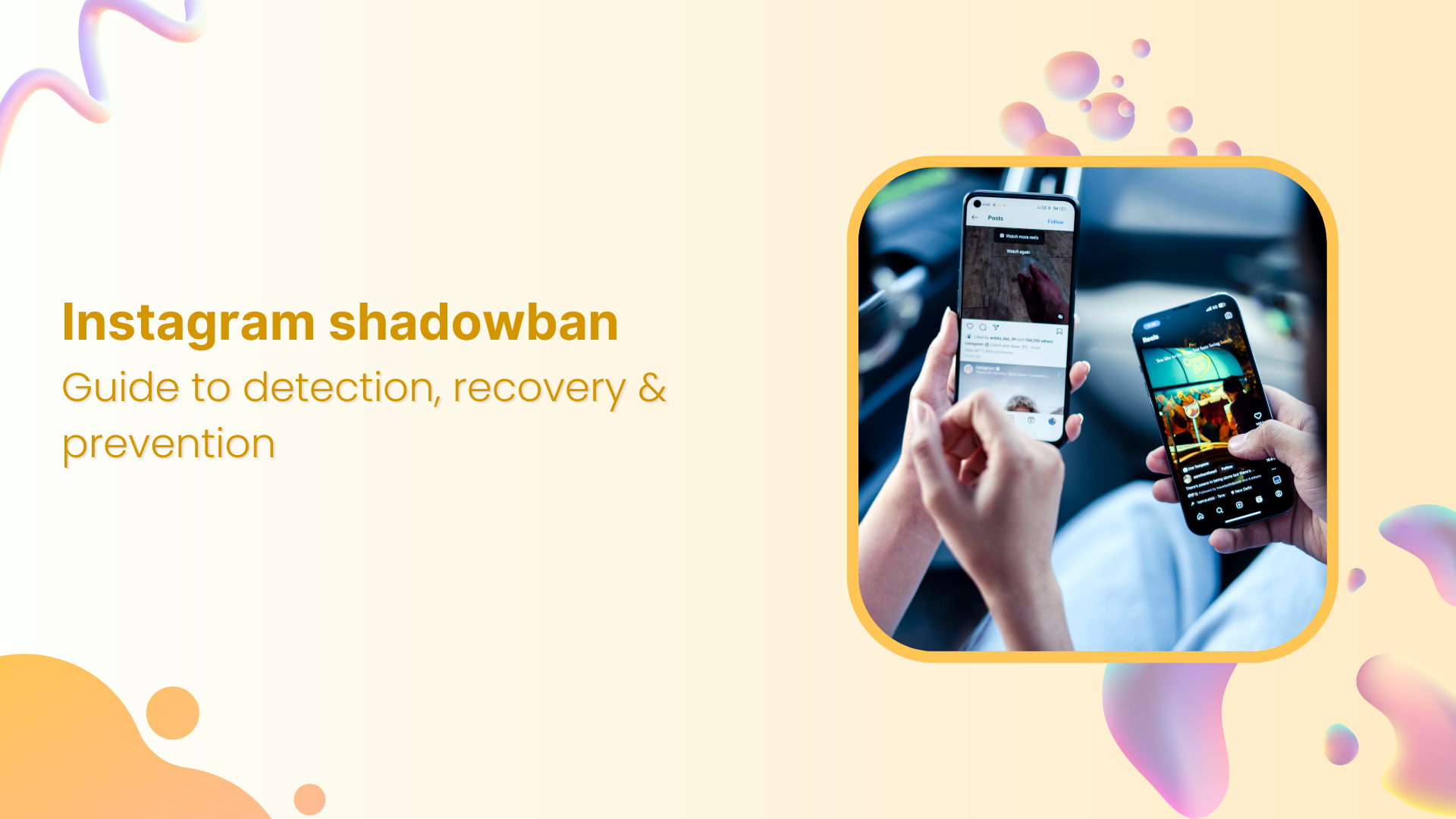
An Instagram shadowban is when the platform quietly limits your content’s visibility without notifying you. Your posts stop appearing on hashtag pages, the Explore tab, and in non-follower feeds, while your account keeps working normally.
In 2026, Instagram’s built-in Account Status tool gives you a direct answer in under five minutes. This guide covers how to confirm a shadowban, what’s triggering it in 2026 specifically, and the exact steps to recover and prevent it from happening again.
An Instagram shadowban is a soft restriction that cuts your content off from discovery without disabling your account. Posts continue to reach people who already follow you but stop traveling to new audiences.
Instagram has never officially used the term “shadowban.” Adam Mosseri, Instagram’s head, stated in a February 2026 Q&A that “in connected ranking, we do not limit reach,” while acknowledging that content violating Instagram’s Recommendation Guidelines receives reduced visibility. What creators experience as a shadowban, Instagram describes as content being “non-recommendable.”
The practical result is the same. Your posts stop showing up on the Explore tab, in hashtag search results, and in Reels suggestions for non-followers. Existing followers see your content normally. Discovery goes quiet, often overnight, with no notification explaining why.
This kind of restriction can quietly undo months of work in marketing on Instagram, since all discovery channels get cut off at once. A creator hitting 40 percent non-follower reach one week might drop to under 5 percent the next, with nothing in their notifications to explain why.
It’s also worth distinguishing between two types of suppression. Account-level restrictions affect your overall eligibility to appear in recommendations. Post-level restrictions suppress individual pieces of content, often because of a flagged hashtag on that specific post. Account Status tells you which one you’re dealing with.
The core mechanism hasn’t changed, but 2026 brought clearer in-app transparency and a new set of dominant triggers that are catching creators off guard.
Here’s what’s different now:
Understanding how these shifts connect to how Instagram ranks content more broadly helps explain why some accounts bounce back faster than others. Accounts with strong pre-existing engagement signals rebuild quicker because there’s a positive signal history for the algorithm to return to.
Account Status is where you start. It gives you an official answer in under two minutes and is more reliable than any third-party checker.
Open Instagram, go to your profile, and tap the top-right menu. Select Settings and activity, scroll down to “More info and support,” and tap Account Status.
Here’s what each indicator means:
| Indicator | What it means |
|---|---|
| Green checkmarks | Account is in good standing and eligible to be recommended |
| Yellow triangles | A specific post or action has been flagged or removed |
| Red indicators | A serious restriction affecting your account’s overall recommendation eligibility |
If Account Status is clean but your reach has still dropped sharply, the restriction may be at the hashtag or post level. Run a manual test to confirm.
Post content using two to three niche hashtags with fewer than 50,000 total posts each. Wait 30 minutes, then fully log out and search those hashtags from an account that doesn’t follow you, filtering by Recent. If your post doesn’t appear, your hashtag distribution is actively suppressed.
Use a genuinely niche tag for this test. Something specific enough that only a handful of posts appear in the Recent feed makes it easy to spot if yours is missing. Generic tags return too many results.
If you have a Professional account, check your Reels performance data and overall reach through Insights. A healthy account in 2026 typically shows 20 to 40 percent of Reels reach coming from non-followers. Look specifically at the “Accounts not following you” metric. A sustained drop of more than 50 percent across three or more consecutive posts is a reliable shadowban indicator.
Publish a test post at a time when your audience is most active and monitor engagement for 24 to 48 hours. Compare it against five to ten similar posts from the previous 30 days. A sudden, sustained drop in non-follower reach, while follower engagement holds steady, points to an active restriction.
Note: a gradual decline over weeks typically reflects content performance issues or algorithm shifts, not a shadowban. You’re looking for a sharp collapse across multiple consecutive posts.
Five triggers account for nearly all shadowbans in 2026. Identifying the right one determines how quickly you recover.
Instagram maintains a continuously rotating list of restricted hashtags. Using a single banned tag in a caption, Story, or Reel can suppress that post’s reach. Repeatedly using restricted tags signals low-quality behavior at the account level and can escalate to broader restrictions.
Before using any hashtag, search it directly in Instagram. If the search shows a warning that recent posts are hidden, skip the tag. Some confirmed restricted tags in 2026 include:
This list changes regularly, which is why checking before posting matters more than memorizing it. For Reels specifically, the approach to hashtags for Instagram Reels differs from feed posts in ways worth reviewing.
Third-party apps that simulate follows, likes, comments, or unfollows through unauthorized access are a leading cause of shadowbans. You don’t need a dedicated bot for this to be a problem. Performing actions at a pace that pattern-matches to automated behavior produces the same flag:
The system responds to behavioral patterns. If your manual activity looks like a bot, it gets treated like one.
Engagement pods were a widespread growth strategy for years. In 2026, they’re one of the leading causes of shadowbans. Instagram’s AI detects accounts that engage with each other in tight, repetitive cycles and flags the pattern as coordinated inauthentic activity.
Accounts caught in this pattern often see recommendation eligibility removed without any formal policy violation on record. The behavior itself is the trigger, not a guideline breach.
Content flagged for any of the following gets removed and can restrict your account’s ability to be recommended:
Even borderline content can trigger automatic review if it gets reported repeatedly. Mass reporting sometimes results in restrictions even when the content is within the rules, because the first-pass review is automated. If you receive a violation notice you disagree with, request a review through Account Status directly. It’s faster than general support.
Reposting TikTok content to Instagram, particularly with a visible watermark, is treated as non-original content. It’s not repurposing that triggers the restriction. It’s the signal that the video wasn’t created for Instagram specifically.
If your Instagram Reels aren’t performing despite a clean Account Status, cross-posted content is one of the first things to examine. Export a clean, watermark-free version before publishing to Instagram.
Most shadowbans clear in 14 to 30 days once the triggering behavior stops. The recovery process works in sequence. Skipping steps or doing them out of order extends the timeline.
For rebuilding distribution signals after recovery, the process of resetting your Instagram algorithm covers how to vary your content formats, captions, and posting cadence to re-engage the recommendation system.
Prevention is mostly about not doing the things that trigger restrictions. A few active habits also build account trust over time, which speeds up recovery if something does happen.
A shadowban feels opaque when you’re in it, but the 2026 diagnostic process has removed most of the guesswork. Account Status gives you a direct answer, the manual hashtag test confirms whether suppression is at the post or account level, and the recovery steps are well-established.
If your Account Status is clean and your reach is still declining, look at your content performance signals before assuming a shadowban. Engagement rate, non-follower traffic, and audience attrition all produce drops that look similar to a restriction but need a different fix.
Check Account Status under Settings. If it shows a restriction, your recommendation eligibility has been affected. If Account Status is clean but reach has dropped sharply, run the manual hashtag test described in this guide.
Post content with two to three niche hashtags under 50,000 posts each. After 30 minutes, search those hashtags from a non-follower account, filtering by Recent. If your post doesn’t appear, your hashtag distribution is actively suppressed.
Most clear in 14 to 30 days once the triggering behavior stops. A single banned hashtag often resolves in under a week. Restrictions tied to automation or repeated violations can take longer.
Instagram’s own Account Status tool is the most accurate diagnostic in 2026. Third-party tools like The Heist and Spikerz provide supplementary engagement pattern analysis, but they’re estimates. Account Status reflects Instagram’s actual internal flags.
Yes. A single restricted hashtag can suppress that specific post from hashtag searches. Using restricted tags repeatedly across multiple posts can escalate to account-level restrictions on recommendation eligibility.
Stop the trigger first. Remove banned hashtags, disconnect unauthorized apps, or leave engagement pods. Pause posting for 48 to 72 hours, then return with fresh content. There’s no shortcut to the restriction period, but stopping the trigger is what starts the recovery clock.
Plan 0 Days of Content in 0 Minutes
Create, schedule, publish and analyze your content across all your social media channels from one simple dashboard.
4.7 on Capterra • 16,500+ marketers trust ContentStudio
Esha Shabbir is a content marketer at ContentStudio, specializing in social media strategy, SEO-led content, and editorial workflows for marketing teams. She writes practical, research-backed content that helps marketers understand what to publish, how to organize their content, and how to build a more consistent social media presence.
View all posts by Esha ShabbirRecommended for you
How to run a holiday campaign calendar from chat with OpenClaw
Google Ads metrics: What to track and what each one tells you
10 social media goals for marketers

How to Make Money on Instagram in 2026 (9 Proven Ways)