How to promote affiliate links on social media in 2026
Oct 2, 202616 minutes

Written by
Arooj IshtiaqUpdated
You have finished the video, checked the thumbnail, and written the title. Now comes a decision that can feel surprisingly consequential: should it go live this afternoon, tonight, or over the weekend?
The best time to post on YouTube depends on your audience and the purpose of the video. YouTube says publishing while viewers are active may help early viewership, but publication time is not known to affect a standard video’s long-term performance. Livestreams and Premieres need more deliberate timing because people must attend at a particular hour.
A clear YouTube channel growth strategy keeps that distinction in perspective. The schedule helps people access your work, while the topic, packaging, and viewing experience give them a reason to watch.
For a channel with sufficient audience data, the most useful starting point is YouTube Studio’s “When your viewers are on YouTube” report. Without that data, a published benchmark can suggest a release window worth testing, but not a rule you must follow.
Once that window is chosen, ContentStudio’s YouTube scheduler can help organize planned releases and approvals. Scheduling supports execution, and it does not determine how widely YouTube recommends the video.
| Format | Strongest reported slot in Buffer’s dataset | Practical interpretation |
|---|---|---|
| Long-form video | Sunday at 10 a.m. | A starting point to test when channel-specific evidence is limited |
| YouTube Shorts | Friday at 4 p.m., followed by 6 p.m. and 7 p.m. | A reason to investigate late-week afternoon and evening releases |
| Livestreams and Premieres | No universal slot established by this comparison | Choose a time the intended audience can attend |
Start with your audience activity report when it is available. If your channel does not yet have enough data, choose a plausible release window for your intended audience and test it consistently.
Evaluate long-form videos and Shorts separately rather than assuming one publishing schedule works equally well for both. For livestreams and Premieres, prioritize a time when viewers can attend.
Viewers have different routines, interests, locations, and reasons for watching. A working professional following an industry channel may behave differently from someone watching entertainment after school.
The content also changes the decision. A searchable tutorial can remain useful months after release, a live discussion needs people online together, and a response to a new announcement may lose value while waiting for a preferred publishing day. That makes timing a supporting decision rather than a substitute for relevance.
Posting time can influence how many people watch your video shortly after it goes live. Like other marketing channels, YouTube has periods when more viewers are active, making them useful times to test. Publishing when your audience is available can give your video a better chance of attracting early views. This is similar to why prime-time TV ads often cost more.
On YouTube, posting time can influence:
However, timing alone cannot make a poorly produced video successful. It can help a strong video reach interested viewers earlier, but your content and how viewers respond to it still matter.
Posting time can affect how many people watch your video soon after it goes live, but it is not the main factor behind a video’s success.
YouTube explains that publishing when your audience is active may help attract early views. However, posting time is not known to affect a standard video’s long-term performance. Livestreams and Premieres are different because viewers need to join at a scheduled time.
Check your channel’s audience activity and past results to find a suitable posting schedule. Also, focus on the topic, title, thumbnail, and viewing experience, as these remain important when deciding how to reach your audience.
| Publication day | Performance versus channel average |
|---|---|
| Sunday | About 3.5% above average |
| Saturday | 2.2% above average |
| Wednesday | 2.2% below average |
These are average observations, not promises for an individual channel. They do not mean that every creator gains 3.5% by switching to Sunday or that Wednesday is a bad release day. The practical implication is smaller and more useful: a reasonable launch window can help, but long-term performance should not be reduced to clock precision.
Rather than following a fixed posting schedule, test two suitable time slots and compare the results of similar uploads to see which works better for your audience.
| Situation | Starting approach |
| Audience activity data is available | Choose a recurring active window |
| Audience data is limited | Choose a manageable slot suited to the intended audience |
| A recurring series has an established schedule | Evaluate results before changing it |
| The content is time-sensitive | Prioritize relevance and readiness |
| The release requires live attendance | Choose for participation |
Record the publication time, time zone, content type, and promotion. Compare results after the same elapsed periods before deciding whether to change the schedule.
Research suggests that Sunday performs best for long-form videos, followed by Tuesday and Monday. For Shorts, Friday ranks highest, followed by Saturday and Thursday. These findings can help you choose times to test, but they do not mean you should change a schedule that already works. Your viewers may be familiar with your current posting routine, and your own results may show that another day performs better.
The best day depends on your audience, content, and publishing routine, not just the highest-ranking day in a general study.
Not always. Some research points to stronger weekend performance, while other studies favor weekday time slots. The right choice depends on your audience and the type of content you publish. Viewers may have more free time for entertainment on weekends, while professional audiences may follow different routines. Event recaps, industry updates, and entertainment videos can also attract viewers at different times.
Instead of committing to weekends, compare a suitable weekend slot with a weekday slot that already works for your channel.
There is no single worst time for every YouTube channel. A quiet period in your time zone may be an active viewing period for people elsewhere.
It also helps to distinguish between uploading and publishing. You can upload a video when it suits your schedule and set it to go public later. The bigger concern is publishing before the video has been checked, fully processed, or prepared for its intended audience. Focus on choosing a suitable release time and making sure the video is ready to go live.
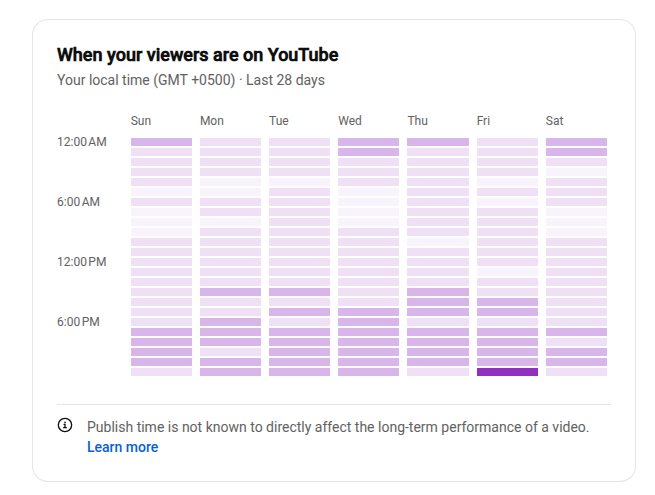
YouTube Studio provides a stronger foundation than a generic “best time” chart once your channel has enough data.
On desktop, the report is a few clicks away:
Before transferring a time to your calendar, check the time-zone label displayed with the report, because a conversion error can undo an otherwise sensible scheduling decision. The report reflects activity during the previous 28 days, so it should be revisited as the audience changes.
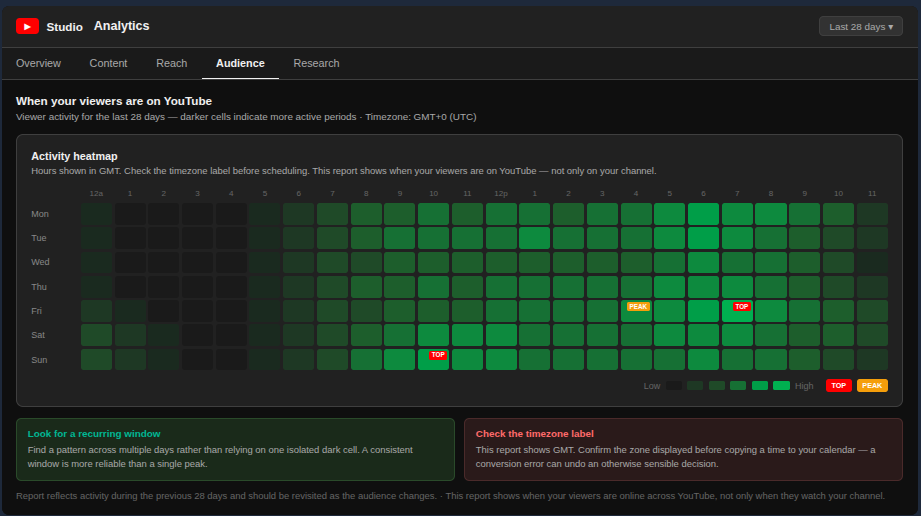
The report shows when your viewers are online across YouTube, not only when they watch your channel. Darker blocks indicate higher activity, but they do not guarantee that those people will choose your next video.
Look for a recurring window rather than one isolated dark cell, then consider the surrounding audience information:
Reading YouTube audience analytics in context helps prevent a heatmap from becoming a falsely precise prediction.
Some third-party recommendations suggest publishing one or two hours before peak activity. That may be a reasonable option to test, but it is not an official requirement for long-term performance. A useful comparison might involve:
The important distinction is that processing should be complete before the planned public release. You do not need to make the video public merely to give YouTube time to process it.
A new or low-traffic channel may not have a usable heatmap. YouTube can limit reports when there is insufficient data, and the absence of a report is not proof of a hidden account problem. In that situation, a simple routine works:
An exact hour should not become another reason to postpone a finished, useful video.
The creator’s location and the audience’s location are not necessarily the same. Scheduling becomes more useful when the target clock is explicit.
“Post at 6 p.m. for a US audience” is incomplete, because Eastern, Central, Mountain, and Pacific viewers do not share the same clock. YouTube’s Top geographies report can identify important countries, but a national audience may still require more investigation. Choose a target time zone based on the audience you most need to serve, or test a workable overlap.
UK time changes between GMT and British Summer Time, and US daylight-saving transitions do not always happen on the same dates as UK transitions. A fixed statement such as “US evening always equals this UK hour” can therefore become inaccurate during part of the year. The scheduled date matters as much as the named hour.
IST and PKT make the scheduling clock clear, but they do not establish one national best time. A creator in either country may primarily serve viewers locally, abroad, or across several markets, so audience location and viewing habits should inform the decision rather than the creator’s address alone.
A worldwide audience rarely has one perfect overlap. You can prioritize the core market, choose a reasonable shared window, or test different slots across a series.
| Audience situation | Practical approach |
|---|---|
| One main region | Begin with its recurring activity window |
| Two important regions | Investigate a workable overlap |
| Widely distributed viewers | Prioritize the core audience or compare alternate windows |
| Live event across regions | Choose for attendance and communicate the time clearly |
| Evergreen video | Favor a dependable release process; viewers can discover it later |
A release record should show both the intended audience time and the scheduled time displayed in the publishing tool, which makes review easier for everyone involved.
A tutorial, a news response, and a live discussion have different timing needs even when they appear on the same channel.
An evergreen video answers a question that remains useful after release day, and search and recommendations can continue introducing it to viewers. For this content, complete processing, accurate packaging, and a reliable release process deserve more attention than repeatedly chasing a perfect hour. YouTube says its systems aim to find suitable videos for viewers regardless of when the videos were uploaded.
A relevant video may lose value while waiting for a benchmark day. When the purpose is to explain a new announcement or respond to an event, the question becomes whether the content is ready while the topic still matters.
Accuracy and rights checks remain necessary, and the publishing timetable should not override the reason for making the video.
A recognizable release pattern can help viewers know what to expect. That is an audience benefit, and it is not evidence of a special algorithm reward for uploading every week.
The schedule should leave enough time to research, produce, review, and respond. YouTube says its analyses have not found growth in views across uploads to be correlated with the time between uploads, so daily or weekly publication is not mandatory.
A business release may depend on a product page, email announcement, sales availability, or support coverage. A video is not well timed if it goes public before its linked offer is ready, which is why a coordinated video marketing strategy accounts for those dependencies rather than optimizing the YouTube clock in isolation.
The format changes what a successful release means. Some videos can wait for discovery, while others depend on viewers showing up together.
YouTube lets you schedule a private video to become public at a selected date, time, and time zone, which separates preparation from the public launch. Allow time to review the finished playback, metadata, captions, and notices. Processing duration varies, so check the actual upload rather than assuming every file needs exactly two hours.
The YouTube video requirements help you prepare a suitable export before it enters that workflow.
Buffer’s reported Shorts windows differ from its long-form windows, particularly around evenings and late-week releases. That makes a separate test worthwhile, though it is not a guaranteed evening rule. A clear opening and complete payoff still matter more than moving an unclear clip from one hour to another, and strong YouTube Shorts ideas provide better material for a timing test.
If you schedule through another tool, verify its format support. YouTube accepts eligible Shorts up to three minutes, while ContentStudio’s currently documented Shorts composer condition is a vertical video under 60 seconds, so the actual upload route should match the finished file. Your options for scheduling YouTube Shorts should therefore be checked before committing to the release calendar.
YouTube specifically recommends using audience activity when planning live streams, because viewers must be available during the broadcast. Consider the following:
A carefully planned YouTube livestream needs an attendance strategy, not simply a benchmark upload slot.
A Premiere gives viewers a scheduled opportunity to watch a prerecorded video together, so the hour should suit that shared experience and the support you can provide around it. YouTube distinguishes Premieres from ordinary uploads when explaining why publication time matters. Not every video needs this treatment, and the decision should follow the value of shared attendance.
A useful timing experiment reduces obvious differences between uploads, although it cannot eliminate them entirely.
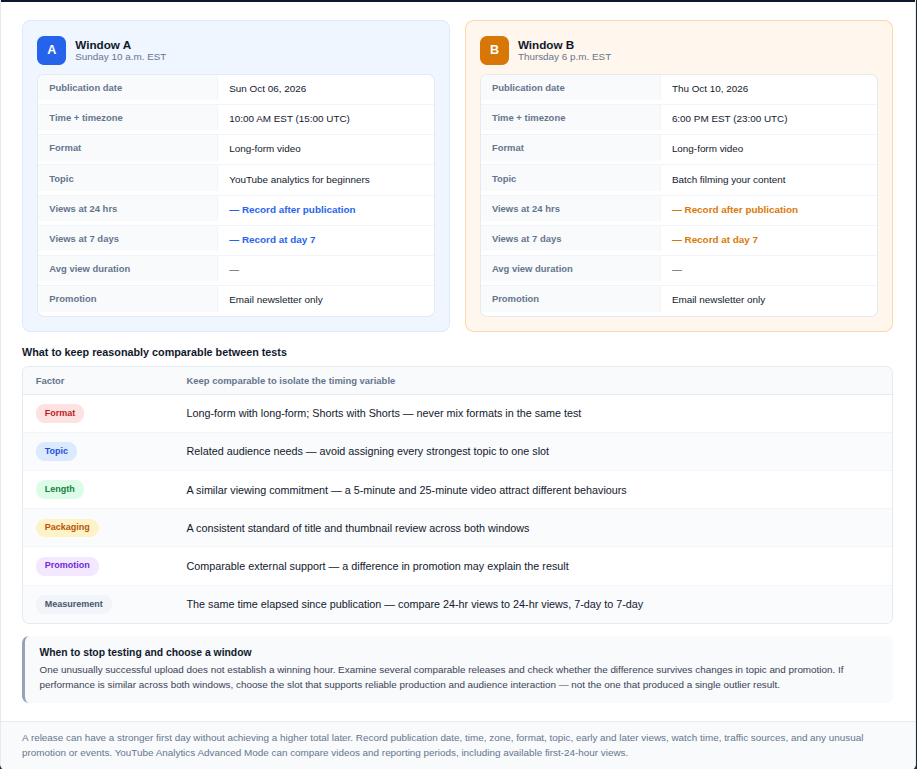
Start with two slots informed by audience activity or research. Testing seven days and many hours at once creates too many moving parts for a small channel. A simple alternating sequence of A, B, A, B, A, B can provide initial observations, but it is a planning template and not statistical proof that six videos establish the best time.
| Factor | What to keep reasonably comparable |
|---|---|
| Format | Long-form with long-form; Shorts with Shorts |
| Topic | Related audience needs |
| Length | A similar viewing commitment |
| Packaging | A consistent standard of title and thumbnail review |
| Promotion | Comparable external support |
| Measurement | The same time elapsed since publication |
Avoid assigning every strongest topic to one slot; otherwise the experiment may measure topic selection rather than scheduling.
A release can have a stronger first day without achieving a higher total later. That early benefit may matter for a launch or event, but it is different from lasting discovery. For each test video, record:
YouTube Analytics’ Advanced Mode can help compare videos and reporting periods, including available first-24-hour views.
One unusually successful upload does not establish a winning hour. Examine several comparable releases and consider whether the difference survives changes in topic and promotion. If performance is similar, choose the slot that supports reliable production and audience interaction.
Scheduling also cannot fix a mismatch between the title and video. Earning more YouTube views still requires a relevant topic, understandable packaging, and an experience worth continuing.
A release calendar should prevent last-minute confusion, and it should never force incomplete content out at an arbitrary hour.
YouTube’s native sequence is:
The final review should confirm the correct channel, file, visibility, processing, and any notices.
For a team, the release record should identify:
A structured YouTube publishing workflow connects preparation in a publishing tool with final checks in YouTube Studio.
Publishing during an active audience period does not mean every subscriber receives an immediate alert. YouTube limits upload and livestream notifications from a channel to three within 24 hours.
Its “Publish to subscriptions feed and notify subscribers” control affects both notifications and Subscription-feed placement, so unchecking it does not merely silence a push alert. For a batch of releases, review how those uploads will be communicated rather than scheduling them together only because the same hour looks favorable.
A relevant Post can communicate the topic, date, and reason to attend a stream or Premiere. Audience feedback may also help you understand preferences, though stated preferences should be considered alongside actual attendance. Developing a YouTube community creates more opportunities for that conversation without treating every upload as an isolated announcement.
Choose the release window for the audience and the purpose of the video. An evergreen tutorial needs reliable preparation and discoverability, a livestream needs attendance, and a timely response needs relevance before the opportunity passes.
When audience data is available, begin there. When it is not, use an attributed benchmark as a starting hypothesis, keep the time zone explicit, complete processing and review before release, and compare similar videos over the same intervals.
The most useful schedule is one that consistently puts finished, relevant content in front of the people it was made for. It should make publishing easier, and a quiet first hour should never become a reason to abandon the video.
Not automatically. Midnight in your location may be an active period elsewhere. YouTube says publication time is not known to affect a standard video’s long-term performance, so a quiet launch is not proof of an algorithm penalty.
YouTube does not describe 1,000 subscribers as a universal unlock threshold for the audience activity report. Reports can be limited when there is insufficient data, so subscriber count alone does not guarantee a useful heatmap.
No. YouTube says channel-location settings are not used to determine recommendations, so changing that setting is not a shortcut to reaching viewers in another country.
The official scheduling and notification documentation reviewed here does not specify a mandatory four-hour gap. Spacing releases can be a practical choice for communication and response management, but it should not be presented as a YouTube rule.
YouTube says the watch-page publication date is based on Pacific Standard Time. A release scheduled in a time zone ahead of it can therefore show different dates in Studio and on the watch page, which is worth checking when a campaign requires a particular displayed date.
Yes. YouTube explains that older videos can attract renewed interest through changing topic popularity, new viewers exploring the channel, recommendations, or a related series release. A slow beginning does not establish the video’s permanent outcome.
Yes. YouTube lets you edit the scheduled publication time or publish immediately through the video’s visibility settings, and a change to the release hour does not require a new file upload.
Plan 0 Days of Content in 0 Minutes
Create, schedule, publish and analyze your content across all your social media channels from one simple dashboard.
4.7 on Capterra • 16,500+ marketers trust ContentStudio
Arooj Ishtiaq is a Content Marketing Strategist with 5+ years of experience writing about social media, SaaS, and AI. At ContentStudio, she creates practical guides, tutorials, and how-to content that help marketers navigate social media trends, sharpen their strategies, and get more from their content.
View all posts by Arooj IshtiaqRecommended for you
How to promote affiliate links on social media in 2026

Multi-location social media management workflow guide

Best SaaS affiliate programs for social media marketers in 2026

19 best social media management tools to plan, schedule, and grow in 2026