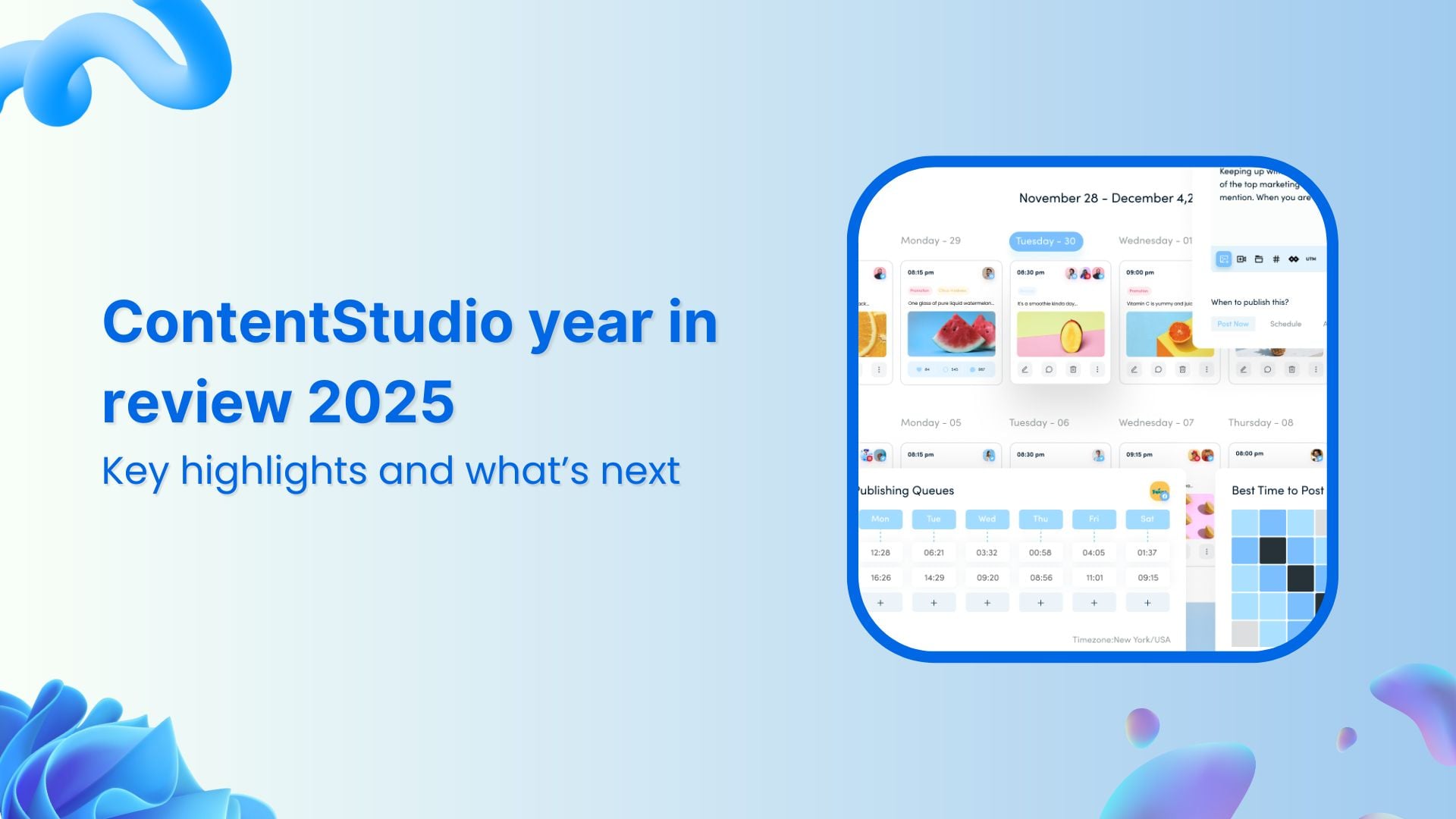
ContentStudio year in review 2025: Key highlights and what’s next
Dec 30, 202518 minutes

Written by
Wasiq NaeemUpdated

Facebook carousel posts let you share between 2 and 10 images or videos in a single swipeable unit, where each card carries its own headline, description, and link. They consistently pull more engagement than single-image posts and give you far more creative real estate in the feed than any other organic format.
This guide covers what Facebook carousel posts are, the 2026 specs you need to know, and how to post them using each available method.
A Facebook carousel post is a swipeable format showing 2 to 10 images or videos in a single post, where each card features its own headline, description, and destination link. Viewers scroll through the cards horizontally without leaving their feed, making it one of the few formats that earns sustained attention in a fast-moving scroll.
You can build carousels via Meta Ads Manager, third-party schedulers, or Facebook’s native multi-image posting. Each method comes with different levels of per-card control, which matters more than most guides acknowledge.
Here are the current technical specs for 2026:
| Spec | Requirement |
|---|---|
| Number of cards | 2 to 10 |
| Recommended image size | 1080 x 1080 px (1:1 ratio) |
| Max image file size | 30 MB |
| Max video file size | 4 GB |
| Accepted file formats | JPG, PNG, MP4, MOV |
| Recommended primary text | Up to 80 characters |
| Headline per card | Up to 40 characters |
| URL per card | Required for full carousel format |
Keep all cards at the same aspect ratio. Mixing portrait and square images in one carousel causes inconsistent cropping on mobile, which makes the whole post look unfinished and reduces swipe-through rates.
Carousels sit naturally within a broader Facebook marketing strategy, alongside Reels and Stories, as the format that rewards pre-planned, structured content most consistently.
Carousels outperform single-image posts for engagement because the swipe interaction extends the time a viewer spends with your content. Each swipe is an active choice, and those micro-interactions signal to the Facebook algorithm that your post is worth distributing further.
For pages focused on growing a Facebook page organically, that algorithmic signal matters. More time on content means more reach, and that compounds over time if the creative quality stays consistent.
Here is what carousels do that standard posts cannot:
For agencies and content managers handling multiple accounts, a Facebook scheduler that supports carousel creation handles the full workflow from card-level editing to publishing without requiring Ads Manager access every time.
A common misconception is worth addressing directly. Uploading multiple images through Meta Business Suite’s post composer creates a swipeable multi-image post, but it is not a true carousel. Every image shares a single caption and a single link. There are no per-card headlines, descriptions, or individual URLs. That limitation matters if your goal is to drive different clicks from different cards.
To post a true carousel with full per-card control, you have two main options in 2026.
Meta Ads Manager is the only native Facebook tool that supports the complete carousel format for organic posts. The process requires setting up a campaign, but you can pause it immediately after the post goes live so no budget is spent.
The carousel appears on your Facebook Page as an organic post. It will not run as an ad once the campaign is paused, and you will not be charged beyond any accidental impressions in the first few seconds.
A social media management platform that supports Facebook carousel posting removes the Ads Manager workaround entirely. ContentStudio lets you build and publish true organic carousels directly from its composer. Here is the process:
For content managers scheduling Facebook posts on a regular cadence, this workflow saves meaningful time over the Ads Manager method, especially when producing carousels in batches.
Carousels earn their place when the information is genuinely better across multiple cards than it would be in a single image or caption. If your content works fine as one post, a carousel adds friction without adding value. The format belongs where sequence, comparison, or layered detail actually matters.
Use one card per product, variant, or feature, with each card linking directly to its purchase or detail page. A skincare brand launching five products can dedicate a card to each, with imagery and copy specific to that item. This turns a single post into a browsable micro-catalogue.
Numbered processes translate naturally to carousels. One step per card, one concept per card. Viewers build understanding as they swipe, which makes complex information feel more manageable than the same content buried in a long caption.
Two or three cards, each featuring a quote, a name, and a photo or logo. This format gives each testimonial visual breathing room instead of stacking them into a single image where they compete for attention.
Card 1 shows the starting state. The middle cards explain what changed and why. The final card shows the result. This structure works for renovation projects, product transformations, fitness results, and any outcome-driven content where the contrast carries the story.
Start with a question or problem in Card 1. Build toward a resolution over the next three or four cards. Close with a clear takeaway or action. This narrative format holds attention longer because the viewer has a reason to keep swiping.
For short-form video content, Facebook Reels for video serves a different purpose and works best alongside carousels rather than as a substitute for them.
Strong creative gets the first swipe. Keeping viewers through to the last card requires a structure that most pages underinvest in.
The first card is the only one that matters until the viewer decides otherwise. It needs to give someone a clear reason to swipe. A weak first card means the rest of your content goes unseen, regardless of how strong cards 2 through 10 are. Build it with the same intention you give a headline in a paid ad.
Beyond the first card, here is what consistently improves carousel performance:
Facebook carousel posts give you more storytelling space, more click destinations, and more interaction time than any other organic format on the platform. The format rewards content that is planned with a clear sequence in mind, not assembled card by card at the last minute.
Carousels take more production time than a single post, but the engagement data consistently shows the investment pays off. Build them intentionally, test what your audience responds to, and let the card-level analytics tell you what to improve next.
A Facebook carousel supports between 2 and 10 cards, with each card able to hold an image or a video. Carousels in the 3 to 5 card range consistently outperform those using all 10.
The recommended size is 1080 x 1080 pixels at a 1:1 aspect ratio. Keep every card at the same ratio to prevent inconsistent cropping across mobile and desktop.
In Meta Ads Manager, create a Traffic or Engagement campaign, select Carousel at the ad level, upload each card with its own link and headline, then publish and immediately pause. A scheduling tool with native carousel support posts them directly from its composer without any campaign setup.
Yes. Carousels work on both mobile and desktop, with viewers swiping through cards on mobile and using navigation arrows on desktop, and the 1:1 image ratio renders cleanly on both.
Plan 0 Days of Content in 0 Minutes
Create, schedule, publish and analyze your content across all your social media channels from one simple dashboard.
4.7 on Capterra • 16,500+ marketers trust ContentStudio
Wasiq Naeem is a Senior Content Strategist at ContentStudio and a research-driven content and digital marketing veteran. He writes on social media strategy, analytics, audience growth, and competitor analysis, covering topics like best posting times and competitor mapping. As a senior editor, he also reviews and fact-checks articles for depth and accuracy.
View all posts by Wasiq NaeemRecommended for you
ContentStudio year in review 2025: Key highlights and what’s next

ContentStudio now speaks your language: French, German, Spanish, Italian, and Greek
Introducing AI Video Generation: Transform ideas into cinematic videos in seconds

New ContentStudio Home: Reimagining AI-powered content creation