
Meta Business Suite guide: Setup, scheduling, inbox, and insights
Oct 14, 202618 minutes
Black Friday: save up to 50% on all plans

Written by
Khadija AnwarUpdated
You can block a Facebook profile, Page, or nickname to prevent unwanted interaction. You can also block messages and calls in Messenger separately if you want to stop chat and call notifications without blocking the person across all of Facebook. Blocking does not delete past comments, tags, or messages.
It reduces future interaction but does not replace reporting serious abuse, impersonation, or threats. For businesses running a Facebook Page, a clear Facebook marketing strategy should include how blocking, restricting, and reporting fit into the community management workflow.
Community moderation and content publishing run on different timelines. A Facebook scheduler can help keep the content calendar consistent while moderation decisions are handled separately, so neither task falls behind.
People do not search for “how to block someone on Facebook” for a single reason. The goal is usually to stop unwanted contact, reduce harassment, protect privacy, or manage a business Page or Group.
| Underlying goal | What the reader wants | Better approach |
| Stop harassment | Prevent repeated unwanted contact | Block the profile or Page and report if necessary |
| Stop spam | Prevent repeated promotional or irrelevant messages | Block the profile or Page |
| Protect privacy | Limit who can see or interact with content | Block, restrict, or adjust privacy settings |
| Manage a business Page | Remove a disruptive commenter or spammer | Block the profile or Page from the Page settings |
| Avoid impersonation | Stop a fake account from interacting | Report the account first, then block it |
| Reduce conflict | Avoid seeing someone’s content without full blocking | Unfriend, restrict, snooze, or mute |
| Protect a Group | Remove a disruptive Group member | Remove the member from the Group, then block if needed |
| Prevent Marketplace contact | Stop unwanted buyer or seller messages | Block the profile or Page on Marketplace |
Blocking on Facebook and blocking messages and calls in Messenger are two separate actions with different scopes. Choosing the right one depends on how much of the interaction you need to stop.
| Action | What it affects | What it does not affect | Best use |
| Block on Facebook | The profile or Page across Facebook — posts, search, friend requests, tags, event invites | The person’s ability to see public content through non-logged-in means | Stopping unwanted interaction across Facebook |
| Block messages and calls | Messenger and Facebook Chat — messages and calls from that person | The Facebook profile connection; they can still see public content | Stopping unwanted Messenger contact without a full profile block |
| Restrict | Limits interaction without a full block; comments go to pending | Public visibility of the person’s content to others | Reducing unwanted interaction while keeping the connection |
| Unfriend | Removes the friendship connection | The person’s ability to follow public content or send a request again | Ending a connection without blocking |
| Report | Sends a report to Facebook for review | The person’s ability to interact until action is taken | Reporting policy violations, impersonation, threats, or abuse |
Facebook says that when you block messages and calls from someone, they cannot chat with you on Messenger or Facebook Chat, and you will not receive messages or calls from them. If you are both in the same group conversation, Facebook will notify you before you enter the conversation.
Blocking is a strong privacy action, but it has clear limits. The table below shows what it can and cannot do, which helps set the right expectations before blocking.
| What blocking can do | What blocking cannot do |
| Prevent the blocked person from seeing your profile, posts, or content | Remove every trace of past interaction such as old comments or tags |
| Prevent the blocked person from messaging you on Messenger | Remove messages already sent in a shared group chat |
| Prevent the blocked person from tagging you in posts or photos | Guarantee the person will not create a new account to contact you |
| Prevent the blocked person from sending friend requests | Remove every comment or tag already posted before the block |
| Prevent the blocked person from inviting you to events or Groups | Prevent all possible impersonation through new accounts |
| Help reduce harassment, spam, and unwanted contact | Replace reporting serious threats, abuse, or policy violations |
The quickest path on mobile is from the person’s profile. This works for blocking a personal profile, a business Page, or a nickname.
Step 1: Open the Facebook app on your phone.
Step 2: Go to the profile or Page you want to block.
Step 3: Tap the three-dot menu at the top-right of the profile.
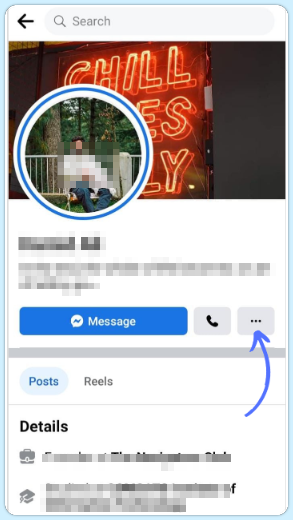
Step 4: Tap Block.
Step 5: Tap Block again to confirm.
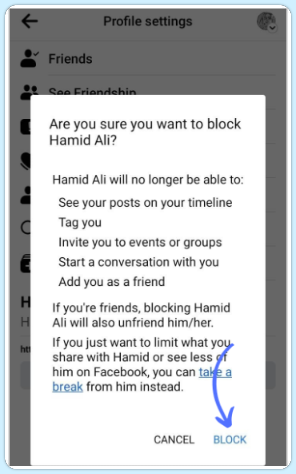
Note: Facebook does not send a notification to the blocked person. However, they may notice changes in visibility or their inability to interact with your content.
For comparison, the guide to how to block someone on TikTok shows how blocking works differently across platforms, since TikTok’s blocking flow has distinct steps and effects.
The desktop path also starts from the person’s profile page. The confirmation label differs slightly from mobile.
Step 1: Open Facebook in a browser on your computer.
Step 2: Go to the profile or Page you want to block.
Step 3: Click Options or More on the profile.
Step 4: Click Block.
Step 5: Click Confirm.
The blocked list path is useful when you want to block someone without visiting their profile, or when you want to review who you have already blocked.
Step 1: Open Facebook in a browser.
Step 2: Click your profile picture in the top-right corner.
Step 3: Click Settings and privacy, then click Settings.
Step 4: Click Blocking under Audience and visibility.
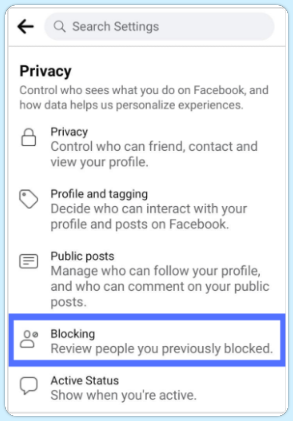
Step 5: Click Edit in the Block profiles and Pages section.
Step 6: Click Add to blocked list.
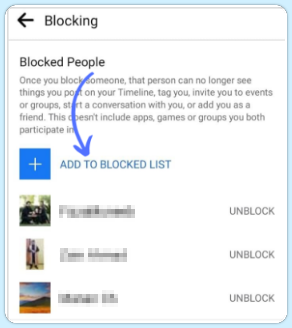
Step 7: Type the name of the profile or Page you want to block.
Step 8: Click Block next to their name.
Blocking messages and calls in Messenger is a narrower action than a full Facebook block. Use this when you want to stop Messenger contact specifically without affecting the Facebook profile connection.
Step 1: Open the Messenger app.
Step 2: Open the conversation with the person you want to block.
Step 3: Tap their name at the top of the conversation.
Step 4: Scroll down and tap
Step 4: Scroll down and tap Block.
Step 5: Choose Block messages and calls or Block on Facebook, depending on how much you want to block.
Step 6: Confirm the block.
Note: Block messages and calls stops Messenger contact only. Block on Facebook applies the full Facebook block. If you are unsure which you need, start with Block messages and calls and escalate to a full block if the contact continues through other means.
The blocked list in Settings shows everyone you have blocked. Reviewing it periodically helps keep the list current, particularly after account changes or if you want to reconnect with someone.
Step 1: Open Facebook and click your profile picture.
Step 2: Click Settings and privacy, then click Settings.
Step 3: Click Blocking under Audience and visibility.
Step 4: Click Edit in the Block users section.
Step 5: Click See your blocked list.
Step 6: Review the list of blocked profiles and Pages.
Step 7: To unblock someone, click Unblock next to their name.
Note on timing: After unblocking someone, there is a waiting period before you can block them again. If you unblock and immediately reblock, the second block may not take effect for 48 hours.
The right action depends on how much interaction you need to stop, whether you want to preserve the connection, and whether a policy violation needs to be reported.
| Action | What it does | Best use |
| Block | Prevents all interaction and limits the person’s visibility of your content | Harassment, spam, impersonation, or repeated unwanted contact that needs to stop entirely |
| Restrict | Limits interaction without a full block; comments go to pending approval | Reducing unwanted interaction without cutting off all contact |
| Unfriend | Removes the friendship connection | Ending a connection cleanly when blocking is not necessary |
| Snooze | Temporarily hides someone’s posts from your feed for 30 days | Taking a break from someone’s content without any permanent action |
| Report | Sends a report to Facebook for review against community standards | Policy violations, impersonation, threats, coordinated abuse, or fake accounts |
| Remove from Group | Removes the person from a Group the user administers | Managing a disruptive Group member without a full profile block |
| Block on Marketplace | Prevents interaction specifically on Facebook Marketplace | Unwanted buyer or seller contact without a full profile block |
If you want to limit interaction without a full block, restricting someone on Facebook is a less visible option that moves their comments to pending and separates their messages from the main inbox, without alerting them that any action has been taken. This is particularly useful for managing acquaintances or family members where a full block would be socially disruptive.
Blocking and reporting serve different purposes and work at different levels. Blocking stops the interaction; reporting flags the account for Facebook review. For serious violations, reporting a Facebook account sends a formal report to Facebook for review and is separate from blocking — both can and often should be done at the same time.
Blocking from a Page prevents the person from interacting with the Page’s posts, comments, and inbox. You need the right Page admin role to take this action.
Step 1: Open the Facebook Page you manage.
Step 2: Go to the profile or Page you want to block.
Step 3: Click or tap Options or More.
Step 4: Click Block.
Step 5: Click Confirm.
| Check before blocking from a Page | Why it matters |
| Page admin access | You need the right Page role; without it the Block option may not appear |
| Comment history | Blocking does not remove comments the person has already posted on the Page |
| Group membership | Blocking from the Page does not remove the person from any Group linked to the Page |
| Reporting option | For serious abuse, report the account as well as blocking it; blocking alone does not trigger a Facebook review |
Blocking on Marketplace prevents the person from messaging you about listings and from seeing your Marketplace activity. This is separate from a full profile block.
Step 1: Go to the profile or Page of the person you want to block on Marketplace.
Step 2: Click Options.
Step 3: Click Block.
Step 4: Click Confirm.
Note: Blocking on Marketplace does not remove existing listings, past messages, or reviews. For fraudulent listings or policy violations, use the Report option on the listing itself.
Blocking a Group member prevents them from interacting with you in the Group and across Facebook. If your goal is only to remove them from the Group without a full block, use the Remove member option in Group admin tools instead.
Step 1: Open the Facebook Group.
Step 2: Go to the profile of the member you want to block.
Step 3: Click or tap Options or More.
Step 4: Click Block.
Step 5: Click Confirm.
Note: Blocking a Group member may not automatically remove them from the Group. Use Group admin tools to remove the member separately if needed. For serious violations within a Group, report the content or the member before or alongside blocking.
Blocking is the strongest privacy action available, but it is not always the right starting point. Lighter options can reduce unwanted contact while preserving more flexibility.
If you want fewer visible activity signals, turning off active status on Facebook hides the online indicator so contacts cannot see when you are actively using the platform. This can reduce unsolicited messages without any account change, since people are less likely to reach out when they cannot see you are active.
Visibility and volume are different problems. If the issue is not a threatening or harassing person but a contact who posts too often or whose messages feel intrusive, muting someone on Facebook reduces their presence in your feed without ending the friendship or sending them any signal that an action has been taken.
For businesses managing a Facebook Page, blocking is part of community health management. A disruptive commenter, a spam account, or an impersonator can affect Page credibility if left unaddressed.
The table below covers the five main options for managing unwanted interaction on Facebook, showing what each one does and which situation it fits best.
| Action | What it does | Who is notified | Best use |
| Block | Prevents all interaction and limits visibility | No notification sent; person may infer it | Harassment, repeated spam, or repeated unwanted contact |
| Restrict | Moves comments to pending; moves messages to request folder | No notification sent | Limiting interaction with someone you do not want to fully block |
| Unfriend | Removes the friendship connection | No notification sent | Ending a connection cleanly without preventing all interaction |
| Snooze | Hides the person’s posts from your feed for 30 days | No notification sent | Taking a break from someone’s content temporarily |
| Report | Sends content or account for review by Facebook | No notification to the reported person | Policy violations, impersonation, threats, or abuse |
Blocking can help reduce unwanted interaction and protect a personal profile or business Page from harassment and spam. It is a one-sided action that does not require the other person’s agreement and does not send them a notification.
Use blocking alongside reporting for serious violations. For less severe situations, restricting, unfriending, or muting may be a better fit. Document concerning behavior before blocking if there is any chance it may need to be reported or escalated outside Facebook.
ContentStudio helps teams organize Facebook content, review and approve posts, and schedule publishing across channels. Start a seven-day free trial. No credit card required.
Facebook does not send a notification when you block someone. The blocked person is not told they have been blocked. However, they may infer it if they notice they can no longer find your profile, see your content, tag you, or message you.
If you block messages and calls from someone in Messenger, they cannot chat with you directly. If you are both in the same group conversation, Facebook will notify you before you enter the conversation. The blocked person’s messages in the shared group may still be visible to other group members.
Yes. You can block a Facebook Page using the same process as blocking a personal profile. Go to the Page, tap or click the three-dot menu or Options, then choose Block and confirm. Blocking a Page prevents it from interacting with your profile, just as blocking a person does.
A block remains in place until you remove it from your blocked list. There is no automatic expiry. If you unblock someone and want to block them again, there is a waiting period before the second block takes effect. Facebook indicates this is approximately 48 hours after unblocking.
Khadija Anwar is a Senior Technical Writer at ContentStudio with over 500 published write-ups across the ContentStudio blog and beyond. She specializes in step-by-step platform guides and Help Center content across Facebook, Instagram, LinkedIn, YouTube, TikTok, and X, and reviews how-to articles to verify every step and platform detail is accurate and current.
View all posts by Khadija AnwarRecommended for you
Meta Business Suite guide: Setup, scheduling, inbox, and insights
How to schedule Facebook video posts with ContentStudio

How to delete Facebook account in 2025

How the Facebook algorithm works in 2026


Plan, create and publish to 12 social channels
Up to 50% off on every plan
Offer ends in:
 Claim your deal
Managing social media doesn't get cheaper than this