How to grow LinkedIn followers organically?
Oct 26, 202621 minutes

Written by
Khadija AnwarUpdated
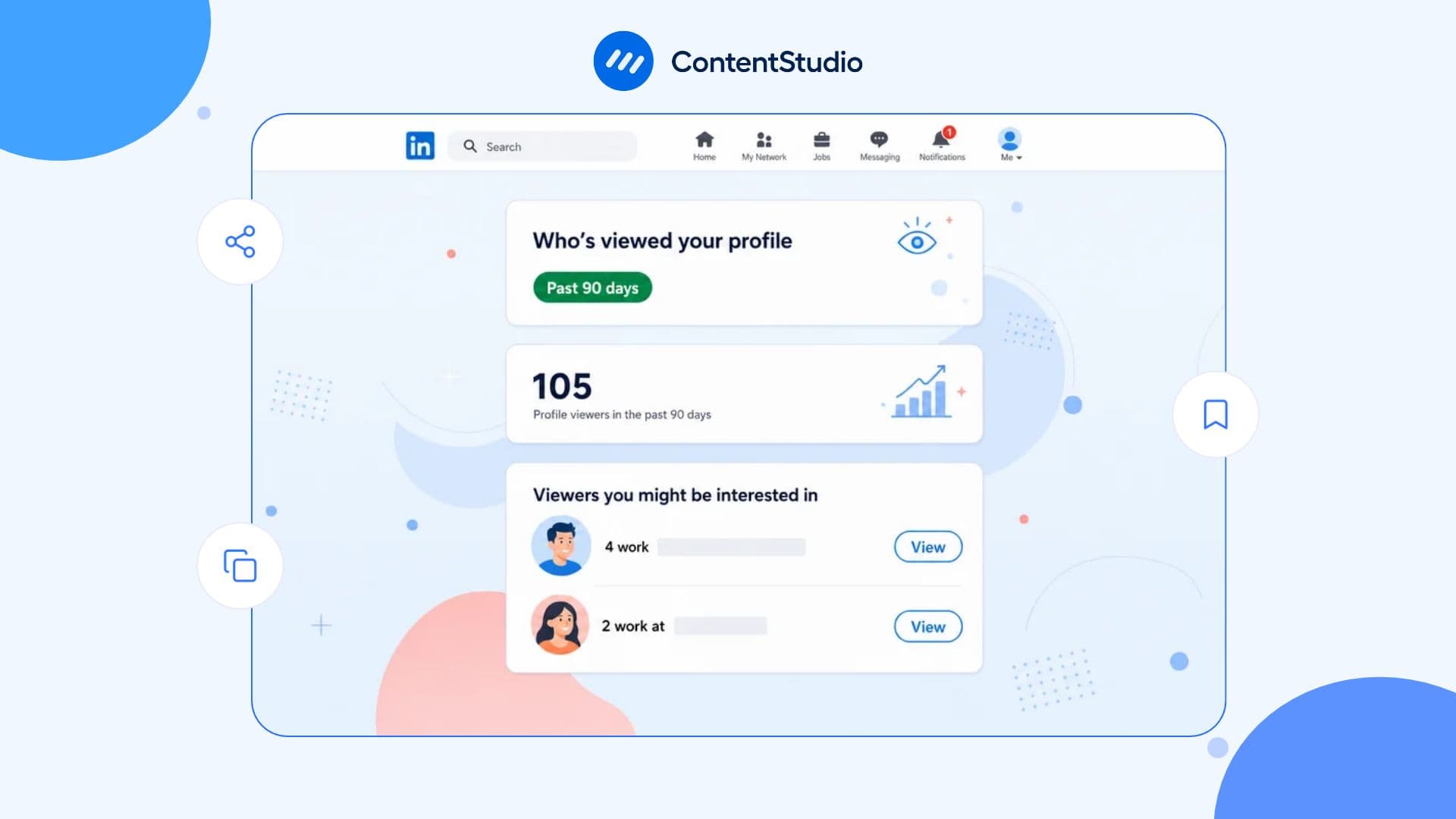
A LinkedIn profile view can show that someone has taken an interest in your professional background, but it does not automatically signal hiring, buying, or networking intent. Someone might visit after reading your comment, reviewing a job application, attending an event, or researching your company or experience.
Profile views become more useful when you understand whom you want to reach and what outcomes matter to you. A clear LinkedIn marketing strategy helps you define those goals and make your profile relevant to the right audience.
This guide explains how to check LinkedIn profile views, why some visitors remain anonymous, how privacy settings affect the information available, what Premium offers, and how to interpret visits without making assumptions about someone’s intentions.
LinkedIn Marketing Establish your brand’s profile on LinkedIn by consistently posting engaging content and engaging with the community.
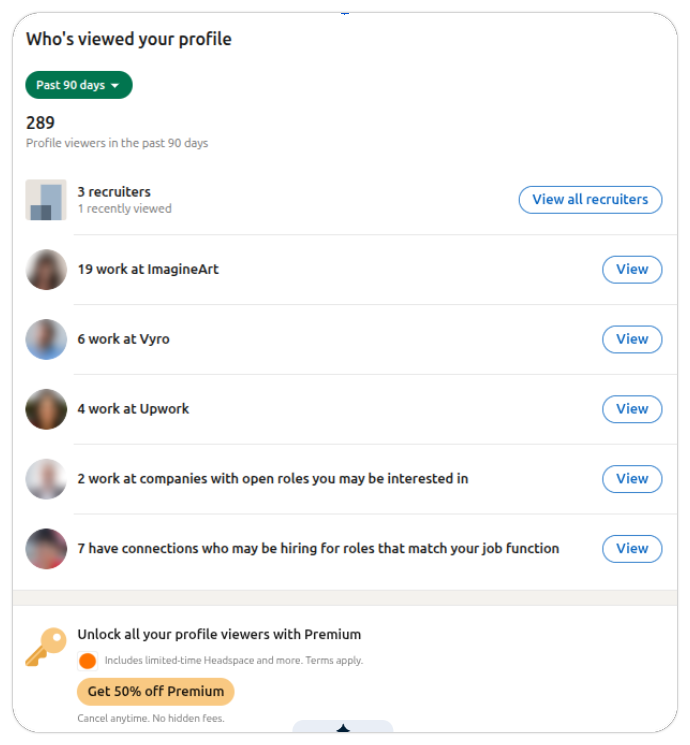
LinkedIn’s Who’s viewed your profile feature provides information about people who have visited your profile within the available viewing period. The details you can see depend on each visitor’s privacy settings and the features available to your account.
Someone might visit your profile after:
These visits can help you identify patterns in professional interest, but they do not confirm a person’s intentions or serve as a reliable lead-scoring system.
A recruiter might check your work history, while a potential client may want to understand your experience before replying to a message. A colleague might review your profile before connecting, or a former coworker might simply be curious about your current role.
The same profile visit can have different explanations depending on the person and context. Consistent, relevant content can also give visitors a reason to explore your profile after discovering you through a post or comment. ContentStudio’s LinkedIn scheduling tool helps you plan and organize that content so you can maintain a consistent publishing routine.
Do not assume that a profile visitor:
A profile view is best treated as one signal within a larger professional context.
LinkedIn’s labels and placement can vary by device, account type, language, and product updates. In most current interfaces, profile-view data is available from the profile’s analytics area.
If you do not see this option, check the profile analytics area, refresh the page, review your privacy settings, or search LinkedIn Help from within your account. Feature labels can change.
If the feature does not appear in the app, update LinkedIn, confirm that you are viewing your own profile, or check through a desktop browser.
Not everyone who views your profile will appear by name. LinkedIn gives members privacy choices that affect how they appear when visiting another person’s profile.
The exact labels may change, but visitors generally appear in one of three ways.
| Viewer visibility | What you may see |
| Full profile visibility | Name, headline, photo, role, and other profile details may appear |
| Limited or semi-private visibility | Partial information, such as role category, industry, or location, may appear |
| Private viewing | The visitor appears anonymously, without identifying information |
A visitor may choose private viewing for many reasonable reasons. They may be researching competitors, exploring a career change discreetly, reviewing candidates, conducting market research, or maintaining privacy while browsing.
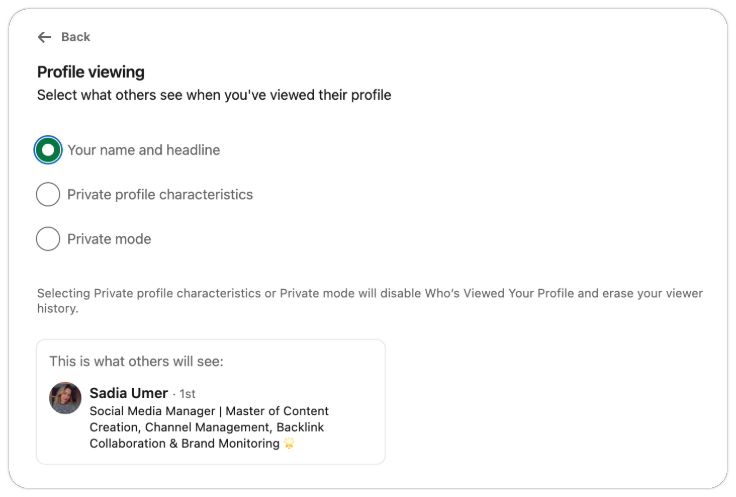
The privacy setting you choose when viewing other profiles affects what those members can see about your visit.
If you browse with full visibility, people may see your name and profile details. If you use a more private setting, they may see limited information or an anonymous view.
Depending on your LinkedIn plan and current privacy setting, using private viewing may also limit the profile-view information available to you. Review the current Profile viewing options settings in your account before changing how you browse.
No legitimate LinkedIn feature, Premium plan, browser extension, or third-party tool can reveal the identity of someone who deliberately chooses fully private viewing.
Be cautious of services that claim to identify anonymous LinkedIn profile viewers. They may rely on unsupported assumptions, encourage account-risky behavior, request sensitive access, or simply provide unreliable information.
Respecting viewer privacy is part of using LinkedIn professionally.
Free and Premium members may see different levels of profile-view information. LinkedIn can change exact feature availability, time windows, and interface labels, so treat your account’s current display as the source of truth.
| Question | Free experience | Premium experience | Important limit |
| Can I access profile-view information? | Usually yes, with limited details or recent-viewer access | May include broader recent-viewer and trend information | Available information can change |
| Can I identify every visitor? | No | No | Private viewers remain anonymous |
| Can I review viewer trends? | Limited information may be available | May include more profile-view insight | Trends do not prove intent |
| Can I browse privately? | Privacy options are available | Privacy options may be more flexible | Privacy settings affect what others see and may affect your own access |
| Can I use profile views for outreach? | Yes, with genuine context | Yes, with genuine context | A view alone is not an invitation |
Premium can be useful when its broader benefits match a real workflow, such as job-search support, professional learning, sales prospecting, recruiting, or expanded professional insights. It should not be purchased solely because you expect to identify people who intentionally browse privately.
If profile-view activity increases while you are applying for roles, make sure recruiters see a consistent story across your profile and your application documents. The process for adding a resume to LinkedIn differs depending on whether you are saving a private file, submitting an Easy Apply attachment, or publishing a public résumé in Featured.
Profile-view information becomes useful when you look for patterns, not when you overanalyze individual names.
Useful patterns may include:
These signals can help you decide what to improve: your profile, content themes, event follow-up, portfolio, job-search materials, or messaging.
Before contacting someone who viewed your profile, ask:
If the answer to the last question is no, do not send the message.
A useful follow-up builds on a real interaction. The principles behind writing LinkedIn messages can help you turn shared context into respectful professional communication rather than surveillance-like outreach.
A message may be appropriate when:
The message should reference that legitimate context—not the profile view itself.
Do not send a message when:
A professional network is built through relevance, not by reacting to every data point.
While seeing who viewed your profile can be valuable, there are times when you might want to browse LinkedIn privately or stop others from seeing when you view their profiles. LinkedIn offers several privacy options to control your visibility.
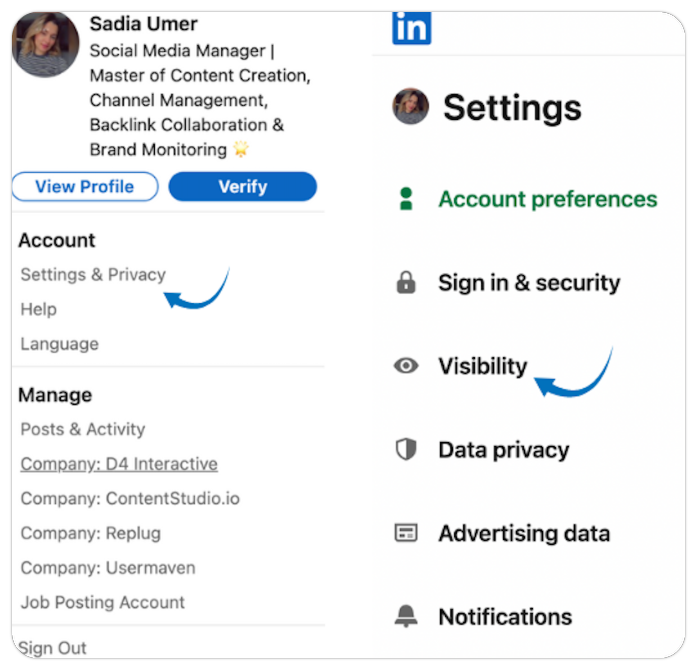
Select your preferred privacy level:
The goal is not to increase profile views at any cost. The goal is to attract visits from people who are relevant to your work, career, business, or community.
A visitor should quickly understand what you do, who you help, what experience supports your work, and what they can explore next.
When a post or comment leads someone to your profile, the profile needs to explain your relevance quickly; a complete LinkedIn profile optimization process helps align the headline, About section, Experience, skills, and Featured proof.
If profile visits reveal an opportunity to refine your headline, About section, Experience, or Featured items, decide whether you want those changes announced to your network. Review LinkedIn profile-update notification settings before making edits you prefer to complete quietly.
Your posts, comments, articles, documents, and videos should reinforce the professional focus described in your profile.
For example:
A clear content strategy for LinkedIn turns profile positioning into repeatable topics, evidence sources, and formats rather than disconnected updates.
Short posts can create curiosity, but some visitors need deeper evidence before they understand your expertise. Publishing LinkedIn articles can create durable resources that explain your thinking in depth and can be added to Featured.
Thoughtful comments can create profile visits when they add context, clarify an issue, share a relevant example, or ask a useful follow-up question.
Avoid commenting only to create visibility. A comment should be useful even if no one visits your profile afterward.
A profile view is not an invitation to message someone, but a meaningful public interaction can create legitimate context for future conversation. Use the context in the interaction, not the profile visit, as the reason to connect or follow up.
Publishing while the right audience is active can increase the likelihood that relevant people see your work and visit your profile. However, there is no universal best hour. Audience location, industry, content format, seniority, and topic all influence timing.
Use your own results alongside the testing method in this guide to determine the best time to post on LinkedIn, rather than relying on a generic schedule.
Profile views are a leading indicator, not a final result.
Track them alongside:
Use a structured LinkedIn analytics workflow to compare profile activity with these broader outcomes instead of treating views alone as success.
These metrics are related but different.
| Metric | What it indicates | What it does not prove |
| Profile views | People visited your profile | That they are qualified, interested, or ready to act |
| Post reach | A post was shown to people | That they read, trusted, or acted on it |
| Search appearances | Your profile appeared in LinkedIn searches | That the searcher viewed your profile or contacted you |
| Follows | Someone opted to receive your activity | That they will engage or become a customer |
| Link clicks | Someone opened a destination | That they completed a valuable action |
A profile view is one visibility signal, while reach on LinkedIn measures how widely a particular post or piece of content was shown. Neither metric is meaningful without audience relevance and a next-step outcome.
Profile views are useful only when you interpret them carefully. Avoid these common mistakes:
ContentStudio does not identify profile viewers or automate outreach based on profile views. It helps teams plan, create, approve, publish, and assess the content that gives relevant visitors a reason to explore a profile.
Use ContentStudio to:
Use profile-view data as a source of context. Use consistent, useful content to give that context meaning.
They may be able to see some information about your visit, depending on the profile-viewing privacy option you selected. If you browse with full visibility, your name and profile details may appear. If you choose limited or private viewing, they may see partial information or an anonymous visit.
Review your current profile-viewing settings before browsing profiles privately.
No. If someone chooses fully private viewing, LinkedIn does not reveal their identity. Premium cannot override that choice.
Possible reasons include the viewer using private mode, your account showing limited viewer information, your own privacy settings affecting access, or LinkedIn changing feature availability. Check the Analytics area of your profile and review profile-viewing settings.
Review whether your headline, About section, Experience, skills, Featured resources, and contact path make your relevance clear. Then examine whether your content is attracting the right audience and whether the profile gives them a useful next step.
Profile views become more valuable when they lead to qualified conversations, applications, portfolio visits, introductions, or other relevant outcomes.
Company Pages can access available Page analytics and audience data, but they do not generally receive the same individual profile-viewer information available through a personal profile’s Who’s viewed your profile feature. The details available depend on LinkedIn’s current Page analytics and privacy rules.
Profile views do not directly guarantee stronger post distribution, search ranking, follower growth, or leads. They are one visibility signal. Relevant content, clear positioning, professional credibility, meaningful interaction, and audience fit are more important.
Khadija Anwar is a Senior Technical Writer at ContentStudio with over 500 published write-ups across the ContentStudio blog and beyond. She specializes in step-by-step platform guides and Help Center content across Facebook, Instagram, LinkedIn, YouTube, TikTok, and X, and reviews how-to articles to verify every step and platform detail is accurate and current.
View all posts by Khadija AnwarRecommended for you
How to grow LinkedIn followers organically?
How to optimize your LinkedIn profile?
How to use LinkedIn for b2b marketing: Strategies, tips, and best practices
LinkedIn Company page guide: How to create, optimize, and grow it