How to use LinkedIn for Business: Setup, teams, and workflows
Dec 12, 202328 minutes

Written by
Arooj IshtiaqUpdated
Most people meet LinkedIn Premium at a moment of mild frustration: a locked list of profile viewers, an InMail they cannot send, or a job listing that shows a tempting “try Premium” banner. The upgrade feels like a shortcut, but a shortcut to what, exactly?
LinkedIn Premium adds paid features for job searching, professional networking, small-business activity, and Company Page management. The right subscription depends on which capability you need, and wanting a more advanced account is not a reason on its own.
For business users, a LinkedIn marketing strategy sets the wider objective. Your subscription decision then answers a narrower question: which paid feature will improve work you actually do?
This guide compares the main plans, explains published starting prices, separates free features from paid benefits, and covers trial and cancellation rules. It also clarifies when Sales Navigator or Recruiter Lite serves a different need.
LinkedIn Premium is a group of paid subscriptions and not one universal upgrade. LinkedIn currently markets four core options: Premium Career, Premium Business, Premium All-in-One, and Premium Company Page.
Career and Business primarily enhance an individual member’s experience. All-in-One combines small-business prospecting, promotion, and hiring capabilities, and Premium Company Page provides benefits for an organization’s Page.
Sales Navigator and Recruiter Lite are related paid LinkedIn products, but they serve specialized sales and recruiting workflows. Buying Premium Career or Business does not automatically provide either one.
Before you compare features, decide who needs access. The buyer could be an individual job seeker, a professional developing a business network, a small-business owner handling several functions, a salesperson researching accounts, a recruiter sourcing candidates, or an organization upgrading its Company Page. That distinction prevents a common purchasing mistake: paying for the right feature on the wrong account or product.
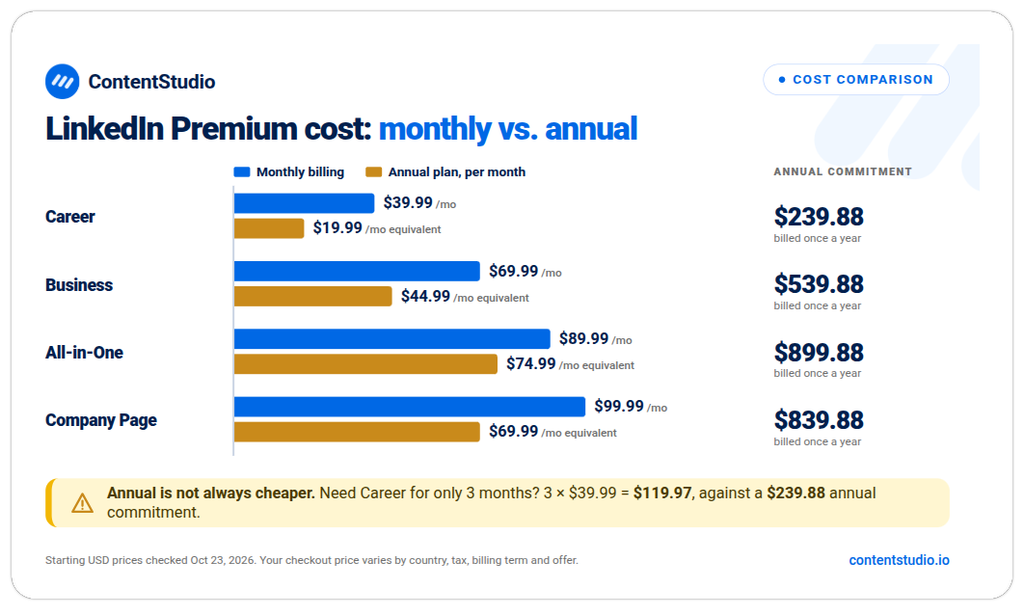
LinkedIn publishes the USD starting prices below. They are reference prices checked on October 23, 2026, and they do not guarantee the offer available to every account.
| Product | Monthly billing: starting price | Annual plan: published total | Monthly equivalent of annual total |
|---|---|---|---|
| Premium Career | US$39.99 per month | US$239.88 per year | US$19.99 |
| Premium Business | US$69.99 per month | US$539.88 per year | US$44.99 |
| Premium All-in-One | US$89.99 per month | US$899.88 per year | US$74.99 |
| Premium Company Page | US$99.99 per month | US$839.88 per year | US$69.99 |
LinkedIn publishes these starting amounts on its product pages. The monthly equivalents divide each annual total by twelve, and they do not describe a monthly payment arrangement.
For comparison, LinkedIn’s official Sales Navigator pricing page lists Core from US$119.99 per month per license or US$1,079.88 per year. That is a separate product decision and not the next rung on a Career-to-Business upgrade ladder. Recruiter Lite pricing depends on the current account offer, and this guide assigns it no universal price without a verified public figure.
LinkedIn says its published amounts are estimates, and several factors can move the final figure:
The amount due, renewal price, billing term, and included features all deserve a review before you confirm payment. The lowest price in a search result does not necessarily represent the current monthly plan.
Annual billing can reduce the cost per month while raising the total you commit to. Three monthly Premium Career payments at the published starting price total US$119.97, while the published annual plan costs US$239.88. If you genuinely need only three months, the lower annual monthly equivalent does not make the annual purchase cheaper overall.
The full commitment should be compared with your likely period of use, and the cancellation and refund terms matter too, because an unused annual balance is not automatically returned.
A free account remains useful for maintaining a professional presence, participating in your network, searching for opportunities, and publishing. The paid decision becomes clearer when you compare specific capabilities.
| Capability | Free account | Paid distinction |
|---|---|---|
| Professional networking | Find and reconnect with people; request and provide recommendations | Additional tools depend on the subscription |
| Profile search | Search for and view profiles | Business and specialist products provide expanded search capabilities |
| Receiving InMail | Basic members can receive InMail | A subscription is not necessary merely to receive it |
| Sending InMail | Incoming messages are not a paid sending allowance | Eligible plans provide monthly credits |
| Private browsing | Available | Premium can retain viewer-information access while browsing privately |
| Profile-viewer history | Limited viewer information | Career and Business provide up to 365 days, subject to privacy restrictions |
| LinkedIn Learning | Not a standard Basic-account entitlement | Included with several paid products |
| Company Page presence | A standard Page can be created without a Premium Page subscription | Premium Company Page adds a separate set of Page benefits |
LinkedIn documents the Basic-account features, plan allowances, and viewer-history differences in its Help pages.
A Premium subscription and a publishing-management tool solve different problems. Teams that need to plan posts, collect approvals, and manage a shared calendar should compare that workflow separately. ContentStudio’s LinkedIn scheduler supports publishing coordination for profiles and Company Pages, but it does not provide LinkedIn Premium entitlements. A content-calendar problem alone is not a reason to buy a networking or job-search subscription.
Each product below gets its own section. The descriptions focus on purchase differences and skip features the plans share.
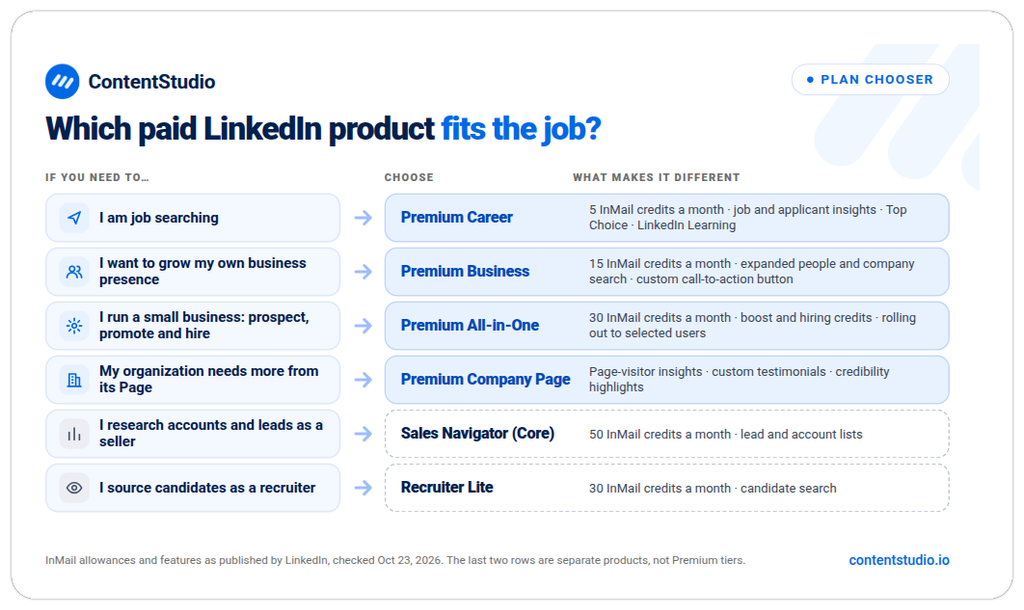
Premium Career targets job seekers and people preparing for their next role. Its current public feature set includes five InMail credits each month, job-match and applicant insights, Top Choice job tools, profile-writing assistance, message proofreading, up to 365 days of profile-viewer information, and LinkedIn Learning access.
The practical value comes from prioritizing suitable opportunities, evaluating fit, and contacting relevant people outside your existing connections. A job seeker might use the insights to identify a suitable role, review the requirements, and spend one InMail credit on a specific question the listing does not answer.
Top Choice is a particular application feature and not proof that every Premium application receives preferential treatment. Availability can also depend on the role and the options shown during application.
Career makes sense when the job-search and learning capabilities together justify the subscription. A higher tier is not an improvement just because its name sounds more senior.
Premium Business focuses on the individual professional’s business presence. LinkedIn currently describes fifteen monthly InMail credits, expanded people and company search, business insights, profile-viewer information, a custom call-to-action button, LinkedIn Learning, and additional profile presentation and visibility features.
The custom button can appear across supported surfaces such as the profile, posts, messages, and search results, and LinkedIn also advertises exclusive Premium placements for profile visibility. These are specific product features. They do not establish a guaranteed increase in qualified inquiries or ordinary post distribution.
Business is a reasonable option to compare when your main need concerns your own professional profile, services, research, and occasional out-of-network contact. If the visitor-facing information is unclear, LinkedIn profile optimization addresses that separately, because a subscription should add a capability and not compensate for inaccurate or incomplete information.
Premium All-in-One targets small-business owners who handle prospecting, promotion, and hiring. LinkedIn currently says the product is rolling out to selected users, so you may not see it in your account.
The product page describes thirty monthly InMail credits, daily prospect suggestions, prospecting search filters, prospect insights, a curated view of relevant prospect posts, post-boosting credits, hiring credits, and a centralized dashboard with recommended actions. The distinction from Business lies in this broader set of operational capabilities and not simply in twice as many InMail credits.
Understand the promotional credits. LinkedIn’s current product page advertises the allocations below.
| Subscription stage | Post-boosting credit | Hiring credit |
|---|---|---|
| Advertised first-month trial offer | US$100 | US$100 |
| Paying monthly subscriber | US$50 per month | US$50 per month |
| Annual subscriber | US$600 upfront | US$600 upfront |
LinkedIn says the credits are localized, and the applicable offer can differ by region and currency, so eligibility and redemption conditions deserve a check in your account. Credits are not cash. Their face value should come off the subscription price only when they replace spending you would actually make on eligible activity.
Check exactly which Page benefits apply. LinkedIn’s small-business comparison describes All-in-One as combining profile and Page capabilities, while its product page also states that Premium Company Page can be added for a business Page. Selected Page-related capabilities do not necessarily establish that the full Premium Company Page upgrade is included in every offer. Before buying, confirm:
All-in-One fits only when you will use several parts of the offer and can verify the access you need.
Premium Company Page upgrades a Page and does not turn its administrator’s personal account into Premium Business. LinkedIn’s comparison lists benefits including Page-visitor insights, custom testimonials, credibility highlights, auto-invitations for eligible content engagers, and invitations involving followers of similar Pages. The Page’s own offer and eligibility deserve a review before you assume every feature is available.
This product answers a different purchasing question. It asks whether the organization needs the paid Page capabilities, and it says nothing about whether the administrator needs a paid personal-profile plan. The LinkedIn Company Page guide covers creating and maintaining the underlying destination, and that setup task should stay separate from deciding whether to buy the upgrade.
Sales Navigator serves sellers who need an ongoing system for researching prospects and target companies. LinkedIn describes Core around advanced search, lead and account organization, recommendations, and updates, and the current comparison lists 50 InMail credits per month. Higher tiers add capabilities intended for teams and more advanced integrations.
It deserves consideration when saved leads, account research, and change alerts form a recurring part of the work. Not every tier includes the same CRM integration, so the exact tier needs a comparison against the systems and team functions you rely on. This guide covers where Sales Navigator fits in the purchase decision and leaves the full prospecting workflow aside.
Recruiter Lite targets individual recruiters and smaller-scale sourcing needs. LinkedIn describes candidate search, recruiting-specific organization, and 30 monthly InMail credits, and its hiring guidance also identifies search access within the recruiter’s third-degree network.
It is worth comparing when you repeatedly need to find and contact candidates and not only publish a vacancy. A promoted job and a recruiter sourcing subscription are different purchases, so the first question is whether your constraint is attracting applicants, finding candidates proactively, or coordinating recruitment across a larger team.
LinkedIn Learning is a benefit to evaluate and not a standalone individual plan with an assumed price. LinkedIn’s current Help comparison says it does not offer individual Learning subscriptions or one-off purchases of individual courses, and it identifies Premium Career as the closest individual subscription because Career includes Learning alongside other capabilities.
Before paying for learning access, check three things:
Course access and demonstrated capability are different things, so the material and its application matter more than the number of certificates you could collect.
InMail is a credit-based way to contact eligible members outside your immediate network, and it differs from a regular message to an existing connection. LinkedIn lists the current monthly allowances in its subscription comparison.
| Product | Current monthly InMail allowance |
|---|---|
| Premium Career | 5 |
| Premium Business | 15 |
| Premium All-in-One | 30 |
| Sales Navigator Core | 50 |
| Recruiter Lite | 30 |
The allocation shows whether a plan fits your expected activity. A larger allowance is no reason to send unnecessary messages, and LinkedIn also states that it does not offer unlimited InMail credits.
LinkedIn’s small-business comparison says Business and All-in-One credits roll over for three months. Sales Navigator documents a maximum balance of 150 credits and a 90-day use period for unused credits, and recruiting products follow their own renewal and accumulation rules. One product’s cap never transfers to another.
The LinkedIn messaging guide explains communication types and writing practices. For a purchase decision, the relevant questions are the allocation, the expiry, recipient settings, and whether you actually need the paid contact route.
Career and Business currently provide up to 365 days of profile-viewer data, with additional filters and trends. LinkedIn’s comparison describes the free view as the three most recent viewers within the previous 90 days when the member displays their name and headline while browsing.
The visitor’s privacy choice still applies, so a Premium account cannot reveal the identity of someone who browsed in complete Private mode.
Basic members can browse privately. The difference is that a Basic member who browses privately loses access to their own viewer information, while Premium can preserve additional viewer access subject to privacy restrictions.
If anonymity is your only requirement, the guide to viewing LinkedIn profiles anonymously is worth reading before you purchase anything. The profile-view guide covers access and interpretation as a separate task. No plan identifies anonymous visitors or turns every profile visit into a qualified opportunity.
The accurate answer separates product features from guaranteed outcomes. LinkedIn promotes exclusive Premium placements and profile presentation features for Business, and Career includes tools such as Top Choice to help communicate interest in an eligible role. Saying Premium provides no visibility-related functionality would therefore be too broad.
Those features still do not establish that:
The actual feature you receive is what deserves judgment, and paying does not improve every part of LinkedIn. LinkedIn’s promotional outcome statistics also fail to show what will happen to an individual subscriber, and they do not isolate the subscription as the only cause.
Premium is worth considering when a paid capability removes a recurring limitation and you can explain the benefit you expect. A useful decision has three parts.
The limitation should be describable without naming the product. Good examples sound like these: “I cannot contact several relevant people outside my network,” “I need a repeatable way to maintain a target-account list,” “I want the additional job-fit information while actively applying,” or “Our Page needs a specific paid visitor or credibility feature.” A goal like “I want better results” is still too broad.
The next step names the feature that changes the work. “I need applicant information and five monthly InMail credits during an active job search” is a clearer Career use case than buying Business because its name sounds more advanced. The same check should confirm whether another subscription or your organization already provides the capability.
A short record keeps the comparison honest. It should cover how often you expect to use the feature, whether a free alternative already meets the need, the full subscription cost, the expected period of use, any learning or setup time, and the evidence that would justify renewal.
A trial may show better search usefulness, more suitable contacts, or time saved, but it may not run long enough to establish a completed hire, job offer, or closed sale.
A sentence like this one, completed before you start, keeps the evaluation honest: “I will keep this plan if I use [feature] regularly and it improves [task] enough to justify [actual renewal cost].”
Not every positive result during the trial is a Premium result, since a referral, earlier conversation, content piece, or existing relationship may explain it. This is a subscription evaluation and not another full LinkedIn performance-reporting framework.
Trial availability depends on eligibility, region, and the offer shown to your account. LinkedIn’s current guidance says that not every member qualifies, trial duration can vary, a valid credit card is required, the trial converts to a paid plan unless canceled, and you cannot switch between Premium plans for free during the trial.
LinkedIn’s Premium homepage also says members who redeemed a profile trial within the previous 12 months are not yet eligible for another profile trial, although a separate Premium Company Page trial may still be available. These rules do not establish identical trial terms for every sales, recruiting, or organizational product.
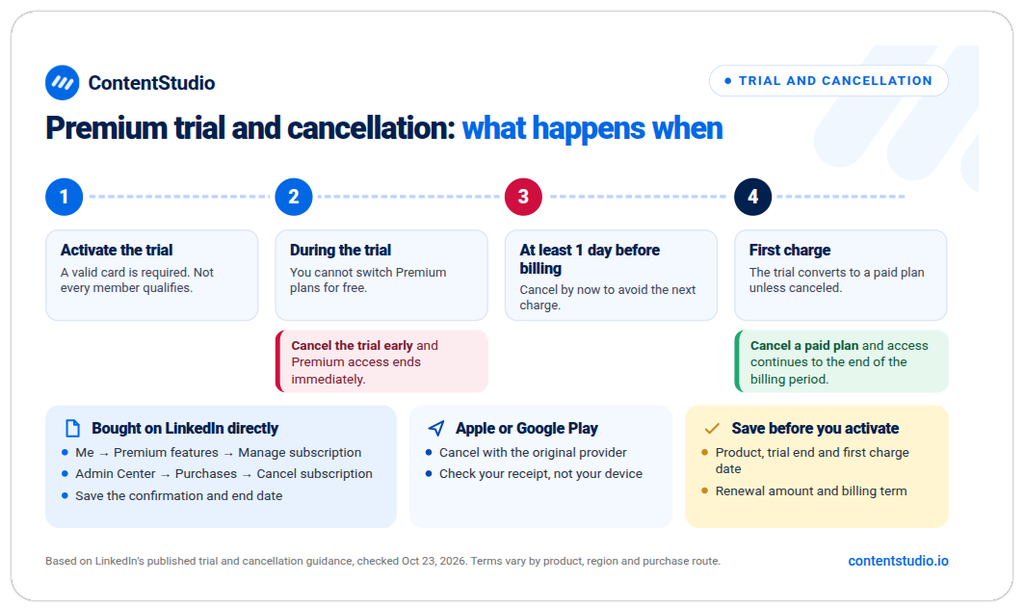
The offer or confirmation worth saving shows:
A reminder set early enough leaves time to review the plan before the cancellation deadline.
LinkedIn’s current cancellation and trial pages state that ending a free trial early immediately removes Premium access, so canceling on day one does not let you use the rest of the trial. LinkedIn advises canceling at least one day before the next scheduled billing date to avoid another charge.
Subscription management depends on the product and the purchase route, so the first step is always to identify where you bought the plan.
LinkedIn’s Help comparison directs existing subscribers to Switch plans in Premium account management. Before confirming, review the new recurring charge, when the change takes effect, which benefits disappear, how credits are handled, and whether a promotional price is lost. LinkedIn warns that changing billing frequency, upgrading, or downgrading can void an active promotion that cannot be restored.
LinkedIn’s current desktop instructions use this route:
1. Open Me.
2. Select Premium features.
3. Select Manage subscription.
4. In LinkedIn Admin Center, open Purchases.
5. Select the active subscription.
6. Choose Cancel subscription.
7. Confirm cancellation.
8. Record the confirmation and effective end date.
These purchases follow the cancellation route of the original purchase. LinkedIn provides separate instructions for Apple App Store and Google Play purchases, and a subscription bought through LinkedIn’s mobile website does not become an Apple subscription just because you used an iPhone. The billing provider on the receipt settles the question better than the device does.
For a paid Premium subscription, LinkedIn says access continues until the current billing period ends, while an early-ended free trial stops access immediately. Canceling renewal and requesting a refund are separate matters, and the current policy for your product, provider, and location replaces any old universal refund rule. Sales Navigator, recruiting, and Company Page products can have their own management instructions, so the documentation for the subscription you actually hold applies.
The best choice is the least expensive option that supplies the capability you need for the period you expect to use it.
Before paying, verify the account or Page receiving the benefits, the actual checkout price, the billing commitment, and the cancellation deadline. During the trial, record whether the paid feature changes the work, and ignore whether the account simply feels more complete. Renew only when that evidence supports the cost.
LinkedIn offers Duo options for Career and Business that give two people separate licenses under one shared subscription. That differs from sharing one personal account or password. The Duo offer available to you deserves a check.
Yes. LinkedIn provides a Premium profile-visibility control that lets you hide the badge. Hiding it changes the displayed badge and leaves the subscription and billing status untouched.
No. LinkedIn says you retain your profile, connections, and other account data when you return to Basic. You lose the paid benefits when access ends, including accumulated InMail credits and additional viewer information.
LinkedIn says the default date range can show 90 days, with Premium Career and Business users able to extend it to 365 days. The date filter is the place to look. Extending the range does not reveal private-mode visitors.
LinkedIn says an InMail accepted, declined, or directly answered within 90 days receives a credit back. Quick Replies can count as responses, while a pending message does not. Sales Navigator and recruiting subscriptions follow product-specific rules.
No. LinkedIn’s trial guidance says you cannot switch between Premium plans for free during the trial period. The offer deserves a careful review before activation, and so do the terms shown before any product change.
Not necessarily. LinkedIn says a canceled promotion or discontinued plan cannot be repurchased at the same offer, and forfeited promotional pricing cannot be restored. The renewal and switching terms matter before you give up a discount.
No. LinkedIn’s current Help comparison says it does not sell individual courses a la carte, and it does not offer standalone individual Learning subscriptions either. It identifies Premium Career as the closest individual option because it includes Learning alongside other benefits.
Plan 0 Days of Content in 0 Minutes
Create, schedule, publish and analyze your content across all your social media channels from one simple dashboard.
4.7 on Capterra • 16,500+ marketers trust ContentStudio
Arooj Ishtiaq is a Content Marketing Strategist with 5+ years of experience writing about social media, SaaS, and AI. At ContentStudio, she creates practical guides, tutorials, and how-to content that help marketers navigate social media trends, sharpen their strategies, and get more from their content.
View all posts by Arooj IshtiaqRecommended for you
How to use LinkedIn for Business: Setup, teams, and workflows
40 best LinkedIn tools for content, sales, analytics, and growth
LinkedIn Company page guide: How to create, optimize, and grow it
How to use LinkedIn for b2b marketing: Strategies, tips, and best practices