How to promote affiliate links on social media in 2026
Oct 2, 202616 minutes

Written by
Saif AliUpdated

Pinterest marketing for businesses means using Pinterest’s visual search engine to publish keyword-rich pins that reach buyers and send them to your website. Pinterest is not a social media platform in the traditional sense. It is a visual discovery engine where people go to plan, dream, and decide.
When you post consistent images and videos on relevant boards, Pinterest shows them in search and home feeds, which turns into steady traffic, email signups, and sales even with a modest budget.
Users arrive on Pinterest with purchase-adjacent goals in mind: they are planning a kitchen renovation, researching a workout routine, scouting gift ideas, building a wardrobe, or learning how to start a business.
For teams that want to manage their Pinterest content at scale, a Pinterest scheduler can be a straightforward choice.
The easiest way to manage and grow your social channels.
Try ContentStudio for FREE
Pinterest marketing is the practice of publishing keyword-rich pins on Pinterest’s visual search engine to drive steady traffic, email signups, and sales. Unlike social feeds that reward follower counts, Pinterest distributes content based on search relevance and engagement quality, so a small brand with 200 followers can outrank an established one if its pins match what people are actively searching for.
Pinterest has more than 631 million monthly active users as of 2026. Pinterest also finds that brands see about 2.3 times more efficient cost per conversion compared with other platforms, which matters when ad budgets feel tight. People open the app when they want ideas for what to cook, wear, renovate, design, or buy next. They are looking forward, not just reminiscing.
Another key difference is content lifespan. A strong pin can keep driving visits months or even years after you publish it. On Instagram or X, a post fades within a day. On Pinterest, the search algorithm continues to resurface pins that match active queries, especially long-tail phrases like “minimalist home office ideas” or “easy gluten-free dinner.”
Pinterest can support almost any business model:
In each case, the goal is the same: publish visual content that appears where people actively search for ideas and then guide those visitors to your site or store.
Pinterest users often open the app with a plan, not for background entertainment. They look for holiday gifts, wedding ideas, room makeovers, recipes, or software workflows and then save options to boards that act like visual wish lists.
Compare that with TikTok or Instagram Reels. Those feeds lean on surprise and humor, so people flick through clips without clear intent to research or buy. You can still sell there, but you often interrupt a leisure activity. On Pinterest, well-placed pins feel like part of the research process, not a break from it.

There is another benefit. Pinterest search and recommendation systems focus on topics and behavior, not social graphs. A small brand with 200 followers can still rank for “ceramic plant pots” if its pins earn clicks and saves. That organic reach, combined with long-term visibility, gives Pinterest marketing a rare mix of patience and payoff for small businesses in 2026.
Here is a simple comparison of how Pinterest stacks up against other popular channels:
| Channel | Typical user mindset | Content life span | Strength for small businesses |
| Planning and researching purchases or projects | Months to years through search and saves | Strong search traffic, high purchase intent, low dependence on followers | |
| Entertainment and social updates | Hours to days | Great for visual branding and community building | |
| TikTok | Short-form entertainment | Hours to days | High viral potential, strong for personality-driven brands |
| Google Search | Task-focused research | Months to years | Very high intent, but often more competitive and text-heavy |
For many brands, the smart approach is not “Pinterest or Instagram” but “Pinterest and Instagram, each with a clear role.” Pinterest drives research and discovery, while other platforms help with relationships and day-to-day interaction.
Pinterest rewards brands that start with the right foundation and build consistently from there.
Whether you are new to the platform or restarting with a clearer strategy, here is the sequence to follow, from setting up your account to measuring what works.
A Pinterest business account gives access to analytics, advertising, Rich Pins, and shopping tools that personal profiles do not provide. For any serious Pinterest marketing effort, a business profile is the base layer. The setup process is quick, and it unlocks the data and features you need to prove ROI.
Start by creating a new business account or converting a personal one inside Pinterest settings. Choose a clear display name that blends your brand and a core keyword, for example “BrightNest Home Decor” or “GreenTrail Camping Gear.”
Add your website URL and pick the most relevant business category so Pinterest understands your niche from day one.
A simple setup checklist looks like this:

Next comes visual branding. Upload a square logo or professional headshot as your profile photo, and set a cover image that reflects your core offer, such as lifestyle shots from recent campaigns. Brands like IKEA and Etsy sellers often use warm, real-life scenes that show products in use, not flat catalog images.
In your 160-character bio, mention what you sell and who you help, and weave in one or two short keywords such as “budget-friendly recipes” or “B2B marketing tips.” Board structure matters as much as the profile itself. Create 5 to 10 boards that mirror how customers think, not just your internal categories.
A skincare brand might start with “Morning skincare routine,” “Acne-friendly makeup,” and “SPF for sensitive skin.” Write a short, keyword-rich description for each board in natural language. Finally, design simple board covers in Canva that use your colors and fonts so your profile looks consistent at a glance.
As your account matures, refine your profile with:
The goal is to make your profile feel like a well-organized library of ideas where a new visitor immediately understands what you do and where to click next.
Try Now: ContentStudio’s Pinterest bio generator
Claiming your website tells Pinterest that you own the domain and want to track how pins from that site perform. Once you add a small HTML tag or DNS record that Pinterest provides, you unlock deeper analytics that connect on-platform activity with site traffic.
Rich Pins add another layer. They pull details from your site into the pin itself, which raises trust and click appeal. Product Rich Pins show live price and availability, Article Rich Pins display headline and author, and Recipe Rich Pins list ingredients and cook time.
Implementation usually takes a one-time update to your site’s metadata. Many WordPress themes and plugins handle this through simple settings, so your developer does not need to write custom code.
Once Pinterest validates your markup, every new pin from that domain can use Rich Pin data without extra steps.
To keep this running smoothly:
If you sell products through Shopify, WooCommerce, or another ecommerce platform, connect your catalog so Pinterest can ingest product data automatically.
If you are starting a brand-new Pinterest business account, do not publish aggressively from day one. Pinterest watches new accounts closely, and accounts that pin at high volume immediately often see suppressed distribution before they have had a chance to build trust with the algorithm.
A simple warm-up approach for the first week:
From day five onward, start with one to three original pins per day and build up gradually toward your target publishing frequency. Most accounts reach a healthy rhythm of five to fifteen pins per day within the first month without triggering any distribution issues.
The warm-up period also gives you time to ensure your profile, board names, and descriptions are fully keyword-optimized before your content starts appearing in search. Early engagement signals matter because Pinterest uses them to decide how widely to distribute your pins going forward.
A strong Pinterest content strategy maps every pin to a single funnel goal: traffic, email growth, or direct sales. The fastest path is to choose two or three content pillars tied to real search terms, build boards around them, and pin consistently for at least three to six months before expecting measurable results.
Start by choosing one or two primary goals for the next quarter. Common goals include email list growth, sales for a specific product line, or lead generation for a course. Map these goals to content pillars. For example, a meal prep brand might focus on “budget dinners,” “meal prep for beginners,” and “kitchen tools.”
Next, create a board plan around those pillars. Each board should feel useful on its own and not just like a dumping ground for every pin. Aim for an 80 to 20 mix where about eighty percent of pins focus on value and inspiration, and about twenty percent focus directly on your offers.

Before you pin, get clear on who you are trying to reach. A short audience profile helps:
When you know these answers, you can create pins that show up at the moment someone starts planning.
Here is a simple way to shape your content plan for a month:
You can also plan content by funnel stage:
People often start holiday and seasonal searches two to three months in advance. Plan Christmas, Black Friday, graduation, and summer content early so your pins earn saves and traction before the rush.
A simple seasonal playbook:
Pinterest offers several formats, and each one suits different outcomes. Picking the right type for each idea helps your Pinterest marketing plan feel focused, not scattered.
Image pins are the classic vertical graphics, often at a 2 to 3 ratio such as 1000 by 1500 pixels. They work well for product photos, blog post covers, checklists, and infographics. Use clear text overlays, brand colors, and a clean background so the message reads instantly on mobile.
Video pins autoplay in the feed and grab attention with motion. Short clips between 6 and 15 seconds often work best for ads and top-of-funnel content, while longer clips can show tutorials or walkthroughs. Many brands repurpose TikTok or Instagram Reels content here with minor edits and a Pinterest-specific cover image.
Also read: How to Download Pinterest Videos
Idea pins combine multiple pages of images or video into one asset. They suit step-by-step guides such as recipes, room makeovers, or workout routines. Since Idea pins keep users on Pinterest longer, they often gain strong reach and saves, which helps your profile overall.
Product pins and shopping formats link directly to individual product pages. With catalog feeds and features such as AR Try On for some categories, retailers on Shopify or WooCommerce can create paths from inspiration to checkout in a few clicks. Rich pins overlay product details so these pins feel more like mini product pages.
Carousel pins contain two to five images that users swipe through. They fit before and after comparisons, mini lookbooks, or multiple angles of one item. Used well, a carousel can tell a short story and tease more content on your website.
Pinterest Collages let you combine products, lifestyle photos, and brand assets into a single multi-image composition. Users can save and remix branded Collages as personal mood boards or share them with others, which makes them one of the few formats on any platform that turns branded content into something people genuinely want to interact with.
For marketers, three things make Collages worth prioritizing in 2026:
| Pin type | Ideal goal | Example use |
| Static image | Fast clicks to your site | “10-minute weeknight dinners” blog post cover |
| Short video | Product awareness and saves | Quick demo of a skincare routine |
| Idea pin | Deep education and saves | Multi-step tutorial for a home office makeover |
| Product/shopping pin | Direct sales | Single product with price and availability |
| Carousel | Showing options or angles | One product in several colors or a mini lookbook |
| Collage | Brand discovery and remixing | A seasonal mood board combining your products with lifestyle imagery |
A helpful rule of thumb: Start each campaign with the pin type that best matches the destination. If the destination is a full article, lead with static images and short videos that promise a clear outcome.
Pinterest SEO means optimizing every element of a pin so Pinterest’s search algorithm surfaces it when users type related queries. The four main ranking signals are domain quality, pin quality, pinner quality, and relevance, and you influence all four through keyword placement in titles and descriptions, consistent posting, and linking pins to authoritative, fast-loading pages.
Unlike social media platforms where algorithmic amplification drives discovery, Pinterest’s search results are heavily influenced by how well you have optimized your content for the queries your audience is typing.
Pinterest’s search algorithm evaluates several factors to determine which pins to surface:
Also read: How to Unblock Someone on Pinterest
Pinterest’s own search bar is your most direct research tool. As you type a query, Pinterest surfaces related search terms in a dropdown, and these autocomplete suggestions represent actual user searches. After performing a search, a row of topic bubbles appears below the search bar showing the most common refinements users apply to that query, which helps you understand semantic variations and subcategories within your niche.
Long-tail searches like “bohemian bedroom ideas on a budget” or “easy weeknight dinners with ground turkey” deserve particular attention. They indicate clear intent and sit low enough in competition that you can realistically rank for them. Build your content calendar around these terms because they represent actual planning decisions your audience is making, not just general curiosity.
Every element of a pin is an optimization opportunity.
Pinterest has acknowledged that hashtags play a limited role in its current algorithm, especially compared to keywords in titles and descriptions. Rather than loading pins with hashtags, focus your optimization effort on well-written, keyword-rich descriptions.
If you use hashtags, limit them to two or three highly relevant ones per pin.
Pinterest advertising adds scale to your organic Pinterest marketing by placing your best pins in front of people who match your ideal customer profile. Because users already search and plan purchases, ads often feel like helpful ideas rather than interruptions.
Pinterest offers several ad formats that line up with different goals. Here is a quick overview.
| Ad format | Best use case | Key features |
| Standard promoted pin | Website traffic and awareness | Regular static pin with paid reach in home feed and search results |
| Video ad | Storytelling and education | Autoplay clip with sound that supports product demos and tutorials |
| Carousel ad | Product ranges | Two to five cards that show colors, angles, or bundles in one unit |
| Shopping ad | Direct sales | Uses product catalog feed to show live price and stock details |
| Collections ad | Discovery of sets | Large hero media with three related items shown below |
| Idea ad | Deep education | Multi-page format that guides through recipes, routines, or projects |
| Premiere Spotlight | Mass awareness | Premium placement at the top of search or home for big launches |
Campaign structure follows a familiar pattern: campaigns set the objective and budget, ad groups define targeting and placements, and individual ads use pins as creatives. When you start out, keep structure simple:
Once you choose a format, define your audience. Pinterest supports interest, keyword, demographic, Actalike, and retargeting options. Interest targeting follows topics such as “home office ideas” or “marketing tips,” while keyword targeting ties ads to exact search phrases. Demographic filters cover age, gender, language, and location.
For creative, remember that ads look almost identical to organic pins in the feed. That is an advantage, but it also means you must compete with strong organic content. Clear branding, a single focal point, and short benefit-driven text overlays matter more than slick effects.
A few practical tips:
Pinterest ads work on an auction model, so prices vary by niche and competition. Recent data from WebFX indicate that, on average, Pinterest ads cost between $0.00 and $0.10 per click, $0.00 and $2.00 per conversion, and $0.00 and $1.50 per 1,000 impressions.
Many advertisers see lower CPC on Pinterest than on Meta, while reaching warmer intent users.
For a first test, start with 10 to 20 dollars per day on one or two campaigns. Pick one clear objective at a time, such as traffic or conversions, and do not mix too many goals in a single ad set. Remember that conversion-focused campaigns often cost more per click but send visitors who are closer to purchase.
Track three main numbers:
If you know that a new customer is worth 100 dollars in profit and your Pinterest CPA is 30 dollars, scaling spend makes sense. If your CPL is higher than your average lead value, review landing pages, offers, and audience targeting before adding budget.
Pinterest analytics give you the numbers you need to judge whether Pinterest marketing drives real business outcomes. Instead of guessing, you can see which pins bring visits, which boards hold attention, and where people fall out of your funnel.
Both Pinterest’s native dashboard and third-party Pinterest analytics tools such as ContentStudio and Google Analytics help build this picture. In the Pinterest analytics dashboard, you can review impressions, saves, outbound clicks, and engagement rates for each pin and board.
You also see audience demographics, device types, and the split between paid and organic reach. For a clearer view of revenue impact, add UTM parameters to every pin link.
This lets you see Pinterest traffic inside Google Analytics or Adobe Analytics and compare behavior against visitors from search, email, and other social channels. Metrics such as conversion rate, revenue per session, and time on site then show whether Pinterest brings buyers or just browsers.
Here is a simple table of core Pinterest metrics and how they tie back to the funnel.
| Metric | What it measures |
| Impressions | How often your pins show in feeds or search, a sign of reach and SEO strength |
| Engagements | Total actions such as clicks, saves, and closeups that show content interest |
| Saves | Users adding pins to boards, a strong sign of intent and future resurfacing |
| Outbound clicks | Visits from Pinterest to your website, blog, or store pages |
| Click-through rate (CTR) | Share of impressions that lead to clicks, a measure of pin relevance and design |
| Conversions | Purchases, signups, or other tracked actions from Pinterest traffic |
| Follower growth | Trend of new followers over time, a sign of brand presence and trust |
A few practical benchmark ranges many marketers use as starting points:
ContentStudio adds another layer by pulling Pinterest data into the same view as Instagram, Facebook, LinkedIn, and other channels. Its reports show impressions, clicks, saves, and engagement per pin, and they can auto-generate presentation-ready PDFs for clients or managers on a weekly or monthly schedule.
For agencies, that consolidated view reduces time spent on manual reports and spreadsheets.
You can use ContentStudio to:
Also Read: How to get more followers on Pinterest in 2026
Analytics only help when they guide action. A simple weekly review rhythm keeps your Pinterest marketing on track without a full-time analyst.
Start with your top ten pins for the past 30 days. Note which ones bring the highest click-through rate and saves. Look for patterns in colors, layout, headlines, and topics. Then check the bottom ten pins by performance and see what they share. This contrast often reveals small design tweaks or topics to avoid.
Next, review board performance. Which boards generate the most clicks to your site and the longest on-platform engagement? Boards that lag may need clearer themes, fresh cover images, or a better mix of pins.
Finally, compare Pinterest traffic quality in Google Analytics against organic search and other social channels. If Pinterest visitors buy at a higher rate, that insight justifies more content and ad budget.
A simple “if this, then that” guide:
Pinterest marketing in 2026 rewards consistent, thoughtful habits more than one-off spikes. Once your account, content plan, and tools are in place, these best practices help you grow faster with less waste.
This is the highest-leverage tactic available to Pinterest marketers. Every URL on your website, whether it is a blog post, product page, or landing page, can support multiple different pins. Different images, different titles, different value propositions, all linking to the same destination.
This approach works for two reasons. First, it multiplies your opportunities to appear in search results for different queries. A blog post about meal prepping might have pins targeting “meal prep for weight loss,” “Sunday meal prep ideas,” “beginner meal prep tips,” and “meal prep containers guide.”
More than 80 percent of Pinterest usage happens on mobile devices. Every creative decision you make should be validated on a mobile screen. This means:
Text overlays must be large enough to read on a small screen without zooming. A font size that looks perfectly readable on a desktop preview can become illegible on a phone.
Image complexity should be limited. Detailed, cluttered images lose their impact at small sizes. Clean, high-contrast visuals with clear subjects outperform busy compositions.
Page speed for your linked content must be excellent. Google’s Core Web Vitals data for mobile-first performance directly impacts how users experience your Pinterest-driven traffic.

While group boards are less powerful than they were in Pinterest’s early days, they still offer value in specific contexts. Contributing to a well-curated group board in your niche exposes your content to an existing audience that has self-selected for interest in that topic.
The key is selectivity. Avoid group boards with thousands of contributors and low quality standards.
When you create new content, do not limit it to a single board. A blog post about minimalist living might belong in your “Minimalist Home Decor” board, your “Intentional Living” board, and your “Small Space Solutions” board.
Pinning to multiple relevant boards increases your content’s discovery surface without requiring additional creative work. Space these saves over a few days rather than saving to multiple boards simultaneously, as the latter can be interpreted as spammy behavior.
Pinterest’s guided search feature, the topic bubbles that appear after a search, shows you how users naturally refine their queries. These refinements reveal semantic clusters around your target topic that represent real content opportunities.
If you are targeting “home office ideas” and Pinterest’s guided search shows refinements for “small,” “cozy,” “dark,” “industrial,” and “cheap,” each of those refinements is a viable content direction with demonstrated search demand.
Pinterest is less conversational than Twitter or Instagram, but engagement still matters. Responding to comments on your pins, following people in your niche, and saving other creators’ content sends positive signals to Pinterest’s algorithm about your account’s activity level and community participation.
These actions take little time and contribute meaningfully to account health over the long term.
Pins get saved and reshared across Pinterest organically, often far beyond the original saver’s network. Adding your website URL or logo to your pin images ensures that your brand travels with the content.
When a pin from your account is saved by 500 people over two years, every person who sees it subsequently also sees your brand attribution. Keep watermarks subtle and positioned where they do not detract from the image, but make them legible.
Your boards are SEO assets. Treat them as such. Regularly audit your boards to ensure their titles, descriptions, and cover images are optimized for the keywords you care about.
Delete or archive boards that are off-topic or have accumulated low-quality content. Add new pins to existing boards regularly to keep them active, as Pinterest factors recency into board authority calculations.
Pinterest’s dark mode adoption has grown significantly, and pins designed on white backgrounds can look jarring in dark mode. Testing how your pins look in dark mode, and occasionally designing pins with darker, richer backgrounds, ensures your content looks intentional across viewing contexts.
Warm-toned images in particular, those using reds, oranges, and browns, consistently perform well across both light and dark mode interfaces.
Pinterest marketing gives small and mid-sized businesses a rare mix of high-intent traffic, long content life, and fair competition against larger brands. Most brands that stick with a clear strategy see measurable organic growth within three to six months of regular pinning, trend-aware planning, and basic Pinterest SEO.
ContentStudio helps you do that without extra tools or headcount. With one platform for planning, publishing, discovery, and analytics, your team can build a Pinterest marketing system that fits neatly inside your broader social media plan.
Social Media Content Calendar
Stay consistent and organized with Contentstudio’s social media content calendar for marketers and agencies.
Get Started for FREE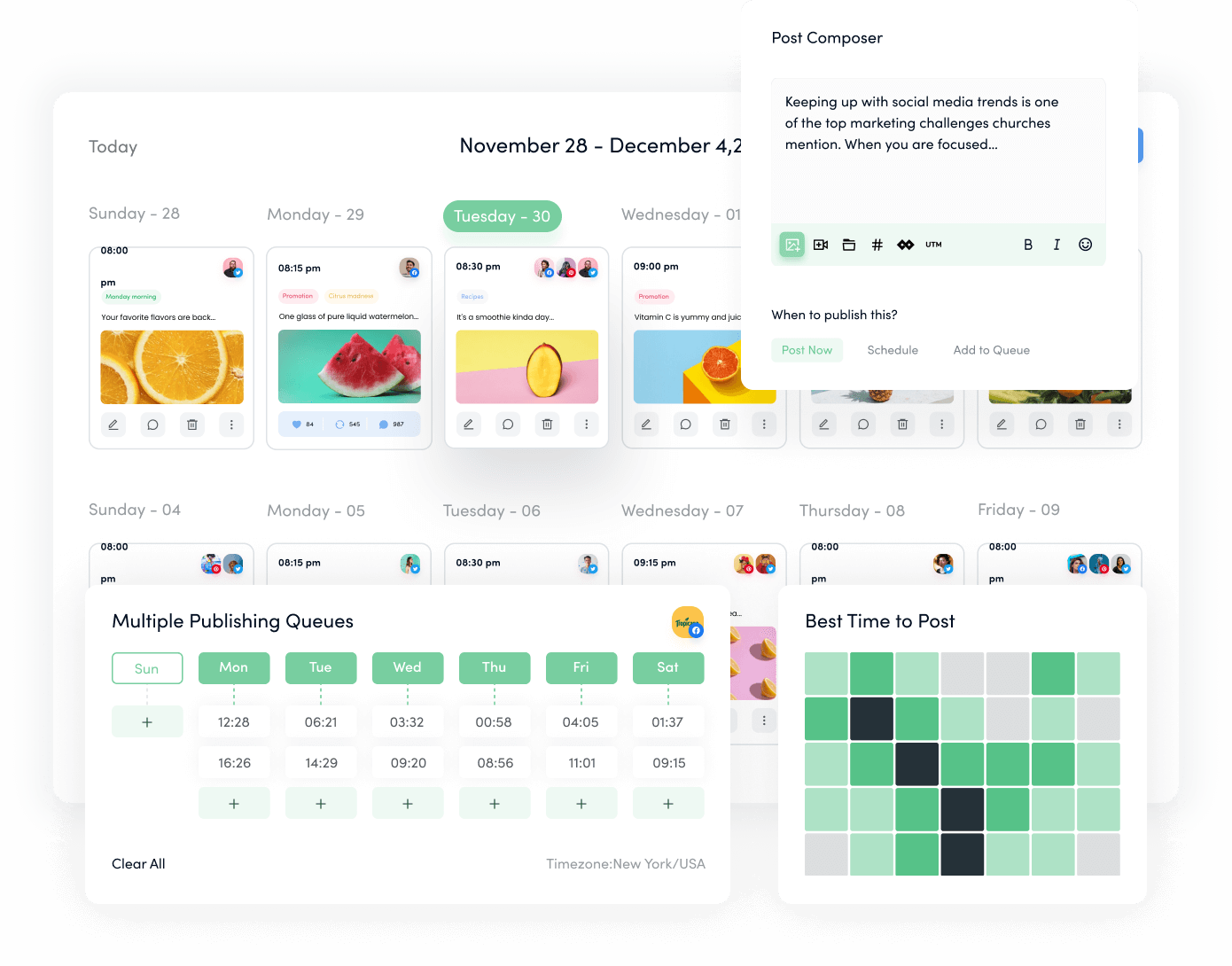
The ideal range is usually between 5 and 15 pins per day, spread across the day. Mix at least 3 to 5 fresh original pins each week with curated content or repins from complementary accounts. A consistent, sustainable rhythm works better than short bursts followed by silence.
The 3-3-3 rule is a community convention that helps marketers stay focused. It means concentrating on three core messages, targeting three audience segments, and showing up consistently across three primary channels. Spreading beyond that dilutes impact and makes it harder to measure what is actually working.
Yes, Pinterest can work well for B2B when you focus on educational and visual content. Infographics, workflow diagrams, checklists, and thought leadership quotes fit nicely into boards that target decision-makers. Service firms, SaaS brands, and consultants often use Pinterest to drive top-of-funnel traffic into email lists and nurturing content.
Pinterest affiliate marketing uses pins that link through affiliate URLs to merchant sites. When a viewer clicks a pin and completes a purchase, the creator earns commission through programs such as Amazon Associates, ShareASale, or CJ Affiliate. Best results come from evergreen gift guides, tutorials, and honest product roundups that include clear FTC-compliant disclosures.
Most businesses that pin consistently begin to see meaningful traffic growth within three to six months. Pinterest content can keep working for months or years, since pins continue to surface in search long after posting. Paid Pinterest ads can drive faster results while your organic presence gains momentum.
The best stack usually includes ContentStudio for planning, publishing, AI-assisted content, and analytics across Pinterest and other networks. Many teams also use Tailwind for additional Pinterest-specific features and Canva for quick pin designs and templates. Native Pinterest Analytics and Pinterest Trends round out the toolkit by guiding keyword choices and seasonal planning.
Pinterest recommends vertical images with a 2 to 3 ratio, such as 1000 by 1500 pixels. Aim for high-resolution JPG or PNG files so pins look sharp on both mobile and desktop. Avoid very tall “giraffe” images that can be cropped in the feed.
In most cases, no. Underperforming pins rarely hurt your account, and occasionally they begin to pick up traction later when related topics trend. Instead of deleting, focus on publishing better versions with improved visuals, headlines, and descriptions.
Yes, but with thoughtful adaptation. Short videos from Instagram or TikTok can work well as Pinterest video pins if you remove watermarks, update captions to fit Pinterest search behavior, and add a cover image with a clear headline. Static Instagram posts can often become Pinterest pins with minor tweaks to aspect ratio and text overlays.
A personal account is designed for individual use and does not include advanced analytics, advertising tools, or some shopping features. A business account provides access to Pinterest analytics, ad campaigns, Rich Pins, and audience insights.
Start with boards that reflect how your ideal customers think about their needs rather than your internal product categories. For example, a home decor brand might use boards like “Small living room ideas” or “Boho bedroom inspiration” instead of “Product line A” or “Collection 2026.”
Plan 0 Days of Content in 0 Minutes
Create, schedule, publish and analyze your content across all your social media channels from one simple dashboard.
4.7 on Capterra • 16,500+ marketers trust ContentStudio
Saif Ali is a Content Marketing Strategist at ContentStudio with over five years of experience across SaaS, IT, and digital marketing. He specializes in SEO-led content, AI content creation, and social media strategy, and leads editorial review at ContentStudio, fact-checking and refining articles for accuracy, SEO, and a consistent brand voice.
View all posts by Saif AliRecommended for you
How to promote affiliate links on social media in 2026
Multi-location social media management workflow guide
Best SaaS affiliate programs for social media marketers in 2026
19 best social media management tools to plan, schedule, and grow in 2026