LinkedIn Company page guide: How to create, optimize, and grow it
Sep 24, 202621 minutes

Written by
Arooj IshtiaqUpdated
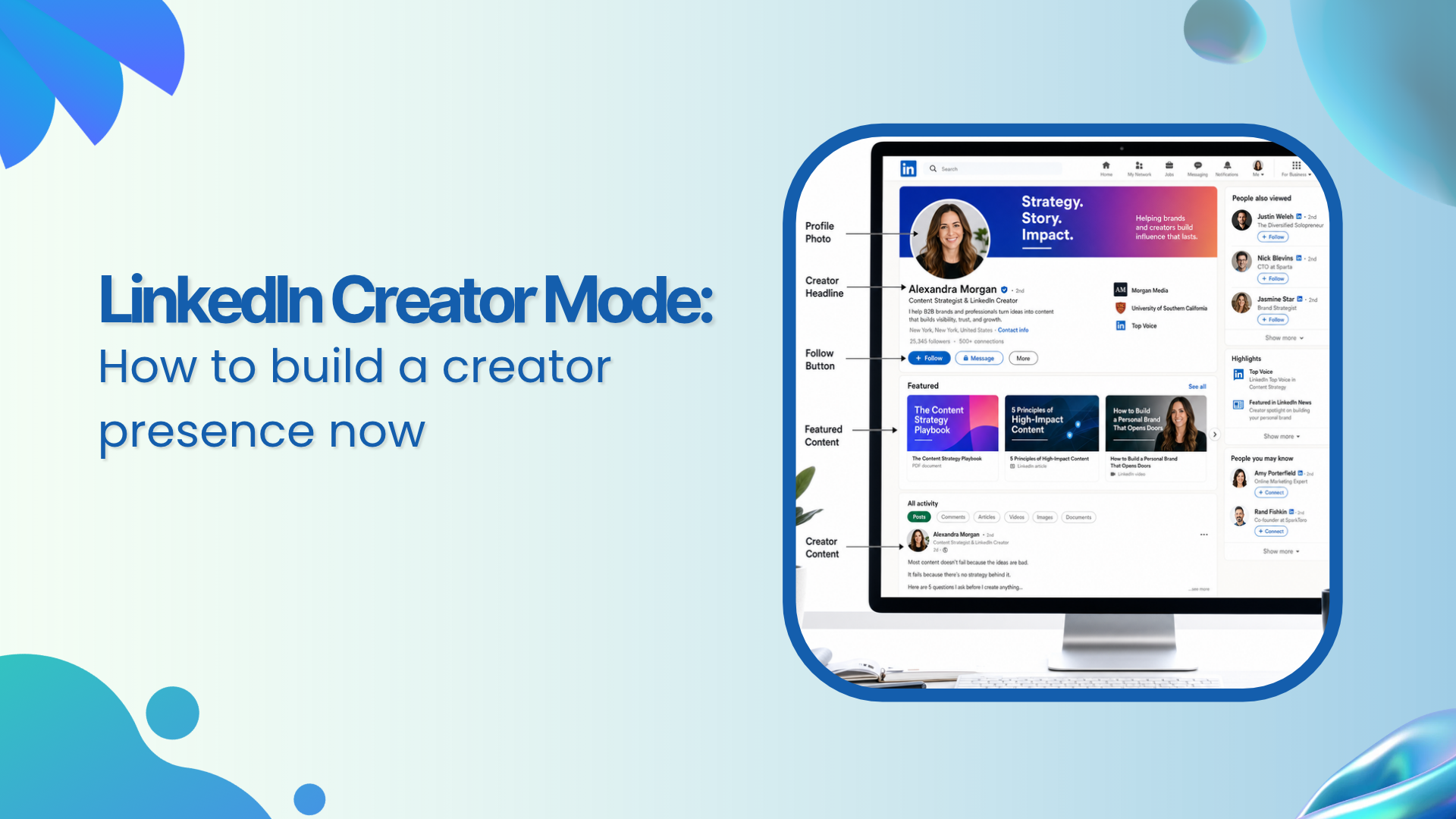
LinkedIn Creator Mode was once a profile setting that grouped creator-oriented tools, analytics, profile changes, and audience-building features under one on/off toggle. That switch no longer exists, but the work creators need to do (clarify expertise, publish useful ideas, build relationships, and learn from audience response) has not changed.
A focused LinkedIn marketing roadmap helps creators decide whether LinkedIn should support professional credibility, customer education, demand generation, career opportunities, hiring, partnerships, or community building. A consistent LinkedIn scheduling tool can then support the practical work of planning, publishing, approvals, follow-up, and review.
LinkedIn removed profile hashtags in February 2024 and removed the Creator Mode toggle in March 2024. It retained the related sharing tools and analytics for members who meet the relevant access criteria.
Use these principles to separate current facts about Creator Mode from outdated advice still circulating online.
LinkedIn Creator Mode was an optional profile setting designed for people who wanted to publish regularly and grow an audience around professional topics. It was introduced at a time when LinkedIn was expanding tools for creators, subject-matter experts, founders, executives, consultants, writers, educators, and professionals who wanted their profiles to function as more than a digital résumé.
When a member activated Creator Mode, LinkedIn grouped several features and profile changes under one setting. These could include:
Creator Mode made these options easier to find, but it did not create expertise, automatically expand reach, or turn a profile into a business. Its main function was to bundle creator-oriented profile behavior and tools into a single setting.
A lot of outdated advice suggests that activating Creator Mode automatically:
Those claims were never platform guarantees. Creator Mode could make it easier for people to follow a member and access certain creator features, but audience growth still depended on the value and relevance of the work being shared.
LinkedIn removed Creator Mode to simplify the profile experience and separate individual features from one account-wide toggle. The update made it clearer that a person does not need to identify as a “creator” to use publishing tools, follow functionality, analytics, or long-form content features.
The change happened in two stages:
| Change | Timing | What changed |
|---|---|---|
| Profile hashtags removed | February 2024 | The topic hashtags shown in the profile introduction section were removed |
| Creator Mode toggle removed | March 2024 | The Resources-section switch for enabling or disabling Creator Mode was removed |
LinkedIn stated that members would retain access to the same sharing tools and analytics after the setting was retired.
The practical result is that LinkedIn creator tools are now handled as separate functions. Instead of enabling one mode, members should decide which individual tools serve their professional goals.
No single feature replaced Creator Mode. Its former functions were unbundled into profile settings, analytics, publishing options, and access-controlled creator tools.
Creator Mode once changed the main profile button from Connect to Follow. Members can now choose which action appears first on their profile. This is not a small cosmetic choice. It shapes what a first-time visitor is encouraged to do.
| Primary action | Better for | What the profile needs |
|---|---|---|
| Follow | People who publish useful public-facing expertise regularly: creators, subject-matter experts, founders, writers, educators, executives, analysts, and speakers | A clear topic focus and a dependable body of content worth following |
| Connect | People whose work depends on curated one-to-one relationships: recruiters, job seekers, consultants, network builders, sellers, partnership leaders, and service professionals | A clear reason to connect, sensible boundaries, and thoughtful handling of requests |
The secondary option remains available. A profile that uses Follow as the primary action can still receive connection requests, and a profile that uses Connect can still be followed.
Choose Follow when your content is likely the main reason someone wants to stay connected. Choose Connect when direct professional relationships are the more valuable first step.
We removed the profile hashtags that appeared beneath a member’s introduction, sometimes described as “Talks about” topics. There is no equivalent profile-tag field to activate in 2026. Use the profile itself to communicate expertise:
A profile should not need a row of hashtags to tell a visitor what the person knows. Clear professional language is more useful and more durable.
Following the Creator Mode changes, LinkedIn emphasized the About section more prominently in the profile introduction experience. This makes the first several lines especially important. A strong About section should explain:
For example:
Specific
I help B2B SaaS teams turn recurring customer questions into clearer onboarding, customer-education, and content systems. I write about product adoption, customer experience, content operations, and the handoffs that affect time to value.
That is clearer than:
Vague
Passionate professional helping companies grow through innovation and customer success.
A well-structured profile on LinkedIn helps convert a content-driven visit into a useful professional relationship.
The Featured section is where a profile can demonstrate the expertise stated in the headline and About section. It can contain posts, articles, newsletters, documents, external links, media appearances, presentations, videos, case studies, portfolio pieces, events, or resources. Use Featured content intentionally:
If your headline says you specialize in cybersecurity governance, a Featured section with a governance checklist, a recent article, a webinar recording, and a case-based perspective provides much stronger proof than a generic motivational post.
Creator Mode once grouped post and audience analytics under a creator-oriented area. LinkedIn retained analytics after removing the toggle. Combined post analytics can help members view portfolio-level trends, while individual post analytics can reveal distribution and interaction patterns. Use analytics to answer practical questions:
Do not treat analytics as a measure of personal worth or thought-leadership status. A post can reach fewer people and still create a valuable conversation with a relevant customer, employer, partner, candidate, or community member.
A structured performance review process keeps these signals connected to real objectives rather than rewarding only high impressions.
Creator Mode was retired, but many tools associated with it remain available individually. Availability can vary by account, region, eligibility, product changes, and, in some cases, paid subscription level.
Combined post analytics show how content performs across a chosen period. They can help identify patterns across short posts, images, video, documents, events, polls, and articles.
Use them to compare content with similar jobs. A customer-education document should not be judged only against a timely opinion post. A recruiting post should not be judged by the same success criteria as a lead-generation resource. Useful review categories include:
A LinkedIn performance metrics framework can help prevent the common mistake of treating visibility, engagement, traffic, and revenue as the same measure.
A LinkedIn newsletter is a recurring long-form publication that subscribers can choose to receive. It is appropriate when the creator can make a reliable editorial promise. Good newsletter concepts are specific:
Avoid launching a newsletter simply because it is available. It needs a distinct theme, sustainable cadence, defined audience, editorial owner, and enough source material to remain useful beyond the first edition.
A newsletter works best when it complements shorter content. Posts can introduce individual insights; newsletters can provide the deeper, organized analysis that readers return to.
LinkedIn articles are useful for durable, structured content that needs more depth than a post. They can support research explanations, frameworks, case studies, operating processes, professional analysis, and detailed points of view.
Use an article when the reader benefits from headings, examples, evidence, links, visual elements, and a coherent argument. Use a post when the point is concise or conversation-led. Articles on LinkedIn can create a public body of work that shows how a professional thinks about a defined subject area. They should not become longer versions of generic tips.
LinkedIn Live and Audio Events can support interviews, webinars, panels, workshops, demonstrations, customer discussions, executive conversations, and professional communities. Use a live format only when real-time interaction adds value. A strong event needs:
Do not host a live event merely to appear active. A short, structured post may be more useful if the topic does not need conversation or demonstration.
A Follow link allows someone to follow a member’s LinkedIn content from outside LinkedIn, such as through a website, email signature, event page, resource library, or speaker bio.
It is most useful when the person regularly publishes content that offers ongoing value. Before promoting a Follow link, make sure a first-time visitor can identify:
A Follow link cannot compensate for an unclear profile or inconsistent content.
Some members may have access to a custom profile button that directs visitors to an external destination. The available button options and access can change, and certain implementations may depend on LinkedIn’s current product and subscription rules. Use the button only when the destination matches the visitor’s likely next step:
| Creator objective | Appropriate destination |
|---|---|
| Consulting or services | Service page, consultation page, or relevant case-study collection |
| Newsletter or research | Publication signup, research library, or latest edition |
| Speaking | Speaker page, event calendar, or booking inquiry page |
| Portfolio | Work samples, selected projects, or media page |
| Community | Event registration, community application, or resource hub |
| Product education | Product page, tutorial, demo, or relevant use-case library |
Do not send visitors to a generic home page if a more specific and relevant destination exists.
The practical replacement for Creator Mode is a system. It combines positioning, themes, formats, relationships, distribution, and review.
Start with a clear statement:
I help [specific audience] understand, decide, improve, or achieve [relevant area] through [experience, expertise, or approach].
Examples:
This is not a slogan. It is a positioning test. If your headline, About section, Featured content, and recent posts do not support this statement, the profile may need more focus.
A creator presence becomes easier to recognize when the content returns to a coherent set of themes. Too many unrelated subjects make it difficult for an audience to understand why they should follow. For a customer-success leader, themes might include:
For a cybersecurity expert, themes might include:
A focused LinkedIn content strategy turns these themes into a sustainable editorial system rather than a list of one-off ideas.
Choose a format because it helps the reader absorb the idea.
| Information need | Suitable format |
|---|---|
| A concise point of view or lesson | Text post |
| A process, checklist, comparison, or framework | Document carousel |
| A complex argument, case study, or detailed analysis | Article |
| A recurring editorial briefing | Newsletter |
| A demonstration, conversation, or interview | Native video or live event |
| A current question from the audience | Poll followed by a substantive interpretation |
| A durable professional resource | Article, document, or external resource linked from the profile |
Carousel posts on LinkedIn can help readers work through a process or framework one page at a time. Use them when the sequence is meaningful, not when the same point would be clearer as a short post.
Consistency does not require posting every day. It means creating enough reliable activity to build a recognizable body of work and learn what helps the audience. A sustainable rhythm accounts for:
For many professionals, two thoughtful posts per week may be more valuable than daily generic updates. The right cadence is one you can maintain while protecting quality and professional credibility.
Publishing is only one part of a creator presence. Comments, replies, reposts with context, event participation, and professional discussions can help a member become known for improving relevant conversations. A useful contribution might:
Avoid comments written solely for visibility. They may produce activity but rarely establish trust.
Not every interaction warrants a message. A reaction, a view, or a generic comment is not consent to a sales conversation.
A private follow-up is more appropriate when a person asks a specific question, references a relevant challenge, requests a resource, attends an event, or signals a genuine reason to continue the conversation. Relationship-led LinkedIn messages should acknowledge the existing context, offer something useful, and let the recipient decide whether to continue.
Creators often encounter advice that promises rapid follower growth through posting frequency, engagement pods, automated comments, copied scripts, mass connection requests, or trend-chasing. These approaches can produce visible activity but often damage relevance and trust.
A relevant audience is more valuable than a large unrelated audience. For a specialist, 500 followers who include prospective customers, peers, partners, candidates, or industry participants may be more useful than 10,000 followers with no connection to the professional focus.
Review whether new followers, profile visitors, comments, and messages reflect the intended audience. If not, adjust the topic, language, examples, and distribution approach rather than simply publishing more often.
Content can introduce the creator, but the profile needs to make that attention meaningful. A useful destination includes:
This connection between content and profile quality is why reach alone is not enough. Impression counts estimate unique exposure; they cannot show whether those viewers understood the expertise or took a meaningful next step.
For professionals who work within a company, the personal profile and Company Page should not publish the same message in the same words.
This approach gives each publishing layer a purpose and helps the audience encounter more than one useful perspective.
A creator presence should be reviewed using the goal it is designed to support. Metrics are evidence, not a ranking of personal value.
Visibility shows whether content is being seen. Review:
These signals show distribution and discovery. They do not prove relevance, trust, or commercial value.
Audience quality shows whether the content is reaching the people it was created for. Review:
Interest shows whether a person took a meaningful next step after seeing the content. Review:
Only report commercial or career impact when there is evidence connecting the activity to the result. Possible outcomes include:
A useful report explains the path from visibility to outcome rather than saying “this post generated revenue” because it had high impressions.
Creator Mode activation guides are obsolete. A more useful approach is to improve one part of the creator system each week.
| Week | Focus | Actions |
|---|---|---|
| Week 1 | Clarify profile positioning | Audit the headline, About section, experience, services, Featured section, primary action, contact details, and external destinations. Remove old Creator Mode references and profile-topic hashtags. Write one sentence that explains your audience, expertise, and professional value, and use it as the test for every profile update. |
| Week 2 | Build an editorial map | Choose three to five repeatable content themes. For each theme, list five audience questions, three examples from experience, one useful framework or checklist, one source of credible evidence, and one format that suits the topic. This creates a practical content backlog without relying on generic prompts. |
| Week 3 | Publish and participate | Publish two or three pieces of useful content. Use a mix of formats only when each format adds value. Add thoughtful contributions to relevant discussions, then respond to substantive comments on your own posts. |
| Week 4 | Review evidence and choose one test | Review visibility, audience quality, profile visits, follows, meaningful comments, messages, website activity, and relevant outcomes. Record one learning and test one variable next month, such as topic framing, format, publishing layer, profile call to action, or follow-up process. |
Avoid these common mistakes to keep your LinkedIn presence effective after Creator Mode.
There is no Creator Mode toggle to enable. Searching for it wastes time and often leads people to outdated instructions. Review individual profile settings and available tools instead.
You do not need newsletters, articles, live events, carousels, a custom button, and a Follow link to be credible. Use only the tools that make the content more useful for the intended audience.
Profile hashtags no longer exist. Do not attempt to recreate them with a headline full of hashtags or a keyword-stuffed About section. Use clear language and content themes instead.
Posting frequently without a defined professional perspective makes it hard for people to understand what you are known for. Publish from real experience, informed analysis, specific examples, and useful frameworks.
Short-term distribution tactics can distract from the work that creates long-term trust. Write for a real professional situation, make the message clear, and give people a reason to return.
Large view counts and follower totals can be useful context, but they do not show whether the audience was relevant, whether the content was understood, or whether it supported a meaningful relationship or outcome.
LinkedIn Creator Mode is no longer something to activate. LinkedIn removed the profile hashtags in February 2024 and the Creator Mode toggle in March 2024, while retaining many creator-related tools and analytics for eligible members.
The most effective current approach is to build a creator presence deliberately: choose Follow or Connect based on your relationship model, clarify your expertise in the profile, publish around a small set of relevant themes, use tools only when they make the content more useful, participate thoughtfully in professional conversations, and measure whether the right people are taking meaningful next steps.
The setting has been discontinued, but the professional opportunity remains.
No. LinkedIn removed profile hashtags in February 2024 and the Creator Mode on/off toggle in March 2024. The creator-related sharing tools and analytics were retained for members who meet relevant access criteria.
LinkedIn removed the profile hashtags, sometimes called “Talks about” topics, in February 2024. Use the headline, About section, experience, Featured content, and recurring content themes to communicate your expertise.
Depending on eligibility and availability, members may use combined post analytics, newsletters, articles, LinkedIn Live, Audio Events, Follow links, profile analytics, and custom profile buttons. Access can vary by account, geography, product updates, and subscription level.
The best replacement is a clear creator system: a well-positioned profile, a defined audience, three to five repeatable content themes, the right formats, thoughtful participation, appropriate relationship-building, and a regular review process.
No. A newsletter is useful only when you can make a clear recurring editorial promise and sustain it. A focused profile, valuable posts, relevant comments, useful documents, articles, and credible follow-up can build a strong creator presence without a newsletter.
Plan 0 Days of Content in 0 Minutes
Create, schedule, publish and analyze your content across all your social media channels from one simple dashboard.
4.7 on Capterra • 16,500+ marketers trust ContentStudio
Arooj Ishtiaq is a Content Marketing Strategist with 5+ years of experience writing about social media, SaaS, and AI. At ContentStudio, she creates practical guides, tutorials, and how-to content that help marketers navigate social media trends, sharpen their strategies, and get more from their content.
View all posts by Arooj IshtiaqRecommended for you
LinkedIn Company page guide: How to create, optimize, and grow it
LinkedIn marketing in 2026: Strategy, content, and growth

How to see scheduled posts on LinkedIn | Step-by-step
How to Use LinkedIn Hashtags Without Overdoing It