Black Friday vs. Cyber Monday: The real difference for software buyers
Oct 22, 202614 minutes

Written by
Saif AliPublished
Many SaaS marketers and social media managers have heard the term affiliate marketing tossed around next to influencer deals and referral programs, yet few can explain how it actually pays out or why it works differently from a typical ad campaign.
That gap matters, because teams that skip this channel often miss a way to add new customers without spending on ads that run no matter the outcome. Affiliate marketing is a performance-based channel where a publisher, called an affiliate, promotes a product and earns a commission only after a tracked action happens, such as a sale or a free trial signup.
This guide breaks down how affiliate marketing works step by step. We will use ContentStudio, a social media management platform that runs its own affiliate program, as a working example along the way.
Affiliate marketing is a revenue-sharing arrangement where a publisher, known as an affiliate, promotes a merchant’s product and earns a commission for every sale, lead, or click that results from that promotion. The merchant pays only when a real result happens, not simply for running an advertisement.
This flips the usual ad model on its head, since a banner ad gets paid regardless of whether anyone buys. An affiliate link, by contrast, turns into income only once someone takes the exact action the program rewards.
Think of affiliate marketing as a working agreement between two businesses with different strengths. One side builds the product, handles support, and processes payments.
The other side brings an audience already interested in that product category. Each party sticks to what it does best, and the commission reflects the value the affiliate added to the sale.
In practice, that split of labor usually breaks down into three roles working together.
Affiliate marketing gets confused with two related but distinct approaches that marketers already know well. Influencer marketing typically pays a flat fee for exposure, such as a sponsored post, regardless of whether anyone actually buys afterward.
Referral marketing relies on personal, informal recommendations between existing customers, usually rewarded with small discounts for both sides rather than a real commission.
Affiliate marketing sits apart because it is formalized, fully trackable through a unique link, and built to scale to a public audience rather than a handful of friends.
That structure is why brands can run affiliate programs with hundreds or thousands of partners at once.
Affiliate marketing works through a repeatable loop. An affiliate shares a unique tracked link, a consumer clicks it, tracking software records that click, and a resulting sale or signup triggers a commission payment back to the affiliate.
Three players make this loop possible, and each one handles a distinct piece of the transaction before money changes hands. The merchant supplies the product and the commission budget, the affiliate supplies the audience and the content, and the consumer supplies the actual conversion that pays everyone.
A typical transaction follows a clear sequence from first click to final payout.
A unique affiliate link is simply a standard product or signup URL with a special code attached that identifies which affiliate sent the visitor. Tracking software reads that code the moment someone clicks, then follows the visitor through the site until they convert or the cookie window expires.
FirstPromoter, the platform that powers the ContentStudio affiliate program, works this way, matching every signup back to the referring affiliate automatically and without manual spreadsheets.
Affiliates log into a dashboard to see clicks, conversions, and pending payouts in one place, which removes most of the guesswork around whether a promotion actually worked.
Affiliate marketing earns its popularity honestly, but it is not without real tradeoffs on both sides of the relationship.
For merchants, the biggest benefit is that spend tracks directly to results. There is no budget burned on impressions that never convert, and affiliates who already carry the right audience bring warmer traffic than most paid ads reach.
The drawback is less control: a company cannot fully dictate how an affiliate talks about its product, and a careless or misleading promotion can create a compliance headache or a bad first impression.
For affiliates, the benefit is income that does not require building or supporting a product. There is no inventory, no customer service, no billing to manage, just content and a tracked link.
The drawback is that earnings depend entirely on traffic and conversion, so a slow month for content means a slow month for income, and a program can change its terms or shut down with little warning.
Weighing it honestly, affiliate marketing tends to favor patient operators on both sides. Merchants who invest in good terms and fast payouts keep affiliates motivated, and affiliates who build real audiences rather than chasing short-term traffic tend to earn the most over time.
Not every affiliate works the same way, and recognizing the type you are, or the type you want to recruit, helps set realistic expectations for how traffic actually converts.
Most SaaS programs see the strongest results from content and comparison sites, since software purchases usually follow research rather than impulse.
Affiliate commission models decide exactly how and when a publisher gets paid, and they fall into three broad categories: one-time, tiered, and recurring. One-time models pay a single commission per sale and suit physical products or digital courses with a single checkout.
Tiered models increase the commission rate as an affiliate drives more volume, rewarding top performers with better rates once they cross set thresholds. Recurring models pay a commission every billing cycle for as long as the referred customer stays active, which is the structure most common in subscription software.
| Commission model | How it pays | Best suited for |
| One-time (pay-per-sale) | A single flat fee or percentage per completed sale | Physical products, online courses, one-time digital purchases |
| Tiered | Commission rate rises as affiliate sales volume increases | High-volume affiliates, large content sites, established partners |
| Recurring | A percentage paid every billing cycle the customer stays subscribed | SaaS tools, membership sites, subscription services |
Choosing between these models usually depends on the product itself rather than personal preference. A $30 kitchen gadget rarely supports a recurring structure, since there is no ongoing subscription to pay against.
A monthly software tool, on the other hand, naturally fits a recurring model because the merchant keeps collecting revenue long after the first referral.
Subscription revenue means an affiliate can keep earning every single month a referred customer remains subscribed, not just once at checkout. That difference compounds fast. Ten referrals paying monthly for a year generate far more lifetime income than ten one-time sales ever could.
The ContentStudio affiliate program reflects this directly, paying up to 40% recurring commission on every referred customer’s subscription, for up to 24 months depending on the affiliate’s tier. This structure rewards affiliates for sending customers who actually stick around, not just anyone who clicks once and disappears
Affiliate marketing comes with its own vocabulary, and understanding a few core terms makes reading any program’s terms sheet far easier. A cookie window is the number of days after a click during which a sale still counts toward the referring affiliate, with longer windows generally favoring the affiliate.
A payout threshold is the minimum balance an affiliate must earn before the program releases payment, often set between $50 and $100. Earnings per click, usually shortened to EPC, measures the average amount a program pays out across every 100 clicks sent by all affiliates, giving a quick way to compare how profitable one program is against another.
These terms show up across nearly every program description, so it helps to keep a quick reference on hand.
Affiliates generally find programs through one of two paths, and each comes with real tradeoffs worth weighing before signing up. Affiliate networks such as Awin and CJ Affiliate aggregate thousands of merchants inside a single dashboard, which simplifies reporting and payments but adds a network fee that can shrink commissions.
Direct programs, like ContentStudio’s, are run in-house by the company itself, often require no account or network sign-up, and tend to offer higher commission rates since there is no middleman taking a cut.
| Factor | Affiliate network | Direct program |
| Setup | One dashboard for many merchants | Sign up directly with the brand |
| Commission rate | Often reduced by network fees | Usually higher, no fee deducted |
| Merchant relationship | Indirect, managed through the network | Direct, closer communication |
| Best for | Beginners wanting many options at once | Affiliates focused on a specific brand |
Affiliate marketing matters for SaaS and social media marketers because both sides of the equation fit the model unusually well. SaaS products carry low fulfillment costs since there is no physical shipping, high lifetime value because customers pay monthly instead of once, and a trial-based buying process that gives affiliates an easy, low-risk recommendation to make.
Social media marketers and agencies, meanwhile, already use and recommend these tools daily, which makes them natural affiliates rather than paid spokespeople reciting a script. A marketer who genuinely relies on a scheduling or analytics tool can talk about it with real specifics, which tends to convert better than generic sponsored content ever does.
This overlap also benefits merchants directly, since affiliates who already serve the exact target audience bring warmer, more qualified traffic than broad advertising ever reaches.
This is also where the new “Should your SaaS company run an affiliate program?” section goes, directly after the platform list below. Order within this gap: platform list first, then the merchant side section, then straight into the existing ContentStudio section.
Several platforms in the social media management space run their own affiliate or partner programs. If you already use or write about any of these, it is worth checking whether a program exists before assuming you would need to start from scratch. Here a few of the best social media saas affiliate programs:
Flip the perspective for a moment. If you are the one building the SaaS product rather than promoting someone else’s, affiliate marketing solves a different problem: how to grow without paying for traffic that never converts. A SaaS company only pays a commission once a real signup or sale happens, which makes the channel far less risky than a fixed ad budget that spends the same whether anyone buys or not.
The tradeoff is time and structure rather than money. Launching a program means a handful of real decisions up front.
Recurring commissions tend to make the most sense for subscription products, since they reward affiliates for sending customers who stick around rather than ones who churn after a month. A company that already has happy customers, a reviewable product, and some early word of mouth usually has what it needs to start small and expand the program as it proves out.
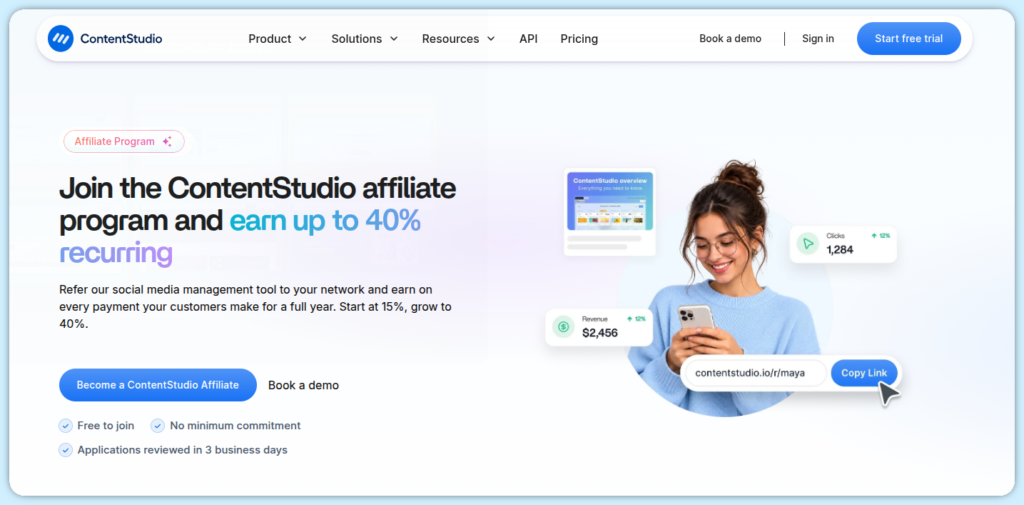
ContentStudio puts these ideas into practice through a program open to any marketer, agency, or creator, not only existing customers. Signing up takes three simple steps, and every referral is tracked transparently through FirstPromoter so affiliates can see clicks and conversions in real time.
Commission starts at 15% and climbs to 40% as an affiliate refers more active customers, paid for 12 months on most tiers and extended to 24 months at the top tier. Marketers who already recommend social media tools to clients or followers can explore the ContentStudio affiliate program to see the full terms and sign-up flow.
Bullets to flesh out the section:
An affiliate program is worth promoting when its commission structure, tracking, and product quality all hold up under scrutiny, not just when the headline percentage looks appealing.
Commission type and rate matter most obviously, but cookie duration, payment threshold, and how often the program actually pays on time deserve just as much attention before committing audience trust to it.
A trustworthy, well-reviewed product converts better than a flashy one regardless of the commission rate attached to it, since no amount of persuasive writing fixes a product that disappoints buyers after purchase.
Before promoting any program, a few checks separate the solid opportunities from the risky ones.
A few recurring mistakes separate affiliates who build lasting income from ones who burn out after one or two programs.
Avoiding these is less about any single trick and more about treating affiliate promotion the way you would treat any other long-term content strategy: consistent, honest, and built around products you would stand behind regardless of the commission attached.
Program terms exist to protect both the brand and the affiliates promoting it, and ignoring them creates real legal and reputational risk. The Federal Trade Commission requires clear disclosure of any affiliate relationship, using plain language like “affiliate link” or hashtags such as #ad and #affiliate placed where readers cannot miss them.
Programs also set rules against spam, false claims, or promotion on low-quality sites, since one bad actor can damage trust in the entire partner network. The affiliate terms and conditions lay out exactly this kind of guidance, giving affiliates a clear standard to follow from day one.
Social media marketers already hold most of what affiliate marketing requires, since the audience, the content habits, and the platform familiarity are already in place.
The real work is picking the right product and program, then folding promotion into content you already produce rather than starting a separate project from zero.
Most marketers overestimate how much new infrastructure this takes, when in reality the first campaign can run through an existing newsletter, blog, or social feed.
A simple path to a first campaign looks something like this.
Affiliate marketing comes down to a trackable loop: an affiliate shares a link, a consumer clicks it, a cookie records the referral, and a conversion triggers a commission. That loop works whether the product costs $20 once or $50 a month, though the payout behind it changes a lot between one-time sales and recurring revenue.
If you already create content for social platforms, blogs, or newsletters, the audience piece is likely already solved. What remains is picking a program that fits your niche and promoting it honestly, disclosure included.
Explore the ContentStudio affiliate program to see how a recurring commission model works once you put it into practice.
No, affiliate marketing and dropshipping work quite differently. Affiliates never touch inventory, shipping, or customer payments; they create content and share a tracked link, earning a commission once someone buys through it. Dropshippers, by contrast, run an actual storefront, set their own prices, and manage customer orders even though a third party ships the product.
Earnings depend heavily on audience size, niche, and the commission structure attached to each program. Beginners often earn $0 to $500 monthly during their first year, while experienced affiliates with engaged audiences can reach $1,000 to $5,000 or more. Recurring SaaS commissions, like the tiered recurring model offered by ContentStudio, pay 15% to 40% for 12 to 24 months depending on tier.
No, a website is not required to start. Social platforms, YouTube channels, and email newsletters all support affiliate links without an owned site. A website helps build lasting organic search traffic over time, but plenty of affiliates earn through social posts and video content alone.
A cookie window is the set number of days after a click during which a purchase still counts toward the referring affiliate. A short 7-day window only credits quick buyers, while a 30-day or longer window benefits affiliates promoting SaaS free trials, since buyers often convert weeks after their first click.
Yes, joining does not require an existing ContentStudio account. The sign-up process takes three simple steps and stays open to marketers, agencies, and creators who understand the platform’s value, even without having paid for a subscription themselves.
Plan 0 Days of Content in 0 Minutes
Create, schedule, publish and analyze your content across all your social media channels from one simple dashboard.
4.7 on Capterra • 16,500+ marketers trust ContentStudio
Saif Ali is a Content Marketing Strategist at ContentStudio with over five years of experience across SaaS, IT, and digital marketing. He specializes in SEO-led content, AI content creation, and social media strategy, and leads editorial review at ContentStudio, fact-checking and refining articles for accuracy, SEO, and a consistent brand voice.
View all posts by Saif AliRecommended for you
Black Friday vs. Cyber Monday: The real difference for software buyers
Black Friday social media post ideas: Captions and posting plan for 2026
Black Friday and Cyber Monday social media checklist 2026
Cyber Monday social media post ideas: Captions, hashtags & retargeting posts