Black Friday vs. Cyber Monday: The real difference for software buyers
Oct 22, 202614 minutes

Written by
Saif AliUpdated
Most guides that promise to show you how to make money with SaaS affiliate programs skip the one thing that actually matters: the math behind recurring commissions.
They list ten programs, slap on some generic tips, and leave you guessing whether any of it adds up to real income. The truth is that software subscriptions pay differently than retail products, and that difference changes everything about strategy.
A single referral can pay you every month for years instead of once. Let’s see how SaaS affiliate marketing actually works, how to pick programs worth your time, and what it takes to turn a handful of referrals into a dependable income stream in 2026.
Before the full breakdown, here are the core answers most readers want fast.
SaaS affiliate marketing is a performance-based arrangement where you earn a commission for every person who signs up, trials, or pays for a software product through your link. Instead of paying for ads with no guarantee of return, software companies only pay you once a real action happens, which keeps the system fair for both sides.
This setup differs sharply from traditional retail affiliate programs, where you usually earn a single small commission on a one-time purchase and nothing more after that.
Why recurring commissions create passive income
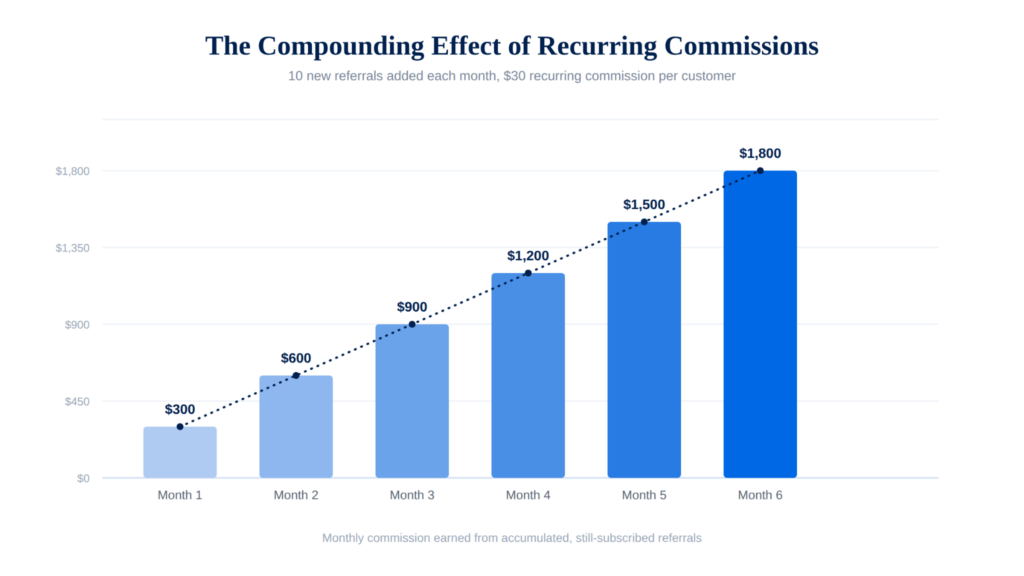
Recurring commissions create passive income because one referral keeps paying you long after the original sale is closed. Picture referring 10 new customers a month to a tool paying a lifetime recurring rate.
By month 12, you are not earning for 10 customers; you are earning for all 120 accumulated referrals still subscribed. That stacking effect is the entire reason recurring models beat flat one-time fees for anyone playing the long game.
Choosing the best SaaS affiliate programs comes down to matching commission structure, payout reliability, and product fit to your specific audience rather than picking the program with the biggest headline number.
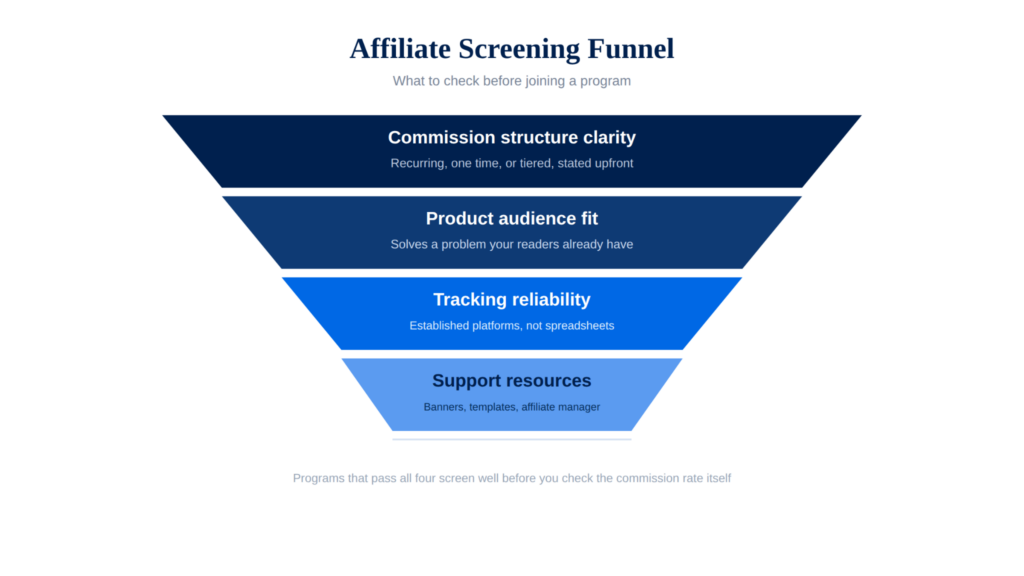
A high percentage on a product nobody renews is worth less than a modest percentage on a product people keep paying for year after year, so retention matters as much as the rate itself. Before joining any program, check a few basics that separate serious partners from programs that waste your traffic.
Avoid the trap of joining a program purely because it advertises a 70% commission if the product has high refund rates or a short average customer lifespan.
A lower rate on a sticky, well-reviewed product often earns more over 12 months than a flashy number on a product people cancel within weeks.
Different SaaS affiliate programs structure payouts in different ways, and understanding each model helps you judge an offer quickly instead of guessing. The table below compares the three common structures affiliates run into most often.
| Model | How it pays | Best for |
| Recurring | A percentage every billing cycle for as long as the customer stays subscribed | Long-term passive income and compounding growth |
| One-time | A single flat fee or percentage paid once at signup | Quick cash flow, but no ongoing upside |
| Tiered | Rate increases as you refer more customers or hit volume milestones | Affiliates with growing traffic or an established audience |
ContentStudio’s program is a clear example of the recurring model, paying 15% to 40% on every billing cycle, for 12 to 24 months depending on tier, rather than a single payout that stops after the first month.
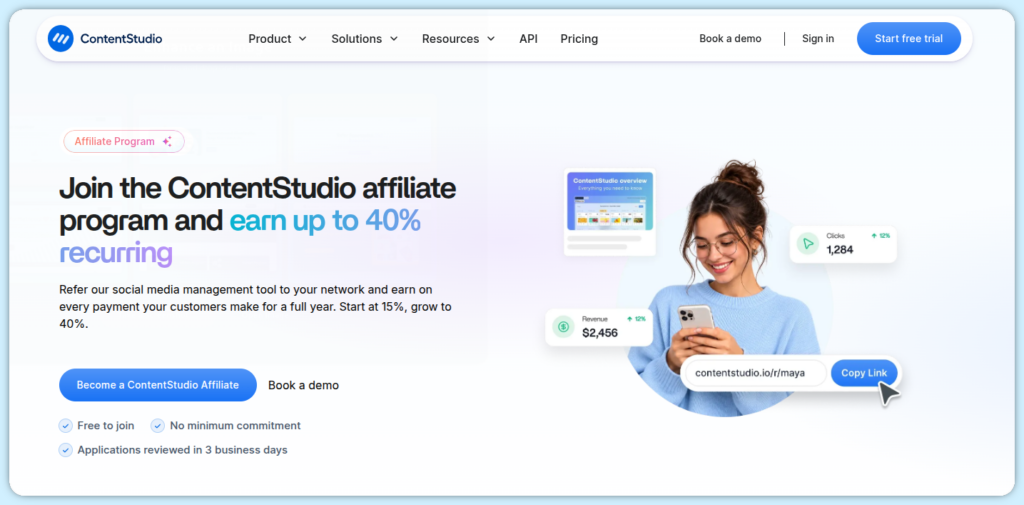
ContentStudio’s affiliate program stands out in 2026 because it pairs a 15% to 40% recurring commission, running 12 to 24 months depending on tier, with a product that does not require affiliates to already be paying customers themselves.
That second detail matters more than it sounds, since many SaaS programs quietly expect you to own an account before you qualify to promote, which shuts out creators who simply want to earn.
Onboarding takes three steps: you sign up, receive your affiliate link, and start promoting right away, with tracking and payouts handled through FirstPromoter, a dedicated referral platform built for accurate attribution.
The product itself is an AI-powered social media management and content marketing platform used by more than 16,500 customers, covering scheduling, content discovery, approval workflows, and AI writing tools across networks like Instagram, LinkedIn, Pinterest, TikTok, and Facebook.
The platform fits a wide range of affiliate niches because its customer base spans solopreneurs, digital agencies, e-commerce brands, and in-house marketing teams managing multiple social profiles at once.
An agency that needed client approval workflows found the platform solved a bottleneck that was slowing down their entire content process. That breadth means affiliates writing for very different audiences, from freelance consultants to enterprise marketing departments, can all find a natural angle for recommending the same tool.
Starting to make money with SaaS affiliate marketing as a beginner means picking a narrow niche first, joining two or three well-matched programs, and publishing content before worrying about scale.
Trying to promote ten unrelated tools at once spreads your effort too thin and confuses any audience you are trying to build trust with. The process works best as a sequence rather than everything happening at once, so treat your first 90 days as a test, not a launch.
Starting small and measuring results before committing months of work protects you from wasting energy on a program or niche that was never going to convert well for your specific audience.
Finding the right niche means looking at the problems your audience already brings to you, then matching those problems to software that solves them directly.
A marketing consultant working with small agency clients, for example, pairs naturally with a social media management tool like ContentStudio, since scheduling and approval workflows are problems those clients already mention.
Rather than targeting obvious terms like “best social media tool,” successful affiliates often target the problem itself, writing about approval bottlenecks or content calendar chaos before the reader even knows a tool like this exists.
This trigger-word approach reaches people earlier in their search, when competition for attention is lower, and intent is still forming.
Also Read: Best SaaS affiliate programs for social media marketers in 2026
The strategies that actually drive SaaS affiliate sales combine educational content, demonstration-based formats, and consistent presence across the channels your specific audience already trusts.
Direct product pitches rarely convert well in software because buyers want proof a tool solves their exact problem before they commit a monthly budget to it.
Research on purchase behavior shows that 90% of consumers consider recommendations and reviews important to their decisions. Several channels show up again and again among affiliates who earn consistently.
Building a simple comparison guide or calculator gives readers immediate value while naturally leading them toward your affiliate link.
A basic tool comparing scheduling features across social media platforms, for instance, can end with a clear recommendation and a link rather than feeling like an advertisement bolted onto the page.
Modern AI assistants like ChatGPT or Claude make building these small tools accessible to affiliates without coding experience, which has lowered the barrier to creating genuinely useful assets.
A simple three-page site, a landing page, a tool, and a comparison or information page, is often enough to start generating steady referral traffic.
Realistic earnings from SaaS affiliate programs depend almost entirely on how many active, paying referrals you accumulate over time rather than how much traffic you send in a single month.
Picture referring 10 customers monthly to a program paying 30% recurring commission on a $100 monthly plan; that is $30 per customer, or $300 in month one.
If those customers stay subscribed and you add 10 more each following month, by month six you could be earning close to $1,800 monthly from accumulated referrals alone, without any extra promotional work beyond keeping your existing content live.
That is the compounding effect recurring commissions create, and it only works if you track performance closely enough to know what is actually converting.
Several mistakes consistently limit how much affiliates earn, and most of them are avoidable with a bit of discipline. Promoting too many unrelated programs confuses your audience about what you actually stand for, while chasing raw traffic volume over qualified leads produces clicks that rarely convert.
Skipping proper disclosure of affiliate relationships also creates legal risk and quietly erodes the trust that makes your recommendations work in the first place.
Making money with SaaS affiliate programs comes down to two things that compound together: picking programs with recurring commissions and staying focused enough in one niche to build real authority there.
Chasing the highest percentage without checking retention, or spreading your effort across ten unrelated products, both slow down the compounding effect that makes this model worth pursuing at all.
A program like ContentStudio’s 15% to 40% recurring commission, running 12 to 24 months depending on tier, paired with a product people actually renew, gives you a reasonable starting point to test this approach for yourself.
From there, the path is simple: join a program that fits your audience, publish focused content consistently, and track your numbers closely enough to know what is actually working before you scale it further.
Most SaaS affiliate programs pay between 20% and 70% commission, depending on the product and pricing model. Recurring percentage structures, where you earn every billing cycle, generally outperform flat one-time fees over a full year, even when the flat fee looks larger on paper at first glance.
No, a large following is not required to succeed with SaaS affiliate marketing. A smaller, niche-focused audience with high intent, people actively searching for the exact problem your software solves, often converts better than a broad but unfocused audience with no clear shared need.
Most SaaS affiliate programs have straightforward sign-up requirements and approve applicants quickly. Some programs, including ContentStudio’s, do not even require you to hold an existing account with the product before joining, which removes one of the more common barriers beginners run into.
It depends on the specific program’s terms. Some programs, like Statusbrew or SocialBee, pay recurring commissions for the entire length of the customer’s subscription, while others, like ContentStudio’s 15% to 40% structure, cap recurring payouts at 12 to 24 months depending on tier before payments stop entirely.
Yes, a full-time income is possible with consistent effort over months or years, not weeks. Affiliates who build recurring referrals across a few well-matched programs and keep publishing focused content see their monthly income grow as accumulated subscriptions compound rather than staying flat.
The best way to track performance is through the affiliate dashboard each program provides, watching clicks, conversion rate, and earnings per click closely. Programs using established tracking infrastructure, such as FirstPromoter, give more reliable attribution than informal or manual tracking methods.
Plan 0 Days of Content in 0 Minutes
Create, schedule, publish and analyze your content across all your social media channels from one simple dashboard.
4.7 on Capterra • 16,500+ marketers trust ContentStudio
Saif Ali is a Content Marketing Strategist at ContentStudio with over five years of experience across SaaS, IT, and digital marketing. He specializes in SEO-led content, AI content creation, and social media strategy, and leads editorial review at ContentStudio, fact-checking and refining articles for accuracy, SEO, and a consistent brand voice.
View all posts by Saif AliRecommended for you
Black Friday vs. Cyber Monday: The real difference for software buyers
Black Friday social media post ideas: Captions and posting plan for 2026
Black Friday and Cyber Monday social media checklist 2026
Cyber Monday social media post ideas: Captions, hashtags & retargeting posts