Meta ads benchmarks 2026: Average CPM, CPC, and CTR by industry
Aug 20, 202617 minutes

Written by
Arooj IshtiaqUpdated
A practical guide to connecting accounts, scheduling content, managing messages, reviewing performance, and controlling team access in Meta Business Suite.
Meta Business Suite is Meta’s free workspace for managing a business presence on Facebook and Instagram. It brings publishing, messages, comments, insights, and access to advertising tools into one place on desktop and mobile. Supported WhatsApp Business connections can also bring customer messages into its Inbox. Advertising spend is separate from using the management tools.
Meta Business Suite can be used to prepare content, schedule supported posts, answer customer questions, and review performance. Those tasks depend on having the correct accounts connected and the right permissions assigned.
This guide explains how the pieces fit together, how to complete the main workflows, and when an additional social media management platform may be useful.
Meta Business Suite helps manage several recurring tasks without opening each connected account separately.
| Task | What Business Suite provides |
|---|---|
| Publishing | Create and schedule supported Facebook and Instagram content |
| Planning | Review upcoming content in a calendar |
| Customer communication | Read and reply to supported messages and comments |
| Automation | Configure available automated responses |
| Measurement | Review content, audience, and performance insights |
| Advertising | Boost content, create supported ads, and access Ads Manager |
| Access management | Manage people and business assets through Settings |
These functions are related, but they are not identical across every channel or account. WhatsApp Inbox support, for example, does not mean WhatsApp has the same publishing workflow as an Instagram feed.
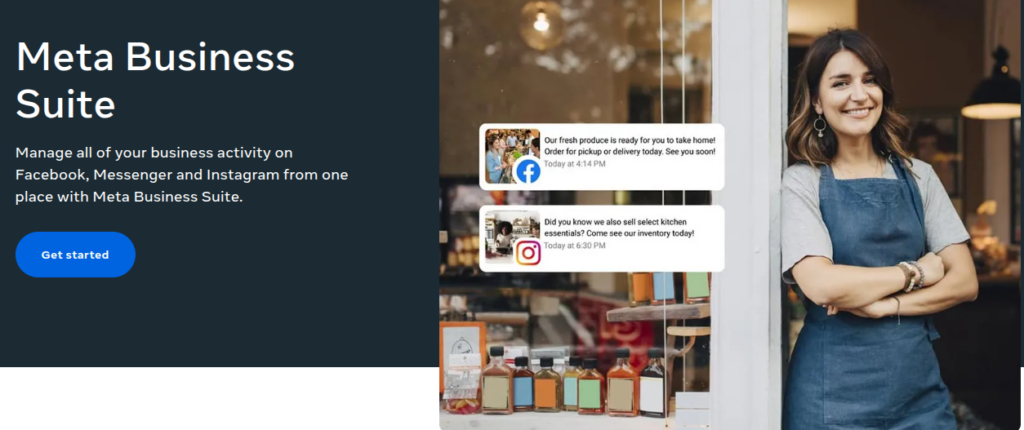
Meta Business Suite is free to use. Scheduling content, checking available insights, and managing supported conversations do not require a social media management subscription.
Running ads is different. A boost or campaign uses an advertising budget, and the relevant account needs an appropriate payment arrangement. Access to Business Suite should not be confused with free advertising.
Meta’s terminology can be confusing because older names, settings pages, and related tools appear within overlapping navigation. The clearest distinction is the job each part performs.
| Term | What it means in practice |
|---|---|
| Meta Business Suite | The workspace for day-to-day publishing, communication, insights, and related business tools |
| Business portfolio | The structure that groups assets such as Pages, Instagram accounts, and ad accounts |
| Business settings or portfolio settings | Where people, assets, permissions, and business information are managed |
| Ads Manager | The dedicated tool for advertising campaign management |
| Events Manager | A related tool used for event data and measurement setup |
Meta’s own documentation describes Business Suite settings as the place to manage portfolio information, people, accounts, and data sources. It also identifies Ads Manager as an additional tool accessible from Business Suite.
“Business Manager” still appears in older instructions and some navigation. Rather than treating it as a paid tier or a completely unrelated account, the actual task should be identified: publishing, managing access, running ads, or configuring measurement.
For a Facebook Page workflow, the following should be in place before starting:
• A Facebook profile with permission to manage the Page.
• The correct business Page.
• Access to the intended business portfolio, if applicable.
• The Instagram account to connect.
• The appropriate WhatsApp Business account, if that messaging connection is needed.
Meta states that access through a Facebook profile depends on having the correct permissions on the organization’s assets. Portfolio membership alone also does not establish access to every asset: people must be assigned the assets they need.
Advertising setup should be kept separate. Payment details, website measurement, and other advanced configurations should be added when the intended workflow requires them, not presented as prerequisites for every person who wants to schedule a post.
Meta Business Suite should be opened on desktop or through the mobile app. For the desktop route described by Meta, sign in with the Facebook profile that has permission to manage the organization’s assets, then confirm that the intended Page or business is selected.
If an expected asset is missing, access should be investigated before creating duplicate Pages or portfolios.
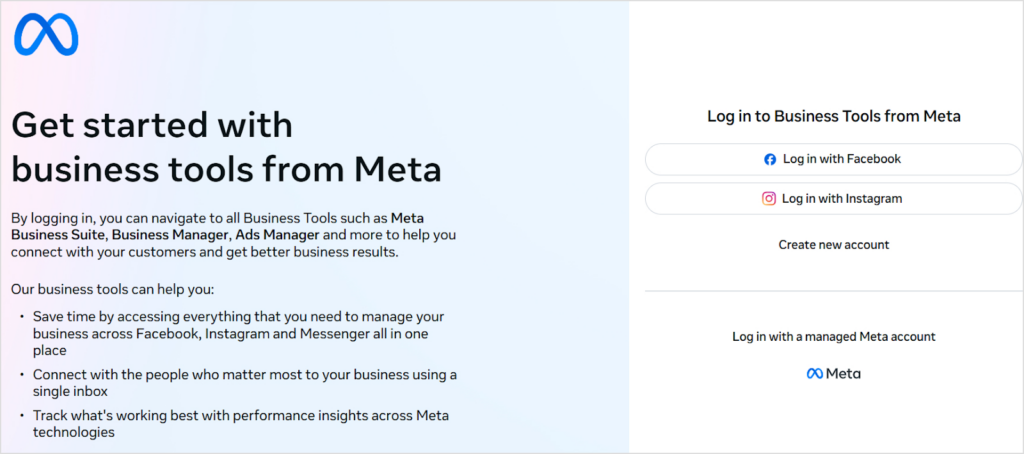
Settings should be opened and the relevant Accounts or Business assets area inspected. Meta’s settings documentation covers Facebook Pages, Instagram accounts, WhatsApp accounts, and ad accounts. These are separate asset types, and adding a saved login is not the same as adding a business asset.
Interface labels can vary. The asset name and ownership context should be checked rather than relying only on the position of a menu item.
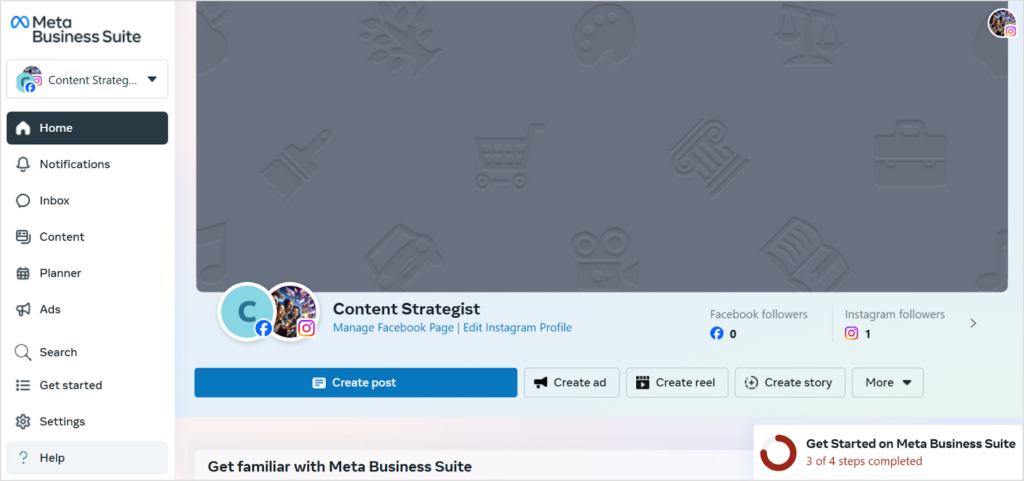
The documented desktop workflow uses Settings, Business assets, and the option to add an Instagram account. It then requires authentication with the intended Instagram account and any applicable security check.
After connecting, the following should be confirmed:
• The correct Instagram handle appears.
• The intended people have access.
• The publishing options needed are available.
• Message access is enabled if Inbox is part of the plan.
Meta specifically notes that connecting Instagram to Business Suite involves a message-access setting. An account connection and access to its messages should not be treated as the same check.
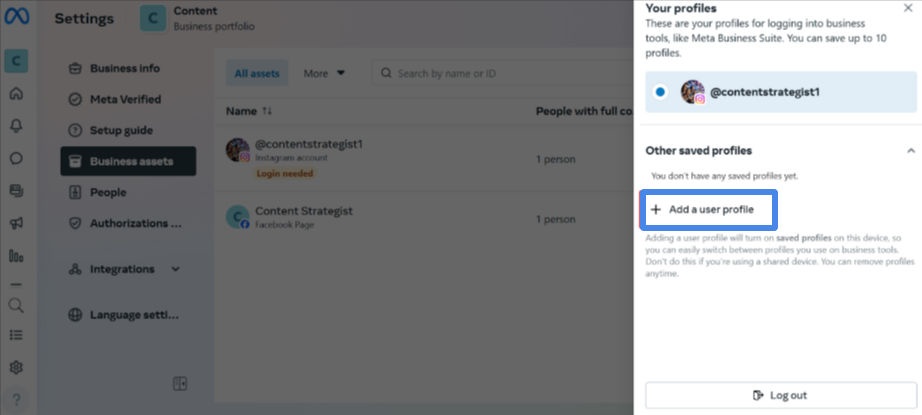
Meta provides a separate workflow under Settings, Accounts, and WhatsApp accounts. Its documented process requires full control of the business portfolio. Linking an existing account includes selecting the country code, entering the number, and completing verification through WhatsApp. A WhatsApp Business account can belong to only one business portfolio.
Afterward, the account should be confirmed as synced with Inbox if centralized messaging is the objective.
People need access to the portfolio and the relevant assets. Current Meta documentation distinguishes:
• Full control: broad management authority.
• Partial access: access to assigned assets or tasks.
• Additional finance permissions where applicable.
A person can have full control of an asset without having full control of the entire portfolio. That distinction matters when deciding who can manage settings, people, or business resources. Access required for the job should be granted. Someone responding to messages does not automatically need authority to change portfolio ownership or financial settings.
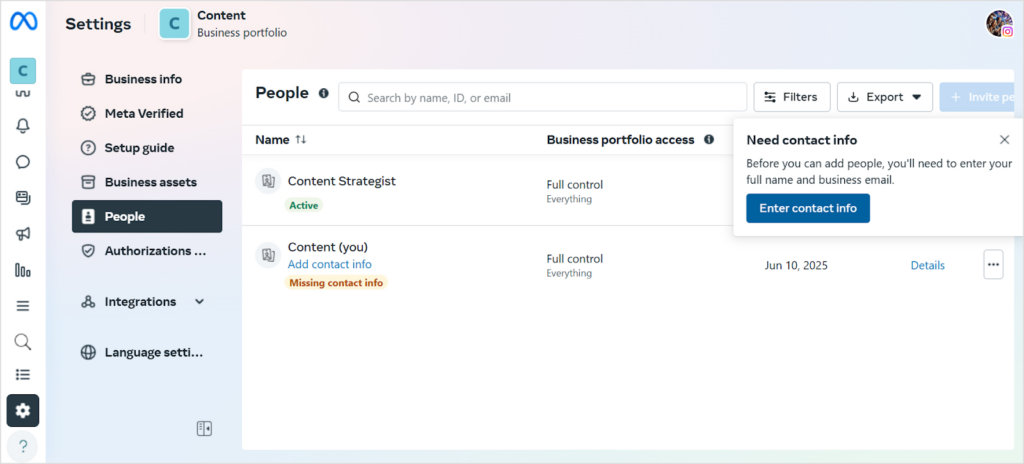
Named access should be used rather than shared credentials. The business should retain appropriate control over its assets, and access should be reviewed when employees or agencies change.
Permissions are a functional part of setup, not an administrative detail: they determine which tools and assets a person can use.
Meta Business Suite can be used to prepare content, schedule supported posts, answer customer questions, and review performance. Teams that need to manage additional networks or approval workflows alongside this can use a social media scheduler for those requirements
The relevant creation option should be started from Home, Content, or Planner. The Facebook Page, Instagram account, or both should be selected where supported. Then the media and text should be added. Business Suite supports preparing content for both platforms within a connected publishing workflow.
Cross-posting should not mean skipping the platform-specific review. The following should be checked:
• Media cropping and orientation.
• Caption wording.
• Links and calls to action.
• Tags and other available options.
• Whether the post still makes sense on each selected platform.
Every feature available in a native Instagram or Facebook creation screen should not be assumed to also be available in a scheduled workflow.
For the Facebook Page-post workflow documented by Meta, the Set date and time option should be turned on under Scheduling options, the time chosen, and Schedule selected.
Meta currently specifies a scheduling window between 20 minutes and 29 days for that workflow. It also states that scheduling uses the current time zone. This should not be generalized into a universal limit for every format. The time zone should be checked before scheduling a campaign or a time-sensitive announcement.
Planner should be opened and the scheduled item inspected. Meta’s documented controls include editing, duplicating, rescheduling, moving the post to drafts, and deleting it.
For a campaign, the sequence as well as the individual posts should be reviewed. The announcement should precede the reminder, and an offer should not publish after its deadline.
Meta’s official introduction documents scheduling for Facebook and Instagram posts and Stories. The available creation options should be checked for the specific account and format before planning the release.
For Reels and other video workflows, the current interface should be inspected rather than assuming that all feed-post controls also apply.
The exact features needed, such as audio, effects, collaboration, or tagging, should be checked before finalizing the content. If the required option is unavailable in the scheduled route, the workflow may need native completion instead.
Business Suite Inbox can bring messages from Messenger, Instagram, and supported WhatsApp connections into one place. It also supports reading and responding to comments on connected Facebook and Instagram posts.
Platform filters should be used when a combined view becomes difficult to manage. A customer may contact the business through more than one channel, but those interactions should not automatically be treated as one continuous conversation.
Meta documents searching Inbox by people, labels, or message content, along with managing customer information. That can help a team find an existing conversation or organize follow-up. It does not remove the need to handle personal information through an approved business process.
Before centralizing messages, a decision should be made about who handles:
• Routine questions.
• Complaints.
• Sales inquiries.
• Sensitive information.
• Cases requiring another team.
Centralizing messages makes them easier to see, but it does not ensure someone is responsible for answering them.
Meta Business Suite supports automated responses for common questions. Its official guidance identifies this as part of Inbox, not a reason to automate every customer interaction.
The available Automations area should be opened and the options shown for the connected channel reviewed.
Before activating a response, the following should be defined:
• What triggers it.
• Which channel it applies to.
• What the person receives.
• Whether a human needs to follow up.
• When the response should stop being used.
A useful acknowledgement can confirm that a message was received and explain the next step. It should not claim that an order was changed or a refund processed unless the connected workflow actually performs that action.
Important: Test from a separate account and review the experience before leaving any automation active.
Insights helps you review content, audience, and performance information. Meta describes it as a way to understand trends, shared content, and audience characteristics. The most useful workflow starts with a question.
| Question | What to inspect |
|---|---|
| Which content received attention? | Available reach, viewing, and interaction measures |
| Which topics prompted useful responses? | Post-level results and relevant conversations |
| Is performance changing? | Comparable reporting periods |
| Did paid distribution contribute? | Available paid and organic breakdowns |
| Are we reaching the intended audience? | Available audience information |
| Did a campaign achieve its objective? | Relevant campaign results and measurement setup |
The date range, account, format, and metric definition should be kept consistent. A longer reporting period may produce a larger total without indicating better performance. A promoted post should not be evaluated as if it had the same distribution conditions as an unpromoted one.
A reaction, message, lead, and completed sale are different events. The available data should be used to describe what happened, and the places where additional measurement is needed should be identified. Engagement alone should not be labeled as proof of revenue or return on investment.
Business Suite supports reporting and exports, but the available fields and views should be checked in the account. Automated email delivery should not be promised unless that exact workflow has been verified.
Business Suite provides access to advertising functions, including creating supported ads and boosting posts. Ads Manager is also available as a related tool.
The important distinction is between:
• Publishing organic content.
• Paying to distribute a post.
• Managing a more detailed advertising campaign.
Advertising setup should follow a defined objective, audience, budget, and measurement plan. Payment-method controls also depend on permissions: Meta limits payment-method changes to people with the relevant portfolio or finance access.
Website-event measurement and other advertising infrastructure are separate tasks. They should not be presented as mandatory steps for every organic publishing user.
The following should be checked:
• The selected business portfolio.
• Whether the asset belongs to that portfolio.
• Whether the profile has access.
• Whether the asset has been assigned.
Meta explicitly distinguishes adding a person to a portfolio from assigning the assets that person can manage.
The Instagram connection and the message-access setting should be reviewed. Meta states that message access is addressed when connecting Instagram and that the account may require another sign-in for security. The publishing connection should not be assumed to prove Inbox access is configured.
Whether full control of the portfolio exists and whether the account already belongs to another portfolio should be checked. Meta lists both as relevant conditions for adding WhatsApp Business accounts.
The selected asset, permissions, format, and scheduling date should all be checked. For the documented Facebook Page-post workflow, Meta specifies Facebook or task access, a supported date window, and the current time zone.
Business assets should not be deleted or disconnected as an initial troubleshooting step. The issue should first be established as concerning permissions, ownership, the selected account, or the specific feature.
Its core publishing workflows serve Facebook and Instagram. WhatsApp support concerns its own business-account and messaging functions. A team publishing to LinkedIn, TikTok, or other non-Meta networks needs a separate workflow for those channels.
Meta provides detailed portfolio and asset permissions. That should not be dismissed as lacking team controls. However, permission to publish is different from an editorial process requiring a named reviewer to approve a draft. That requirement should be evaluated separately.
Business Suite provides useful native performance information. It should not be described as inadequate simply because it does not combine results from unrelated networks. Cross-network reporting is a different requirement, with its own metric-definition and comparability challenges.
Publishing formats, messaging connections, permissions, and related tools do not all behave identically. The intended workflow should be tested before it becomes central to a campaign.
ContentStudio provides a separate workspace for supported publishing, approvals, inbox interactions, AI assistance, and reporting. Its relevance depends on the workflow the team needs, not merely on whether the business is growing.
| Requirement | What to evaluate |
|---|---|
| Facebook and Instagram publishing | Whether native Business Suite already covers the required formats |
| Additional social networks | ContentStudio’s support for the specific accounts and formats |
| Editorial sign-off | ContentStudio’s Anyone or Everyone approval settings |
| Repeatable publishing themes | Content categories and predefined queue slots |
| AI-assisted replies | Supported accounts, review mode, instructions, and usage limits |
| Client reporting | Required metrics, exports, branding, and plan access |
ContentStudio documents both Anyone and Everyone approval conditions. It also provides content-category queue slots, which can reduce repeated manual time assignment. Those are specific workflow differences, not evidence that it is better for every team.
Its Social Inbox supports Instagram business-profile DMs and post comments. Auto-reply rules can use fixed wording or AI-generated responses, with AI replies sent automatically or saved as drafts. Access and allowances depend on the plan.
ContentStudio should not be presented as replacing Ads Manager, portfolio ownership controls, or every native Meta function. It is an additional management option for supported tasks. If Business Suite already covers the accounts, permissions, content, and reporting requirements, another subscription may not be necessary.
Unlike Meta Business Suite’s limitation to Meta’s ecosystem, ContentStudio allows you to manage all your social media accounts from one dashboard. This is particularly valuable for businesses with a diverse social media presence or even managing content for a savings comparison website that needs to maintain consistent messaging across all platforms.
You can easily manage multiple social media accounts without switching between different tools.
ContentStudio offers sophisticated scheduling features, including bulk scheduling, smart content queues, optimal posting times across all platforms, AI-powered post optimization, and advanced automation rules that go far beyond what Meta Business Suite provides. The platform also supports content batching strategies for more efficient workflow management.
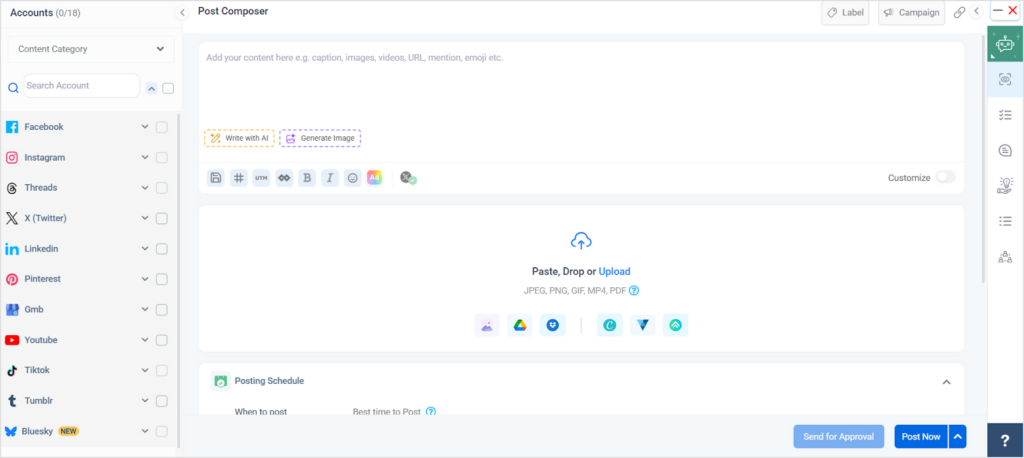
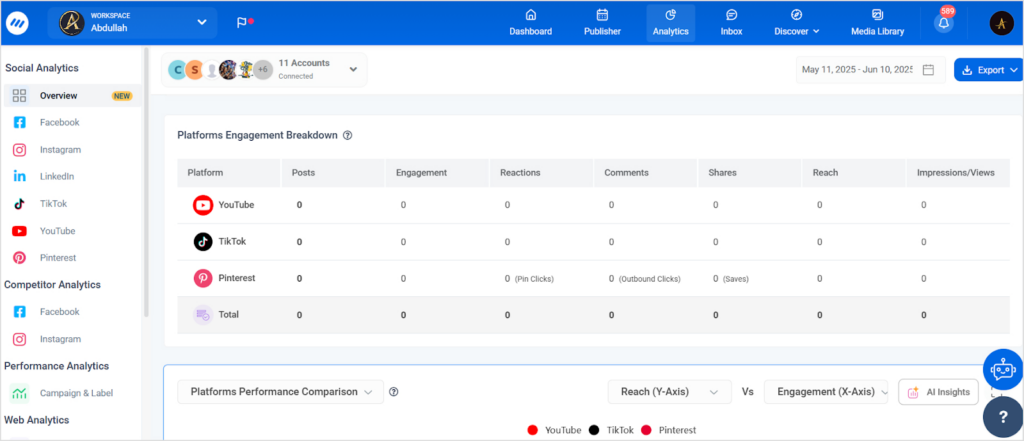
The platform provides detailed analytics across all connected platforms, allowing for true cross-platform performance comparison.
You can track metrics, generate custom reports, create white-label reports for clients, and gain insights that help optimize your entire social media strategy rather than just Meta platforms. The analytics capabilities include advanced social media analytics features for deeper performance insights.
ContentStudio includes powerful content discovery features that help you find relevant, trending content to share with your audience. This addresses the common challenge of maintaining consistent, engaging content across multiple platforms and saves significant time in content research. The platform also supports content curation strategies to keep your social media feeds active and engaging.
The platform offers robust team collaboration features, including comprehensive approval workflows, detailed user roles, client management tools, and collaborative content planning that make it ideal for agencies and marketing teams of all sizes. These collaboration features are essential for implementing effective social media approval workflows.
For agencies, ContentStudio provides white-label social media management capabilities, allowing you to brand the platform as your own when working with clients, something that Meta Business Suite doesn’t offer.
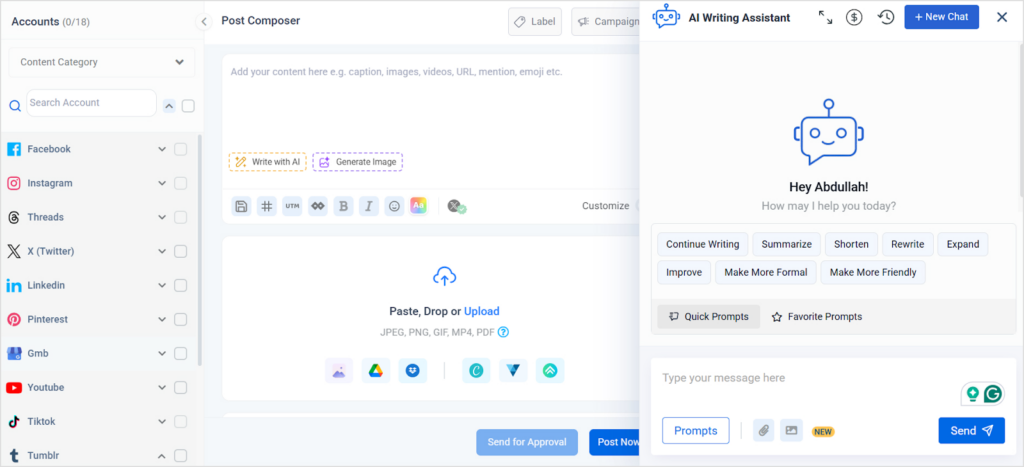
ContentStudio includes AI assistant capabilities that help with content creation, caption writing, hashtag suggestions, and post optimization, streamlining your content creation process significantly.
The social inbox feature consolidates messages from all platforms, not just Meta platforms, providing a comprehensive view of all customer interactions across your entire social media presence.
Unlike Meta Business Suite, ContentStudio offers dedicated customer support with responsive assistance for all users, ensuring you get help when you need it without navigating complex support channels.
ContentStudio provides sophisticated automation tools, including smart posting schedules, content recycling, RSS feed automation, and AI-driven content suggestions that help businesses scale their social media efforts efficiently. These social media automation capabilities are essential for businesses looking to maintain consistent engagement without manual intervention.
Overall, for businesses looking to scale their social media efforts beyond Meta’s ecosystem, ContentStudio provides the comprehensive functionality needed to manage a complete, professional social media strategy effectively while saving time and improving results.
Meta Business Suite provides a native workspace for managing Facebook and Instagram content, customer communication, and performance information, with supported WhatsApp messaging connections.
The correct assets and permissions should be set up first; then publishing, Inbox, and reporting should be tested against the tasks the team actually performs. Additional software should be considered only when a specific requirement, such as another network, editorial approval, or a reporting workflow, justifies it.
Facebook Business Suite is the earlier name. Meta’s current product is Meta Business Suite, which brings together business-management tasks across its supported services.
No, Meta Business Suite is designed to manage Facebook, Instagram, and WhatsApp accounts within Meta’s ecosystem. Suppose you need to manage other social media platforms like Twitter, LinkedIn, or TikTok. In that case, you’ll need to use additional tools or consider comprehensive alternatives like ContentStudio that support multiple platforms beyond Meta’s offerings.
There’s no specific limit to the number of users you can add to your Meta Business Suite account. However, the number of people you can add may depend on your Meta Business Manager settings and the specific roles you’re assigning. Different permission levels are available, including admin, editor, moderator, advertiser, and analyst roles.
No. Organic publishing, customer communication, and available insights are separate from advertising. Running ads introduces a budget and payment requirements.
Supported WhatsApp Business connections can sync with Inbox. Account eligibility, portfolio ownership, and permissions need to be configured correctly.
Meta’s current instructions specify between 20 minutes and 29 days for the documented Page-post workflow. The applicable interface should be checked for other formats.
Use the people and asset-management controls in Settings. First, assign the appropriate portfolio access, then grant access to the relevant assets and configure task permissions. Meta distinguishes between full control and partial access.
Not completely. ContentStudio supports its own publishing and management workflows, while native Meta tools remain relevant for asset administration, advertising, and other Meta-specific functions. The tools should be evaluated by task rather than treated as complete substitutes.
Plan 0 Days of Content in 0 Minutes
Create, schedule, publish and analyze your content across all your social media channels from one simple dashboard.
4.7 on Capterra • 16,500+ marketers trust ContentStudio
Arooj Ishtiaq is a Content Marketing Strategist with 5+ years of experience writing about social media, SaaS, and AI. At ContentStudio, she creates practical guides, tutorials, and how-to content that help marketers navigate social media trends, sharpen their strategies, and get more from their content.
View all posts by Arooj IshtiaqRecommended for you
Meta ads benchmarks 2026: Average CPM, CPC, and CTR by industry
Top 9 Meta Threads analytics tools for 2025
Meta Ads performance analysis: How to measure what’s working
How to read your Meta Ads report (Metrics that matter)