How to build an executive’s LinkedIn content workflow with Claude Code
Oct 1, 202615 minutes

Written by
Saif AliUpdated
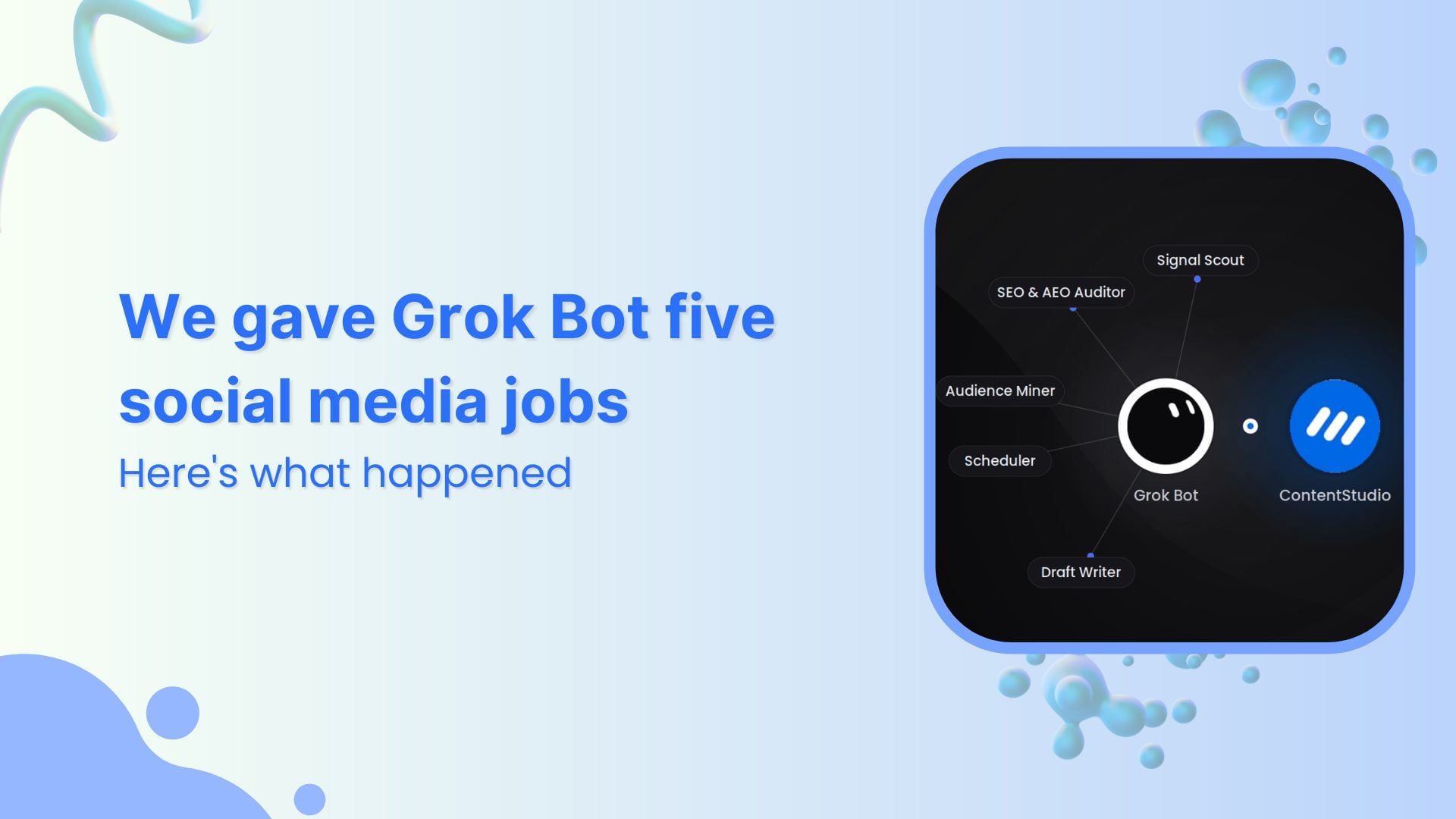
We built a little team of Grok bots and handed them the kind of work a social media manager actually does all day. Find what people are talking about. Pull the questions worth answering. Check where the site ranks. Write the post. Get it ready to publish. Five bots, each with one job, and a manager to keep them in line.
Here is the short version before we get into it. Grok is great at the grind. It reads X all day without getting bored, it sorts through a messy pile of mentions and hands back the complaints that keep coming up, it gives you a real list of SEO fixes, and it writes fast. But it trips on the last step. Grok can read X, but it can’t post to it.
So left on its own, it does all the work and then just stops, holding a finished post with nowhere to send it. The thing that finishes the job is ContentStudio. That’s where the post gets scheduled and where someone signs off before anything goes live.
So can five bots run your social media? Mostly, yeah. As long as you keep the final say and something that’s actually built for agents handles the posting.
Grok Bot lets you build small bots that go and do things instead of just chatting back at you. Each one can log in to your tools, read, and write. You give it a role and a connection, and it goes off and does the job inside the apps you already use.

Plenty of people can tell you what Grok is supposed to do. We wanted to actually try it on real work and write down where it delivered and where it fell short. If you’re thinking about handing your own workflow to something like this, that’s the part you care about.
When you open it up, it walks you through the basics and asks what you’ll be using it for. We picked marketing. Then it drops you on a blank screen and asks you to build your first bot. So that’s where we started.

We started with the Scheduler on purpose because it’s the one piece that connects to the outside world. Its whole job is to take an approved post and get it scheduled inside ContentStudio. Nothing else. It doesn’t write, it doesn’t research, it just publishes what it’s told to, once someone says yes.
To do that, it needs a connection, so we pasted in a ContentStudio API key, and the two linked up. This part is worth slowing down on, because it’s the reason any of this works. The bot didn’t connect through some custom hack we rigged up. ContentStudio runs an MCP server, which is the thing that lets an outside agent read its accounts and drive it directly.
So the moment the key went in, Grok could see the whole workspace and knew what it was allowed to do. That’s the difference between a tool a person clicks through and a tool an agent can actually operate.
And you could see it land. Once it was connected, the Scheduler saw every network in the workspace ready to go, including LinkedIn, Instagram, Facebook, X, YouTube, TikTok, Threads, Bluesky, and Pinterest. Its standing orders were simple: never post straight to a platform, always schedule through ContentStudio, and always show the plan and wait for a yes first.

We’ll come back to why this bot matters so much, because it turns out to be the hinge the whole thing swings on.
Next, we built Signal Scout. Think of it as our ears on the platform. Its job is to read X and find the conversations in our corner that actually matter, and to catch topics starting to heat up before everyone else piles on.
Setting it up was one step. We connected it to an X account, read-only, and it confirmed it could only read and not post, then showed 32 tools it could use to search posts and watch trends.

So how did it do? Once it was reading, it came back with live threads, not some stale keyword dump from last week. The good part is that it keeps reading, so it catches a conversation while it’s still going instead of after everyone’s moved on. That’s an hour of scrolling you get to skip.
On the trend-spotting side, it flagged topics as they picked up steam, which is the whole difference between posting into a trend and posting after it’s already dead. There’s one honest catch, though. A bot reading X will tell you what’s moving, but deciding which of those trends is worth your brand’s time is still on you. It narrows things down. You still pick.
The verdict: this one just works. Reading all day without getting tired is exactly the kind of thing you want to hand off, and it was one of the clearest wins of the whole test.
If Signal Scout listens to the whole room, Audience Miner listens to your own people. Your mentions, your replies, the same gripes and questions coming up over and over. We connected it to the X account too, so it could pull from mentions in real time.
This is where Grok gave us its most useful stuff. We asked it to read the brand mentions and group what it found, and it came back with actual themes instead of a wall of raw posts. The complaints landed in three buckets. Lifetime-deal buyers are annoyed that publishing to multiple networks now costs an extra monthly fee.
Questions about the quality of the posts, including off-brand copy and image glitches like a hand with two right hands. And confusion about whether the video and image features burn extra credits on top of the plan. It also pulled the questions people kept asking, like “Do we pay extra for credits?” and “Where’s the prompt in ALT?”

That grouping is the whole value. The same question asked in fifteen different ways is really just one thing to write about, and this is what boils the noise down to that one thing. It even noticed a big chunk of the inbox was just promo and spam and offered to run the whole thing as a weekly digest.
The verdict: really strong. This is the tedious work nobody wants to do by hand, and it’s exactly what a bot should be doing for you.
This is the bot we cared about most. It checks two things. Where the site ranks on Google, and where it shows up when someone asks an AI tool a question. That second one, answer engine optimization, is newer, and it matters more every month as people start searching inside chatbots instead of the search bar. We gave it clear instructions on exactly what to track and pointed it at both.
It came back with a real list of fixes, not the usual hand-waving. It flagged a redirect to clean up, told us to strip old years out of live titles and headings, caught an alternatives page throwing a 404, and handed over 11 competitor keywords to keep an eye on, everything from “buffer alternatives” to “social media management tool comparison.” That’s the kind of list an SEO would burn an afternoon putting together.

The verdict: a real result, and the one to put on a routine. Set it up once and let it check in on its own.
Last of the five was the Draft Writer. It takes everything the other bots dug up and turns it into an actual post in our voice. It writes and nothing more. Every draft gets parked for review, and it never sends or schedules anything itself.
Handed the audience questions and the trend context, it produced a draft fast. That speed is the headline. Going from a pile of research to a written first draft in one pass takes out the slowest part of most people’s day. Whether the voice lands exactly right is where your own edit comes in, and you’ll probably tighten it before it ships. But a fast first draft built on real audience research beats staring at a blank page.
The verdict: good for getting moving. Use it to reach a first draft, not a final one.
Five bots with nobody in charge is just five bots. So we built a manager too. Instead of talking to every worker one by one, we talk to the manager, and the manager hands out the work. It knows what each bot does, delegates the job, and pulls everything back together.

Then we put all of them in one group chat and set the rules. The manager runs point. When a job comes in, it asks the team for updates and decides who does what. Every bot reports back to the manager, not to us. And the rule sitting above everything else: nothing gets scheduled or posted until a person approves it.


With everyone built, we gave them one simple job. Get a post ready to schedule based on what the audience is actually talking about. Notice we didn’t spell out the steps. We handed the manager the goal and stepped back to watch.
They talked it through, weighed which angle was worth posting, and the writer drafted it. That back-and-forth is the part that makes it feel like a team instead of a tool. Then we asked for it to be dropped straight into ContentStudio.

And there it is. The post the bots came up with, drafted, and passed along, sitting in ContentStudio waiting for a human yes. That’s the full loop.
This is the thing worth understanding before you build your own version. Remember the Scheduler, the first bot we made? Here’s why it’s the hinge. Grok can read X, but it can’t post to it. Leave the bots alone, and they’ll do all the digging and drafting and then just stall, sitting on a good post with no way to send it out.
ContentStudio is what finishes the job. The Scheduler links to it, and from there, the draft gets scheduled, the person approves it, and it actually goes live across whatever networks you want.
And here’s the part that’s easy to miss. That handoff was clean because ContentStudio was built to be run by an agent, not just clicked through by a person. The API and the MCP server are the reason Grok could plug in and operate it at all.
The grind. Reading X all day, pulling the same questions out of a messy pile of mentions, catching topics while they’re still rising, handing back a real SEO fix list, and drafting fast. This is the stuff that eats your hours and bores you to death, and the bots just keep going.
The team part holds up too. Handing the manager a goal and watching the bots sort out the work feels less like running a tool and more like actually delegating.
It stops halfway. Grok reads X but can’t post to it, so on its own it gives you good research and finished drafts that go nowhere. And the calls that need judgment still need you: which trend is worth jumping on, whether a draft actually sounds right, which question to answer first. The bots narrow things down. They don’t make the decision for you.
Posting. That’s the gap, and it’s not a small one. The whole point of a bot team falls apart if the finished post can’t leave the building. ContentStudio is what fills it. It’s where the drafts land, where they wait for approval, where they get scheduled, and where the whole publishing side of the operation actually lives, across every network.
The bots do the digging and the writing. ContentStudio is the part they hand off to, and the part that’s built to take that handoff from an agent in the first place. If you want the bots doing the heavy lifting while you keep the final say, that’s the combo that actually works. If you were hoping to press one button and walk away, that’s not this, and honestly, you wouldn’t want it to be.
Five Grok bots can run most of your social media, and the parts they run, they run well. The catch is always that last step. Grok does the research and the writing, but it can’t put anything live on its own.
That is the piece ContentStudio owns. It takes the finished work straight from the bots, holds it for your yes, and schedules it out across every network, because it was built to be run by an agent in the first place. That is the real lesson here.
The bots on top can be anything you like. The thing that turns their work into published posts is a platform that speaks their language, and that is what ContentStudio is.
Plan 0 Days of Content in 0 Minutes
Create, schedule, publish and analyze your content across all your social media channels from one simple dashboard.
4.7 on Capterra • 16,500+ marketers trust ContentStudio
Saif Ali is a Content Marketing Strategist at ContentStudio with over five years of experience across SaaS, IT, and digital marketing. He specializes in SEO-led content, AI content creation, and social media strategy, and leads editorial review at ContentStudio, fact-checking and refining articles for accuracy, SEO, and a consistent brand voice.
View all posts by Saif AliRecommended for you
How to build an executive’s LinkedIn content workflow with Claude Code

How to turn one product photo into 5 video Ads with Claude Code
Social media MCP server: How to automate posting with ContentStudio
How to automate social media with n8n: A practical guide