
Black Friday vs. Cyber Monday: The real difference for software buyers
Oct 22, 202614 minutes

Written by
Arooj IshtiaqUpdated

A 30% affiliate commission does not tell you how much you will earn. Your income also depends on the eligible payment amount, the number of qualifying customers, their billing schedules, and how long commissions continue.
The ContentStudio affiliate program illustrates this difference: published rates range from 15% to 40%, but the applicable tier, commission period, and payout conditions determine what those percentages mean for your earnings. An affiliate commission calculator can handle the arithmetic, yet a useful estimate needs more than a rate and a customer count. It needs realistic assumptions about payments, renewals, refunds, and costs.
This article breaks down affiliate earnings, explains the formulas, and shows how to distinguish projected commission from approved earnings, cash received, and profit. All hypothetical examples use clearly stated assumptions rather than promised results. The first step is identifying exactly what earns commission.
Affiliate programs can pay a percentage of eligible revenue, a fixed amount per qualifying action, or a combination of both, and one-time or recurring arrangements then determine whether the commission is paid once or continues across eligible payments. The payment model should be established before any customer count enters the calculation.
| Commission model | Calculation basis | Hypothetical example |
|---|---|---|
| Percentage-based | Eligible revenue multiplied by the commission rate | 20% of an eligible $100 payment produces $20 |
| Fixed payment | Approved qualifying actions multiplied by a stated amount | Ten approved referrals at $30 each produce $300 |
| Recurring percentage | Eligible subscription payments multiplied by the applicable rate | A $50 eligible monthly payment at 20% produces $10 per qualifying payment |
| Hybrid | Each qualifying component calculated separately | A fixed acquisition payment plus commission on eligible renewals |
The broader mechanics of affiliate marketing explain how referrals receive credit. For an earnings breakdown, the essential distinction is between a tracked visitor, a signup, a paying customer, and an approved commission, and those events should not be counted as if they were the same outcome.
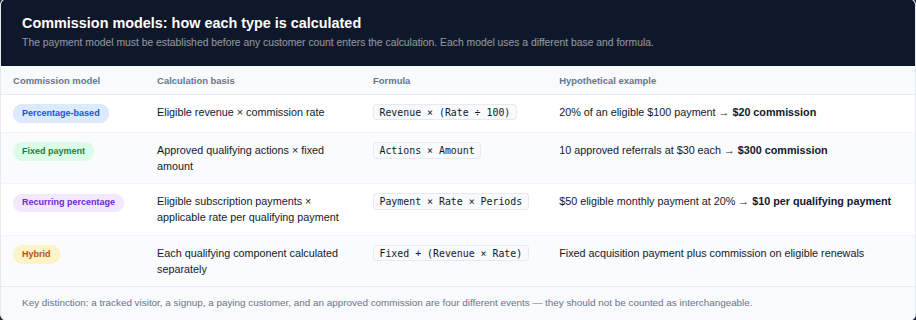
A percentage-based calculation starts with the revenue the program accepts as commissionable. The basic formula is:
Commission = Eligible revenue × (Commission rate ÷ 100)
Suppose a referred customer makes an eligible $120 payment and your applicable rate is 25%. The calculation is 120 × 0.25 = 30, so your commission is $30. If eight customers each make the same eligible payment at the same rate, the total is 8 × 120 × 0.25 = 240, which produces $240 in commission before any later adjustments.
The calculation changes when customers pay different amounts. In that case, the total eligible revenue is more useful than multiplying customer count by one assumed price.
| Customer | Eligible payment | Rate | Commission |
|---|---|---|---|
| A | $40 | 25% | $10 |
| B | $80 | 25% | $20 |
| C | $120 | 25% | $30 |
| Total | $240 | 25% | $60 |
This example uses one rate across all three customers. When referral groups have different rates, each group needs a separate calculation.
A fixed-payment program requires a simpler calculation, but the qualifying action still matters. The fixed-commission formula is:
Commission = Approved qualifying actions × Payment per action
A hypothetical program paying $35 for each approved customer generates $420 from twelve approved customers. That does not mean twelve trial signups automatically produce $420, because the program may require a completed purchase or another qualifying event before approving the payment.
Bonuses should also remain separate from the standard commission calculation. A milestone bonus earned once should not appear as recurring income in every future month. For example, $420 in ordinary commission plus a qualifying $50 one-time bonus produces $470 for that period, and the next period starts without the bonus unless another published condition makes it payable again.
Even when the rate is clear, the advertised purchase price may not be the correct calculation base. The most important input is eligible revenue: the amount the program actually uses to calculate commission.
ContentStudio defines qualifying revenue as subscription fees received and kept. Its terms exclude taxes, duties, payment processing fees, refunds, chargebacks, certain credit-funded payments, and one-time non-subscription purchases. Consequently, a product’s advertised price is not automatically the commissionable amount.
| Input | Hypothetical amount |
|---|---|
| Advertised subscription price | $100 |
| Eligible revenue after applicable adjustments | $80 |
| Commission rate | 20% |
| Commission earned | $16 |
Applying 20% to the advertised $100 would produce $20, overstating the commission by $4. The affiliate transaction record or applicable terms should establish the base, and a forecast should not invent deductions or assume that every program excludes the same items.
Once the commission per payment is established, recurring earnings require careful treatment of time. Recurring commission can accumulate as existing customers renew and new customers join, but the income depends on continued qualifying payments and the program’s commission window. It should not be calculated as if every referral remains eligible indefinitely.
For a monthly recurring program, a simplified formula is:
Monthly commission = Commission-eligible active customers × Eligible monthly payment × Commission rate
Ten eligible customers paying $50 each per month at 20% generate $100 in monthly commission. That formula works when the customers share the same payment amount and rate, and a mixed customer base needs separate calculations by group.
The first forecasting distinction is between income earned during a period and possible future income. The following figures answer different questions:
| Figure | What it tells you |
|---|---|
| Commission this month | Earnings generated by eligible payments within the month |
| Commission this year | Earnings generated by eligible payments within the year |
| Potential remaining commission | What current referrals might generate during their remaining eligible periods |
| Cash received this year | Payouts actually transferred during the year |
A customer acquired in December does not contribute twelve monthly payments to that same calendar year, since their future payments belong in a later-period forecast. Similarly, a strong December commission does not mean the same amount was earned in every earlier month.
Grouping referrals by acquisition month makes the timing easier to see. Consider a hypothetical recurring program with these assumptions:
Each customer contributes $10 per eligible payment, so each new monthly group adds $50 to monthly commission.
| Month | Eligible active customers | Commission that month | Cumulative commission |
|---|---|---|---|
| 1 | 5 | $50 | $50 |
| 2 | 10 | $100 | $150 |
| 3 | 15 | $150 | $300 |
| 4 | 20 | $200 | $500 |
| 5 | 25 | $250 | $750 |
| 6 | 30 | $300 | $1,050 |
| 7 | 35 | $350 | $1,400 |
| 8 | 40 | $400 | $1,800 |
| 9 | 45 | $450 | $2,250 |
| 10 | 50 | $500 | $2,750 |
| 11 | 55 | $550 | $3,300 |
| 12 | 60 | $600 | $3,900 |
The final month generates $600, but the first-year total is $3,900. Multiplying $600 by twelve produces $7,200, which is not first-year earnings because the final customer count was not present throughout the year.
This distinction matters when building SaaS affiliate income, since new customer acquisition and existing renewals create different contributions across time.
A more realistic forecast also accounts for customers who stop making eligible payments. A recurring model needs to track both cancellations and the end of each customer’s commission period, because a customer can remain subscribed after your right to commission expires. “Active customer” and “commission-eligible customer” are therefore not always interchangeable.
A simplified customer-count worksheet can use:
Closing eligible customers = Opening eligible customers + New eligible customers − Cancellations − Commission expiries
For example, a group begins with 20 eligible customers, gains five, loses two before renewal, and has three whose commission windows expire. The closing count is 20 eligible customers, and under a simplified month-end model with $50 eligible payments and a 20% rate, those customers generate $200. Actual commission should still follow transaction dates, since a cancellation after a qualifying payment does not necessarily have the same effect as a cancellation before payment, and reversals depend on the program’s terms.
The same precision is necessary when a program changes commission tiers. ContentStudio publishes several commission tiers and a separate Agency Partner track. The example below applies each rate to a hypothetical $50 eligible monthly payment; it does not represent a current subscription price.
| Tier or track | Published qualification | Rate | Commission period | Commission per $50 payment |
|---|---|---|---|---|
| Partner | Starting tier | 15% | 12 months | $7.50 |
| Silver | 5–14 active referred customers | 20% | 12 months | $10 |
| Gold | 15–39 active referred customers | 30% | 12 months | $15 |
| Elite | 40+ active referred customers or $2,000+ referred MRR | 40% | 24 months | $20 |
| Agency Partner | Separate application | 25% | 24 months | $12.50 |
These qualifications, rates, and periods come from ContentStudio’s published terms. Tier reviews occur quarterly using the previous 90 days, with changes taking effect at the beginning of the following month. Crucially, a changed rate applies to customers referred after the change takes effect, so existing referrals should not automatically be recalculated at the new rate. A mixed-rate example shows why separate referral groups matter.
| Referral group | Eligible monthly revenue | Applicable rate | Commission |
|---|---|---|---|
| Two earlier Partner referrals | $100 combined | 15% | $15 |
| Three later Silver referrals | $150 combined | 20% | $30 |
| Total | $250 | Mixed | $45 |
Applying the latest 20% rate to all $250 would produce $50 instead of the correct $45 under these assumptions. An effective comparison of SaaS affiliate programs should therefore consider rates alongside eligible revenue, duration, qualification requirements, and any earning limits.
Once the forecast is calculated, the next question is whether those earnings are approved, payable, and profitable. An estimated commission is not cash in your account: a dashboard balance may include transactions awaiting approval, while an approved balance may still be below the payout threshold. These stages belong in separate columns.
| Stage | Meaning | Planning implication |
|---|---|---|
| Projected | Estimated from assumptions | Not yet earned |
| Pending | Recorded but awaiting approval | May change |
| Approved | Accepted under program rules | May still await payout conditions |
| Paid | Released by the program | Payment has been initiated or completed |
| Received | Available in your account | Usable cash, subject to relevant costs |
Clear labels prevent an optimistic forecast from being mistaken for money available to spend.
Program-specific rules then determine when an approved balance becomes payable. ContentStudio approves commission after a referred customer completes 30 paid days.
The approved commissions are paid monthly, by the 15th of the following month, once the balance reaches $200 and the affiliate has at least two active referrals, and balances below the threshold roll over. The threshold and active-referral requirement are separate conditions.
| Hypothetical position | Interpretation |
|---|---|
| $180 approved, two active referrals | Below the $200 threshold |
| $230 approved, one active referral | Threshold met, active-referral requirement not met |
| $230 approved, two active referrals | Both stated conditions met, subject to other requirements and payment processing |
The affiliate terms also allow commission reversals for refunds, chargebacks, certain cancellations, errors, and invalid activity, and adjustments can be offset against future commissions. A recorded commission should therefore retain its approval status until it becomes final under the applicable rules.
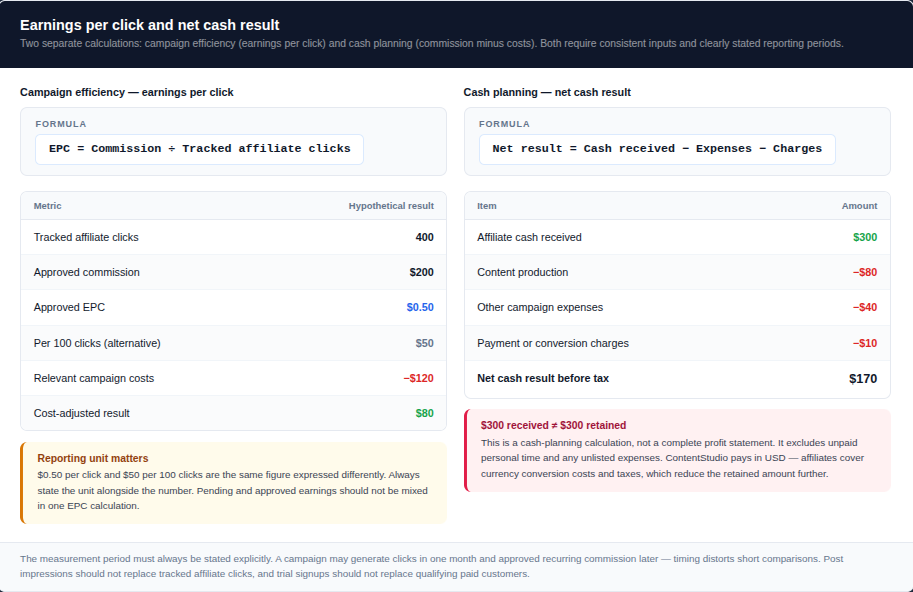
Profit requires a further calculation because promoting an offer can have costs. A practical cash-planning formula is:
Net cash result before tax = Cash received − Relevant cash expenses − Payment charges
Suppose an affiliate receives $300 and incurs the following costs:
| Item | Amount |
|---|---|
| Affiliate cash received | $300 |
| Content production | −$80 |
| Other campaign expenses | −$40 |
| Payment or conversion charges | −$10 |
| Net cash result before tax | $170 |
The $300 payout is not $300 of retained income. This example is a cash-planning calculation, not a complete accounting profit statement, and it excludes unpaid personal time and any expenses outside the example. ContentStudio pays in US dollars, while affiliates cover currency conversion costs and taxes on their earnings, and those obligations should remain visible when estimating the amount retained.
Campaign efficiency adds another useful comparison, provided the denominator is consistent. Earnings per click expresses commission relative to tracked affiliate clicks:
Earnings per click = Commission ÷ Tracked affiliate clicks
A campaign producing $200 in approved commission from 400 tracked clicks generates $0.50 per click. Some reports express earnings per 100 clicks, and under that convention the same result would be $50 per 100 clicks, so the reporting unit should always accompany the figure.
The commission status also matters, because pending earnings from one campaign should not be compared directly with approved earnings from another. A useful campaign worksheet can separate these inputs:
| Metric | Hypothetical result |
|---|---|
| Tracked affiliate clicks | 400 |
| Approved commission | $200 |
| Approved earnings per click | $0.50 |
| Relevant campaign costs | $120 |
| Cash-cost-adjusted result | $80 |
Timing can distort a short comparison, since a campaign may generate clicks in one month and approved recurring commission later. The measurement period should therefore be stated explicitly. When evaluating affiliate promotion on social media, post impressions should not replace tracked affiliate clicks, and trial registrations should not replace qualifying paid customers.
A forecast becomes more useful when it makes these assumptions easy to review rather than hiding them. A spreadsheet can perform the calculation transparently before an interactive affiliate commission calculator is available.
| Field | What to record |
|---|---|
| Program | The offer being promoted |
| Referral group | Customers sharing the same acquisition period and applicable terms |
| Commission model | Percentage, fixed, recurring, or hybrid |
| Eligible payment | Revenue used for the commission calculation |
| Applicable rate | Rate assigned to that referral group |
| Billing interval | Monthly, annual, or another schedule |
| Eligible paid periods | Actual or forecast payments within the commission window |
| Expiry date | When commission eligibility ends |
| Adjustments | Refunds, reversals, and corrections |
| Approval status | Pending, approved, or paid |
| Cash received | Amount actually received |
| Costs | Relevant expenses recorded separately |
Three scenarios help expose uncertainty without pretending to predict the future.
| Scenario | Assumptions |
|---|---|
| Conservative | Fewer qualifying customers, shorter retention, and cautious costs |
| Working | Available observed results and current applicable terms |
| Upside | More favorable acquisition and retention assumptions |
The upside case should not become the spending plan simply because it produces the largest number. Where customer retention or conversion data is unavailable, the assumptions should be labeled, since a precise total can still be unreliable when the inputs are guesses.
A useful affiliate earnings estimate starts with the eligible payment, uses the correct rate for each referral group, and counts only payments inside the commission window. Approval rules, payout conditions, and costs then determine how much becomes usable cash.
Your next step is a small forecast that you can compare with actual results. If ContentStudio fits your audience, its affiliate application provides a practical starting point. A sustainable promotion budget should follow the conservative calculation, not the highest advertised rate.
Plan 0 Days of Content in 0 Minutes
Create, schedule, publish and analyze your content across all your social media channels from one simple dashboard.
4.7 on Capterra • 16,500+ marketers trust ContentStudio
Arooj Ishtiaq is a Content Marketing Strategist with 5+ years of experience writing about social media, SaaS, and AI. At ContentStudio, she creates practical guides, tutorials, and how-to content that help marketers navigate social media trends, sharpen their strategies, and get more from their content.
View all posts by Arooj IshtiaqRecommended for you
Black Friday vs. Cyber Monday: The real difference for software buyers

Black Friday social media post ideas: Captions and posting plan for 2026

Black Friday and Cyber Monday social media checklist 2026

Cyber Monday social media post ideas: Captions, hashtags & retargeting posts