
How many Instagram accounts can I have? [2026]
Jul 27, 20266 minutes
Black Friday: save up to 50% on all plans

Written by
Khadija AnwarUpdated
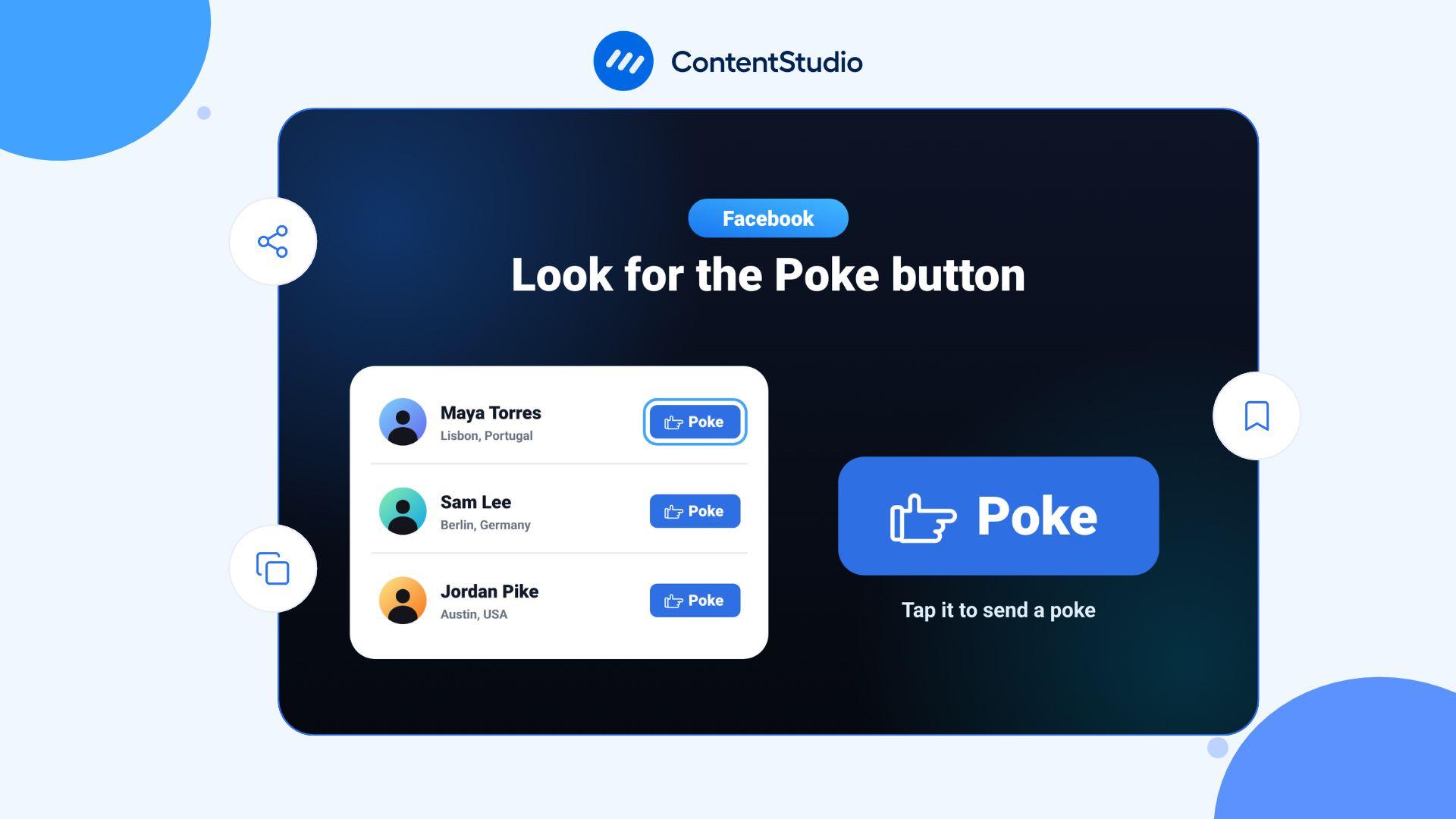
A Facebook poke is a lightweight way to get someone’s attention. You can poke a friend, poke back someone who poked you, undo a poke you just sent, or dismiss a poke you do not want to respond to. Facebook says that if someone pokes you, you can tap the notification to view the Pokes dashboard and poke them back.
If you are using Facebook for business, a clear Facebook marketing strategy should focus on Page content, comments, messages, and community engagement rather than on pokes, which are a personal interaction and not a content channel.
A Facebook scheduler can help you keep the public content side consistent while you manage direct interactions separately, since posts, comments, and messages all require different rhythms and tools.
People do not search for “how to poke on Facebook” for a single reason. The goal is usually to send a lightweight signal without starting a full conversation.
| Underlying goal | What the reader wants | Better approach |
| Get someone’s attention | Send a lightweight signal without a message | Poke the person from the Pokes dashboard |
| Restart a conversation | Remind someone you are thinking of them | Poke the person, then send a message if they respond |
| Respond to a poke received | Let someone know you saw their poke | Poke them back from the Pokes dashboard or notification |
| Undo an accidental poke | Remove the poke before the person sees it | Tap Undo in the Pokes dashboard |
| Dismiss an unwanted poke | Remove a poke from someone you do not want to respond to | Long-press the name and tap Dismiss poke |
| Understand the feature | Know what a poke means and what it does | Read the explanation and decide whether to use it |
| Avoid confusion | Know the difference between a poke and a message | Use a poke for a lightweight signal, a message for a conversation |
A poke sends a notification to the person you poked. They can see the poke in their Pokes dashboard and choose to poke back, ignore it, or dismiss it. The poke is private between the two people involved and does not appear on a feed or profile.
Facebook says that if someone pokes you, you can tap the notification to view the Pokes dashboard and poke them back. If you poke someone and they do not poke back, you can poke them again after 24 hours.
| Action | What it does |
| Poke someone | Sends a notification to that person |
| Poke back | Responds to a poke you received in the Pokes dashboard |
| Undo a poke | Removes the poke you just sent |
| Dismiss a poke | Removes the poke from your Pokes dashboard without poking back |
| Poke again after 24 hours | Lets you send another poke after waiting 24 hours if the first was not returned |
Several common assumptions about pokes are incorrect. The table below clarifies what a poke cannot do.
| Limitation | What it means |
| It does not start a conversation | A poke sends a notification only; a message is needed to start a conversation |
| It does not guarantee a response | The person may ignore, dismiss, or not notice the poke |
| It does not appear publicly | A poke is a private notification between two people; it does not show on a feed, profile, or in comments |
| It does not add someone as a friend | A poke does not create a friendship; a friend request is a separate action |
| It does not disappear after two days | Facebook says you can repoke after 24 hours if there is no response; there is no documented automatic expiry |
| It does not work identically on every device | Interface labels and navigation paths can vary by app version, device type, and account settings |
Note on the FAQ in the previous version: The original article said “If the person you poked doesn’t notice or respond within two days, the poke goes away on its own.” This is inaccurate. Facebook’s Help Center says you can poke someone again after 24 hours if they do not poke you back. It does not state that pokes disappear automatically after two days.
The main mobile path goes through the Pokes dashboard, accessed by searching for Pokes in Facebook’s search bar. There is also a direct path from a person’s profile.
Step 1: Open the Facebook app on your phone.
Step 2: Tap Menu in the top-left or top-right corner (three lines).
Step 3: Tap the Search icon in the top-right corner.
Step 4: Type Pokes in the search bar.
Step 5: Tap Pokes from the results.
Step 6: Find the friend you want to poke from your friends list.
Step 7: Tap Poke next to their name.
Step 1: Go to the profile of the friend you want to poke.
Step 2: Tap below their profile name or cover photo.
Step 3: Tap Poke from the options.
On desktop, the Pokes dashboard is accessed through Facebook’s search bar or directly at facebook.com/pokes in a browser.
Step 1: Open Facebook in a browser on your computer.
Step 2: Click Search Facebook in the top-left corner of the Feed.
Step 3: Type pokes in the search bar and press Enter.
Step 4: Select Pokes on Facebook from the results.
Step 5: Click Pokes to open the dashboard.
Step 6: Search for a friend by name.
Step 7: Click Poke to the right of the person’s name.
Shortcut: You can also go directly to facebook.com/pokes in a browser to reach the Pokes dashboard without searching.
When someone pokes you, you receive a notification. The poke also appears in your Pokes dashboard under Friends who poked you.
Step 1: Open the Facebook app.
Step 2: Tap the notification for the poke, or go to the Pokes dashboard directly.
Step 3: Find the person under Friends who poked you.
Step 4: Tap Poke back next to their name to return the poke.
If you do not want to poke back, you can leave the poke in the dashboard, dismiss it, or take one of the other actions below.
| Action | What it does | Best use |
| Poke back | Returns the poke to the person who sent it | You want to acknowledge the poke |
| Dismiss the poke | Removes the poke from your Pokes dashboard | You do not want to respond or see it again |
| Send a message instead | Opens a Messenger conversation with the person | You want to start an actual conversation |
| Ignore and leave it | Leaves the poke visible in your dashboard | You are undecided about responding |
If you poke someone by accident, you can undo it from the Pokes dashboard. The Undo option appears next to the poke you just sent.
Step 1: Open the Facebook app.
Step 2: Tap Menu, then search for Pokes and tap it.
Step 3: Find the poke you sent under Friends you poked.
Step 4: Tap Undo next to the name.
Facebook says you can undo a poke by tapping Undo. Act quickly if you want to undo it before the person receives the notification.
Dismissing a poke removes it from your Pokes dashboard without sending a poke back. It is different from blocking or restricting — the person is not notified when you dismiss a poke.
Step 1: Open the Facebook app and go to the Pokes dashboard.
Step 2: Find the person under Friends who poked you.
Step 3: Long-press the person’s name.
Step 4: Tap Dismiss poke.
Step 1: Open the Pokes dashboard.
Step 2: Tap See all next to Friends who poked you.
Step 3: Tap Dismiss.
Step 4: Select the people whose pokes you want to dismiss.
Step 5: Tap Select all to dismiss every poke at once.
Step 6: Tap Dismiss and confirm.
Facebook says that if you poke someone and they do not poke you back, you can poke them again after 24 hours. The original article incorrectly stated that pokes disappear after two days; this is not documented by Facebook.
| Situation | What to do |
| You poked someone and they did not respond | Wait 24 hours before poking again |
| You want to start a real conversation | Send a message rather than poking repeatedly |
| You want to avoid creating unwanted pressure | Poke once and wait; do not send multiple pokes in a short period |
| You want to respond to a poke | Poke back or send a message, depending on what feels appropriate |
Only friends can poke you on Facebook, so the most direct way to stop pokes from a specific person is to unfriend them, restrict them, or block them. You can also dismiss pokes without responding, which removes them from your dashboard.
| Setting | What it controls | Why it matters |
| Friend list | Who can poke you in the first place | Only people on your friends list can send a poke |
| Dismiss poke | Removes a specific poke from the dashboard | Clears the poke without responding and without notifying the sender |
| Blocked accounts | Who cannot interact with you at all | Blocking prevents any further pokes, messages, or interaction |
| Restricted accounts | How much someone can interact with you | Restricting limits interaction while keeping the friendship |
| Notification settings | Whether poke notifications appear on the device | Turning off notifications reduces interruptions from pokes |
If someone is sending unwanted pokes alongside other unwanted interaction, restricting someone on Facebook limits their ability to engage without alerting them that any action has been taken. Restricting is the lower-impact option when you want to reduce contact while keeping the connection.
Restriction reduces what a person can do, but it does not prevent all contact. If the situation involves repeated, unwanted messages, pokes, or other contact that makes you uncomfortable, blocking someone on Facebook prevents any further interaction and removes the person from the friends list entirely.
Managing a specific person is different from managing your general visibility. If your goal is to lower your overall presence on the platform regardless of who is reaching out, turning off active status on Facebook hides the online indicator and reduces one of the signals that prompts others to reach out.
A poke is a personal, one-to-one interaction between Facebook friends. It has no role in a business marketing strategy and no meaningful impact on Page reach, engagement, or discovery.
For businesses managing a Facebook Page, the more relevant interactions are comments on posts, direct messages in the Page inbox, and community engagement within Groups. These are the touchpoints where content strategy and response workflows apply. For context on what your own profile reveals publicly versus what a Page shows, the guide to viewing a private Facebook profile explains how Facebook’s privacy settings affect what others can see on a personal profile versus a Page.
The table below distinguishes the poke from other Facebook interaction types so you can choose the right one for each situation.
| Action | What it does | Who can see it | Best use |
| Poke | Sends a lightweight private notification | Only the two people involved | Getting a friend’s attention without sending a message |
| Friend request | Asks to become Facebook friends | Only the two people involved | Connecting with someone you are not yet friends with |
| Message | Starts a private conversation in Messenger | Only the participants in the conversation | Having an actual conversation |
| Reaction | Responds to a post or comment with an emoji | Anyone who can see the post | Quickly responding to content |
| Tag | Mentions someone in a post or comment | Anyone who can see the post, plus the tagged person | Associating someone with a piece of content |
A poke is the simplest interaction Facebook offers: one tap, one notification, no message required. It works best as an occasional signal between people who already know each other, not as a tool for initiating contact with someone you do not know well.
If someone does not respond to a poke, do not poke repeatedly. Wait 24 hours if you want to try again, or send a message if there is a real reason to start a conversation.
ContentStudio helps teams organize Facebook content, review and approve posts, and schedule publishing across channels. Start a seven-day free trial. No credit card required.
No. The Pokes dashboard only shows friends you can poke. If you want to interact with someone who isn’t a friend, start with a friend request. If the person’s profile is private and you are not connected, a friend request is the only direct interaction available.
Facebook does not offer a dedicated setting to turn off poke notifications specifically. You can manage notifications at the category level in Facebook’s notification settings, or manage device-level notification permissions for Facebook. Dismissing pokes from the dashboard removes them from view without blocking further pokes from that person.
Dismissing a poke removes it from your Pokes dashboard. The person is not notified that you dismissed their poke. Ignoring a poke simply means leaving it in the dashboard without taking action. The poke remains visible until you dismiss it, poke back, or the person undoes it. Neither action affects the friendship or sends any signal to the other person.
The poke stays in the Pokes dashboard under Friends you poked until they respond or you undo it. After 24 hours without a response, Facebook allows you to send another poke. The poke does not disappear automatically after two days, contrary to what some older sources suggest.
Khadija Anwar is a Senior Technical Writer at ContentStudio with over 500 published write-ups across the ContentStudio blog and beyond. She specializes in step-by-step platform guides and Help Center content across Facebook, Instagram, LinkedIn, YouTube, TikTok, and X, and reviews how-to articles to verify every step and platform detail is accurate and current.
View all posts by Khadija AnwarRecommended for you
How many Instagram accounts can I have? [2026]
Secret to Success: 12 Instagram Hacks to Boost Engagement
Can You Unsend Instagram Messages?
Instagram automation: How it works, uses, and risks


Plan, create and publish to 12 social channels
Up to 50% off on every plan
Offer ends in:
 Claim your deal
Managing social media doesn't get cheaper than this