149 Best Cyber Monday & Black Friday software deals in 2026
Nov 28, 2025118 minutes

Written by
Saif AliPublished
For software buyers, Black Friday and Cyber Monday are nearly the same event wearing two different names. Most SaaS subscriptions carry the identical discount on both days.
Digital products never needed separate in-store and online sales pushes the way appliances or electronics do.
Physical retail still splits sharply by category. Appliances and electronics get their deepest cuts on Black Friday. Fashion, beauty, and gadgets often shine a bit more on Cyber Monday.
Software skips that split almost entirely. ContentStudio builds tools for marketing teams juggling both a Black Friday marketing campaign and a software budget, so this pattern shows up every November.
This guide breaks down what actually changes between Black Friday and Cyber Monday for software. It covers how SaaS brands structure their offers, and it gives you a simple framework for timing your next purchase decision.
Black Friday and Cyber Monday started as two separate retail moments built around different shopping habits, not different discount depths. Black Friday began as an in-store tradition the day after Thanksgiving.
Retailers opened early and used doorbuster deals to pull shoppers into physical locations.
Cyber Monday is much younger. Ellen Davis, then an executive at the National Retail Federation, coined the term in a 2005 press release as a purely online alternative, aimed at shoppers who wanted to avoid Black Friday’s crowds and long lines.
The timing still matters for planning purposes. Black Friday 2026 falls on November 27, and Cyber Monday follows on November 30. That gives shoppers and marketing teams a familiar four-day gap between the two.
That gap used to mean something distinct for each channel. Today it mostly determines which marketing emails land in your inbox, not which prices you actually see.
Retailers built these two days around two different shopping behaviors, in-store versus online, not around two different discount strategies. For physical goods, that behavioral split still shapes pricing in meaningful ways.
For software, as you’ll see next, that original logic barely applies at all.
Omnichannel retail has made the Black Friday versus Cyber Monday distinction far less meaningful for general shopping. Most big retailers now offer identical deals in-store and online on both days.
The channel difference that once defined each event has mostly disappeared.
Retailers have also stretched both events into weeks-long promotions branded as “Black November” or “Cyber Five.” A single day of deals has turned into a sustained push that starts in early November and often runs past Cyber Monday.
The short answer is no, not in any meaningful way. Cyber Monday exists because shoppers wanted to avoid in-store crowds, but software was never sold in a store to begin with.
There’s no physical line to skip, no parking lot to avoid, and no early morning doorbuster rush for a project management tool or a social media scheduler. Every SaaS purchase happens through the same browser tab whether it’s a Thursday in November or a Monday in December.
That means the channel difference that defines Black Friday versus Cyber Monday for retail simply doesn’t exist for software. A checkout page for an annual plan looks and behaves the same regardless of which day you land on it.
This is the core reason software buyers searching for a difference between the two days often come up empty. Vendors publish one pricing page, one promo code, and one countdown timer, and it runs through both dates without a reset.
Some companies will still market the days separately for attention. They might send a “Black Friday deal” email on Thursday and a “Cyber Monday reminder” email the following Monday.
But the price attached to both emails is typically the exact same number.
Understanding this distinction changes how you should shop. Instead of asking which day is better, software buyers are better served asking whether the current price is already as low as it’s going to get this season.
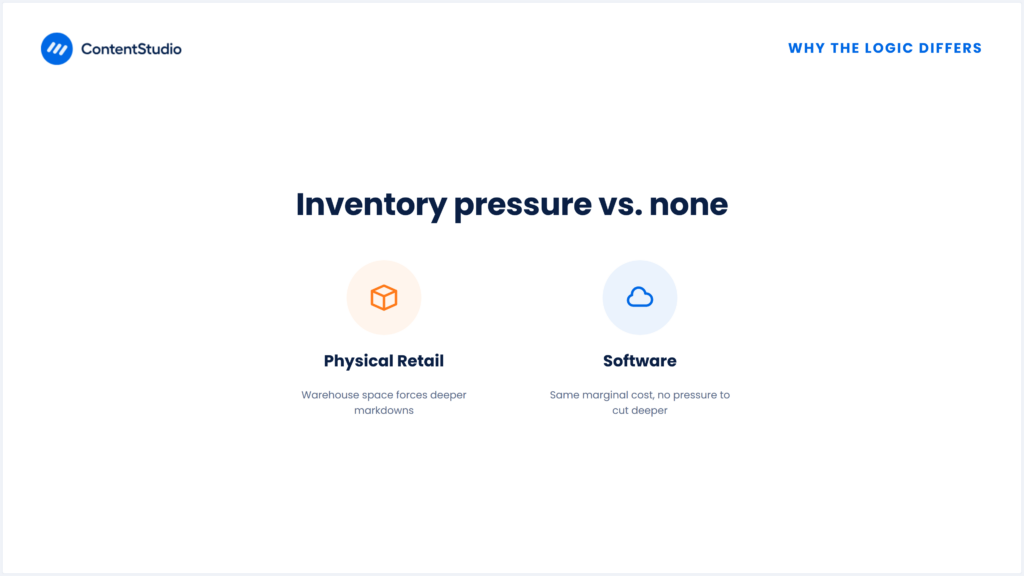
Physical retailers discount Black Friday electronics and appliances deeply because they need to clear warehouse space before new inventory arrives. A retailer holding too many televisions has a real cost problem that a steep markdown solves directly.
Software has no equivalent cost. A SaaS company can sell its 10th subscription or its 10,000th subscription at nearly the same marginal cost.
There’s no warehouse pressure forcing a bigger discount on one specific day.
For software specifically, the discounts are typically identical across both days rather than one day being deeper than the other. This holds true across most categories of SaaS tools, from social media management platforms to accounting software to design tools.
Annual plan discounts and subscription pricing promotions are usually locked in by the marketing team weeks before Black Friday even arrives. Once that percentage-off is set, it simply runs through the entire promotional window, covering both Black Friday and Cyber Monday without adjustment.
This is very different from the pattern you’ll see with a big box retailer slashing television prices on Thursday and restocking different deals by Monday. Software pricing pages are usually static assets built once and left alone for the whole campaign.
Part of the reason is operational. Changing a pricing page mid-campaign creates confusion for sales teams, support staff, and existing customers who might see a lower price than what they paid days earlier.
Most SaaS marketing teams view Black Friday and Cyber Monday as one combined event for planning purposes, even if a separate wave of Cyber Monday marketing still goes out referencing that date. The pricing engine behind the scenes rarely cares which day it is.
So if you’re asking which is better, Black Friday or Cyber Monday, for buying software, the honest answer is that it mostly doesn’t matter. What matters more is whether the specific tool you want is actually running a promotion at all this year.
ContentStudio’s own Black Friday software deals roundup tracks live annual plan discounts across dozens of tools if you want to see this pattern in practice.
A few things can genuinely shift between the two dates, even when the headline discount stays flat.
What almost never shifts is the core percentage-off on annual plans. If a tool is advertising 40% off annual pricing on Black Friday, that same 40% is very likely still active on Cyber Monday, often for several more days after.
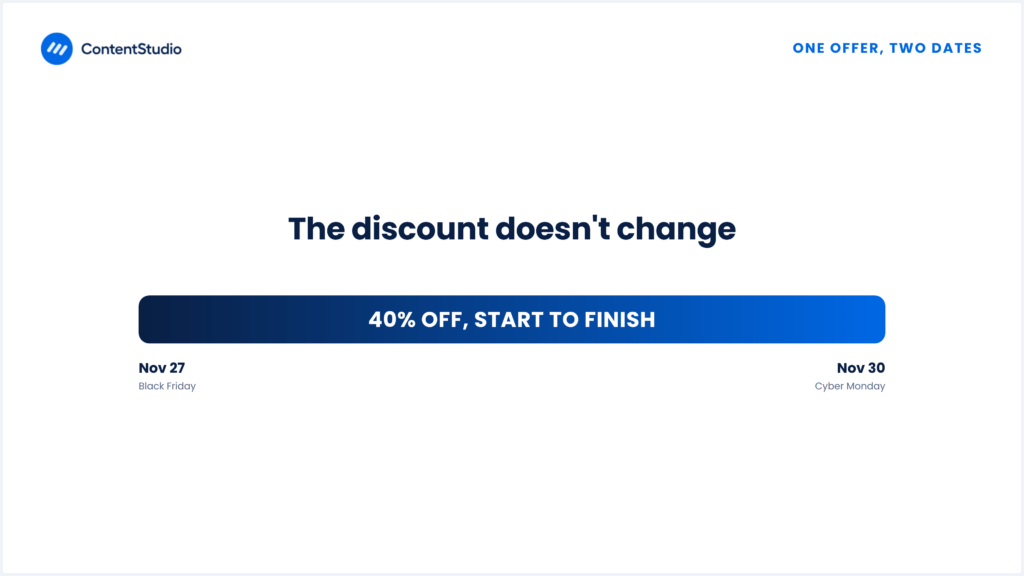
Most SaaS companies run a single extended promotional window rather than two genuinely separate offers. A typical pattern opens the sale a few days before Black Friday, keeps the same pricing through the weekend, and lets it continue unchanged through Cyber Monday and sometimes into the following week.
This single offer approach makes sense from a marketing and operations standpoint. Running two distinct offers would require two separate pricing configurations, two different checkout flows, two rounds of customer support training, and a second pass through the BFCM social media checklist, all for a discount that rarely needs to change.
Some companies do rebrand the identical offer midway through. They might swap a “Black Friday sale” banner for a “Cyber Monday extension” banner on the same landing page.
This is almost always a marketing refresh rather than a pricing change, usually paired with a new batch of Cyber Monday social media posts meant to catch the attention of people who missed the first email.
If you see a software company send you a second email on Cyber Monday with the exact same discount percentage as their Black Friday email, that’s the single offer pattern at work. It’s one sale wearing two pieces of branding, not two separate sales events.
Recognizing this pattern helps you avoid a common mistake. Shoppers sometimes delay a purchase expecting Cyber Monday pricing to beat Black Friday pricing, then discover both emails point to the identical checkout page.
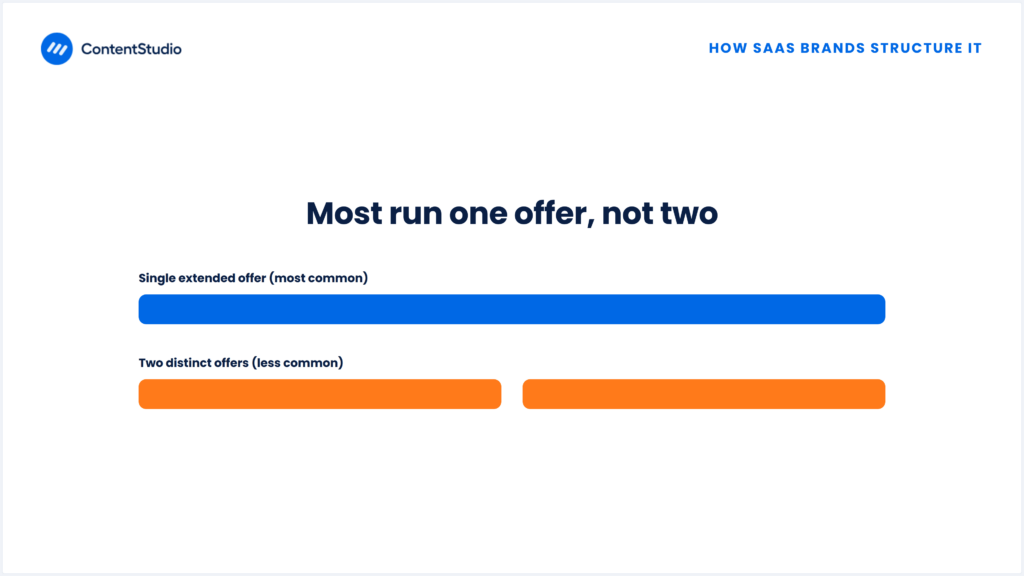
The table below shows the two structural patterns SaaS vendors commonly use, along with the signals that reveal which one you’re looking at.
| Pattern | Typical start date | Typical end date | Discount consistency | Example trigger |
|---|---|---|---|---|
| Single extended offer | Early to mid November | Cyber Monday or several days after | Stays the same throughout | One pricing page, reused banner copy |
| Two distinct offers | Black Friday itself | Cyber Monday, separately | May add a bonus or swap the incentive | New promo code or added trial days on day two |
Big ticket physical items remain the category where Black Friday clearly outperforms Cyber Monday. Televisions, large appliances, furniture, and mattresses see their steepest markdowns on Black Friday.
Retailers need to clear high-value inventory and drive both store and online traffic at once.
Cyber Monday keeps its edge for smaller electronics, laptops, beauty products, and fashion items. These categories fit naturally with online browsing habits, where shoppers compare specs, read reviews, and check size charts before buying.
Digital subscriptions and software sit closer to the Cyber Monday side of this list, simply because they were always online purchases to begin with. But as covered above, that alignment doesn’t translate into bigger software discounts specifically on Cyber Monday.
If your business also buys physical hardware, like laptops, monitors, or office equipment, alongside your software budget, it’s worth applying the retail pattern there and shopping those items on the day that historically favors them.
Cyber Monday isn’t inherently better for software buyers, since the discount depth rarely changes between the two dates. The main advantage Cyber Monday offers is a second chance, useful if you missed a flash sale or a limited quantity lifetime deal during the Black Friday rush.
Some vendors do restock a sold-out lifetime deal tier or extend a bonus credit offer specifically on Cyber Monday, which can genuinely benefit a buyer who waited. That’s the exception rather than the rule, though.
Waiting past Cyber Monday into December rarely pays off for subscription software, which differs from physical retail. Clearance sales on televisions or furniture can continue well into the holiday season, but SaaS promotional pricing typically ends on schedule and reverts to standard rates.
So the practical verdict is straightforward. Cyber Monday deserves a quick check if you missed something on Black Friday, but it’s not a day to deliberately hold out for if a software price already meets your budget.
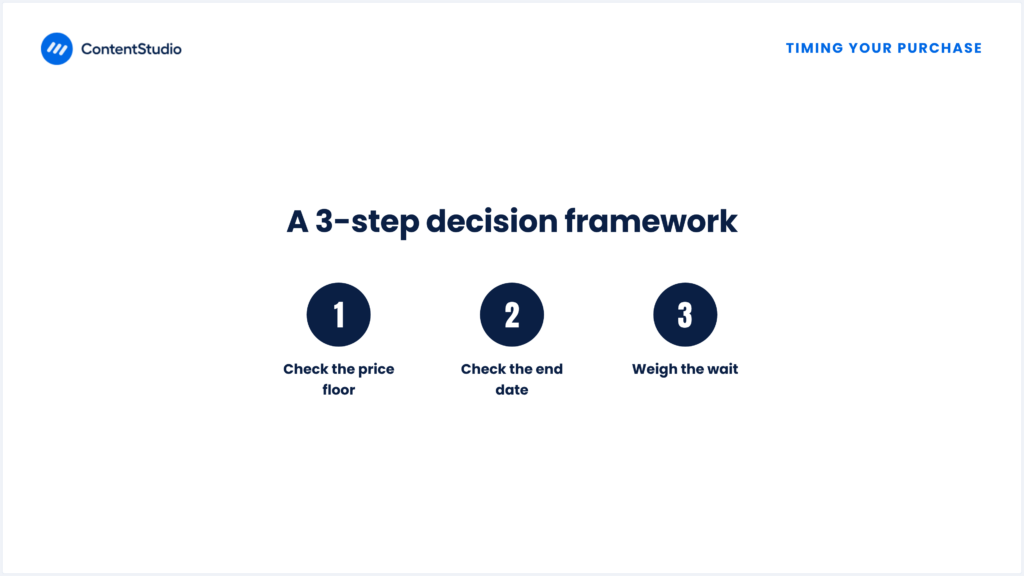
The simplest rule for software buyers is this. If the annual plan discount already meets your target price and solves a need you actually have, buy it now rather than waiting for a mythical better deal.
Subscription pricing almost never gets meaningfully cheaper by holding out a few extra days.
Waiting on software carries specific risks that don’t apply the same way to physical goods. Promo codes often expire on a fixed date and aren’t always reissued, so missing the window can mean paying full price for the entire next year.
Bonus credits, onboarding perks, or extended trial periods attached to a holiday promotion also tend to disappear once the campaign ends. These extras are sometimes worth more than the percentage discount itself, especially for teams that need hands-on setup help.
Limited time lifetime deal tiers present the sharpest risk of all. Unlike a percentage-off annual plan, these tiers are often capped at a fixed number of licenses and genuinely sell out, unlike the fake scarcity sometimes used in retail marketing.
Price anchoring also plays a role in decision-making. If you’ve tracked a tool’s regular annual price over the past few months and the current offer beats that baseline by a meaningful margin, that’s a strong signal the price is already close to its seasonal floor.
Teams juggling multiple software decisions during this period should also weigh the cost of indecision itself. Every week spent comparing tools is a week your campaigns, content calendar, or client reporting isn’t running on the better system.
A short checklist can replace the guesswork most buyers go through every November.
Regardless of which day a team finally commits to a purchase, the real priority during Black Friday and Cyber Monday is campaign execution, not the discount itself. Marketing teams running holiday promotions across multiple channels need their tools working the moment a decision is made, not days later.
That holds whether a team is still finalizing a Cyber Monday marketing plan or picking up where Black Friday left off. A single dashboard that brings scheduling, approvals, and analytics for channels like Facebook, Instagram, LinkedIn, TikTok, Pinterest, and Google Business Profile into one place matters most during a week when a team might be managing dozens of promotional posts across several client accounts at once.
Content prep tends to matter more than the software decision itself during this stretch. Teams that walk into launch day with drafted posts and a stocked list of Black Friday captions and slogans usually get more value from that prep than from whichever day they signed up for a subscription.
The goal isn’t to add another tool to compare during a busy shopping week. It’s to make sure that once a team has decided on a platform, they can act on a campaign the same day instead of losing momentum to onboarding delays.
For software specifically, Black Friday and Cyber Monday function as one event wearing two labels, with the same core discount running across both dates. The category differences that matter so much for electronics, furniture, and appliances mostly don’t apply once you’re comparing SaaS pricing pages.
Buy when the price in front of you meets your target rather than gambling on a better day that likely doesn’t exist. Use the framework above the next time a software decision lands on your desk during this season, and skip the guessing entirely.
Neither day is reliably better, since software discounts are typically identical on both dates. The real difference usually shows up in bundle extras like bonus trial days or added credits, not in the core percentage off on the subscription itself.
Yes, lifetime deals appear more often among smaller SaaS tools during this window than at any other point in the year. These offers are frequently tied to a limited quantity of licenses, so they can genuinely sell out, unlike most ongoing subscription discounts.
Prices rarely drop further once Cyber Monday ends, unlike physical retail clearance sales that can run for weeks. The next realistic discount window for most software tools is typically a New Year promotion or the following year’s Black Friday season.
Often, yes. Annual plan commitments, multi-year contracts, or simply contacting a vendor’s sales team directly can sometimes beat public promo pricing at any point in the year, especially for mid-size or enterprise-level software purchases.
Not meaningfully. Travel Tuesday and Small Business Saturday are retail and travel-focused events, centered on flights, hotels, and local shops. They show no consistent pattern of affecting SaaS subscription pricing either up or down.
Generally, yes. Vendors prioritize locking in longer-term revenue, so annual plans typically see the deepest percentage off during this stretch, while monthly plans either see smaller discounts or no promotional pricing at all.
Check a price history or price tracking tool, or simply compare the sale price against the vendor’s regular listed annual rate over the past few months. If the gap between the usual price and the sale price seems unusually wide, treat the regular price with some skepticism.
Plan 0 Days of Content in 0 Minutes
Create, schedule, publish and analyze your content across all your social media channels from one simple dashboard.
4.7 on Capterra • 16,500+ marketers trust ContentStudio
Saif Ali is a Content Marketing Strategist at ContentStudio with over five years of experience across SaaS, IT, and digital marketing. He specializes in SEO-led content, AI content creation, and social media strategy, and leads editorial review at ContentStudio, fact-checking and refining articles for accuracy, SEO, and a consistent brand voice.
View all posts by Saif AliRecommended for you
149 Best Cyber Monday & Black Friday software deals in 2026
Black Friday marketing campaign: Complete 2026 guide
Cyber Monday marketing campaign: Strategies, examples, and tips for 2026
Cyber Monday social media post ideas: Captions, hashtags & retargeting posts