Cyber Monday marketing campaign: Strategies, examples, and tips for 2026
Oct 22, 202633 minutes

Written by
Arooj IshtiaqPublished
A Cyber Monday post needs to do more than announce a discount. It needs to give shoppers an actual reason to buy, and that bar keeps rising as the holiday itself grows. Cyber Monday 2026 falls on November 30.
Social commerce is already a meaningful slice of that day’s revenue. Adobe found that social media drove 3.6% of U.S. online revenue on Cyber Monday 2025, up from 2.3% in 2024, while affiliates and partners, including influencers, accounted for 21.8% (though Adobe doesn’t isolate creator-driven sales specifically).
The takeaway is simple: strong Cyber Monday marketing campaigns combine engaging feed posts with creator content, retargeting, and timely answers to shoppers’ questions.
This guide shares 26 Cyber Monday post ideas with ready-to-adapt captions, a hashtag strategy that follows Instagram’s five-hashtag limit, retargeting ideas, a daily posting calendar, compliance tips, and five post mockups for your designer.
A Cyber Monday post isn’t just a smaller ad. It has one of four jobs, and that job should decide the format, the caption, and the moment you publish it.
| Job | What it does | Typical posts | The number to watch |
|---|---|---|---|
| Tease | Makes people remember you and raise a hand | No-price reveals, early-access signup, behind the scenes | Saves, sends, signups |
| Prove | Answers “is this worth it?” before the sale | Creator hauls, reviews, comparisons, FAQ carousels | Saves, watch time, profile and site visits |
| Close | Turns intent into an order on the day | Launch, hourly drops, stock updates, last call | Link clicks, orders, revenue |
| Rescue | Brings back people who looked and left | Retargeted reminders, answers to objections, thank-yous | Cost per purchase against break-even |
Instagram’s head, Adam Mosseri, said in January 2025 that watch time, likes, and sends are the platform’s top-ranking signals, with sends counting for more among people who don’t already follow you (Social Media Today, January 2025, quoting Mosseri; I could not reach the original video).
My read: posts people actually forward to someone, like gift guides and “send this to the person who…” prompts, are well suited to that signal.
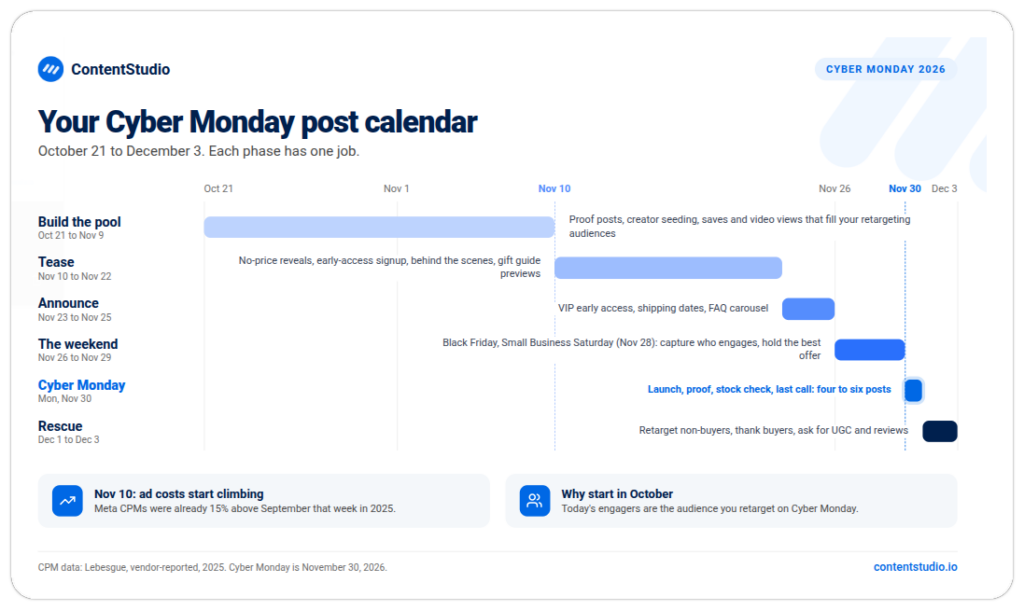
Two parts of that calendar are worth defending. The first phase starts today, because the audience you retarget on Cyber Monday is built from people who engaged with your posts back in October and early November.
That timing follows platform limits. Meta’s help center reportedly allows engagement audiences to reach back up to 365 days and website audiences up to 180 days, and TikTok’s own help center confirms its custom audiences need at least 1,000 people and take 24 to 48 hours to generate.
Starting that process on November 29 risks running short on scale or processing time before the day itself.
The second is the weekend row. Adobe’s figures imply roughly $12 to 13 billion in U.S. online spending across Saturday and Sunday (my arithmetic from its forecast), and Small Business Saturday, founded by American Express in 2010, falls on November 28.
People are already browsing. Your job over the weekend is to be the post they come back to on Monday, easier to pull off when the whole sequence is mapped out in a content calendar ahead of time rather than written the morning of.
Each idea below has a caption you can lift. Replace anything in [brackets] and don’t publish a line you can’t back up: a “was” price, a stock count, and a deadline all have to be real.
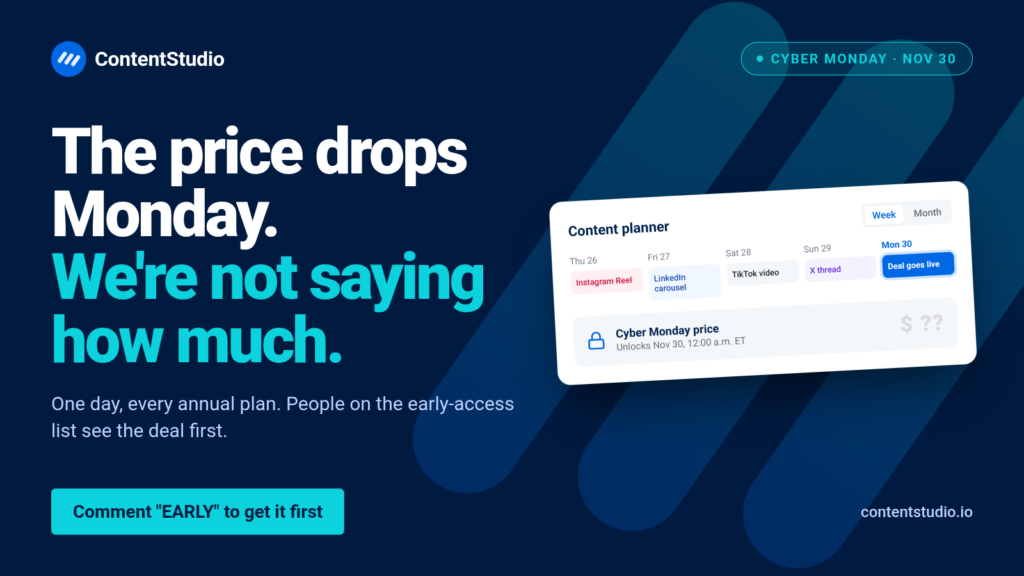
1. The no-prices-yet reveal. Show the hero product or a covered version of it, give the date, and say nothing about the discount. You’re collecting people, not selling yet.
Monday, November 30. We’re not saying what it costs yet. We’re saying [product] is part of it, and that you’ll want our notifications on.
2. The early-access keyword. Offer something to people who raise a hand: a DM keyword, a link in your bio to a signup, a text list. The reply or tap is itself a signal, and the list becomes your VIP audience.
Early access starts Sunday night for the people on our list. DM “EARLY” and we’ll send you the signup link. It’s the same offer, you just get it first.
3. The packing-table Reel. Show how an order actually gets packed, who does it, and what goes in the box. Five of the seven pages I read recommend some version of behind-the-scenes content, and for good reason: it’s cheap, and it can show the people and process behind the brand before the sale starts.
This is what a Cyber Monday order looks like before it leaves [city]. [Name] packs about [real number] a day. We’ve added [number] more people for next week so the 30th doesn’t slow anything down.
4. The gift-guide carousel. “What to buy for who”: five to seven products, one slide each, a price, and one reason. It gives people a clear, specific reason to send the post to someone.
Gifts for the person who says “I don’t need anything.” Swipe for seven under $[price]. Send this to the person who’s been asking you what you want.
5. Save this post. Ask people to bookmark. Saves are an engagement signal, and they build the audience you’ll retarget.
Save this so you can find it Monday. These are the five things we’ll have on offer, and we’ll tell you the price on the 30th.
6. The “help us choose” poll. Put two hero options in a Stories poll and ask which should lead. You get demand data for free, and every voter is an engager.
Which one goes first on Monday? [Option A] or [Option B]. Vote, and we’ll put the winner at the top of the page.
7. The “here’s what’s actually discounted” post. Say what the sale covers, what it doesn’t, and for how long. In a week of “EVERYTHING MUST GO,” a plain post stands out.
Cyber Monday at [Brand]: [X]% off [specific range] for 24 hours. Not on sale: [exclusions]. That’s the whole list.
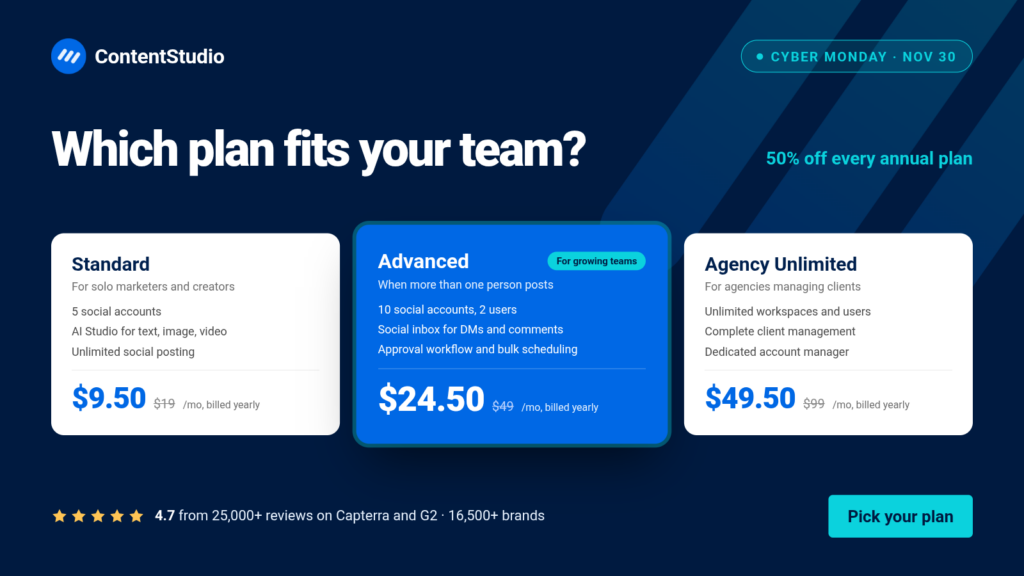
8. The creator “what I’d actually buy” video. A creator you trust picks three items and says why. Pair it with a unique code and an end time so you can see what it earned. Disclose the partnership in the caption and, for video, inside the video itself, since a caption alone isn’t enough. Livestreams should repeat the disclosure periodically, too.
Ad | Paid partnership with [Brand]. [Creator] picked the three things from [Brand] they’d buy for themselves. Code [CODE] works until midnight on the 30th.
9. The real-review carousel. One review per slide, with the customer’s words and the product. Only use real reviews, and get permission to post them. Under the FTC’s consumer reviews rule (16 CFR Part 465, effective October 21, 2024), fake reviews and certain undisclosed insider reviews or testimonials are prohibited, along with specified purchases or sales of fake social influence indicators. Reviews you feature in marketing count as testimonials.
“[Real quote].” [First name], [city]. Swipe for five more from people who bought [product] last year.
10. The FAQ carousel. Shipping cutoffs, returns, sizing, what “final sale” means. Baymard’s research found that 40% of shoppers who abandoned a cart cited extra costs, 20% slow delivery and 13% an unsatisfactory returns policy (Baymard). Every one of those is answerable in a post.
Before you check out: what ships by when, what’s the return window, and what’s the total with shipping. Five slides, no surprises.
11. The good-better-best comparison. Three tiers of the same product with one honest line on who each is for. People use social to research before they buy, and a post that does the research for them earns the save.
Not sure which [product] is right? [Entry] if [situation]. [Mid] if [situation]. [Top] if [situation]. We’ll tell you if you don’t need the top one.
12. The price-honesty post. Show the regular price, the date it started and the sale price. If you can’t show that, lead with the offer and leave the percentage off. Consumers’ Checkbook tracked 25 national chains weekly for 24 weeks in 2025 and found 21 advertised sale prices more than half the time (Consumers’ Checkbook, 2025). People notice.
[Product]: $[regular] since [date]. $[sale] for Cyber Monday only. We’ll put it back at $[regular] on December 1.
13. The launch post. Morning, one product, one price, one deadline with a time zone, and the keyword in the first line.
Cyber Monday: [product] is $[price] until 11:59 p.m. [time zone]. Link in bio.
14. The Stories countdown. Instagram Stories have a countdown sticker people can set a reminder on (check your own app for current options). Set it to the real end time, and use it for the launch and the last call.
Ends tonight at 11:59 p.m. [time zone]. Tap the sticker to get a reminder.
15. The hourly drop. One surprise per hour is hard to ignore and easy to schedule. Chubbies ran a version, “Thighber Monday,” that gave random gifts with every hourly purchase (BroBible; the page doesn’t state the year).
2 p.m. drop: free [gift] with every order for the next hour. Gone at 3.
16. The live shopping session. A short live with one host, three products and a running Q&A. TikTok says sellers and brands hosting livestreams saw sales grow 84% across Black Friday weekend 2025, which is TikTok’s own number and unaudited (Tubefilter, December 2025).
Live at 1 p.m. [time zone]: three products, your questions, and a deal only people in the live get. Set a reminder.
17. The honest stock update. Say how many are left, only if the number comes from live inventory.
[Number] left in [size/colour]. We’ll mark it sold out as soon as it is.
18. The “missed Friday?” second chance. Deals now run all week and shoppers start earlier, which is how Adobe’s analyst explained Black Friday’s momentum. That leaves Monday as the day the people who waited can still finish. Say so.
Missed Friday? Monday has the same [offer] on [product], until midnight.
19. The creator-code push. Re-share creator posts and remind followers of codes with an end time.
[Creator]’s code [CODE] ends at midnight. Here’s what they picked.
20. The last call. Early evening, plain, with the real end time. If the offer repeats, don’t say it won’t.
Final hours: [offer] on [product] ends at 11:59 p.m. [time zone]. Tomorrow it’s $[regular] again.
21. The viewed-but-didn’t-buy post. A short product-proof video (use, fit, size, unboxing) shown to people who looked at the product page. It’s an ad, built to answer the question that stopped them.
Still thinking about [product]? Here’s [real customer] using it for [time], and what they’d change.
22. The cart answer. Show people with a cart the one thing that usually stops the sale: shipping date, returns, the total with tax.
It ships Wednesday, returns are free for [days], and the price you see is the price you pay.
23. The Black Friday buyer follow-up. Show a complement or a gift to people who bought on Friday. Leave them out of acquisition ads so they don’t see “20% off for new customers” three days after paying full price.
You picked up [product] on Friday. This is what goes with it, and it’s [offer] through Monday.
24. The December 1 extension. Use this only for a genuine reason. A hero product still being in stock isn’t, on its own, enough to make a “final” deadline not final, since an extension needs real circumstances behind it or it risks making the original urgency claim misleading. If you extended because the sale underperformed, don’t dress it up.
We kept [product] at the Cyber Monday price through Tuesday because [real reason]. After that, it goes back to $[regular].
25. The thank-you and UGC ask. Thank buyers, ask for a photo and a review once the product arrives. Give people an easy path, and get permission before you repost anything.
Thank you for your orders. When yours arrives, we’d love to see it. Tag us, and if we repost it we’ll ask first.
26. The different angle (only if it’s yours). A small number of brands have opted out of the sale altogether. Patagonia ran “Don’t Buy This Jacket” in a Black Friday ad, REI made its #OptOutside closure permanent in 2022, and Everlane gave its Black Friday 2015 profits to its factory workers.
Consistency with how the brand behaves the other 364 days of the year is what makes a message like this credible. None of those sources reports sales results, so treat this as a positioning choice rather than a proven sales tactic.
We’re not discounting on Cyber Monday. We’re [specific action] instead, and here’s why.
Most caption advice comes down to one thing: people decide in a line and a half whether to read the rest. On Instagram, about the first 125 characters reportedly show before “more” (Meta documents only the 2,200-character limit, so check your own app; note that Buffer states a 3,000-character limit, which conflicts with other sources).
Hootsuite’s guidance is to open with a hook, and it notes that captions are among the things Instagram analyzes to determine what a post is about. Buffer recommends clear, concise calls to action and restraint with emojis and hashtags.
A tool like ContentStudio’s AI caption generator is useful here, mainly for breaking writer’s block on the first line. The structure below is what actually does the work.
Put together, that gives you a structure I’d use for every promotional caption:
Poppi’s 2024 Black Friday sale ran on TikTok, Instagram and Threads with the same offer and different caption lengths and visuals for each, according to Sprout Social’s roundup (Sprout). Here is the same offer, written for five places.
| Platform | Caption |
|---|---|
| Cyber Monday: [product] is $[price] until 11:59 p.m. [time zone]. Free shipping over $[amount]. Tap the link in bio. | |
| TikTok | [Hook in the video]. Cyber Monday price on [product] is live until midnight, link on our profile. |
| X | [Product] is $[price] for Cyber Monday, ends 11:59 p.m. [time zone]. [link] |
| Cyber Monday is live. [Product] is $[price] until 11:59 p.m. [time zone], and shipping is free over $[amount]. [link] | |
| Cyber Monday deal on [product]: [specific description with keywords], $[price] through November 30. |
Pinterest is a search engine first and a feed second. Write that description as a sentence someone would type into the search box.
A 2021 Elite Daily roundup of Cyber Monday captions shows the patterns that have been done to death: Monday reframing (“the only Monday I like”), food puns (“words cannot espresso”), idiom twists (“work hard, shop harder”), and Santa or pop-culture riffs. The ranking pages keep repeating the same patterns with “Wi-Fi” and “404.”
The puns that actually land bend the brand’s own name or product, not the holiday. Chubbies’ “Thighber Monday” and Tunnelbear’s “Cybear Monday” (per Campaign Monitor) both work because they’re built around who the brand is. A fair test: if your pun would work equally well for any other brand, it will work for them too, which means it isn’t really doing anything for you.
Instagram said in December 2025 that it would “gradually update the number of hashtags that you can include in a caption for a reel or post to five.” It also said fewer, more targeted tags can perform better than many generic ones, and asked people to avoid generic tags like #reels and #explore. Rollout is gradual, and accounts can differ.
What happens if you go over five isn’t fully clear. Sources conflict on whether extra tags are ignored or the post won’t publish at all, so test your own composer before building a caption around that assumption. A tool like ContentStudio’s Instagram hashtag generator can help you land on five tags worth keeping instead of guessing.
The platform’s own framing matters more than the number. Mosseri has said, as reported, that hashtags don’t increase reach but are a good way to tell people what a post is about, and I’d use them exactly that way.
Socialinsider’s analysis of more than 75 million Instagram posts from 2021 to 2022 found engagement almost flat across hashtag counts, between 3.2% and 3.4% (vendor-reported, older, via a summary). The five-tag cap makes the old “use 30” advice obsolete, and the data suggests it never did much anyway.
A five-tag formula.
| Type of brand | Starter set |
|---|---|
| Fashion | #CyberMonday #FashionDeals #[Brand] #OOTD #[Brand]Style |
| Beauty and skincare | #CyberMonday #SkincareSale #BeautyDeals #[Brand] #[Brand]Routine |
| Home | #CyberMonday #HomeDecorDeals #HomeStyle #[Brand] #[Brand]Home |
| Tech and gadgets | #CyberMonday #TechDeals #GadgetGifts #[Brand] #[Brand]Tech |
| Food and drink | #CyberMonday #FoodieGifts #[Brand] #[Brand]Table #ShopSmall |
| Local or small business | #CyberMonday #ShopSmall #SmallBusinessSaturday #[City]Made #[Brand] |
Two cautions are worth keeping in mind. First, write hashtags in CamelCase, with a capital at the start of each word. CamelCase helps screen readers and people alike parse a multi-word tag like #CyberMonday into separate words, since #cybermonday can run together; BOIA recommends capitalizing each word for this reason.
Second, I haven’t found evidence on how often any of these specific tags is used or how well they perform. Rival IQ’s 2025 report listed #competition, #win, and #giveaway as the top Instagram hashtags in retail, with no Cyber Monday tag among them, so look at what each tag actually shows in your own app before you commit to it.
TikTok has reportedly applied a five-hashtag limit to some accounts since August 2025, though I couldn’t verify an official, universal rule, so check your own composer and use a small set of relevant tags. ContentStudio’s TikTok hashtag generator can help you shortlist them. On Pinterest, put your effort into the description and the title instead, because Pinterest runs on search. On X, one or two hashtags is plenty.
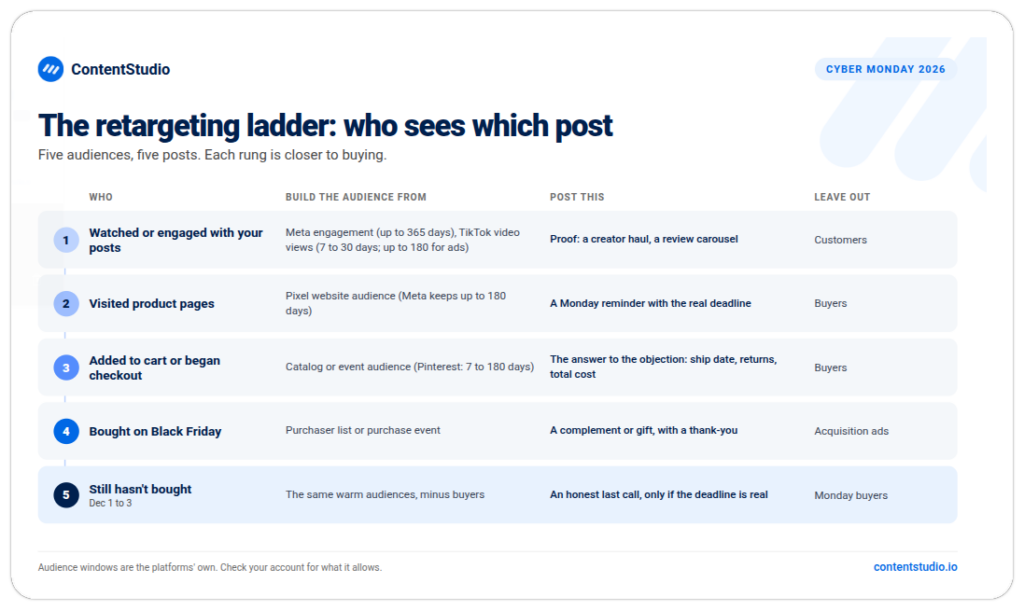
Retargeting posts are the ones almost no list covers, yet they address people who have already shown interest. They’re content or ads delivered to a previously engaged group, sometimes a post you already made and sometimes new creative built specifically for that group, because that group already told you something by watching, tapping, or adding to cart.
Why you need to start earlier than you think: ad costs rise sharply before the day itself. Lebesgue’s analysis of Meta spend in 2025 (vendor-reported, $22.6 million across September to November) found median CPMs were already 15% above September in the week of November 10, 59% above in Black Friday week, and 71% above on Cyber Monday (Lebesgue).
That rising cost didn’t mean falling profitability, though. The same data showed conversion rate up 48% and Meta-reported ROAS up 19% in Black Friday week, so expensive didn’t mean unprofitable.
Triple Whale’s retrospective of more than 33,000 shops put the 2025 Black Friday through Cyber Monday averages at a 2.26 ROAS and a $22.26 CPM on Meta.
Check those against your own break-even before you set a budget, and tag every retargeting link with a UTM builder so the revenue actually traces back to the post that earned it. The margin math, including break-even ROAS, is worked through in the companion Cyber Monday marketing campaign guide.
What each platform lets you build.
Three rules I’d follow.
Two platform changes make older advice stale. Meta announced that its Ads Insights API would stop returning 7-day-view and 28-day-view attribution data from January 12, 2026, with 1-day view and the click windows still available. This is a reporting and API change, so check your current Ads Manager settings separately, since they reportedly already align with the remaining values (reported by ppc.land; not from Meta’s changelog).
Advantage+ shopping campaigns also reportedly no longer have an existing-customer budget cap, according to Jon Loomer, so watch how much spend goes to people who already bought. If you’re copying 2024 advice, check both changes first.
Retargeting post captions.
Rung 1, proof: You asked about [thing] a lot, so here it is in real life. [Customer] has used it for [time].
Rung 2, deadline: The [product] you looked at is $[price] today, until 11:59 p.m. [time zone].
Rung 3, objection: It ships [day], returns are free for [days] and the price includes everything. Ready when you are.
Rung 4, complement: You’ve got [product]. [Complement] makes it better, and it’s [offer] through Monday.
Rung 5, last call: Last call on [product]. It goes back to $[regular] [day].
| Platform | What the evidence says | What I’d post |
|---|---|---|
| Emplifi’s Q3 2026 data for fashion retailers shows median interactions per post of 35 for Reels, 32 for carousels and 20 for images (vendor, 1,334 profiles, July to September 2026). Rival IQ’s 2025 report found Reels led for retail and photos led on Facebook, though its own retail figures contradict each other. | Reels for proof and live moments, carousels for gift guides and FAQs, Stories for countdowns and polls | |
| TikTok | Salesforce found TikTok‘s share of social traffic to commerce sites up 86% in the weeks to mid-November 2025. TikTok says US Shop sales passed $500 million over Black Friday weekend through Cyber Monday (company figure, unaudited). TikTok’s own 2026 examples include Princess Polly’s approximately 6,000 creator videos in a single month and Dossier’s more than 80,000 videos “in market,” with products sampled to roughly 1,000–5,000 creators monthly (attribute these figures to TikTok, not to independent measurement). | Creator seeding, live sessions, short product-in-use videos |
| Photos led in Rival IQ’s retail data. Lives had the highest median interactions on fashion retailers’ Facebook pages in Emplifi’s Q3 2026 data (53.5). | Photo posts with a clear offer, Lives, groups if you have one | |
| A search-first platform. Pinterest’s own help describes dynamic retargeting with product catalogs. | Keyword-rich product and gift-guide pins, started early | |
| X | Rival IQ reported the steepest year-over-year engagement decline of the four platforms it covered (-48%). | Short, dated updates and replies, not your main effort |
On timing, the largest published studies are vendor-reported and don’t agree on the hour. Sprout Social’s 2026 analysis of engagement across hundreds of thousands of profiles put Instagram’s best slots at Monday 2–4 p.m. and midweek afternoons generally.
Buffer’s analysis of 9.6 million Instagram posts found Thursday 9 a.m., Wednesday noon, and Wednesday 6 p.m. strongest, with Friday and Saturday weakest. They agree that midweek beats weekends, but their strongest recommended windows differ.
I found no study of Cyber Monday or BFCM posting times specifically, so the honest answer is to use these as a starting plan (see our breakdown of the best time to post on Instagram), then check your own Insights from Black Friday weekend.
Instagram has also made algorithm changes in the past year. Its own announcement says “Your Algorithm,” which lets people dial topics up or down, is now live across Feed, Reels and Explore (Instagram, June 2026). Reports from April 2026 say Instagram has extended its rule against recommending accounts that mostly repost other people’s content to photos and carousels.
| Topic | What applies | Source |
|---|---|---|
| Creator and influencer posts | Disclosures must be “hard to miss” and placed with the endorsement itself. They are “likely to be missed” if they sit on a profile page, at the end of a post or “anywhere that requires a person to click MORE.” A hashtag like #ad is fine but not required, and “don’t mix your disclosure into a group of hashtags.” Don’t assume a platform’s own tool is enough. | FTC, Disclosures 101 for Social Media Influencers |
| Who is responsible | “The ultimate responsibility for clearly and conspicuously disclosing a material connection rests with the influencer and the brand – not the platform.” | FTC Endorsement Guides Q&A |
| Reviews and testimonials | Fake reviews, buying reviews by sentiment, undisclosed insider reviews and fake social indicators are prohibited. Incentives aren’t banned but can’t depend on a particular sentiment. | 16 CFR Part 465 (effective Oct 21, 2024); FTC Q&A |
| “Was” prices | A former price must be “the actual, bona fide price” at which the item was offered regularly. | 16 CFR 233.1 |
| Time-limited claims | The UK ASA upheld complaints against PrettyLittleThing’s 2023 posts: “30% OFF EVERYTHING*” when exclusions applied, and “one hour ONLY” when the offer repeated. The ASA said such messaging was “likely to pressure consumers into making swift transactional decisions.” UK ruling, not US law. | ASA, May 15, 2024 |
| Giveaways | The FTC suggests a disclosure placed at the start of a post for giveaways that require posts. Instagram’s promotion guidelines are reported to require official rules, a statement that the promotion isn’t sponsored or administered by Instagram, and accurate tagging. I couldn’t read the page, so check it. | FTC Q&A; Instagram (reported) |
| Music | TikTok’s Commercial Music Library is cleared for commercial use on business accounts. TikTok warns that using its general library to promote a business risks infringement. Meta’s business accounts reportedly see a restricted catalog, not the full one. Check Meta’s help page. | TikTok; reported for Meta |
| Accessibility | Alt text on images, accurate captions on video, CamelCase hashtags. | W3C WCAG 1.1.1; BOIA |
A note on reposting customer photos: I couldn’t find an authoritative source for exactly what permission you need, so what follows is my own practice rather than legal advice. Ask the person first, in writing, and keep the message, since it costs nothing and avoids any dispute later.
For the creator-disclosure side of this, our guide to affiliate disclosure on social media walks through the wording the FTC actually expects.
One more claim to watch is the superlative. “Biggest sale of the year” and “99% happy customers” are lines in the bank of slogans I read that a brand could be asked to substantiate. If you can’t point at the evidence, don’t post it.
None of the brands below published campaign results, except where noted, so I’m not claiming any of these worked. I’m showing the idea behind each one instead. A few lean on user-generated content rather than brand-produced creative, which is worth reading as a separate strategic choice rather than a guarantee of performance.
| Brand | Year | The idea | What to take |
|---|---|---|---|
| Patagonia | 2011 | “Don’t Buy This Jacket” anti-sale ad | Works only if it fits how you behave all year |
| REI | 2015, permanent in 2022 | #OptOutside | A real action beats a message about one |
| Everlane | 2015 | Black Friday profits to factory workers | Say exactly where the money goes |
| Cards Against Humanity | 2015, 2016 | “$5 for nothing,” a livestreamed hole | Absurdity suits brands that already do absurd |
| Gymshark | 2021 | “Jim Shark” fake birthday, with celebrity Cameo videos, before the sale | A pre-sale teaser that is entertainment first |
| 2024 | Black-owned Friday spotlight | A cause works when you give it the spotlight, not just a mention | |
| Lindt Canada | 2024 | Early access for loyalty members (per Sprout) | A reason to join the list |
| Poppi | 2024 | One offer, different caption and visual per platform (per Sprout) | Write for the platform you’re on |
| Glossier | 2025 | A plain sale post: 25% off, 30% off $100 and up | Plain is allowed |
| Chubbies | Year not stated | Hourly mystery gifts | Make the countdown a reason to return |
| Princess Polly, Dossier | 2026 prep | Thousands of creator videos on TikTok Shop (TikTok figures) | Seed creators early and at scale |
And one to avoid: PrettyLittleThing’s November 2023 posts, covered in the rules table above. The quotes show exactly how “everything” and “one hour only” go wrong.
Measure each job by its own number, not by one blended score.
| Post job | Measure | Why |
|---|---|---|
| Tease | Saves, sends, signups, new engagers | They fill the audiences you retarget |
| Prove | Watch time, saves, product-page visits | Intent signals, not sales |
| Close | Link clicks, orders, revenue by UTM | The day’s results |
| Rescue | Cost per purchase against your break-even | Retargeting costs real money |
Benchmarks are hard to compare because the definitions differ (our guide to social media metrics covers which definitions actually matter for a holiday push). Rival IQ divides interactions by followers, Emplifi’s Q3 2026 report uses impressions, and I couldn’t read Socialinsider’s definition. Use these figures for scale, not as hard targets.
In Emplifi’s Q3 2026 data, the median fashion account posted about 68 times on Instagram in a quarter, roughly five a week. That tells you Cyber Monday’s four to six posts in a single day is a real spike worth planning capacity for.
I found no BFCM-specific engagement benchmarks, and no large-sample study of how user-generated content performs against brand content. I didn’t locate one in this review, which isn’t the same as saying one doesn’t exist.
If you do one thing today, start the audience pool. Post three pieces of proof content this week (a creator pick, a review carousel, an FAQ), because engagement on those becomes the retargeting audience you’ll use on the 30th. Then write the Monday sequence: launch, proof, stock, last call. If you can’t back a line with a real price, a real count, and a real deadline, cut it.
A boosted post is a simple way to reach more people with existing content. Ads Manager offers more control over campaign goals, audiences, placements, and testing. The best option depends on whether your main goal is visibility, engagement, or sales.
Instagram Story scheduling depends on the tool you use and the features you need. Some tools require you to publish Stories manually or add interactive stickers inside Instagram. A quick test before Cyber Monday can help you avoid last-minute issues.
The destination should match the offer in your post. A product page works best for a discounted item, while a collection page suits multiple products. Service businesses can link directly to a booking page or inquiry form. A relevant landing page also saves customers from searching for the deal.
Service businesses can promote discounted packages, gift cards, or limited-time booking offers. Each promotion should explain what customers receive, when they can redeem it, and any restrictions. A direct booking link makes it easier for interested customers to take action.
Deleting every post is not necessary. Expired promotions can remain useful if their captions clearly state that the offer has ended. Removing them from pinned positions and pausing related ads also helps prevent confusion. Posts with outdated prices or misleading deadlines should be updated or archived.
Plan 0 Days of Content in 0 Minutes
Create, schedule, publish and analyze your content across all your social media channels from one simple dashboard.
4.7 on Capterra • 16,500+ marketers trust ContentStudio
Arooj Ishtiaq is a Content Marketing Strategist with 5+ years of experience writing about social media, SaaS, and AI. At ContentStudio, she creates practical guides, tutorials, and how-to content that help marketers navigate social media trends, sharpen their strategies, and get more from their content.
View all posts by Arooj IshtiaqRecommended for you
Cyber Monday marketing campaign: Strategies, examples, and tips for 2026
Black Friday marketing campaign: Complete 2026 guide
100+ Black Friday quotes, captions, hashtags & slogans for 2026

149 Best Cyber Monday & Black Friday software deals in 2026