Black Friday marketing campaign: Complete 2026 guide
Nov 4, 202534 minutes

Written by
Arooj IshtiaqPublished
A great Cyber Monday marketing campaign does more than shout about a discount. It finds the shoppers who are already close to buying, gives them a reason to act today, and does it without handing your profit back to the customer. The hard part is the thinking that comes first: who is ready, how much discount you can truly afford, and when to reach the people who are still deciding.
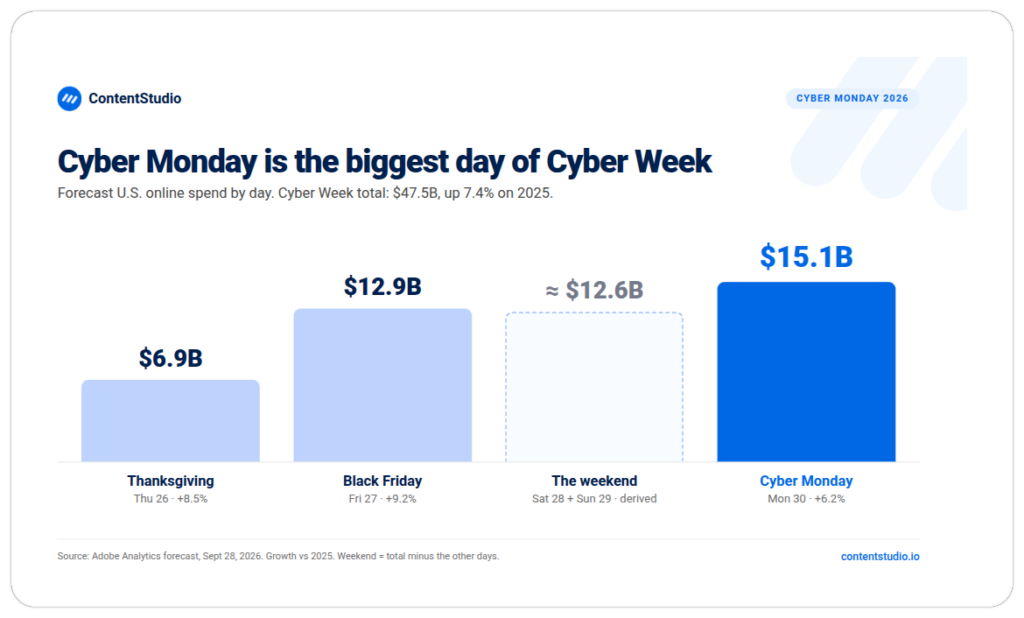
The stakes are high because so much buying lands on one day. Adobe forecasts that U.S. shoppers will spend $15.1 billion online on November 30, 2026, up 6.2% from the record $14.25 billion on Cyber Monday 2025. In a crowd that big, a discount code and a countdown timer will not set you apart. A plan that connects customer behavior, margins, and timing will.
That plan has to answer some uncomfortable questions. A 30% discount may bring in more orders, but will those orders cover the profit you give up? And what happens when shoppers have already compared prices and filled their carts over the weekend? This guide works through both, then covers email, text messaging, paid media, creators, your landing page, and measurement, with templates you can copy and the rules you need to follow.
Cyber Monday marketing is everything a brand does to win online shoppers around the Monday after Thanksgiving: offers, emails, text messages, ads, social content, and the website updates that tie them together. It usually sits inside Cyber Week, the five-day stretch that includes Thanksgiving, Black Friday, and Cyber Monday.
The name goes back to 2005, when Shop.org, the online arm of the National Retail Federation (NRF), coined it after noticing a jump in online shopping on that Monday. What started as an observation is now a fixture of holiday marketing plans.
It also plays by different rules than Black Friday. Shopping happens online, and mostly on phones: mobile generated 57.5% of Cyber Monday sales in 2025. And plenty of shoppers arrive with a product already in mind after comparing offers all weekend.
That changes what Monday is for. Instead of introducing every offer from scratch, your campaign can focus on people who have already shown interest. Cart reminders, relevant product recommendations, early-access follow-ups, and a clear checkout path turn that interest into orders.
Cyber Monday is still a giant, but Black Friday has been gaining on it. Adobe’s figures show Black Friday online sales growing 10.2% in 2024 and 9.1% in 2025, while Cyber Monday grew 7.3% and 7.1%. Its 2026 forecast follows the same pattern, at 9.2% for Black Friday and 6.2% for Cyber Monday.
Adobe ties part of that shift to competitive deals running all through Cyber Week. When good offers show up early, shoppers have less reason to wait. If you want to see how the earlier part of the week works, our Black Friday marketing campaign guide covers the planning side in detail.
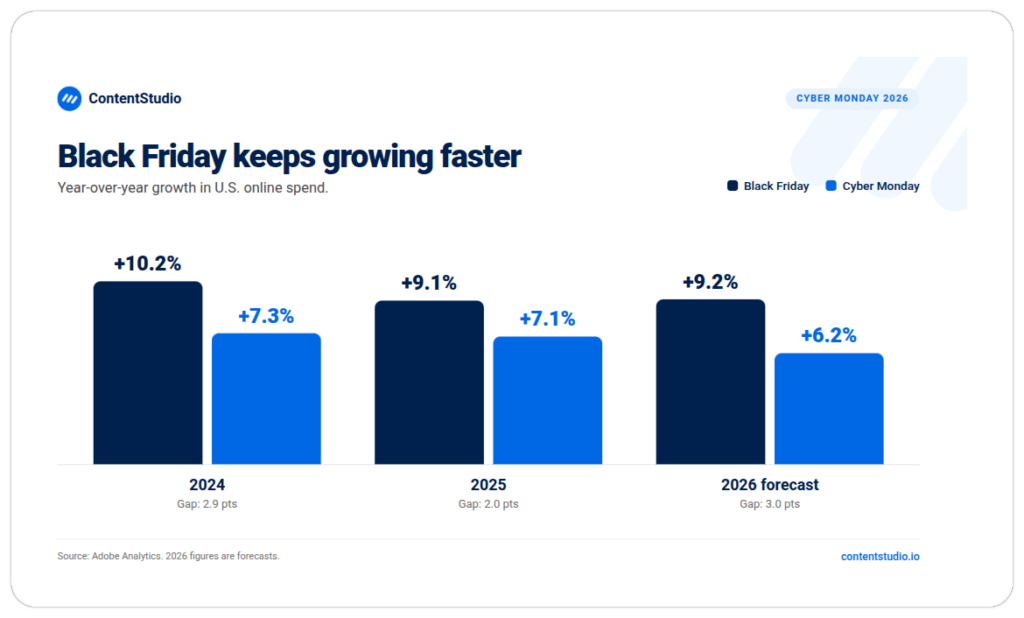
Slower growth does not mean Monday has lost its power. Shoppers still spent $14.25 billion online that day in 2025. What has changed is behavior. By Monday, some people have finished their gift lists, others are comparing last options, and a few are waiting for a better price on one specific product. A campaign that treats every visitor as a brand-new prospect misses those differences.
So do not save everything for Monday. Build interest beforehand, keep track of who has engaged, and follow up with relevant offers when they are ready. Cart abandoners, weekend browsers, and early-access subscribers let you work with existing purchase intent and not just lean on a bigger discount.
You will see Cyber Monday figures that disagree, and they are usually all correct, because each source measures something different.
Adobe tracks U.S. online spending ($14.25 billion in 2025), Salesforce models shopper data and puts U.S. online sales at $13.6 billion, Shopify counts sales across its own merchants worldwide for the whole Black Friday to Cyber Monday weekend, and Klaviyo reports the revenue its platform attributes to email and text, using a five-day window for email and 24 hours for text. Deloitte and the NRF publish forecasts and surveys built on different calendars.
| Source | What it measures | Cyber Monday 2025 figure | Watch for |
|---|---|---|---|
| Adobe Analytics | U.S. online spend, from over a trillion retail site visits | $14.25B, +7.1% | Measured spend, not orders |
| Salesforce | Modelled shopper data across 1.5 billion shoppers | $13.6B U.S. online, +6% | Modelled, with its own assumptions |
| Shopify | Sales across its own merchants, worldwide, Black Friday to Cyber Monday | $14.6B for the weekend, +27% | Unaudited, its own merchants only |
| Klaviyo | Revenue its platform attributes to email and text | $3.8B attributed value | Attribution window: five days for email, 24 hours for text |
| Deloitte, NRF | Surveys and forecasts, built on different calendars | Deloitte’s e-commerce forecast runs November to January | Not comparable to Adobe’s November to December window |
Mobile shows the problem clearly. Adobe puts mobile at 57.5% of Cyber Monday 2025 spending, while Salesforce says mobile drove 70% of online orders during Cyber Week. Both can be true, because one counts spending on a single day and the other counts orders over a week. Pick one source for your own benchmarking and stay with it.
| What | Figure | Type | Source |
|---|---|---|---|
| U.S. online spend, Cyber Monday 2026 | $15.1B, +6.2% | Forecast | Adobe, Sept 2026 |
| U.S. online spend, Cyber Monday 2025 | $14.25B, +7.1% (Adobe had projected $14.2B) | Actual | Adobe, Dec 2025 |
| Mobile share of Cyber Monday 2025 spend | 57.5% ($8.2B) | Actual | Adobe |
| Peak spending, Cyber Monday 2025 | $16M per minute, 8 to 10 p.m. | Actual | Adobe |
| Buy now, pay later, Cyber Monday | $1.03B in 2025; $1.09B forecast for 2026 | Actual, forecast | Adobe |
| Share of revenue, social vs. affiliates and partners, Cyber Monday 2025 | 3.6% (+56.5%) vs. 21.8% | Actual | Adobe |
| Online shoppers on Cyber Monday 2025 | 75.9M, up from 64.4M | Survey-based | NRF and Prosper Insights |
| Average planned holiday spend per household | $1,654, up from $1,595 | Survey | Deloitte, Oct 2026 |
| Share planning to shop Cyber Monday | 44% | Survey | Deloitte, Oct 2026 |
| Peak discounts, Cyber Week 2026 | Up to about 30% (electronics 30%, toys 29%, apparel 23%) | Forecast | Adobe |
| Holiday season online sales, 2026 | $275.1B, +6.7% (Nov 1 to Dec 31) | Forecast | Adobe |
Campaigns rarely fail because of one weak email. They fail earlier, through fuzzy goals, discounts that eat the margin, and messages that reach the wrong people. These five decisions keep the rest of the work honest.
Choose a single primary goal. You might want to convert weekend browsers, clear specific inventory, win new customers, or bring existing customers back. A secondary goal is fine, but a pile of priorities muddies the offer, the ads, the emails, and the landing page. If you build campaigns often, our guide to a high-ROI social media campaign shows how to set goals that the whole team can follow.
A discount can lift sales, but it also shrinks what you keep from every order. Before you announce an offer, work out how many extra units you need to sell to make up the difference.
Take a product that sells for $50, costs $20 to produce, and costs another $8 to ship and process. At full price, it contributes $22 per unit, a 44% contribution margin. Here is what each discount does, assuming those costs stay the same.
| Discount | Selling price | Contribution per unit | Unit volume needed vs. full price | Break-even ROAS |
|---|---|---|---|---|
| 0% | $50 | $22 | 1.00× | 2.27 |
| 20% | $40 | $12 | 1.83× | 3.33 |
| 30% | $35 | $7 | 3.14× | 5.00 |
| 40% | $30 | $2 | 11.00× | 15.00 |
The volume multiple is the original contribution per unit divided by the discounted contribution per unit, and break-even ROAS is the selling price divided by contribution per unit. Both ignore advertising and fixed overhead, and they assume per-unit costs stay constant.
At 30% off, contribution drops from $22 to $7 per unit. To generate the same total contribution before advertising and fixed costs, you would need about 3.14 times your usual unit sales, which is roughly 214% more units. At 40% off, contribution falls to $2, and you would need 11 times the volume. That makes it very hard to pay for ads and overhead.
The same math sets your advertising ceiling. At 30% off, this product needs a ROAS of 5.0 just to cover ad spend from its contribution. For context, Triple Whale’s retrospective of more than 33,000 shops reported a 2025 Black Friday and Cyber Monday average ROAS of 2.26 on Meta and 3.62 on Google (Triple Whale’s BFCM report).
Those are platform-reported averages across very different businesses, so they do not predict your results. Still, a required ROAS well above broad averages is a signal to test carefully and keep the budget conservative before you commit.
Not necessarily. Klaviyo’s vendor-reported data showed average discounts among its customers falling from 29.6% to 26.2% during BFCM 2025 while sales grew, and the brands with the smallest discounts recorded 14% year-over-year growth. That is a correlation, not proof that smaller discounts caused the growth.
Research on discount depth points the same way: the effect depends on who you are discounting for. A 2006 Journal of Marketing Research study linked deeper acquisition discounts to lower repeat purchase rates.
A 2004 Marketing Science experiment found that discounts increased repeat purchases among first-time buyers but reduced them among established customers. An agency analysis of 106 Shopify stores found that customers acquired during BFCM returned at a lower rate than other customers.
The practical lesson is to judge a campaign by what happens after the sale. Tag the customers you acquire on Cyber Monday and compare their repeat purchase rate in June 2027. That tells you whether you attracted long-term customers or mostly one-time bargain hunters.
Shoppers notice when a “was” price is not real. Consumers’ Checkbook tracked 25 national chains weekly for 24 weeks in 2025 and found that 21 advertised sale prices more than half the time (Consumers’ Checkbook’s 2025 findings). Use genuine reference prices and keep records that support them. If you cannot substantiate a percentage-off claim, lead with the actual price or the value of the deal.
A long list of deals makes a campaign harder to understand and harder to run. Pick two or three products or bundles with a clear reason to buy, enough inventory for the expected demand, and margins that can carry the discount. Let them lead your emails, ads, landing page, and social posts. Other products can appear, but they do not need equal billing, and a tighter selection makes it much easier to see which offers earn a profit.
One discount does not have to go to everyone. Loyal buyers may respond to early access, while someone who left a cart behind needs a nudge about that specific product. A simple segment plan keeps your messages relevant and your discounts rare.
| Audience segment | Suggested offer or action | Message angle |
|---|---|---|
| VIPs and repeat buyers | Early access 12 to 24 hours before launch | Shop before everyone else. |
| Engaged subscribers (opened in the past 90 days) | Standard Cyber Monday offer | Introduce the main deal and explain its value. |
| Weekend browsers who did not buy | Relevant product reminder with the standard offer | Bring them back to products they viewed. |
| Cart abandoners | Cart reminder featuring the specific product | Help them return to checkout. |
| Lapsed subscribers (no opens in six months or more) | Suppress from routine promotions, or use a suitable re-engagement approach | Rebuild interest without raising complaints. |
| Customers who already bought this campaign | Suppress from acquisition messages and send a confirmation or thank-you | Acknowledge the purchase and avoid repeating the offer. |
Behavior should decide what comes next. A loyal customer may value early access more than a deeper discount, and someone who just paid should never receive a “last chance” email for the offer they already used. Before mailing lapsed subscribers, check consent, engagement, and deliverability, and watch spam complaints against your email provider’s requirements and not a single universal target.
Your channels should support one another and not repeat the same message everywhere. That is the heart of an integrated marketing campaign: email explains the full offer, SMS delivers a time-sensitive nudge, and paid search catches shoppers already hunting for the product.
| Channel | Main role on Cyber Monday | What to monitor |
|---|---|---|
| Explain offers, showcase products, drive sales | Engagement, unsubscribes, spam complaints, revenue | |
| SMS | Early access, important updates, genuine last-chance reminders | Consent, opt-outs, quiet hours, message frequency |
| Paid search and shopping ads | Reach shoppers actively searching for products and deals | Cost per click, conversion rate, profit after ad spend |
| Paid social and retargeting | Reconnect with interested visitors and reach relevant audiences | Creative fatigue, CPM, conversion rate, ROAS |
| Creators and affiliates | Build awareness, demonstrate products, drive trackable referrals | Disclosure, commissions, attributed sales |
| Website and checkout | Convert traffic from every other channel | Mobile speed, availability, checkout errors, cart abandonment |
With roles defined, it is much easier to see which channels contribute and where customers drop off, and you avoid sending the same urgent message by email, text, and ads at the same moment.
Before launch, test the whole journey on a phone, from the first click to the confirmation page. A well-planned campaign still loses sales to slow product pages, broken discount codes, or needless checkout friction.
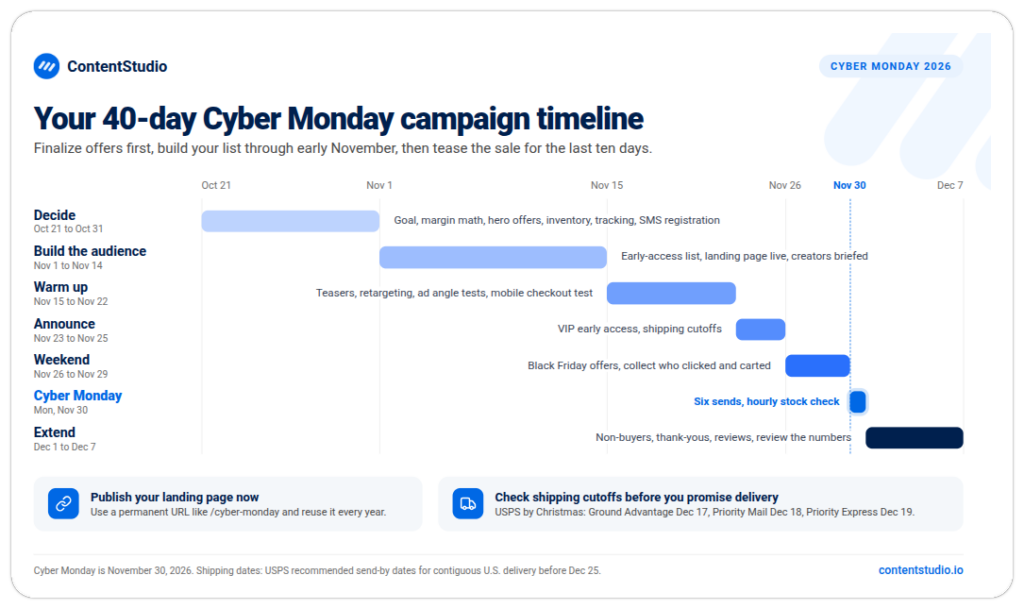
Forty days is enough time if you work in order: finalize offers and margins first, build your early-access list through early November, and spend the last ten days teasing the sale. A shared content calendar makes the sequence easier to follow, because every email, post, and ad sits in one view with an owner and a release date.
These are the ideas worth building a 2026 campaign around, roughly in order of how much they tend to matter. Several are older than the internet. Execution is what changes.
| Idea | Why it works | Effort |
|---|---|---|
| Second-chance offer for weekend browsers | Targets people who showed intent and did not buy | Low |
| VIP early access, 12 to 24 hours | Rewards loyalty without discounting for everyone | Low |
| Tiered spend thresholds | Lifts order value while margin stays controlled. Epic Sports ran $10 off $100 and $15 off $150, which are both 10% but read as two offers | Low |
| Gift-ready bundles | Fits the gifting job. Lancôme advertised a holiday beauty box this way | Medium |
| Gift with purchase | Protects the hero product’s price. Allbirds offered free socks at $100 | Low |
| Creator codes with an end time | Measurable, and the creator’s voice adds a personal recommendation | Medium |
| Comparison and best-buy content | Shoppers overwhelmed by choice want a guide | Medium |
| Prominent buy now, pay later | $1.09B forecast in Cyber Monday BNPL spending | Low |
| Honest stock counts | Real scarcity is believable and useful | Low |
| A December 1 follow-up for non-buyers | Catches people who needed one more nudge, as long as the offer is valid | Low |
| A product feed AI shopping tools can read | AI-referred traffic is growing fast | Medium |
And a short list to skip. A sitewide deep discount is the quickest way to break your margin math. Countdown timers that reset when the page reloads are a trust problem and a legal one. Six emails in six hours to your entire list invites fatigue and complaints, so protect your sender reputation instead.
Email is still the workhorse. Klaviyo credits email and text together with 42% of revenue across its customers during BFCM 2025 (vendor-reported), and Omnisend’s full-year 2025 data shows automated emails made up 2% of sends but 30% of email-driven revenue.
The lesson is that triggered, targeted messages out-earn blasts. Build your cart and browse flows before November, and put your campaign energy into segmentation. If you are weighing how much of that work to hand to software, how AI is changing email marketing is a useful read on drafting, segmentation, and subject lines.
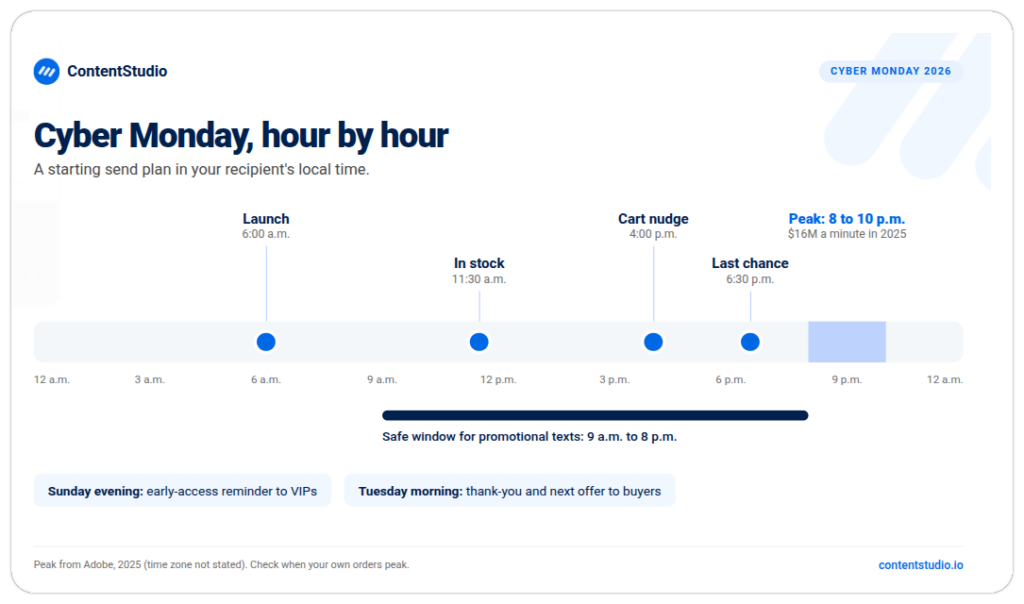
The last-chance email at 6:30 p.m. is deliberate. Adobe measured spending peaking between 8 and 10 p.m. on Cyber Monday 2025, and an email that lands shortly before that rush leaves time to decide. Adobe’s release does not give a time zone for that window, so after Black Friday, look at your own hourly orders and adjust. Always suppress buyers from every later message, because a “last chance” email an hour after someone pays teaches them to ignore you.
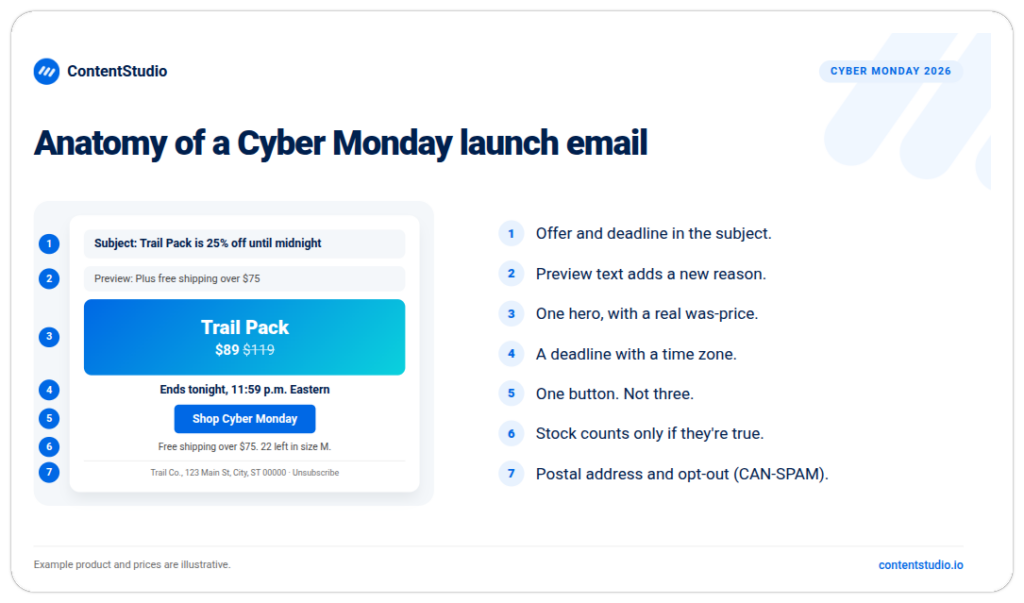
Specific subject lines make the offer clear, and clear tends to beat clever. Treat these patterns as suggestions to test, not benchmarks.
| Moment | Subject line pattern |
|---|---|
| Teaser | “Monday, 6 a.m. Here’s what’s coming” |
| Early access | “You’re in early: Cyber Monday starts for you today” |
| Launch | “[Hero product] is [X]% off until midnight” |
| Cart reminder | “You left this in your cart. It’s still in stock.” |
| Midday | “What sold out this morning (and what’s left)” |
| Last chance | “Ends tonight at 11:59 p.m. [time zone]” |
| Post-purchase | “Your order is in. Here’s what happens next.” |
Template 1: The teaser (send November 23 to 25)
Subject: Monday, 6 a.m. Here’s what’s coming
Preview: A few things we’ve been saving.
Hi [First name], on Monday, November 30, we’re running our Cyber Monday sale for [one day / two days]. We’re keeping it short on purpose: [Hero offer 1] and [Hero offer 2], and that’s it. If you’d like to see it before everyone else, join the early-access list below. Early-access members get the offer [12 / 24] hours before the public launch. [Button: Get early access]
Template 2: Early access (send Sunday, November 29, at 6 p.m., so members get 12 hours before a 6 a.m. launch)
Subject: You’re in early: Cyber Monday starts for you today
Preview: Your offer is live now. It’s public tomorrow.
Hi [First name], because you’re on our early-access list, [Hero offer] is live for you now, [X] hours before everyone else. [One sentence on why this product, written from the customer’s side.] Stock on [product] is [number] units. When it’s gone, it’s gone until [date]. [Button: Shop early access]
Template 3: The launch (send 6:00 a.m. on November 30)
Subject: [Hero product] is [X]% off until midnight
Preview: Plus [free shipping / a free gift] over $[amount].
It’s Cyber Monday, so we’ll keep this short. [Offer 1]: [price], was [price]. [One line on who it’s for.] [Offer 2]: [price], was [price]. [One line on who it’s for.] Free [shipping/gift] on orders over $[amount]. Ends tonight at 11:59 p.m. [time zone]. [Button: Shop Cyber Monday]
Template 4: The cart reminder (send 4:00 p.m. to people with items in their cart)
Subject: You left this in your cart. It’s still in stock.
Preview: [Product name], now [price].
Hi [First name], you had [product name] in your cart earlier. Today it’s [price], down from [price], and we still have [number] left in [size/color]. The sale ends tonight at 11:59 p.m. [time zone]. [Button: Go back to my cart]
For shoppers who only viewed a product, use the same structure with a softer opening such as “You were looking at [product name],” and leave out any claim about a cart.
Template 5: Last chance (send 6:30 p.m.)
Subject: Ends tonight at 11:59 p.m. [time zone]
Preview: Last call for [hero offer].
Hi [First name], the Cyber Monday offers close tonight. [Hero offer 1] and [Hero offer 2] go back to full price at midnight, and [product] is down to [number] units. [Button: Shop before midnight]
Template 6: Thank-you and next steps (send December 1)
Subject: Your order is in. Here’s what happens next.
Preview: Shipping details and how to get the most from [product].
Hi [First name], thank you for your order. It ships by [date], and you’ll get tracking details as soon as it moves. In the meantime, here’s [a short guide/setup tip] for getting started with [product]. [Button: See what’s new] If it fits your goals and margins, you can add a modest offer on the next order here, valid until [date]. It is optional, not a default.
Peak volume is when sender reputation breaks, and the mailbox providers have written the thresholds down.
Before November, remove subscribers who haven’t opened in six months, warm volume up gradually, and send your heaviest campaigns to your most engaged readers first.
Text is for moments, not stories. Use it for early access, the launch, a low-stock alert, and the final hours
This is the part most likely to have changed since you last read about it, so check these points with your messaging provider and counsel before launch.
None of this is legal advice. If you text customers in several states, have counsel confirm the consent, frequency, and timing rules for your program before November 30.
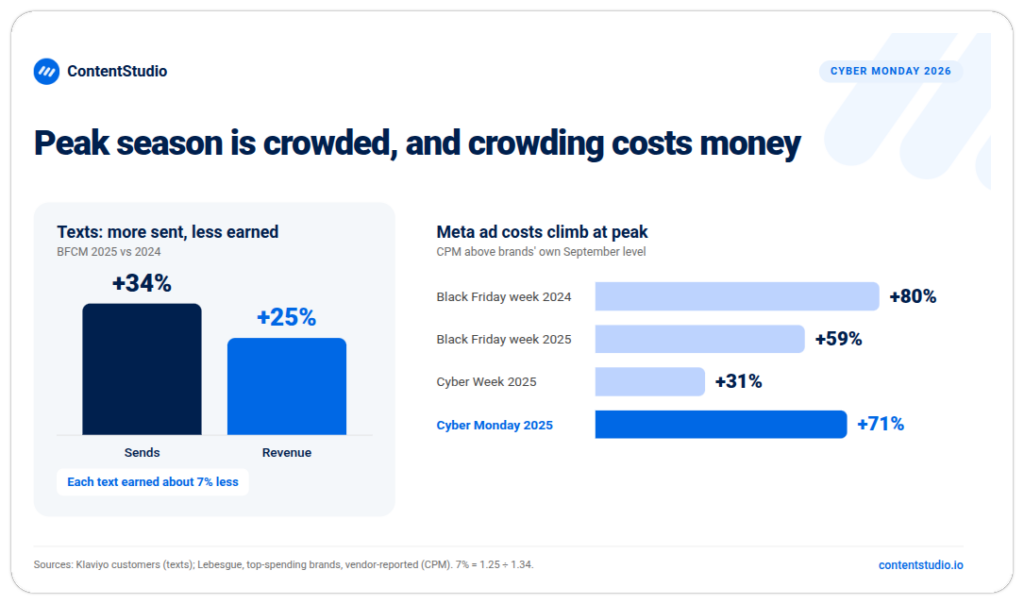
Two trends stand out. On Meta, brands paid 31% to 71% more than their September CPM during Cyber Week 2025, with Cyber Monday reaching 71% above September levels. Lebesgue reported this for the highest-spending brands on its platform, so it may not reflect every advertiser. Costs also began rising later in 2025 than in 2024, around November 10 instead of October 14, which makes October a good time to test creative before competition pushes prices up.
Text messaging shows a different problem. Klaviyo’s data suggests send volume grew faster than revenue, meaning each additional message earned about 7% less.
Triple Whale’s 2025 retrospective shows how results varied by platform. Meta’s average ROAS stayed relatively flat at 2.26 while CPM rose 7.6% to $22.26. Google’s ROAS fell 21% to 3.62, and its CPA increased 34% to $26.31, while TikTok’s CPM dropped 27.5%. These are platform-reported figures from 33,000 shops, so use them as benchmarks and not predictions.
Adobe’s 2025 data shows why social media and creator partnerships should be treated as separate channels. Social media drove 3.6% of Cyber Monday revenue, up 56.5% from the year before. Affiliates and partners accounted for 21.8%, but that category also includes cashback and rewards sites, not just influencers, so the full share cannot be credited to creators.
Treat creators as a performance channel with clear costs, trackable sales, and commission terms. Our guide to influencer marketing and how to run campaigns that work goes deeper on tiers, vetting, and tracking. For Cyber Monday specifically:
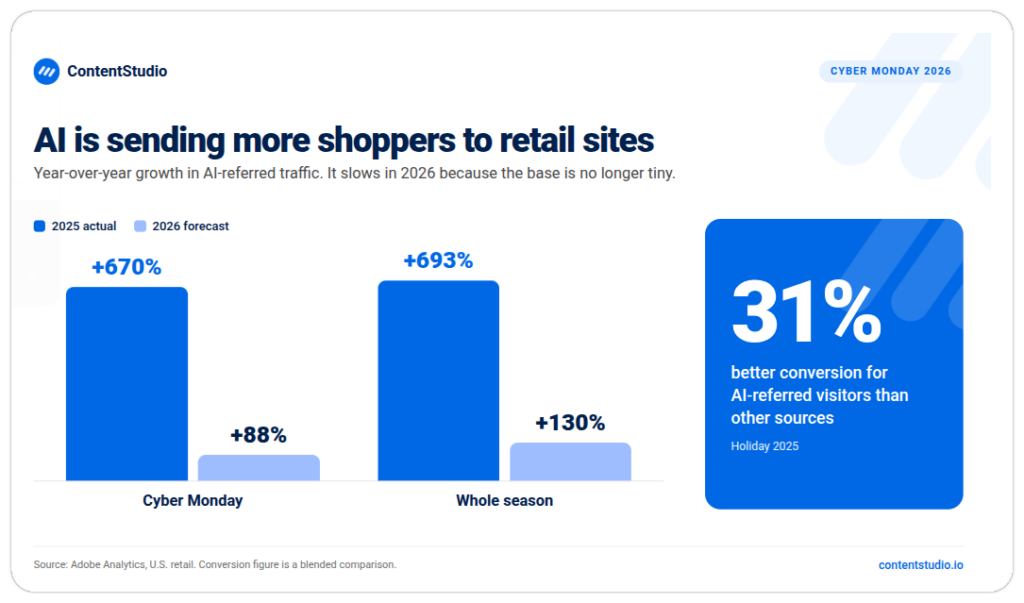
AI is becoming part of how people find and compare products. Adobe’s 2025 holiday data showed that visitors referred by AI assistants converted about 31% better than visitors from other sources (Digital Commerce 360, January 2026).
Looking ahead, Adobe’s September 2026 forecast expects AI-referred traffic to U.S. retail sites to grow 130% across November and December, including an 88% increase on Cyber Monday.
That Cyber Monday growth rate is lower than last year’s, but it is growing from a larger base. AI referrals are still a small share of overall traffic, yet retailers have good reason to prepare for shoppers who use AI tools to find products.
Other research points the same way, although the figures measure different things. Salesforce estimates that AI and AI agents influenced 20% of global Cyber Week orders in 2025, worth around $67 billion, but that is a modelled estimate and not a direct count.
An August 2026 Narvar survey found that 65% of 1,348 U.S. consumers planned to use AI for at least one part of their holiday shopping, while only 8% of the 100 retailers surveyed felt very confident using AI to improve the shopping experience (Narvar’s survey findings).
One caution: do not build your campaign around a particular AI assistant’s checkout feature until you have confirmed it works for your business. Integrations between assistants, retailers, and payment systems change quickly, so verify availability first.
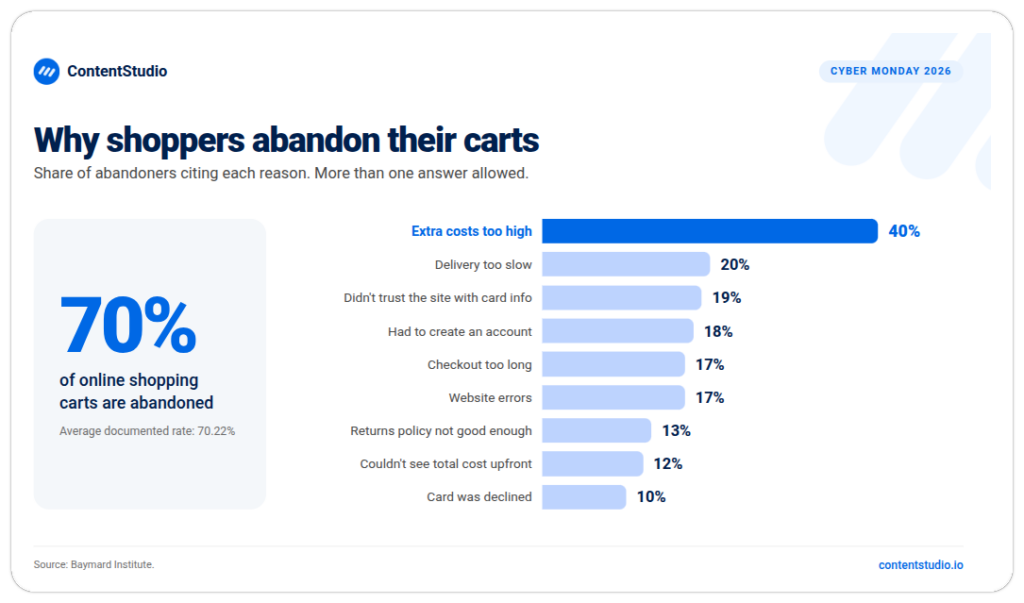
Baymard Institute estimates that shoppers abandon around 70.22% of online shopping carts. Among shoppers who gave a reason other than simply browsing, 40% said extra costs, such as shipping, taxes, and fees, were too high. Before changing your headlines or ads, make sure customers can see the shipping threshold and estimated total cost without scrolling.
More than half of Cyber Monday 2025 spending came from mobile devices. If your website loads quickly on a desktop but struggles on an average phone with a slower connection, you could lose sales. A 2020 Google and Deloitte study, Milliseconds Make Millions, examined 37 brands over four weeks and found that a 0.1-second improvement in mobile site speed increased retail conversions by 8.4%.
The study is several years old, so treat this as evidence of the value of speed, not a guarantee of the same results. Test your website’s performance before Cyber Monday, including the Friday before the sale.
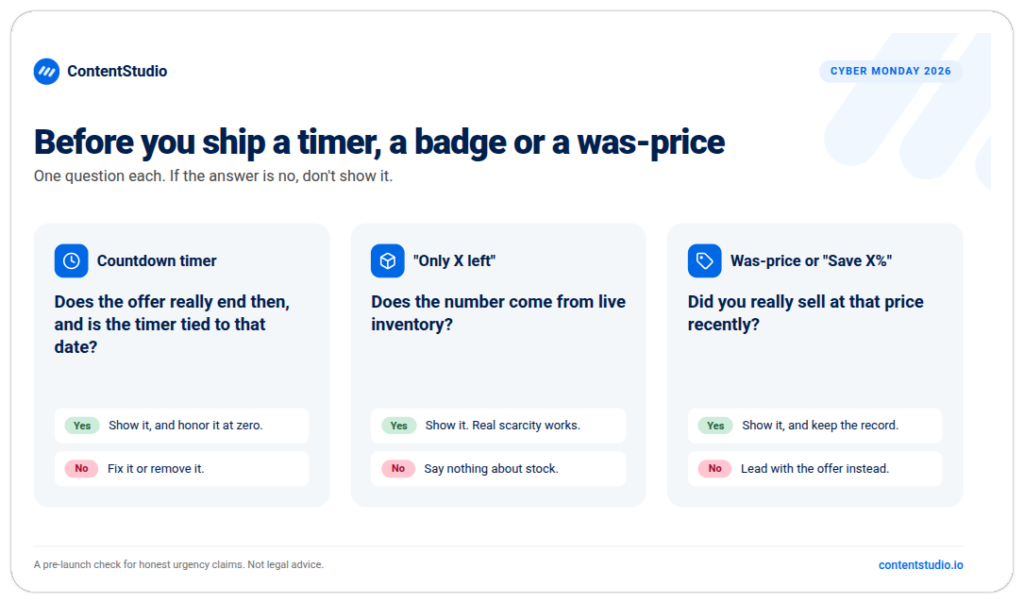
Urgency works because it is real. When it is not, it becomes evidence. The European Commission screened 399 online shops in 2023 and found 148 used at least one dark pattern; 42 used fake countdown timers (European Commission, 2023). A 2019 academic crawl of roughly 11,000 shopping sites found more than 1,800 dark-pattern instances across 1,254 of them.
In the U.S., no countdown-timer rule exists by name. The principle is the FTC Act’s ban on deceptive practices. For reference prices, the FTC’s pricing guides require that a former price have been a bona fide price offered for a reasonably substantial period (16 CFR 233.1). If your deadline is real and your “was” price is real, show both and keep the records.
| Area | The rule or guidance | Source |
|---|---|---|
| Email authentication | SPF, DKIM, DMARC; one-click unsubscribe; spam rate below 0.10%, never 0.30% | Google, Yahoo |
| Email content | Valid postal address; opt-out honored within 10 business days | FTC, CAN-SPAM |
| Marketing texts | Prior express written consent; honor all seven revocation keywords; FCC 26-67 effective date still to be confirmed | FCC |
| Text timing | Federal: 8 a.m. to 9 p.m.; some states stricter; recommended window: 9 a.m. to 8 p.m. local | 47 CFR 64.1200; state law |
| Reference prices | Former price must be bona fide and offered for a reasonable period | 16 CFR 233.1 |
| Fake reviews | FTC rule on fake reviews in effect since October 21, 2024 | 16 CFR Part 465 |
| Creator disclosure | Clear and conspicuous; advertiser is responsible for what endorsers post | FTC Endorsement Guides |
| Product feeds | Sale price must match landing page and checkout | Google Merchant Center |
One clarification on a commonly repeated claim: the FTC’s drip-pricing rule applies to live-event tickets and short-term lodging, not to retail e-commerce in general. Hidden fees in ordinary online retail are still a Section 5 concern, just not under that specific rule.
These failure modes are predictable. Most of them show up in the margin table or the channel data before the campaign goes live.
Decide your numbers before the day, so you are not choosing them after you see the results.
| Metric | What it tells you | How to use it |
|---|---|---|
| Revenue and orders by channel | Where sales came from | Compare with last year’s Cyber Monday and this year’s Black Friday |
| Contribution margin after discount | Whether you made money | The real scorecard — revenue alone is not |
| Blended ROAS and channel ROAS vs. break-even | Whether ads paid for themselves | Cut or reduce anything below break-even |
| Conversion rate and average order value | Offer and page strength | Use to test spend thresholds against discounts |
| New vs. returning customers | Acquisition vs. loyalty campaign | Match to your stated Monday goal |
| Email spam complaints and unsubscribes | Whether you pushed too hard | Keep complaints well below 0.10% |
| Six-month repeat rate of BFCM-acquired customers | Customer quality | Tag the cohort now; measure it in April–June 2027 |
A note on attribution. Klaviyo credits email conversions within five days of a send and SMS within 24 hours. Ad platforms credit themselves generously and independently — one purchase can be claimed by a paid ad, an email, and a text message at the same time.
Start with total revenue and total contribution margin, then use channel-level data to explain the sources. Never build the plan around attributed channel revenue alone.
The campaign should not end when the clock hits midnight. On December 1, you can send non-buyers one final message if there is a genuine reason to act, such as a popular product still in stock. Any new promotion must carry valid prices and stand on its own, and you should not extend a deal that you advertised as ending on Cyber Monday.
Customers who bought should get a thank-you and shipping updates, followed by a review request once they have had time to try the product. Then review the campaign while the details are fresh. Record which offers worked, which channels drove profitable sales, where shoppers dropped off, and what needs fixing, and you will start next year ahead.
Cyber Monday falls on November 30, 2026, the Monday after Thanksgiving on November 26.
Six to eight weeks is a useful window. With 39 days left as of October 22, you can still prepare a strong campaign by finalizing offers and margins first, building your early-access list through early November, and starting to tease deals in the last 10 days.
You need to offer the smallest discount that gives customers a clear reason to buy while protecting your margin, and calculate it product by product. Adobe forecasts peak Cyber Week discounts of around 30% for electronics, 29% for toys, and 23% for apparel in 2026. Tiered offers, gifts with purchase, and early access can also encourage purchases without deeper price cuts.
Give each a clear job: you can use email for explaining offers and showcasing products, SMS for timely updates, early access, and genuine last-chance reminders. Klaviyo reported that shoppers who received both email and SMS placed 11% more orders than those who received one channel during BFCM 2025. That is vendor-reported data, so your results may differ, and every message must follow the relevant consent and opt-out rules.
Only if you meet the consent and messaging requirements, which include prior express written consent, 10DLC registration for applicable U.S. messaging, quiet-hours rules, and honoring opt-outs. FCC Order 26-67 addresses opt-outs, but its effective date has not been set, so confirm current requirements with your provider and legal counsel before launch.
Set your budget around how much you can afford to pay for each order. For example, if you want 100 orders from ads and can spend $12 to acquire each one, budget $1,200 for advertising. Add content, creator, and software costs separately. Check that your margins can cover the total.
No. You can keep the same deal and feature different products on Monday. If you introduce a new offer, consider a bundle or gift instead of a deeper discount. Make the dates and terms clear.
Start with your recent website traffic, conversion rate, and average order value. Estimate orders by multiplying expected visits by your conversion rate. Then multiply those orders by your average order value to estimate revenue. Keep your target within your stock and fulfillment limits.
Plan 0 Days of Content in 0 Minutes
Create, schedule, publish and analyze your content across all your social media channels from one simple dashboard.
4.7 on Capterra • 16,500+ marketers trust ContentStudio
Arooj Ishtiaq is a Content Marketing Strategist with 5+ years of experience writing about social media, SaaS, and AI. At ContentStudio, she creates practical guides, tutorials, and how-to content that help marketers navigate social media trends, sharpen their strategies, and get more from their content.
View all posts by Arooj IshtiaqRecommended for you
Black Friday marketing campaign: Complete 2026 guide
100+ Black Friday quotes, captions, hashtags & slogans for 2026

149 Best Cyber Monday & Black Friday software deals in 2026
How to calculate affiliate earnings: Commissions and earning breakdown