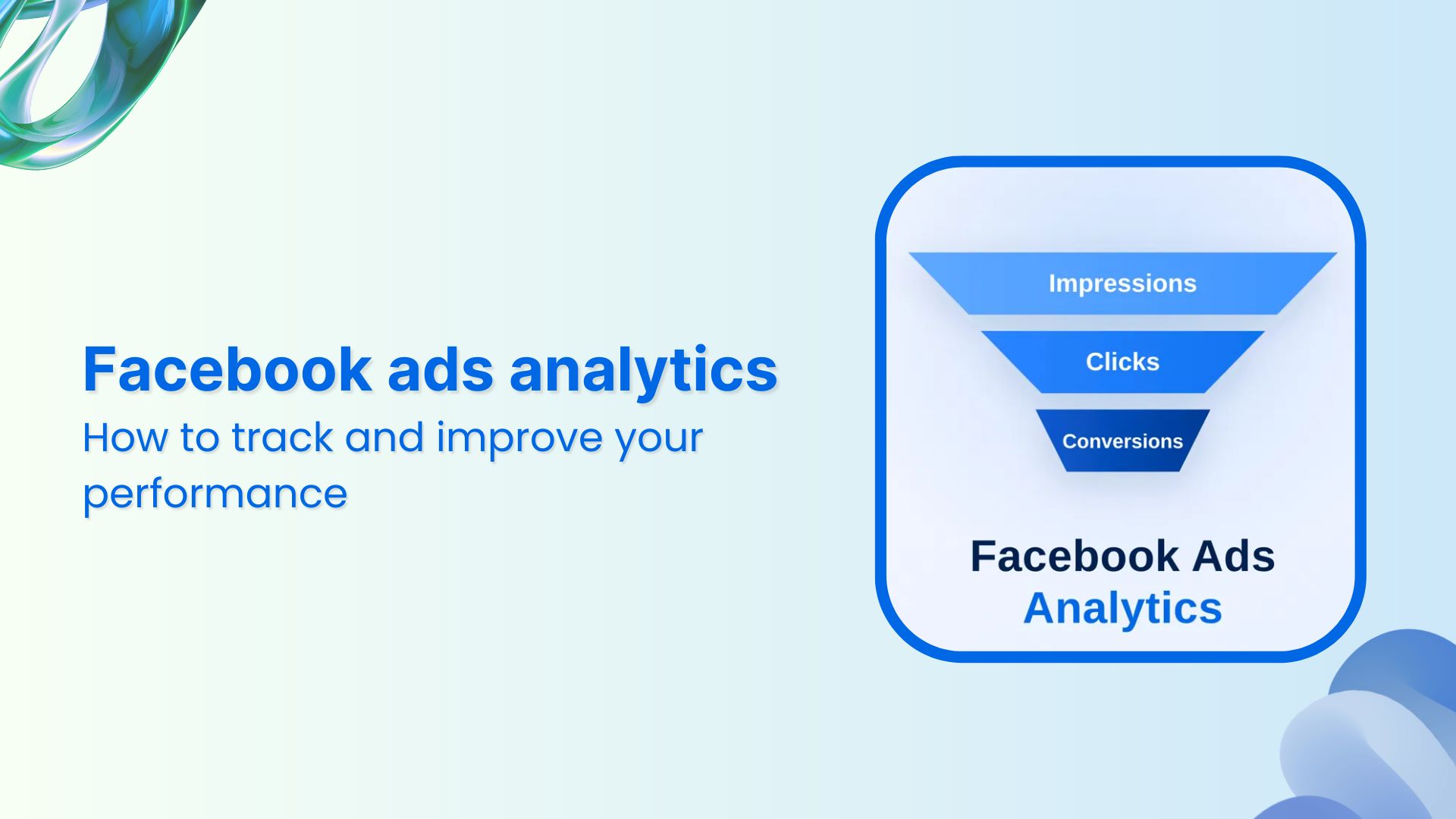
Facebook ads analytics: How to track and improve your performance
Aug 20, 202617 minutes

Written by
Nawal MansoorUpdated
Facebook analytics tools track page performance, audience growth, and both organic and paid results across your Facebook presence. After Meta shut down its standalone Analytics tool in 2021, the market split into two tiers: free native dashboards that Meta provides and third-party platforms that go further with competitive benchmarking, cross-channel reporting, and client-ready exports.
This guide covers both tiers side by side, a decision framework, and use-case recommendations so you can pick the right tool without trying out a dozen platforms first.
Meta provides three free built-in analytics tools for any Facebook Business Page: Meta Business Suite for organic and audience insights, Meta Ads Manager for paid campaign data, and the Professional Dashboard for quick on-page metrics. They cover the basics at no cost but fall short on competitive context, historical depth, and client-ready reporting.
Meta’s native tools are free, reliable for basic monitoring, and built directly into the platform. They cover organic page data and paid campaign performance without any setup beyond connecting your business account. The tradeoff is limited historical data, no competitive context, and no export formats suitable for client reporting.
Here is how each one works in 2026.
Meta Business Suite (business.facebook.com) is the central analytics hub for both Facebook and Instagram. The Insights tab gives you three views: Overview shows a snapshot of reach and engagement trends across both platforms; Content shows post-level metrics including reactions, comments, shares, and reach per post; Audience shows follower demographics by age, gender, and location.
It also includes a content planner and scheduling tools. If you want approval workflows, bulk publishing, or cross-platform scheduling beyond what Meta natively offers, pairing the analytics with a dedicated Facebook scheduler keeps your publishing and performance data aligned without jumping between platforms.
Best for: Pages managing one or two accounts who need free, real-time organic performance data.
Ads Manager is the dashboard for all paid Facebook campaigns. It tracks impressions, link clicks, cost per click (CPC), cost per action (CPA), return on ad spend (ROAS), and conversion events tied to your Meta Pixel or Conversions API.
The strongest feature is column customization. You can build and save report views around your specific campaign KPIs, and schedule those reports to arrive in your inbox automatically. When you’re running multiple ad sets simultaneously, boosting a Facebook post and an awareness campaign at the same time, Ads Manager lets you see exactly where your budget is and isn’t working without logging in daily.
Best for: Anyone running paid Facebook campaigns who needs granular, ad-level performance data.
The Professional Dashboard is the fastest access point for basic page metrics. From your Facebook page, select “Professional Dashboard” from the left-hand menu, then click “Insights” to see follower activity, daily post reach, and recent engagement trends without leaving the page.
It shows a rolling 7-to-28-day window by default and offers no export options, no competitor context, and no trend data beyond a month. It’s a diagnostic check, not a strategy tool.
Best for: Quick daily check-ins on a single page when you don’t want to open a separate platform.
Native Meta tools are accurate for what they measure, but they leave consistent gaps that push most teams toward third-party platforms as their needs grow.
These limits work fine for a solo operator managing one page. For anyone running a more deliberate Facebook marketing strategy across multiple accounts or clients, they become a daily constraint.
Third-party platforms fill the gaps native tools leave: competitive benchmarking, social listening, flexible report exports, multi-channel visibility, and longer data histories. The right choice depends on whether your primary need is organic reporting, paid campaign analysis, client reporting, or competitive intelligence. Below are the strongest options in 2026, each matched to the use case it handles best.
ContentStudio is a social media management platform that combines publishing, analytics, and competitive intelligence across Facebook, Instagram, LinkedIn, TikTok, and other channels. Its Facebook analytics module tracks audience growth, post performance, publishing behavior by content type, and competitor page data in one dashboard.
The publishing behavior view is particularly useful for content strategy. It maps your posts by type (images, videos, Reels, text) against their reach and engagement over a selected timeframe, showing you at a glance whether Facebook Reels analytics are outperforming carousels or whether your weekend posts are consistently pulling more reach than weekday ones.
Agencies benefit most from ContentStudio’s white-label reporting layer. You can generate custom reports combining your performance data with competitor analysis, then schedule those reports for automatic delivery to clients. The competitor analytics module tracks competitor audience growth, top-performing posts, engagement rates, hashtag usage, and profile changes without any manual monitoring.
Best for: Agencies and multi-account teams who need competitor intelligence, white-label reporting, and publishing tools in one place.
Key features:
Pricing: Standard $19/month (billed annually) or $29/month; Advanced $49/month (billed annually) or $69/month; Agency Unlimited $99/month (billed annually) or $139/month
Sprout Social is an enterprise-grade platform built for teams that need deep analytics, social listening, and customer care tools alongside their publishing workflow. Its Facebook analytics dashboard covers organic post performance, paid campaign data, audience demographics, and competitor benchmarking, all in a single interface.
Cross-channel reporting is where Sprout earns its premium. You can compare Facebook performance directly against Instagram, LinkedIn, and X in the same view, which matters for brands running coordinated multi-platform strategies with distinct KPIs per channel. The AI-assisted sentiment analysis on incoming comments and messages is also more sophisticated than what you’ll find at lower price points.
Best for: Larger teams and enterprises that need social listening, advanced analytics, and built-in CRM-level engagement tools.
Key features:
Pricing: Standard $199/seat/month, Professional $299/seat/month, Advanced $399/seat/month, Enterprise custom
Metricool is built around analytics-first workflows with a pricing model structured around brands rather than seats, which keeps costs predictable as you scale. Its Facebook analytics cover organic post metrics, Stories, video performance, and audience activity alongside paid Facebook Ads and Google Ads data in a unified dashboard.
The best-time-to-post heatmap is one of the most practically useful features in the analytics tool category. It maps your historical engagement data onto a weekly calendar grid showing exactly when your specific audience is most active, built from your own data rather than generalized platform averages.
Best for: Creators and small teams who want combined organic and paid analytics without the per-seat cost of Hootsuite or Sprout Social.
Key features:
Pricing: Free (1 brand, 20 posts/month), Starter ~$20/month (5 brands), Advanced ~$53/month (15 brands), Custom for larger agencies
Brand24 is a social listening platform that tracks real-time brand mentions across Facebook, Instagram, news sites, blogs, forums, podcasts, and video platforms, then categorizes each mention by sentiment. For Facebook specifically, it monitors your brand and competitor names appearing in public posts, comments, and group discussions that your own pages would never surface.
Its focus is on what people are saying about your brand, rather than on how your content performs. This makes it most useful alongside a standard analytics tool rather than in place of one. Teams investing in Facebook brand monitoring as part of a PR or reputation function get the most from it.
Best for: PR teams and brands that need real-time public mention tracking and sentiment analysis across the broader web.
Key features:
Pricing: Individual $199/month, Team $249/month, Pro $499/month, Enterprise $1,499/month
Whatagraph is a reporting platform built specifically for agencies that send regular performance reports to clients. It connects to Facebook, Instagram, Google Analytics, LinkedIn, and over 40 other data sources, then generates automated, visual reports you can white-label, brand, and schedule for delivery on a fixed cadence.
Its job is not to help you make strategic decisions. Its job is to make your existing data look clean and professional for clients who don’t want to interpret raw dashboards themselves. If building monthly client reports manually takes your team four or more hours, Whatagraph eliminates most of that work.
Best for: Agencies that need automated white-label client reporting across multiple data sources without manual assembly.
Key features:
Pricing: Start $229/month, Boost $463/month, Enterprise custom (all plans billed annually only)
SocialPilot is a flat-fee agency platform covering scheduling, analytics, client management, and team collaboration without per-seat pricing. Its Facebook analytics include post-level performance, follower growth, engagement rate trends, and audience demographics, with white-label PDF reports available from the Premium plan upward.
The flat-fee structure is its strongest differentiator for agencies. Your cost stays predictable as you add clients rather than compounding per seat. Competitor analysis reports, available on Standard and above, give you benchmark context for client accounts without requiring a separate competitive intelligence tool.
Best for: Budget-conscious agencies managing multiple client Facebook pages without per-seat pricing eating into retainer margins.
Key features:
Pricing: Essentials $30/month, Standard $50/month, Premium $100/month, Ultimate $200/month
Rival IQ is designed specifically for competitive intelligence. It tracks competitor Facebook pages across post frequency, engagement rates, content types, and hashtag usage, then benchmarks your metrics against industry peers and brands of comparable audience size.
Its automated alert system is the most useful feature for active competitive tracking. You receive a notification when a competitor publishes content generating unusually high engagement, giving you visibility into what’s resonating in your market before those trends peak. Tracking Facebook hashtag performance across public competitor pages is one of the most detailed things Rival IQ handles compared to other tools in this list.
Best for: Brands and agencies running structured competitive analysis as a regular part of their strategy cycle.
Key features:
Pricing: Drive $239/month, Engage $349/month, Engage Pro $519/month
Native tools are worth using when you’re managing a single page and need basic post performance and audience data. They stop being sufficient once your requirements move beyond what Meta surfaces on its own.
These are the situations where a third-party tool becomes worth the cost:
If two or more of these apply, the time you’re spending working around native tool limitations is already costing more than a mid-tier paid subscription.
The right tool depends on your primary use case, team size, and whether you need client-facing outputs. Paying for two analytics platforms before you’ve outgrown one is rarely efficient.
Use this as a starting point to narrow down your options:
| Primary need | Best fit | Starting price |
|---|---|---|
| Free organic performance monitoring | Meta Business Suite | Free |
| Paid campaign tracking | Meta Ads Manager | Free |
| Affordable combined organic and paid analytics | Metricool | Free / ~$20/month |
| Scheduling plus analytics plus competitor data | ContentStudio | $19/month (annual) |
| Budget agency multi-page management | SocialPilot | $30/month |
| Automated white-label client reporting | Whatagraph | $229/month |
| Brand mentions and sentiment tracking | Brand24 | $199/month |
| Structured competitive benchmarking | Rival IQ | $239/month |
| Enterprise analytics with social listening | Sprout Social | $199/seat/month |
For most small agencies and solo operators, the practical starting point is Meta Business Suite for free monitoring plus one third-party tool that addresses your biggest specific gap. Identify the bottleneck first. If you’re spending two or more hours a week assembling performance data manually, that’s the workflow your paid tool should solve.
Native tools are a solid starting point and most pages get real mileage from them. The moment your needs shift toward competitive context, client reporting, or multi-channel visibility, free dashboards stop keeping up.
The decision doesn’t have to be complicated. Identify the one gap that’s costing you the most time or clarity right now, and pick the tool that closes it. A focused choice beats a feature-rich platform you only use a fraction of.
Whatever you pick, consistency matters more than sophistication. Checking a handful of clear metrics every week will tell you more than a detailed dashboard you open once a month.
For organic pages, prioritize reach, engagement rate, follower growth, and post-level content performance. For paid campaigns, focus on ROAS, CPA, CTR, and conversion events. The right mix depends on whether your goal is awareness, engagement, or direct response.
For ongoing organic content, check core post metrics weekly and audience trend data monthly. For active paid campaigns, review Ads Manager daily to catch budget waste or underperforming ad sets early. A monthly strategy review using 90-day trend data from a third-party tool is worth building into your regular workflow.
A Facebook analytics dashboard is a single interface that aggregates your page and ad performance data in one view. Meta Business Suite includes a native version. Third-party tools like ContentStudio, Metricool, and Sprout Social offer customizable dashboards that pull data from multiple channels and support report exports and scheduling.
Plan 0 Days of Content in 0 Minutes
Create, schedule, publish and analyze your content across all your social media channels from one simple dashboard.
4.7 on Capterra • 16,500+ marketers trust ContentStudio
Nawal Mansoor is a Digital Marketing Specialist at ContentStudio who tracks the latest trends and technologies. She writes on social media strategy, AI scheduling and video tools, Instagram advertising, LinkedIn marketing, and emerging platforms like Snapchat, and reviews articles for relevance, accuracy, and currency in a fast-moving social media landscape.
View all posts by Nawal MansoorRecommended for you
Facebook ads analytics: How to track and improve your performance
70 ChatGPT prompts for Facebook to drive reach and engagement

Facebook cover photo size: The complete 2026 guide
Ultimate guide to schedule Facebook posts, Reels & Stories