
100+ best Black Friday SaaS & software deals in 2026
Nov 5, 202678 minutes

Written by
Umer Daraz KhanPublished
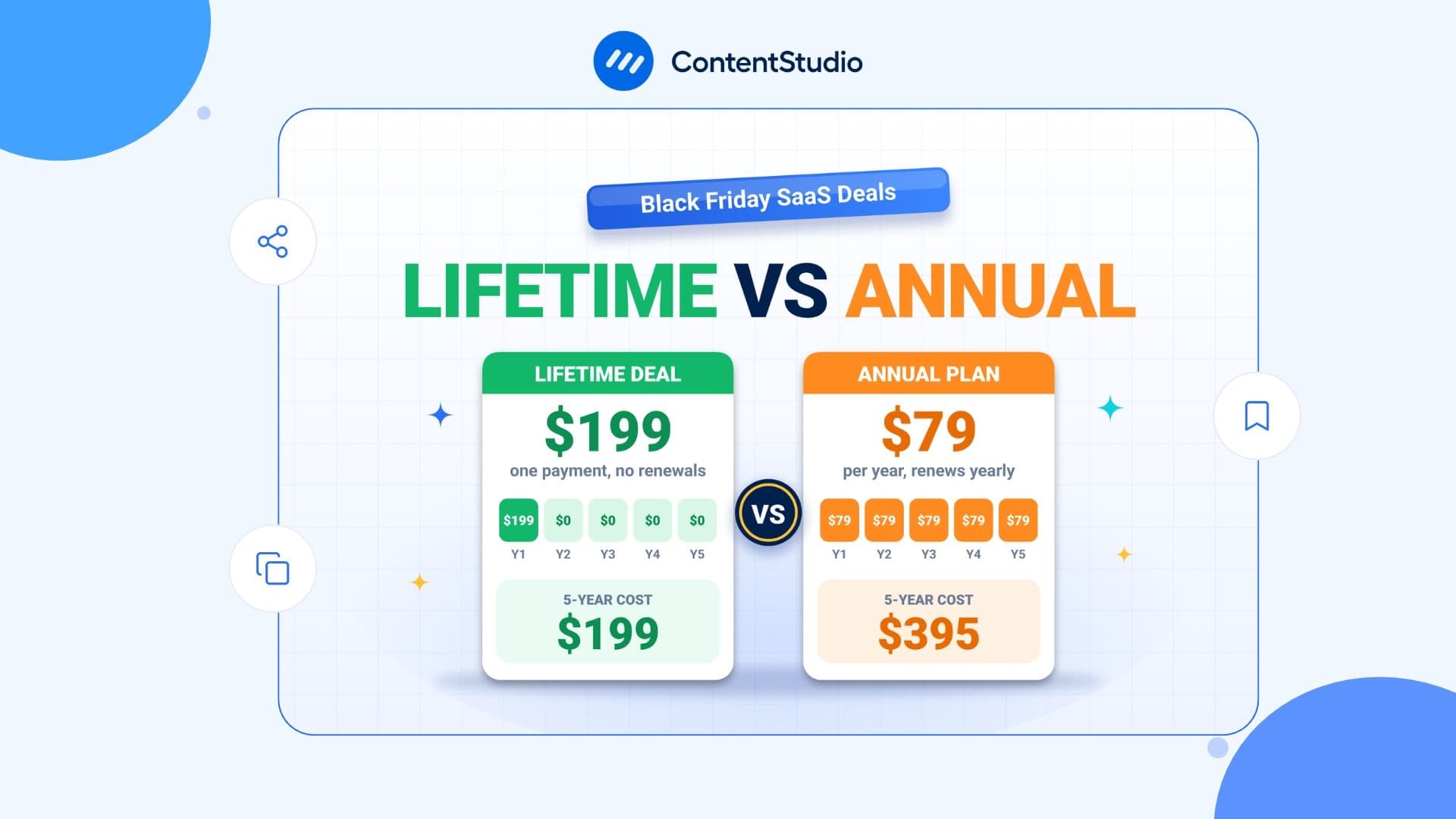
A lifetime deal almost never loses on price. It loses on fit. That is the part most Black Friday roundups skip, and it is the reason so many people own four or five licences they stopped opening years ago.
Every November the same two offers land in your inbox. I have bought both kinds over the years, and regretted both kinds at least once. One tool wants 50% off the first year of an annual plan. Another wants $199 once, for life. Both look cheap next to the $29 a month you would otherwise pay. They are not the same bet, and the right answer depends on how long you will actually use the tool, how many people need seats, and what the vendor means by “lifetime”.
This guide gives you the math, the five questions to ask before you pay, and the red flags that separate a real deal from a repackaged price list. If you want to see live offers while you read, our roundup of Black Friday SaaS deals tracks both kinds, with dates and codes, across 70+ tools.
Key takeaways
A SaaS lifetime deal (LTD) is a one-time payment that buys access to a software product for as long as that product exists. You pay once, usually somewhere between $49 and $299, and you never see a renewal invoice for that tier.
The word “lifetime” refers to the life of the product, not your life. That distinction is written into most deal terms and it is the single most misread line in the whole category.
AppSumo, the largest lifetime deal marketplace, defines it the same way: lifetime means the lifetime of the product or service, and the 60-day refund window on most of its listings is the practical insurance against that (tlinky’s review quotes the policy directly from AppSumo’s help centre).
There are three common shapes:
| Shape | What you get | Where you see it |
| Marketplace LTD | A tiered licence (Tier 1, 2, 3) sold through AppSumo, Dealify, PitchGround or similar, with the marketplace handling refunds | Smaller or early-stage tools, often in their first two years |
| Vendor direct LTD | The company sells a lifetime tier on its own pricing page, usually for a limited window or a capped number of licences | Mature niche tools, WordPress plugins, utilities |
| Lifetime discount | Not a lifetime licence. A percentage off that stays locked for as long as you keep paying | Established SaaS brands that want long-term subscribers, not one-time cash |
That third shape matters because it gets confused with the first two. A “lifetime 40% off” offer is still a subscription. You still pay every year. The discount is what lasts, not the access.
If you only read one table, read this one. The rest of the article explains each row.
| Lifetime deal | Annual discount | |
| What you pay | One payment, typically $49 to $299 | A reduced price on year one, then the standard annual rate |
| Cost over 3 years | The one payment, nothing more | Year one discounted, years two and three at full price |
| Seats and workspaces | Usually one user, one workspace, a fixed number of connected accounts | The plan’s normal limits, which scale as you upgrade |
| Updates | What exists today, plus whatever the terms promise, often with a cutoff | Every release, for as long as you subscribe |
| Biggest risk | Outgrowing the tier, the tier being frozen, or the product being sunset | Forgetting the renewal price and paying full rate from year two |
| Refund | Marketplace window, usually 30 to 60 days | Vendor policy, sometimes excluded for sale purchases |
| Best for | Single-purpose tools, solo users, mature products you could replace | Daily team tools, anything with platform integrations, products that ship often |
| Worst for | Agencies, teams, tools with per-use costs like AI or video | Tools you will use for less than a year |
Lifetime deals appear all year, but late November is when most of them land at once. Three things line up. Vendors want cash before the year closes. Buyers have use it or lose it budgets and a reason to look. And marketplaces run their biggest sale of the year, which gives small vendors a crowd they could not reach alone.
The timing question people ask most, whether Black Friday or Cyber Monday is better for software, has a short answer: for subscriptions it rarely matters, because most vendors run one offer across both days.
We covered the pattern in detail in Black Friday vs Cyber Monday for software buyers. Lifetime deals are the exception. They are often capped at a fixed number of licences, and a capped tier can genuinely sell out on the Friday.
To make this concrete, here are the different structures showing up in our Black Friday software deals list this month. Terms change, so check the live page before you rely on any of these.
| Tool | Offer type | What it tells you |
| ProWritingAid | 50% off annual and lifetime Premium | A mature product selling both models side by side, so you can price them against each other |
| Internxt | 85% off annual and lifetime storage plans | Lifetime storage is a different risk from lifetime software: the cost to the vendor keeps growing |
| ThriveCart | 15% off a lifetime licence | A vendor that only sells lifetime, so the discount is the whole offer |
| FooGallery | 30% off annual, up to 25% off lifetime | A plugin vendor, where lifetime usually means updates and support for a fixed site count |
| ContentStudio | Up to 50% off annual and quarterly plans | A subscription discount, no lifetime tier, which is the norm for platforms with per seat and per channel costs |
The pattern to notice: the tools offering lifetime licences tend to be single-purpose, with low ongoing cost to serve. The tools that do not are the ones where every extra user or connected account costs the vendor money every month.
Run the numbers over three and five years, not one. A first-year discount looks dramatic on launch day and ordinary by the second renewal. A lifetime deal looks expensive on launch day and free by month fourteen.
Take a scheduling tool with these real-world shaped prices:
| Cost over time | Monthly, no deal | Annual, Black Friday 50% off year one | Lifetime, $199 |
| Year 1 | $348 | $145 | $199 |
| Through year 2 | $696 | $435 | $199 |
| Through year 3 | $1,044 | $725 | $199 |
| Through year 5 | $1,740 | $1,305 | $199 |
| Break-even vs annual plan | n/a | n/a | About 8 months of full price use |
On price alone, the lifetime deal wins from the first renewal onward, and it keeps winning. If the vendor shut down after 18 months, you would have paid $199 for 18 months, which works out at $11 a month, still cheaper than the discounted annual plan. This is why “what if the company dies” is the wrong first question. Price risk on a lifetime deal is small.
Add the constraints and the table changes. The $199 tier allows one workspace and five profiles. The $290 annual plan in this example allows unlimited workspaces and 25 profiles. The moment you add a second client, or a sixth Instagram account, you are buying a second lifetime code or upgrading to the subscription anyway.
| Scenario | Lifetime, $199 tier | Annual plan |
| Solo marketer, 3 profiles, same setup for years | Clear win | Overpaying |
| Freelancer who adds a client every quarter | Needs a new code or a tier jump each time, and the deal may be closed by then | Scales without a decision |
| Agency with 4 team members | Usually not eligible at all, or capped at 1 to 2 seats | Only option that fits |
| Team that needs the feature on the roadmap, not the one shipped today | Roadmap items are often excluded from LTD tiers | Gets every release |
The honest summary: a lifetime deal is a bet that your needs stay inside the tier you bought. An annual discount is a bet that you will still want the tool at full price next November. Decide which of those two things you are more sure about, and the choice makes itself.
For any deal, work out the cost per month you will actually use it:
\text{Effective monthly cost} = \frac{\text{Total paid}}{\text{Months you realistically use the tool}}
For the lifetime tier above, assuming three years of real use, that is $199 divided by 36, or $5.53 a month. For the annual plan over the same three years, it is $725 divided by 36, or $20.14 a month. If your honest estimate of “months you will use it” is under ten, the lifetime deal stops being obviously better, and if the tier caps bite before then, it was never better.
A lifetime deal is a loan from the customer to the company. Understand what the company plans to do with the money, and you understand how safe the deal is.
A $199 licence is worth more to a two-person startup today than $29 a month might be over the next few years, because the $199 funds the next hire or the next feature. This is the AppSumo model, and it has worked since 2010 because the arbitrage is simple for both sides: the buyer pays $49 to $99 once instead of $29 a month, and the vendor converts a few thousand strangers into cash and reviews in a single campaign (The GTM Directory summarises the trade well, including the catch that access can be changed after the refund window closes).
A lifetime deal cohort is noisy, demanding and useful. Vendors get hundreds of bug reports and feature requests in weeks. If you buy early, you are part of that cohort, which means you get a product that improves fast and support that is sometimes stretched thin.
Some lifetime deals are a way to lock a batch of users into an old feature set so the vendor can move paying subscribers to a new one. That is not sinister, but it does mean your tier may freeze while the public plans move on.
| Signal | Likely meaning | What to do |
| Sold through a marketplace with tiers | Early stage, needs cash and distribution | Use the marketplace refund window as your trial. Assume feature caps are permanent |
| Sold direct, capped licence count, returns every year | Mature vendor using LTDs as a seasonal revenue line | Lower risk. Check what previous cohorts got and whether they still have access |
| Lifetime tier appears only once, never again | Vendor was raising cash or testing demand | Higher risk. Read the terms on future updates twice |
| Vendor sells annual plans and no lifetime tier at all | Costs scale with usage, so they cannot afford to | Expect a first year discount only. Judge it on the renewal price |
That last row describes most of the platforms marketers use daily. A tool that connects to social networks pays API and infrastructure costs for every account you add, so it will discount the annual plan rather than sell you a lifetime licence.
If you are on the other side of this, running your own promotion rather than buying one, the section on SaaS offers in our Black Friday marketing campaign guide explains why annual plan discounts beat lifetime deals for most software companies.
If you sell software and you are weighing a lifetime deal for this November, the buyers reading this article will apply the questions in the next section to your offer. Publish your tier limits, your refund window, and your definition of “lifetime” on the deal page itself. The Cyber Monday marketing campaign guide covers how to hand the same offer from Black Friday into the following week without confusing anyone.
Then put the offer in front of people on a schedule rather than a whim. Our social media checklist for Black Friday and Cyber Monday covers what to post and when, from the teaser to the last call.
Ask these in order. Most bad purchases fail on question one or two, before the discount percentage even matters.
For an annual discount, this is the only number that matters after month twelve. “50% off” nearly always means 50% off the first year, with renewal at the full annual rate.
Some vendors state it clearly, some bury it, and a few advertise the discounted rate as locked for as long as you stay subscribed (treat the exact wording on the vendor’s checkout page as the source for that, not a roundup, including ours). If the page does not say, email support before you buy and keep the reply.
A quick test: write down what you will pay in November 2027 for this tool. If you cannot answer from the deal page, you do not know what you are buying.
This is the same question from a different angle, and it is worth asking separately because the answer changes the three-year math completely. A 50% discount that stays is worth more than a 70% discount that vanishes at renewal. In the worked example above, a permanent 50% off turns $725 over three years into $435.
This is the question that decides whether a lifetime deal is a bargain or a dead end. Look for:
Map your actual numbers against the tier before you pay. If you are within 20% of any cap today, you will exceed it.
Read the deal terms, not the headline. You are looking for three things: whether “lifetime” is tied to the product, the plan, or the company; whether the vendor reserves the right to change or sunset the tier; and what happens if the company is acquired. Acquisitions are one of the common ways lifetime access quietly ends, because the acquirer inherits the users but not always the promise.
This is not theoretical. LTD Explorer, a lifetime deal directory that tracks what happens after the sale, documented four endings in 2026 alone, each from AppSumo’s own deal pages (Why lifetime deals die):
| Product | How the lifetime deal ended | What buyers got |
| Fable (interactive demos) | Hosted platform shut down in early 2026 | Access extended to 15 February 2026, code open-sourced for self-hosting, no refund because the window had closed |
| VidTags (interactive video) | Sunset on 31 March 2026 as the team folded into another product, LeadPal | Free access to LeadPal, not a refund |
| KeepSolid VPN Unlimited | Product kept running, but in September 2026 features lifetime buyers relied on moved behind a new paid plan | The same licence, with less in it |
| CloudStick (server control panel) | Product still works, but features advertised for a tier at launch were not delivered to that tier | Reviews split between five-star and one-star, mostly over the roadmap |
Four products, four different endings, and only one of them is a shutdown. The quiet ones, where the tier shrinks, or the roadmap never arrives, are the ones the terms let you see coming.
Also check whether updates are included. Some plugin and desktop software lifetime licences cover the current major version only. That is a legitimate model, but it is a different purchase from a hosted SaaS tool.
For marketplace deals, the marketplace usually does. AppSumo’s standard window is 60 days on most listings, processed by AppSumo rather than the vendor, and the general advice from experienced buyers is to treat those 60 days as your real trial: if the tool is not part of your workflow by day 50, refund it (The GTM Directory and most independent AppSumo reviews make the same point). After the window closes, you own the licence and the risk.
For vendor direct deals, the refund policy is whatever the vendor’s standard terms say, and Black Friday purchases are sometimes excluded. If the page says “all sales final”, price that in.
| Question | Annual discount | Lifetime deal |
| Renewal price | Decides the deal | Not applicable |
| First year only? | Usually yes, check | Not applicable |
| Seats, workspaces, usage caps | Normal plan limits apply | The deciding factor |
| Meaning of “lifetime” | Not applicable | Read the terms |
| Refund window | Vendor policy | Marketplace policy, usually 30 to 60 days |
None of these alone means a deal is bad. Two or three together usually do.
Buy the annual plan for the tools your work depends on. The discount is smaller, the renewal is real, and that is the point: you are paying for a vendor that has to keep earning your money every year.
Ask: if this tool vanished on a Tuesday, how bad would Wednesday be? If the answer is “we would lose a day”, buy the subscription. If the answer is “I would find another one by lunch”, keep reading.
Buy the lifetime deal when the tool is useful, narrow, and replaceable. That is not an insult to the tool. It is the profile where the math works and the downside is small.
This is a hypothetical example, not a real purchase.
She manages four clients, a dozen profiles across them, and does everything herself. For scheduling, approvals, and reporting, she takes the annual discount on a platform built for that, because every client is a workspace and every profile is a connection, and lifetime tiers in that category stop at one and five.
For her carousel designs and her link tracking, she takes two lifetime deals, because each tool does one job, she is the only user, and she could swap either out in an hour.
Total outlay in November: about $600.
Total outlay in November 2027: the one renewal, at a price she wrote down before she bought.
A capped lifetime tier that sold out on the Friday sometimes gets a small second release on the Monday. If you missed one, check once. Otherwise, as explained in our comparison of the two days, the subscription discounts will be identical and waiting buys you nothing.
We keep the Monday offers in a separate list of Cyber Monday SaaS deals so you can check in two minutes.
Lifetime deals live in three places, and each one tells you something different about the deal before you have read a word of the terms.
AppSumo is the largest and the one with the most consistent refund handling. Dealify, PitchGround, Rockethub, and Ken Moo’s deal listings cover smaller tools and sometimes the same tool at a different tier. SaaS Mantra closed its deals section in January 2025, which is its own lesson: the marketplace can disappear too. A marketplace listing usually means an early-stage vendor, a 30 to 60 day refund window handled by the marketplace, and a tier structure with caps.
Mature tools that run a lifetime tier once a year sell it direct. There is no marketplace refund, but there is a track record you can check: what last year’s cohort paid, what they got, and whether they still have it. Search the vendor’s name plus “lifetime” plus last year’s date and read what came back.
During November, the fastest way to see what is on offer is a maintained list. Ours covers subscription discounts and lifetime tiers together, marks each entry as confirmed or expected, and links to the vendor’s own page rather than another roundup: Black Friday SaaS deals 2026. A roundup is a starting point, not a source. Confirm the terms on the vendor’s page before you pay.
Copy this into a note and fill it in for every deal on your list. If any line is blank, you are not ready to buy.
Then the two verdicts:
| If the tool is… | Buy |
| Something the team runs on, multi-user, shipping often, connected to platforms that cost the vendor money | The annual discount, and write the renewal price down |
| A single-purpose utility, one user, mature, easy to leave | The lifetime deal, bought on day one so the refund window is a real trial |
For the live list of both kinds, with codes, dates and whether each offer is confirmed or expected, go to the Black Friday software deals roundup. It is updated through Cyber Week.
ContentStudio is on the annual discount side of this guide, on purpose. It connects to Facebook, Instagram, LinkedIn, TikTok, YouTube, Pinterest, Threads, Bluesky, and Google Business Profile, runs approval workflows and client workspaces for agencies, and ships new features every month. Those are exactly the things a lifetime tier would have to cap.
This Black Friday, the offer is up to 50% off annual and quarterly plans, applied automatically at checkout, and you can see what each plan includes on the pricing page before you decide.
If you want to try it before the deal ends, there is a 7-day free trial, no credit card required. Start free trial.
| Term | Meaning |
| Lifetime deal (LTD) | A one-time payment for access to a product for as long as the product exists. “Lifetime” refers to the product, not the buyer |
| Lifetime discount | A percentage off that stays for as long as you keep paying. Still a subscription |
| Annual discount | A reduced price on a 12-month plan, most often for the first year only |
| First year only | The discount applies to the initial term, and renewal is at the standard rate |
| Locked in or grandfathered pricing | A rate the vendor promises to honour for existing customers even after public prices rise |
| Tier (Tier 1, Tier 2, Tier 3) | Marketplace lifetime deal levels, each with higher limits and a higher one-time price |
| Code stacking | Buying several marketplace codes for the same product to unlock a higher tier. Check how many codes a deal allows |
| Seat | One user login. Lifetime tiers are often one seat |
| Workspace or brand | A separate client or company environment inside one account |
| Connected account or profile | A social, email or ad account linked to the tool. The usual cap on social tools |
| Usage cap | A monthly limit on posts, contacts, credits, generations, or similar |
| Fair use policy | A clause that lets the vendor limit “unlimited” features if your usage is far above normal |
| Sunset | When a vendor retires a product, plan or tier. The end of a lifetime deal’s lifetime |
| Legacy plan | A plan no longer sold, often with a frozen feature set. Where lifetime tiers tend to end up |
| Refund window | The number of days after purchase during which you can get your money back |
| Deal terms | The page that defines limits, updates, refunds and the meaning of lifetime. Always read it |
The lifetime of the product, plan or tier, not of the buyer. If the vendor shuts down, is acquired, or retires the tier, access can end. The deal terms say which of those three the promise is tied to, and that line is the one to read before anything else.
Over three years, the lifetime deal is cheaper in almost every case where it fits your usage. In the worked example above, a $199 lifetime licence against a $290 annual plan with 50% off the first year comes out at $199 against $725. The subscription is cheaper only when the lifetime tier’s caps force you to buy more codes or upgrade anyway.
Most do not. The standard offer is a discount on the first year with renewal at the full annual rate. A minority of vendors lock the discounted rate for as long as you stay subscribed. If the deal page does not state the renewal price, ask support in writing before buying.
Yes, though it is uncommon with established vendors. The three usual routes are the company closing, an acquisition where the new owner does not honour old tiers, and a terms clause that lets the vendor move a tier to legacy status. The first two are visible in advance from the company’s age and funding; the third is visible in the terms.
Look up the pricing page from a few months ago in the Wayback Machine and compare. Check whether the same offer ran last year and at what percentage. Confirm the end date is specific. And read the terms for the renewal price and any caps. If three of those four check out, the discount is real.
Rarely for core tools. Agencies need multiple workspaces, client access, approvals and many connected profiles, and lifetime tiers are built for the opposite profile. Agencies do well with lifetime deals on utilities each team member uses alone, and with annual discounts on the shared platform. Agencies running Black Friday promotions for clients will find the posting plans in our Cyber Monday social media post ideas and the matching Black Friday list more useful than any single licence.
Plan 0 Days of Content in 0 Minutes
Create, schedule, publish and analyze your content across all your social media channels from one simple dashboard.
4.7 on Capterra • 16,500+ marketers trust ContentStudio
Umer Daraz Khan is Digital Marketing Manager at ContentStudio, with 9 years of experience in digital marketing, social media management, SEO, and content. His work focuses on AI search, generative engine optimization, and agentic marketing workflows built with Claude Code, APIs, and MCP integrations.
View all posts by Umer Daraz KhanRecommended for you
100+ best Black Friday SaaS & software deals in 2026
Black Friday marketing campaign: Complete 2026 guide
100+ Black Friday quotes, captions, hashtags & slogans for 2026
Black Friday and Cyber Monday social media checklist 2026