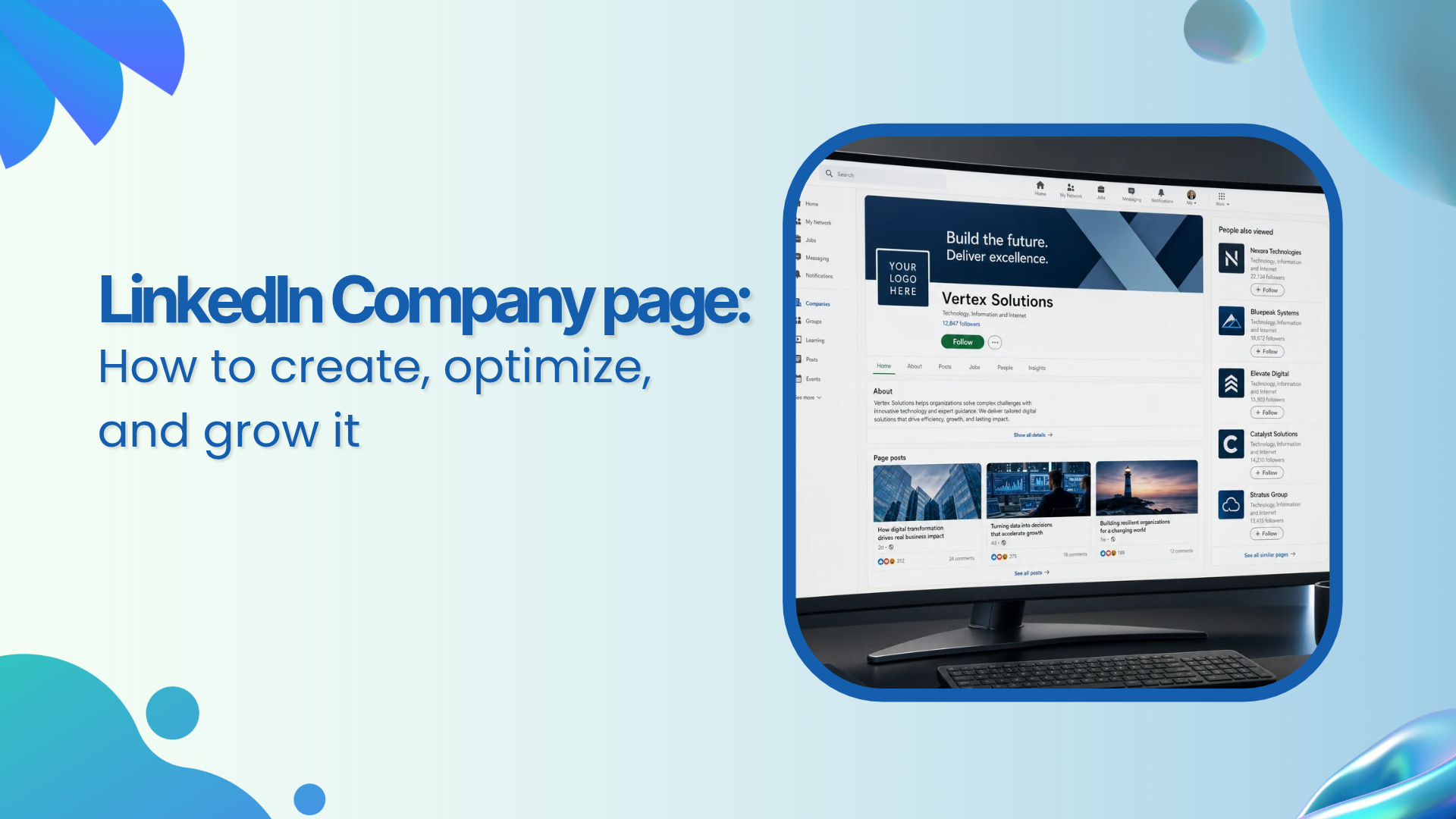
LinkedIn Company page guide: How to create, optimize, and grow it
Sep 24, 202621 minutes

Written by
Arooj IshtiaqUpdated
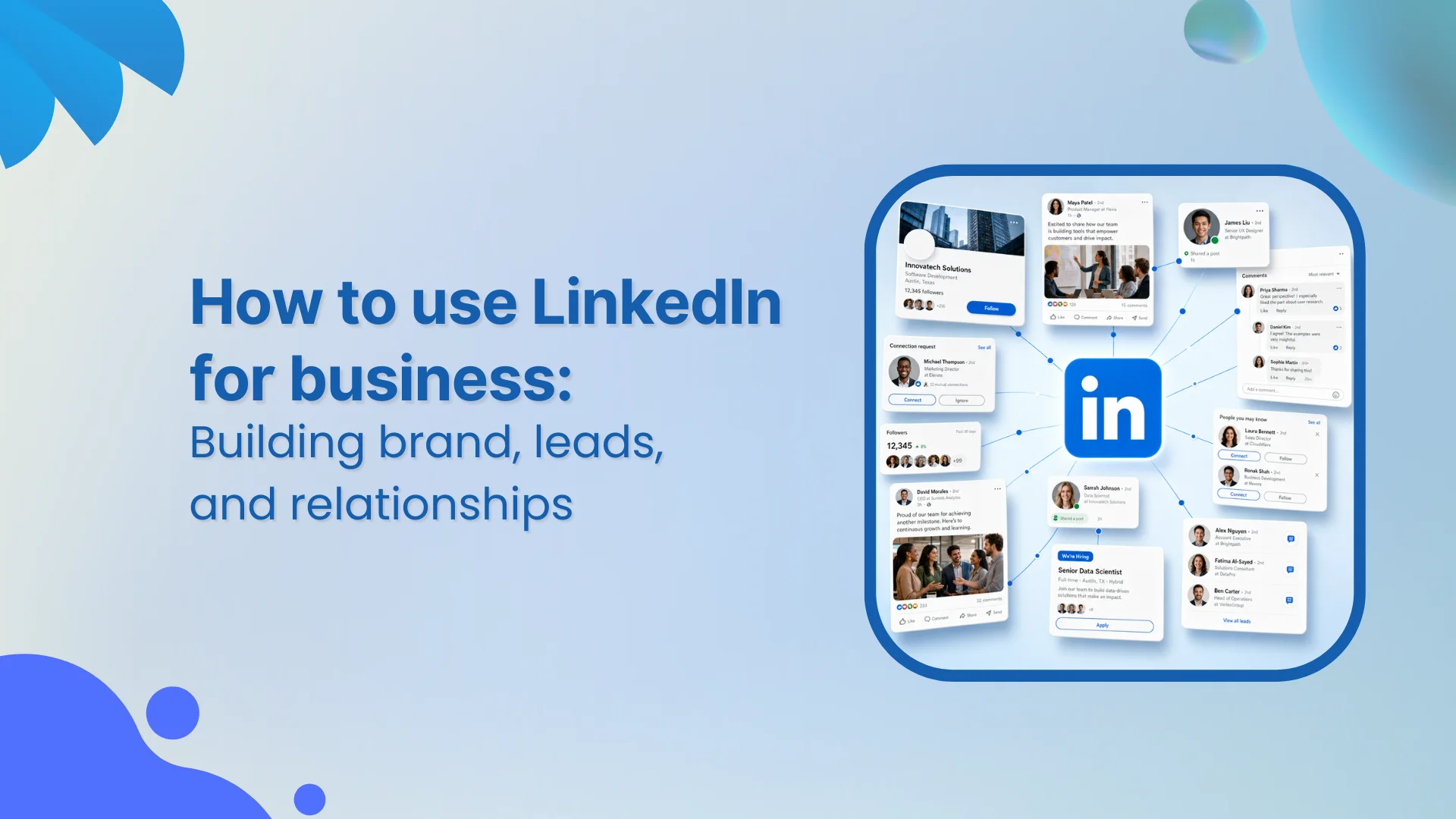
LinkedIn is more than a platform for job seekers and recruiters. Businesses can use it to build brand awareness, connect with potential customers, share industry knowledge, generate leads, and attract talent.
However, simply posting updates on a Company Page is not enough. Businesses need a clear strategy to reach the right audience and achieve their goals.
With a well-planned LinkedIn marketing strategy, businesses can share relevant content, build professional relationships, and measure results. ContentStudio’s LinkedIn content scheduling platform helps teams plan, schedule, and publish content consistently.
This guide covers how to use LinkedIn for business, from setting up a Company Page and creating engaging content to generating leads, recruiting talent, running ads, and measuring performance.
LinkedIn for business means using the platform’s professional network, Company Pages, personal profiles, content, analytics, advertising, and sales tools to achieve business goals.
The approach depends on the type of business. A B2B SaaS company might use LinkedIn to generate leads and book demos. A recruitment agency may use it to find candidates and connect with employers. A consultant can share expertise to build credibility, while a local business can connect with potential customers and recruit employees.
Consistent publishing is an important part of making LinkedIn work for your business. A LinkedIn content scheduler like ContentStudio helps businesses plan posts in advance, maintain a regular posting schedule, and manage content more efficiently.
LinkedIn’s business solutions support several key areas, including marketing, advertising, sales, recruitment, professional learning, and small-business growth.
LinkedIn gives businesses access to a professional environment where people share work experiences, follow organizations, discuss industry changes, research potential suppliers, evaluate employers, and develop relationships.
That context makes LinkedIn especially useful when your business sells expertise, services, products, talent, or partnerships to other professionals.
People often research a business before they book a call, submit a form, apply for a job, accept a meeting, or respond to an outreach message. They may look at:
A complete LinkedIn Company Page gives potential customers, candidates, and partners an official place to understand what your organization does, who it serves, and where to learn more. Meanwhile, well-structured professional LinkedIn profiles help visitors understand the people, experience, and expertise behind the business.
LinkedIn can help a business become more recognizable among potential buyers, customers, candidates, partners, peers, media contacts, and industry specialists.
The objective is not to reach everyone. It is to become visible to people who are relevant to your business. For example:
LinkedIn can support the sales process before, during, and after direct outreach. Buyers may see expert content, review a Company Page, visit an executive profile, read a relevant guide, attend an event, or notice how your business engages in industry discussions.
This familiarity can make future sales conversations more relevant. It does not remove the need for a clear offer, a strong sales process, a useful discovery conversation, and responsible follow-up.
LinkedIn’s small-business guidance includes sales tools such as Sales Navigator, which is intended to help teams identify and research relevant accounts and prospects using filters, recommendations, and account insights.
LinkedIn can also help businesses attract candidates before a job opening is published. Prospective employees often evaluate a company’s work, leadership, people, culture, and public communication before deciding whether to apply. A business can use LinkedIn to share:
LinkedIn identifies hiring as one of its core business use cases, with products and resources for posting jobs, sourcing candidates, and building an employer brand.
Many small-business and B2B opportunities come through referral partners, vendors, agencies, industry groups, event speakers, professional associations, and complementary service providers.
LinkedIn can help you identify relevant organizations, follow their work, contribute to public conversations, develop familiarity, and create value before making an ask.
A good partnership approach starts with relevance. Do not send a pitch simply because someone fits a title or works at a target company.
LinkedIn can support many business objectives, but not every objective should be prioritized at the same time. Start with one or two main goals and build your presence around them.
| Business goal | What LinkedIn should help accomplish | What to measure |
|---|---|---|
| Brand awareness | Help relevant professionals recognize and understand the business | Relevant reach, follower quality, Page visits, profile visits, branded search activity |
| Lead generation | Educate potential buyers and guide them toward a next step | Resource downloads, event registrations, website visits, qualified leads, assisted pipeline |
| Sales enablement | Help sales teams build familiarity and conduct better account research | Account engagement, qualified conversations, meetings, opportunities |
| Customer education | Help current customers solve problems and understand changes | Saves, questions, resource clicks, webinar attendance, support-topic trends |
| Recruiting | Reach and inform qualified candidates | Job views, applications, candidate quality, referrals |
| Employer brand | Improve awareness and trust among potential employees | Talent audience growth, employee participation, candidate feedback |
| Executive visibility | Establish a credible expert voice | Profile views, relevant followers, invitations, relationship growth |
| Partnerships | Build relationships with complementary organizations | Partner conversations, co-marketing opportunities, referrals, event collaborations |
Do not make follower count the only goal. A smaller audience of buyers, candidates, customers, or partners can create more value than a large group of people with no connection to your market.
The most effective LinkedIn content is written for a defined audience, not for “everyone.” Instead of writing for “business owners,” identify the people who make, influence, or support the decisions connected to your offer. A useful audience description includes:
For example:
Operations leaders at mid-market logistics businesses who need to reduce fulfillment delays, improve handoffs between teams, and make more reliable delivery commitments.
Or:
HR and talent-acquisition leaders at regional healthcare organizations that need to hire specialized clinical and administrative leadership talent.
This level of detail improves your Company Page copy, content topics, sales research, employee advocacy, paid targeting, and reporting.
A LinkedIn Company Page is the official professional presence for your business. It gives people a place to understand what you do, see the people associated with the company, follow updates, explore jobs, visit your website, and engage with your content.
LinkedIn and third-party LinkedIn marketing guidance both emphasize that a complete Page is foundational. A business should make it easy for visitors to understand the organization, find relevant information, and take an appropriate next step.
Before you focus on follower growth or content, complete the essentials:
A tagline should explain what the business does and who it helps.
Weak tagline
Innovating the future through powerful solutions.
Clearer tagline
Recruitment and workforce-planning support for healthcare organizations.
Another example
Cybersecurity consulting for mid-market financial-services teams.
Avoid vague phrases such as “best-in-class,” “innovative solutions,” “results-driven,” or “industry-leading” unless you can clearly prove what they mean.
Your About section should make it easier for a visitor to decide whether your business is relevant. Use this structure:
Example:
[Company] helps [audience] address [problem] through [service, product, or approach].
We work with [type of organization] that need [outcome]. Our team brings experience in [relevant specialties] and focuses on [differentiating principle or method].
We share practical insights on [topic one], [topic two], and [topic three]. Learn more at [website].
Use relevant audience and industry language naturally. LinkedIn for business guidance recommends completing core Company Page fields and incorporating appropriate keywords in the Page description so visitors and search engines can understand what the business offers.
Your call-to-action button should match the main purpose of the Page or current campaign.
| Business priority | Suitable CTA |
|---|---|
| General company information | Learn more or Visit website |
| Consultation or service inquiry | Contact us |
| Webinar or event campaign | Register |
| Resource, newsletter, or trial | Sign up |
| Creative or project portfolio | Visit portfolio |
| Ecommerce destination | Visit store |
Do not send people to a generic homepage if a more relevant landing page exists. The destination should continue the conversation started on LinkedIn.
Your Company Page provides the official business voice. Personal profiles create the relationship and human context that many professional audiences expect.
Founders, executives, sales professionals, recruiters, customer-success leaders, product leaders, and subject-matter experts can all use LinkedIn to share their own relevant perspective.
| Channel | Primary purpose | Best use cases |
|---|---|---|
| Company Page | Official company presence | Brand updates, product education, job opportunities, resources, events, campaigns, team milestones |
| Founder profile | Business vision and market perspective | Industry observations, lessons learned, mission, partnership conversations |
| Executive profile | Leadership perspective and trust-building | Strategic insights, culture, management lessons, market commentary |
| Sales profile | Account relationships and professional credibility | Relevant insights, buyer education, relationship-based outreach |
| Recruiter profile | Candidate relationships and talent-market expertise | Career content, hiring guidance, candidate experience, job context |
| Subject-matter-expert profile | Expertise and education | Frameworks, how-to content, research interpretation, event takeaways |
| Employee profile | Human proof of the business | Team stories, learning, professional contributions, employee advocacy |
Business leaders and employees should consider the following profile basics:
Business owners should use their headline and About section to explain the business story, demonstrate expertise, and connect the individual profile to the Company Page.
A business should not use LinkedIn only for self-promotion. People follow because they expect future content to help them understand their work, industry, customers, career, or decisions.
A useful LinkedIn content strategy connects content topics to a real audience problem, source of expertise, format, business objective, owner, and expected action.
Content pillars are the recurring topics your business can discuss with credibility. Most businesses need three to five. Example for a professional-services business:
| Content pillar | Audience need | Source material | Example post |
|---|---|---|---|
| Industry insight | Understand a market change | Research, expert analysis, industry events | “What this new workforce report may mean for regional employers” |
| Practical education | Solve a recurring professional problem | Customer questions, internal frameworks, support themes | “A checklist for preparing for a major system implementation” |
| Decision support | Evaluate options and trade-offs | Buyer questions, sales calls, expert perspectives | “How to compare two implementation approaches without oversimplifying the decision” |
| Team expertise | Understand the people behind the company | Employee interviews, work processes, internal learning | “How our consultants prepare for a discovery workshop” |
| Employer brand | Assess the workplace and career opportunity | Employee stories, hiring process, development initiatives | “What candidates can expect from our interview process” |
Do not rely solely on brainstorming sessions. Your team already encounters questions and insights that can become content. Look for ideas in:
The best content often begins with a real question:
A feed made entirely of company announcements, job openings, product updates, and blog links is unlikely to create lasting interest. Use a mix of educational, expert-led, human, and timely content.
| Content type | Purpose | Example |
|---|---|---|
| Educational post | Answer a recurring audience question | “Five questions to ask before choosing a recruitment partner” |
| Checklist or framework | Give readers an actionable process | “A six-step vendor-evaluation checklist” |
| Expert perspective | Share a specific professional point of view | “Why time-to-fill is not enough to measure hiring quality” |
| Research interpretation | Explain what verified data may mean | “Three implications of a workforce-report finding” |
| Customer-safe lesson | Share practical learning without exposing details | “A common onboarding problem and how teams can prevent it” |
| Employee expertise | Show knowledge inside the company | “A consultant explains how to prepare for a first discovery call” |
| Culture content | Support employer brand with credible detail | “How our mentoring process works for new employees” |
| Product or service update | Explain a meaningful change | “What changed in our service model and why it matters” |
| Event post | Invite discussion and participation | “Live Q&A: planning for workforce changes in 2027” |
| Curated resource | Add value through informed selection | “A report worth reading, plus three questions it raises” |
| Job content | Help qualified candidates self-assess | “What the first 90 days in this role will involve” |
A varied approach that includes thought leadership, employee and culture content, customer stories, industry updates, and different content formats.
Different ideas need different formats. Using the same format for every topic makes the feed repetitive and can make complex ideas harder to understand.
| LinkedIn format | Best for | Example |
|---|---|---|
| Short text post | One focused insight, lesson, or point of view | “The project handoff most teams underestimate” |
| Long-form post | A story, detailed explanation, or nuanced argument | “What we learned when a project timeline changed mid-implementation” |
| Image post | A human moment, event recap, simple visual insight | A team photo with a specific lesson from a client workshop |
| Native video | Expert explanation, demonstration, Q&A, event takeaway | “A founder explains one common customer misconception in 60 seconds” |
| Document carousel | Checklists, frameworks, comparisons, processes | “Seven questions to ask before entering a new market” |
| LinkedIn article | Detailed evergreen education | “A complete guide to choosing the right implementation partner” |
| Newsletter | Recurring insight, market briefing, expert series | “Monthly operations and workforce update” |
| Poll | Genuine audience learning or discussion starter | “Which hiring stage creates the greatest delay?” |
| LinkedIn Event or Live | Real-time education and conversation | Panel discussion with customers, partners, or experts |
| External link post | Driving readers to a deeper resource | “Three takeaways from our new guide, with the full report linked” |
A carousel post on LinkedIn is useful when the information has a logical sequence, checklist, process, or comparison. A LinkedIn article is a better choice when the audience needs more depth, examples, sources, and a resource they can revisit.
Consistency helps your audience understand what to expect, but frequent posting is not valuable if it reduces quality.
A founder with limited time may publish one useful post weekly and comment on a few relevant conversations. A small marketing team may publish two or three Company Page posts weekly while leaders and employees provide supporting expertise. A larger business may have a more regular calendar across departments, regions, campaigns, executives, and employee advocates.
You can create a sustainable LinkedIn publishing schedule and maintain it rather than posting only when inspiration appears.
Use the table below as a starting point, then adjust it to what your team can realistically sustain.
| Team capacity | Starting cadence |
|---|---|
| Individual consultant or founder | One original post each week, plus relevant comments |
| Small business | One to two Company Page posts each week, plus leader participation |
| Growing B2B business | Two to four Company Page posts each week, plus employee advocacy |
| Larger business | Regular Company Page publishing, executive content, expert contributors, engagement management, and campaign support |
A LinkedIn scheduler helps teams plan content, coordinate approvals, maintain a realistic calendar, and reduce last-minute publishing pressure.
Posting is only one part of LinkedIn. The platform is also a place to listen, respond, learn, and participate in relevant professional conversations. You can use LinkedIn as a relationship-building environment by connecting, engaging with relevant content, and participating consistently rather than using the platform solely as a broadcast tool.
When people comment on your posts, respond in a way that extends the conversation.
Weak response
Thanks for your comment!
Stronger response
That distinction is important. We often see teams measure whether a project launched, but not whether the new process was actually adopted. What metric has helped your team identify adoption more clearly?
A useful response can:
Your Company Page, executives, and employees can become more visible by contributing thoughtfully to conversations already happening in your field. Good comments may:
Avoid using comments to paste promotional links, repeat product claims, tag unrelated people, or leave generic comments at scale.
LinkedIn messages can be useful when there is real context: an event conversation, a shared connection, a relevant post, a referral, an introduction, or a specific professional question.
A useful opening message is relevant and low pressure:
Hi Daniel — your point about reducing approval bottlenecks in implementation projects stood out. We hear a similar challenge from operations leaders when responsibility moves between teams. I appreciated the framework you shared and would be interested in how your team tracks ownership across handoffs.
This is different from sending a generic sales message immediately after connecting.
A thoughtful message on LinkedIn should build on context and professional relevance, not mass automation.
Employee advocacy can expand the visibility of useful company content, but it works only when employees have a genuine reason to participate.
People are more likely to engage with posts from recognizable individuals than with content that feels like corporate copy. Give employees the information, resources, and ideas they need, then let them contribute their own perspective.
A strong employee-advocacy program includes:
Businesses should encourage employees to connect their profiles to the official Company Page, share relevant business content, and contribute as people rather than as corporate duplicates.
Instead of giving everyone this caption:
We are proud to announce our new report. Download it today.
Give them a simple brief:
An employee might then share:
One finding from our latest report stood out to me: many teams identify process bottlenecks only after customer experience begins to suffer. In my work with implementation teams, the earlier warning sign is usually unclear ownership between departments. The report includes a few useful questions leaders can use to identify that risk earlier.
The employee adds credibility because the post has real context and a distinct point of view.
LinkedIn can support demand generation and sales when businesses use it to help the right people understand a relevant problem, evaluate options, and take a suitable next step.
Do not treat LinkedIn as a place to collect large volumes of unqualified contacts.
A basic LinkedIn lead-generation path can look like this:
Match content to where the buyer is in that path.
| Buyer stage | Audience question | Helpful LinkedIn content |
|---|---|---|
| Problem awareness | “Is this issue worth addressing?” | Industry insight, diagnostic questions, common mistakes |
| Solution exploration | “What options are available?” | Frameworks, comparisons, buyer guides, expert explainers |
| Vendor evaluation | “How do we assess providers?” | Evaluation checklists, implementation insights, customer-safe case-study lessons |
| Decision readiness | “What should we do next?” | Consultation invitation, event, assessment, detailed resource, product demonstration |
| Post-purchase | “How do we get value?” | Onboarding guidance, customer education, best practices, product updates |
A LinkedIn lead generation strategy should connect content, audience targeting, landing pages, sales follow-up, CRM measurement, and campaign goals.
For B2B companies, LinkedIn can also support account-based marketing and sales. Instead of targeting every person with a job title, identify a defined group of accounts and understand:
Then create content and outreach that genuinely reflects those realities.
Candidates often research employers before applying. They may look at the Company Page, current employees, executive activity, public comments, job posts, employee reviews, and the organization’s stated values.
Your LinkedIn activity can help candidates assess whether the business is credible, relevant, and aligned with their goals.
Useful employer-brand content can include:
You can show company culture, employee stories, and the people behind the business so potential applicants have a clearer picture of the organization.
A job listing should make it easier for the right candidate to decide whether the role is relevant. Include:
Avoid vague requirements, inflated job titles, unnecessary credentials, unrealistic wish lists, and culture claims that employees would not recognize.
Paid LinkedIn campaigns can help businesses reach a defined professional audience faster. They work best when the business already has a clear audience, relevant offer, viable landing page, sales or recruiting follow-up process, and measurement framework.
LinkedIn offers advertising tools built around professional targeting and campaign objectives, including awareness, engagement, website traffic, lead generation, and recruitment-related use cases, per LinkedIn’s small-business resources.
Consider paid campaigns when you need to:
Paid promotion cannot fix an unclear offer, weak landing page, generic creative, or poor lead follow-up.
LinkedIn metrics should be tied to business goals. A post with high impressions may be useful for awareness, but it is not automatically evidence of pipeline, customer success, or hiring quality.
Use LinkedIn Page analytics, post-level performance, website analytics, CRM data, recruitment data, campaign data, and qualitative feedback together.
| Measurement category | Useful metrics | Why it matters |
|---|---|---|
| Audience quality | Follower job function, seniority, industry, company size, location | Shows whether the right people are discovering the business |
| Content visibility | Impressions, reach, views, Page visits, profile visits | Indicates awareness and discovery |
| Meaningful engagement | Comments, saves, shares, direct messages, quality of discussion | Signals professional relevance and usefulness |
| Website intent | Link clicks, engaged sessions, downloads, registrations, return visits | Shows deeper interest beyond the platform |
| Demand contribution | Qualified leads, meetings, opportunities, assisted pipeline | Connects LinkedIn activity to commercial outcomes |
| Recruiting contribution | Job views, applications, candidate quality, referrals | Measures talent impact |
| Employer brand | Talent-audience growth, employee engagement, candidate feedback | Indicates the strength of public employer perception |
| Employee advocacy | Employee participation, expert content, engagement from employee networks | Shows whether the company is expanding credible reach |
| Efficiency | Production time, approval time, content reuse rate, campaign cost | Helps determine whether the program is sustainable |
A focused LinkedIn analytics process helps businesses connect platform performance with web traffic, sales, recruiting, customer, and campaign outcomes.
Review performance monthly, then choose one or two informed changes. Ask:
Do not make major decisions based on a single post. Look for patterns over several weeks or months.
A structured 90-day plan gives a business enough time to set up the foundation, create regular activity, test formats, and learn from results.
| Phase | Focus | Actions |
|---|---|---|
| Days 1–30 | Build the foundation | Define one or two core LinkedIn objectives and identify the priority audience. Audit the existing Company Page and key employee profiles, then update the tagline, About section, imagery, CTA, links, specialties, and admin access. Create or improve executive, sales, recruiting, and expert profiles. Build a list of audience questions and content opportunities, choose three to five content pillars, and create a four-week editorial calendar. Establish content review and approval rules, set up baseline reporting, and add Company Page links to the website, newsletter, email signatures, event pages, and relevant sales or recruiting materials. |
| Days 31–60 | Publish and participate | Publish content according to the planned cadence and test multiple formats, such as text posts, document carousels, video, and event content. Ask leaders and subject-matter experts to contribute original ideas, and start a practical employee-advocacy process. Respond thoughtfully to comments and messages, engage with relevant industry conversations, and promote one relevant resource, webinar, newsletter, or event. Review post-level results and audience feedback weekly, and track follower quality and Page-visitor trends. |
| Days 61–90 | Improve and expand | Identify high-performing topics, formats, and calls to action, then repurpose the strongest content into articles, carousels, videos, newsletters, guides, or events. Improve weak content areas using audience feedback, and test a collaboration with a partner, customer, association, or expert. Improve employee content resources and guidelines, and connect LinkedIn engagement with website, lead, recruiting, and event results. Determine whether paid promotion has a specific, measurable use case, and document successful content patterns, workflow improvements, and learnings for the next quarter. |
A LinkedIn strategy needs a reliable operating system. ContentStudio can help teams manage the work across discovery, planning, creation, collaboration, publishing, engagement, analytics, and reporting. A practical ContentStudio workflow can include:
ContentStudio does not replace the expertise and relationships that make LinkedIn effective. It helps teams make the strategy easier to run consistently.
A Page that only lists services and occasionally shares company news offers little ongoing value. Treat it as a living business destination with useful content, current information, and clear paths to learn more.
People do not usually follow a business to see constant sales messages. Balance promotions with practical education, perspectives, research interpretation, customer-safe lessons, team expertise, and relevant industry commentary.
Company Pages are important, but employees and leaders often create the strongest professional relationships and conversations. Use the Page as the official hub and personal profiles as expert-led extensions.
Identical captions can feel artificial. Give employees a shared message and approved resources, then encourage them to add their own honest perspective.
A connection request or message should have a real reason. Avoid pitching immediately, pretending familiarity, or using automated sequences that treat people as a list.
Purchased followers, artificial engagement, and coordinated engagement groups distort reporting and rarely create relevant business relationships. They can also weaken trust.
Every business should verify facts, data, names, links, customer claims, product claims, legal language, accessibility, and confidentiality before publishing.
Reach, impressions, likes, and follower totals may be useful context, but they are not enough. Measure audience quality, meaningful engagement, website behavior, leads, applications, opportunities, and business contribution.
Scheduling approved content is useful. Automating connection requests, messages, comments, likes, or endorsements can create a poor experience and may introduce platform, compliance, and reputational risks.
LinkedIn can help a business become easier to discover, understand, trust, and choose. The strongest results come from a clear strategy, a credible Company Page, optimized employee profiles, useful content, thoughtful participation, relationship-led sales and recruiting activity, and measurement tied to real business outcomes.
Start with a defined audience and a small number of goals. Make your Company Page clear. Give leaders and employees room to share real expertise. Publish information that helps people do their jobs better. Then measure what creates meaningful conversations, visits, applications, partnerships, and opportunities.
AI can help with research, outlines, content variations, editing, accessibility checks, reporting summaries, and idea organization. It should not replace professional judgment, subject-matter expertise, fact-checking, customer approvals, legal review, or human relationship-building. Do not use AI to create fake personal stories, fabricate results, send automated outreach, or publish unreviewed content.
Use tagged links, campaign landing pages, CRM source fields, lead forms, event-registration data, sales notes, and attribution reporting. Track the full path where possible: LinkedIn post or ad, website visit or resource interaction, lead or conversation, meeting, opportunity, revenue. Not every LinkedIn interaction will convert directly, so also track assisted pipeline and sales-team feedback.
Yes. Businesses can assign Page roles to trusted employees or agency partners so responsibilities for posting, analytics, engagement, advertising, and administration do not sit with one person. Use the minimum appropriate access level, review admin permissions regularly, and remove access when a team member or external partner no longer needs it.
Respond calmly, promptly, and professionally. Acknowledge the concern, correct factual errors where necessary, avoid discussing confidential details publicly, and offer an appropriate route to continue the conversation privately. Do not delete criticism simply because it is unfavorable; remove or report content only when it violates platform rules or your organization’s moderation standards.
Plan 0 Days of Content in 0 Minutes
Create, schedule, publish and analyze your content across all your social media channels from one simple dashboard.
4.7 on Capterra • 16,500+ marketers trust ContentStudio
Arooj Ishtiaq is a Content Marketing Strategist with 5+ years of experience writing about social media, SaaS, and AI. At ContentStudio, she creates practical guides, tutorials, and how-to content that help marketers navigate social media trends, sharpen their strategies, and get more from their content.
View all posts by Arooj IshtiaqRecommended for you
LinkedIn Company page guide: How to create, optimize, and grow it
LinkedIn marketing in 2026: Strategy, content, and growth

How to see scheduled posts on LinkedIn | Step-by-step
How to Use LinkedIn Hashtags Without Overdoing It